
Imagine electricity traveling from a power station to your home. It starts at very high voltage for efficient transmission, then safely reduces to a lower voltage before entering your house. This voltage change is made possible by transformers—one of the most important devices in electrical systems.
Transformers are everywhere: in power grids, industries, mobile chargers, and renewable energy systems. However, not all transformers are the same. There are different designs and types based on application, voltage level, construction, and cooling method.
Understanding the Types of Transformers is essential for electrical students, engineers, and technicians. It helps in selecting the right transformer, designing efficient systems, and ensuring safe operation.
In this article, you will learn the complete types of transformers working principle, classification, components, applications, advantages and disadvantages, and selection guide. By the end, you will have a clear and practical understanding of how different transformers are used in real-world systems.
2. What is Types of Transformers?
Types of Transformers refer to the different categories of transformers based on their design, function, construction, and application.
Simple Explanation
A transformer is a device that changes voltage levels (step-up or step-down) without changing frequency. Different types are used depending on the need.
Practical Example
- A power station uses a step-up transformer to increase voltage
- A home uses a step-down transformer to reduce voltage
- A mobile charger uses a small transformer for low voltage
3. Working Principle
The types of transformers working principle is based on electromagnetic induction.
Step-by-Step Explanation
- Alternating current flows through primary winding
- A magnetic field is created in the core
- This magnetic field links to secondary winding
- Voltage is induced in the secondary winding
- Output voltage depends on turns ratio
Key Formula
Voltage relationship:
[
\frac{V_1}{V_2} = \frac{N_1}{N_2}
]
Where:
- (V_1, V_2) = Voltages
- (N_1, N_2) = Number of turns
Easy Analogy
Think of it like two coils connected by a magnetic bridge:
- More turns → higher voltage
- Fewer turns → lower voltage
4. Types / Classification
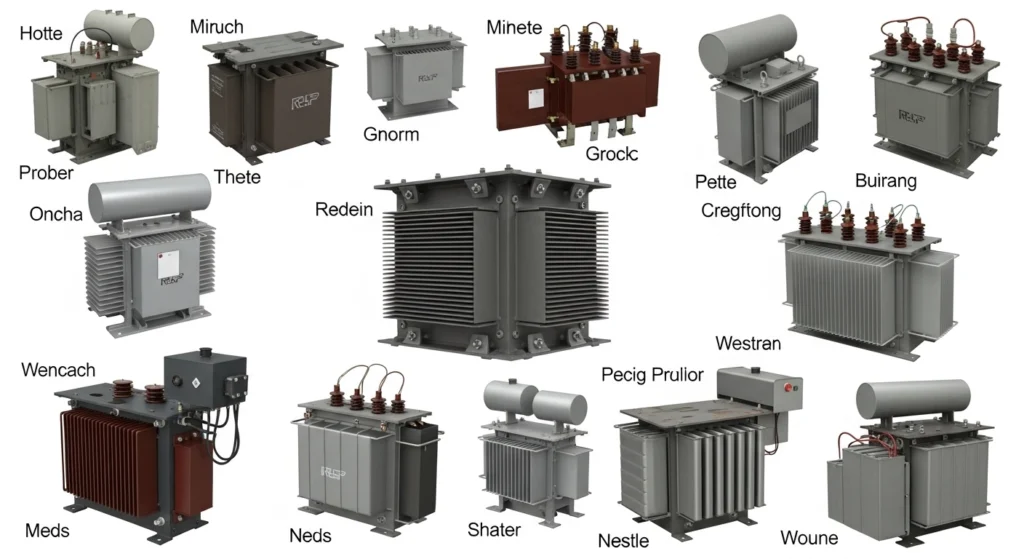
Transformers can be classified in multiple ways.
Based on Voltage Level
Step-Up Transformer
- Increases voltage from primary to secondary
- Used in power transmission
Step-Down Transformer
- Decreases voltage
- Used in homes and industries
Based on Construction
Core-Type Transformer
- Windings placed around the core
- Easy to cool and maintain
Shell-Type Transformer
- Core surrounds the windings
- Better mechanical protection
Based on Application
Power Transformer
- Used in transmission systems
- Operates at high voltage
Distribution Transformer
- Supplies electricity to consumers
- Operates at lower voltage
Instrument Transformer
- Used for measurement and protection
Types:
- Current Transformer (CT)
- Potential Transformer (PT)
Based on Phase
Single-Phase Transformer
- Used in homes
- Simple design
Three-Phase Transformer
- Used in industries
- Handles large power
Based on Cooling Method
Dry-Type Transformer
- Air cooling
- Used indoors
Oil-Immersed Transformer
- Oil used for cooling and insulation
- Used in outdoor installations
Based on Special Purpose
Isolation Transformer
- Provides electrical isolation
- Improves safety
Auto Transformer
- Single winding
- More efficient and compact
5. Main Components
Core
- Provides magnetic path
- Made of laminated steel
Windings
- Primary and secondary coils
- Carry current
Insulation
- Prevents short circuits
- Ensures safety
Tank
- Holds core and windings
- Contains oil (if used)
Bushings
- Provide external connections
Cooling System
- Maintains temperature
- Uses air or oil
6. Advantages
Types of Transformers Advantages
- Efficient voltage conversion
- No moving parts (low maintenance)
- High reliability
- Long lifespan
- Supports power transmission
- Safe and stable operation
7. Disadvantages / Limitations
Types of Transformers Disadvantages
- Cannot operate on DC
- Large size for high power
- Heat generation requires cooling
- Initial cost can be high
- Losses (core and copper losses)
8. Applications
Types of Transformers Applications
Home Applications
- Mobile chargers
- Doorbells
- Power adapters
Industrial Applications
- Power distribution
- Machine operation
- Control systems
Modern Technology
- Renewable energy systems
- Electric vehicles
- Smart grids
- Data centers
Transformers are essential in all electrical systems.
9. Comparison Section
Difference Between Power Transformer and Distribution Transformer
| Feature | Power Transformer | Distribution Transformer |
| Application | Transmission | Distribution |
| Voltage Level | High | Low to medium |
| Efficiency Focus | Full load | All load conditions |
| Size | Large | Smaller |
| Location | Power stations | Near consumers |
10. Selection Guide
Choosing the right transformer depends on your application.
Tips for Beginners
- For home use → Step-down transformer
- For industry → Three-phase transformer
- For measurement → Instrument transformer
Key Factors to Consider
- Voltage level
- Power rating
- Load type
- Cooling method
- Installation environment
Practical Advice
- Always select proper rating
- Avoid overloading
- Ensure proper cooling
- Follow safety standards
11. Common Problems & Solutions
Why does a transformer overheat?
- Overloading
- Poor cooling
Solution:
Reduce load and improve cooling system.
Why is transformer humming?
Magnetic vibration in core.
Solution:
Check mounting and core condition.
What causes voltage drop?
Load increase or winding issues.
Solution:
Check load and connections.
Can transformer work on DC?
No, it requires AC supply.
Why insulation failure occurs?
Heat and aging.
Solution:
Regular maintenance and monitoring.
12. Future Trends
Transformer technology is evolving rapidly.
Key Trends
- Smart Transformers: Real-time monitoring
- Eco-Friendly Materials: Reduced environmental impact
- Digital Protection Systems: Improved safety
- Compact Designs: Space-saving solutions
- Renewable Integration: Solar and wind systems
Future transformers will focus on efficiency, automation, and sustainability.
13. Conclusion
Understanding the Types of Transformers is essential for anyone working in electrical engineering. Each type is designed for a specific purpose, from power transmission to household applications.
By learning the types of transformers working principle, classification, and applications, you can select the right transformer for any system. While transformers have some limitations, their advantages make them indispensable in modern electrical networks.
As technology advances, transformers will become smarter, more efficient, and environmentally friendly. Building strong knowledge in this area will help you grow as a skilled engineer or technician.
Keep learning and exploring practical applications to strengthen your expertise.