
Imagine a sudden short circuit happens in your home. Sparks appear, and the power goes off instantly. In some houses, you may need to replace a burnt wire inside a fuse. In others, you simply flip a switch back on. This difference comes from two common protection devices: Fuse and MCB (Miniature Circuit Breaker).
Electrical faults like overloads and short circuits are common and can damage appliances or even cause fires. That’s why protection devices are essential in every electrical system. Understanding the Difference Between Fuse and MCB is important for students, engineers, technicians, and even beginners who want to work safely with electricity.
In this article, you will learn the complete difference between fuse and MCB, their working principles, types, components, advantages and disadvantages, applications, and how to choose the right one. By the end, you will clearly understand when to use a fuse and when to use an MCB in real-world situations.
2. What is Difference Between Fuse and MCB?
The Difference Between Fuse and MCB refers to how these two devices protect electrical circuits from damage caused by excessive current.
What is a Fuse?
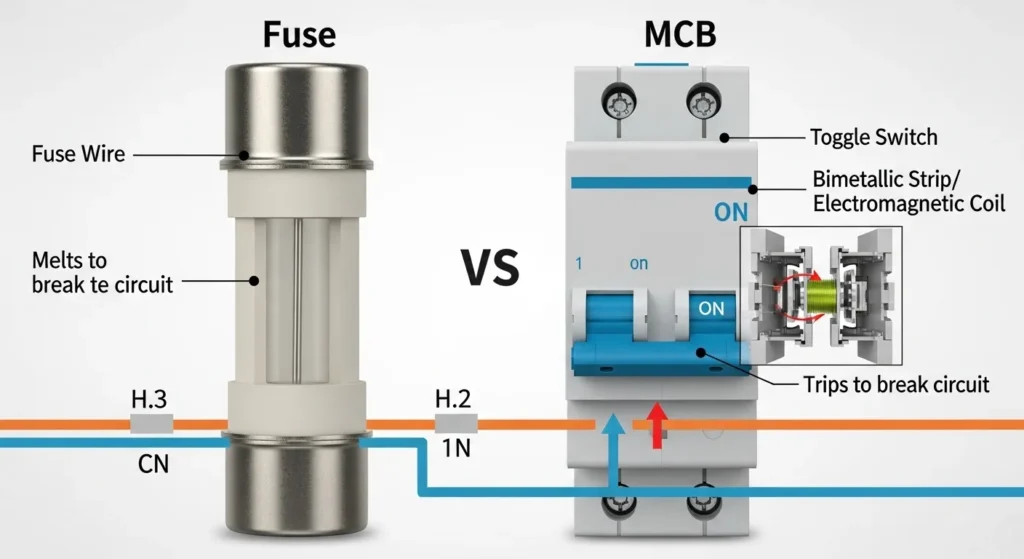
A fuse is a simple electrical safety device that melts and breaks the circuit when current exceeds a safe limit.
Simple Explanation:
It acts like a weak link in the circuit that sacrifices itself to protect other components.
Practical Example:
In older homes, when a fault occurs, the fuse wire burns out and needs replacement.
What is an MCB?
An MCB (Miniature Circuit Breaker) is an automatic switch that trips and disconnects the circuit during overload or short circuit.
Simple Explanation:
It works like a reusable switch that turns off automatically during faults.
Practical Example:
In modern homes, when a fault occurs, the MCB trips and can be reset easily.
3. Working Principle
Fuse Working Principle
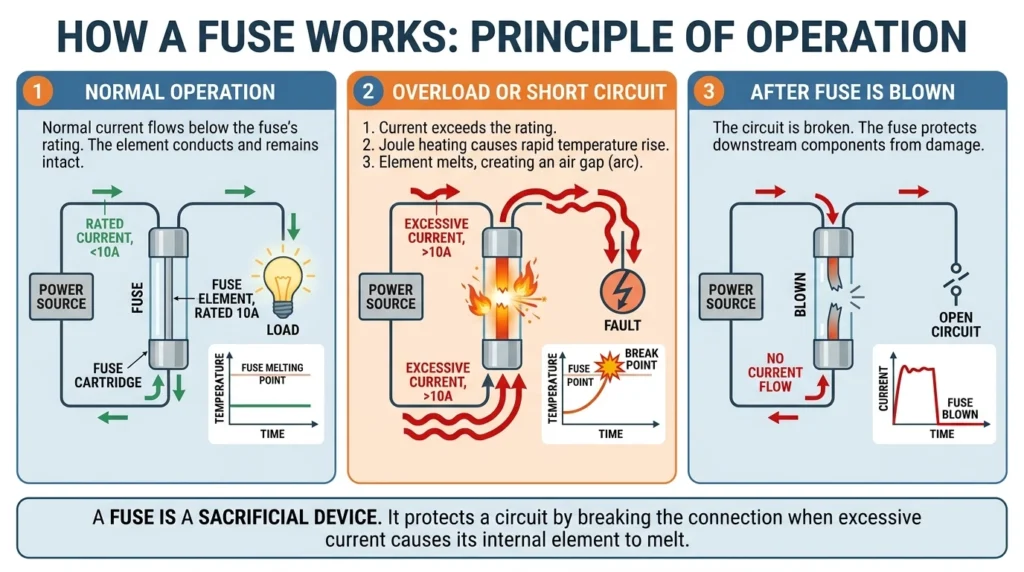
The working principle of a fuse is based on the heating effect of electric current. A fuse contains a thin metal wire or strip made of a material with a low melting point, which is connected in series with the electrical circuit. Under normal operating conditions, the fuse allows current to flow safely through the circuit. However, when an overload or short circuit causes the current to exceed the fuse’s rated value, excessive heat is generated in the fuse element. This heat melts the fuse wire, breaking the circuit and stopping the flow of current. By disconnecting the faulty circuit, the fuse protects electrical equipment, wiring, and appliances from damage caused by excessive current. Due to its simple design, low cost, and reliable protection, the fuse is widely used in residential, commercial, industrial, and electronic applications.
The fuse working principle is based on the heating effect of current.
Step-by-Step:
- Current flows through the fuse wire
- If current exceeds rated value
- Heat increases rapidly
- Fuse wire melts
- Circuit breaks and stops current flow
Analogy:
Like a thin rope that breaks when overloaded.
MCB Working Principle
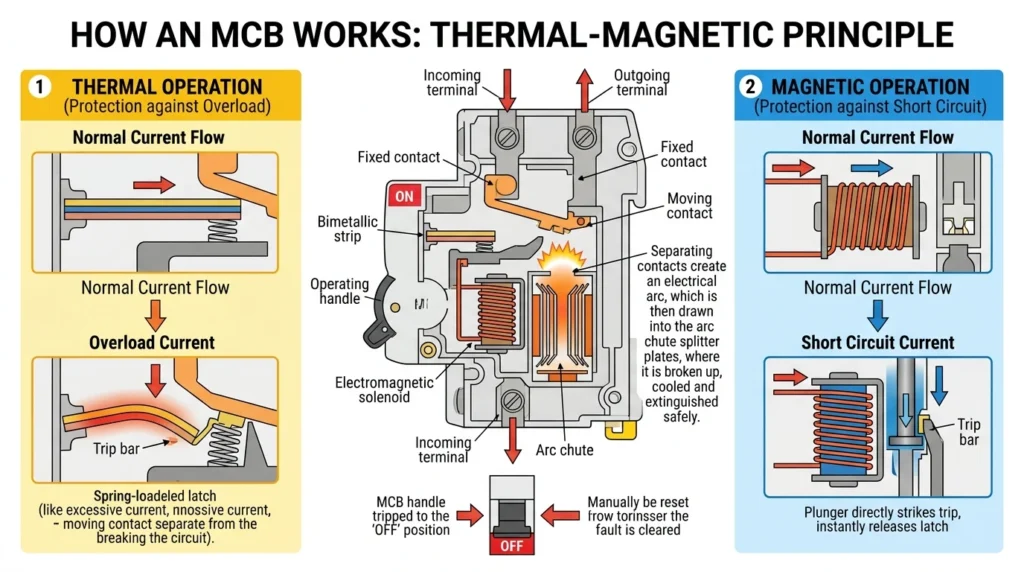
The working principle of an MCB (Miniature Circuit Breaker) is based on automatically interrupting the flow of electric current when an overload or short circuit occurs in the electrical circuit. Under normal operating conditions, the MCB allows current to pass safely through its contacts. When the current exceeds the rated limit due to an overload, a bimetallic strip inside the MCB heats up and bends, triggering the tripping mechanism. In the case of a short circuit, a magnetic coil generates a strong magnetic force that instantly trips the breaker. Once tripped, the MCB opens its contacts and disconnects the power supply, protecting wires, appliances, and electrical equipment from damage. After the fault is removed, the MCB can be manually reset and used again, making it a reliable and widely used protective device in residential, commercial, and industrial electrical installations.
The MCB working principle is based on thermal and magnetic effects.
Step-by-Step:
- Current flows through MCB
- During overload:
- Thermal element heats up
- Bimetal strip bends
- Trips the circuit
- During short circuit:
- Magnetic coil activates instantly
- Trips the switch
Analogy:
Like an automatic switch that turns off when danger is detected.
4. Types / Classification
Types of Fuses
Rewirable Fuse
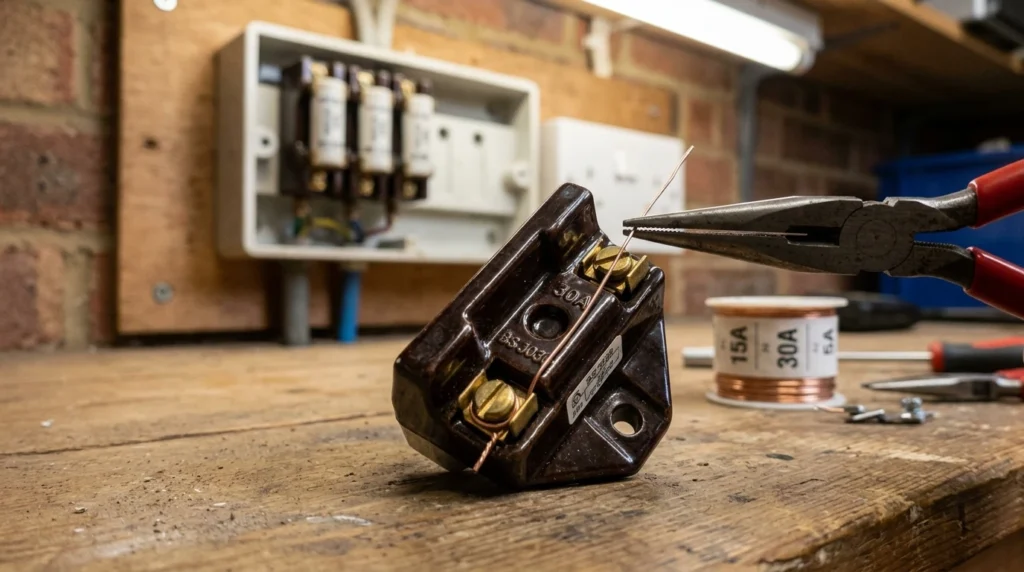
A rewirable fuse, also known as a kit-kat fuse, is a type of fuse in which the fuse wire can be replaced easily after it melts due to an overload or short circuit. It consists of a porcelain base, a fuse carrier, and a fuse wire connected in series with the electrical circuit. Under normal conditions, the fuse wire carries the load current safely. When excessive current flows through the circuit, the fuse wire heats up and melts, breaking the circuit and protecting electrical equipment from damage. After the fault is identified and corrected, the damaged fuse wire can be replaced with a new wire of the correct rating, allowing the fuse to be reused. Due to its simple construction, low cost, and easy maintenance, rewirable fuses are commonly used in residential and small commercial electrical installations.
- Replaceable fuse wire
- Common in old systems
Cartridge Fuse
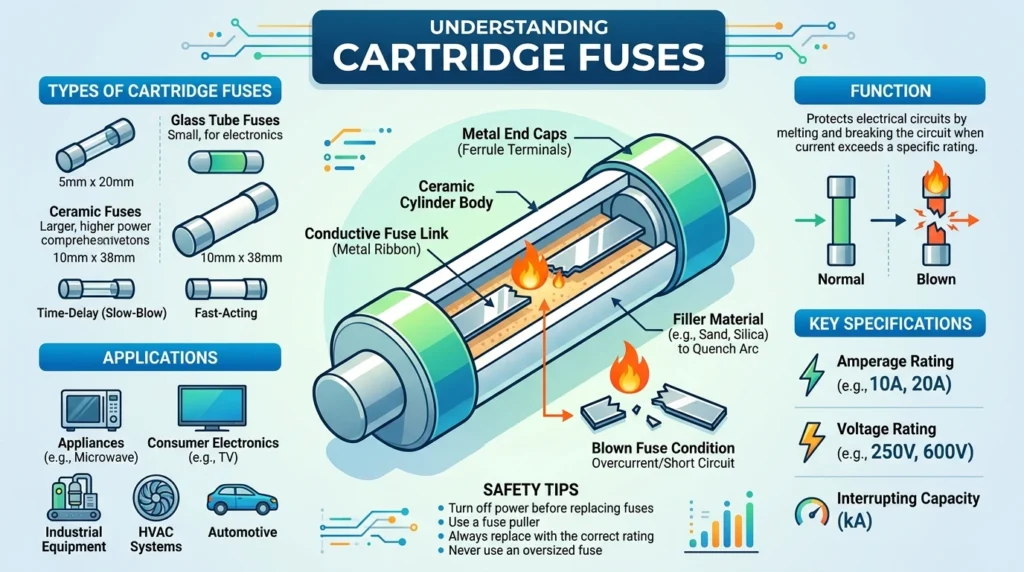
A cartridge fuse is a type of fuse in which the fuse element is enclosed inside a sealed ceramic, glass, or porcelain tube with metal caps at both ends. It is designed to protect electrical circuits and equipment from overloads and short circuits by interrupting excessive current flow. Under normal operating conditions, the fuse element carries current safely. However, when the current exceeds the rated value, the fuse element heats up and melts, breaking the circuit and preventing damage to connected devices. Unlike a rewirable fuse, a cartridge fuse cannot be repaired and must be replaced after it operates. Cartridge fuses provide reliable protection, faster fault clearance, and higher breaking capacity, making them widely used in industrial equipment, power distribution systems, household appliances, and electronic circuits. Their enclosed design also enhances safety by preventing exposure to live parts and arc formation.
- Sealed unit
- More reliable than rewirable fuse
High Rupturing Capacity (HRC) Fuse
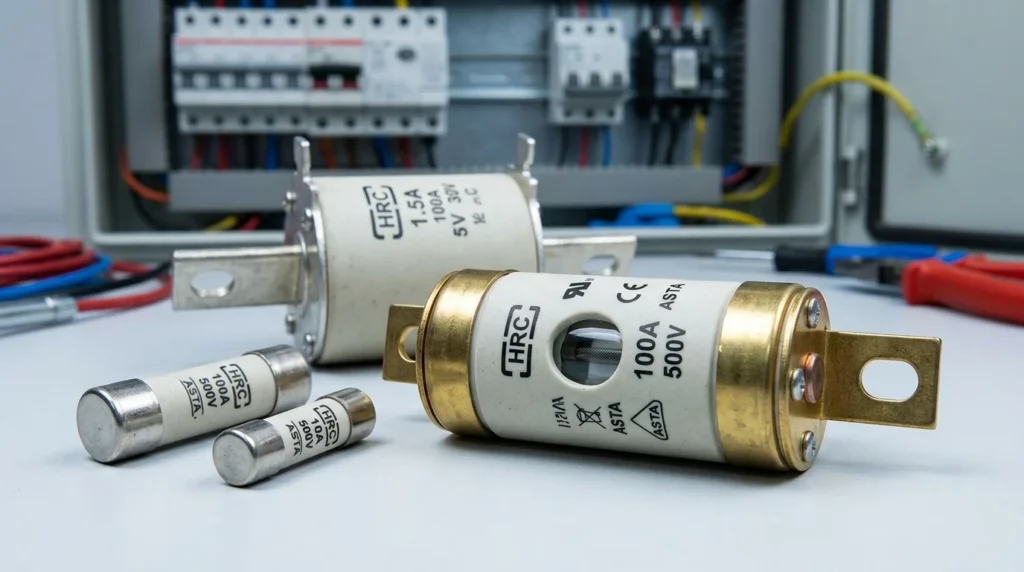
A High Rupturing Capacity (HRC) fuse is a special type of cartridge fuse designed to safely interrupt very high fault currents without causing damage to the electrical system. It consists of a strong ceramic body containing a fuse element made of silver or other suitable conductive material, surrounded by finely powdered quartz or silica sand. Under normal operating conditions, the fuse element carries the load current safely. When an overload or short circuit occurs, the fuse element melts due to excessive heat, and the silica powder helps extinguish the arc formed during the interruption process. This enables the HRC fuse to break large fault currents quickly and safely. Because of its high reliability, fast operation, excellent protection, and high breaking capacity, the HRC fuse is widely used in industrial plants, power distribution systems, transformers, motors, and other high-power electrical equipment.
- Handles high fault current
- Used in industrial applications
Types of MCB
B MCB
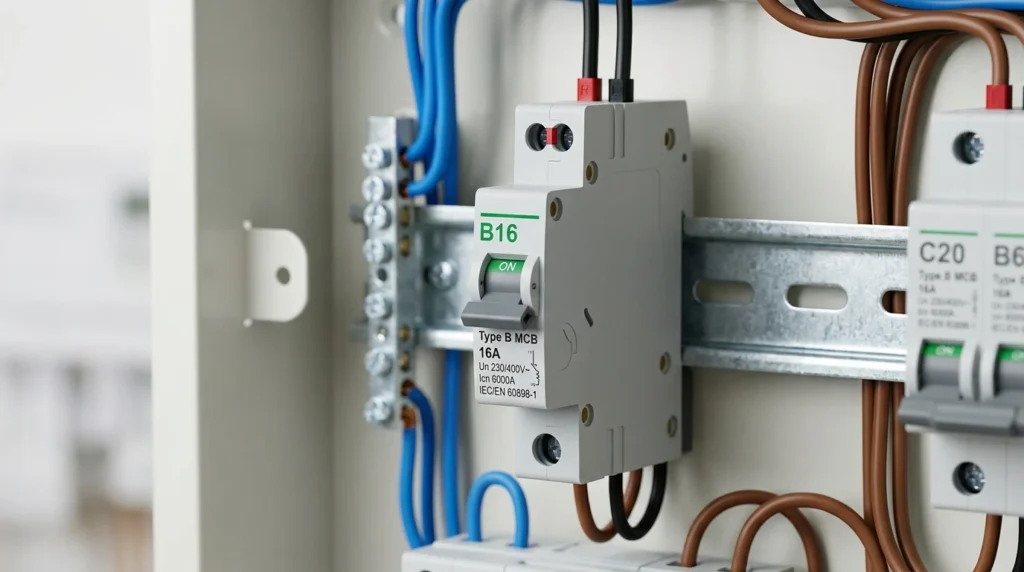
A Type B MCB (Miniature Circuit Breaker) is a protective device designed to trip when the current reaches approximately 3 to 5 times its rated current value. It provides protection against overloads and short circuits in electrical circuits with low inrush currents. Under normal conditions, the MCB allows current to flow safely through the circuit. However, if an overload or fault occurs, its thermal and magnetic tripping mechanisms operate to disconnect the power supply and protect the wiring and connected equipment. Type B MCBs are commonly used in residential and light commercial installations, such as lighting circuits, socket outlets, and household appliances, where sudden current surges are relatively low. Their fast and reliable operation makes them ideal for protecting sensitive electrical systems from damage caused by excessive current.
- Trips at low current
- Used in residential applications
C MCB
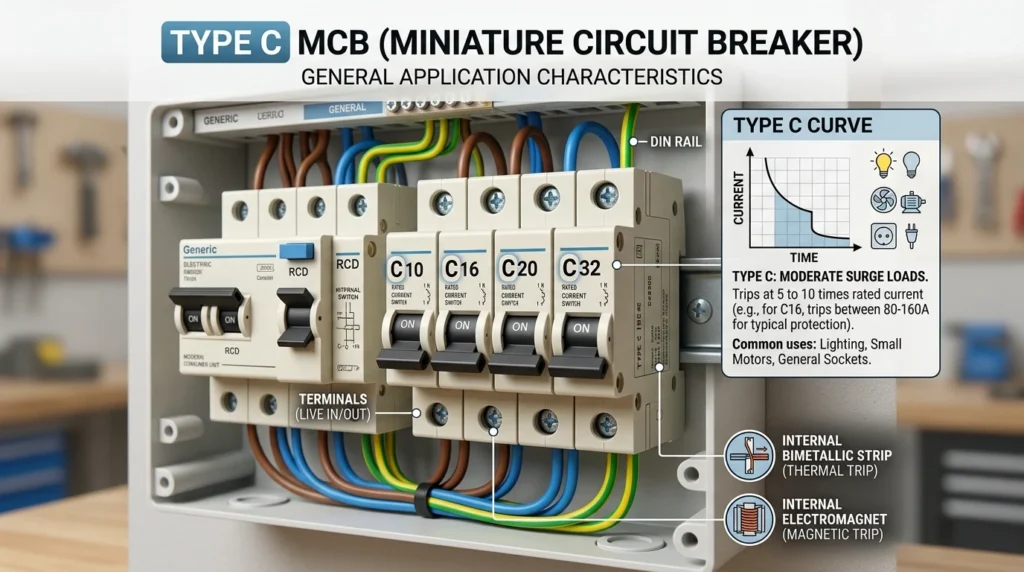
A Type C MCB (Miniature Circuit Breaker) is a circuit protection device that trips when the current reaches approximately 5 to 10 times its rated current value. It is designed for circuits that experience moderate inrush currents during startup. Under normal operating conditions, the MCB safely carries the load current, but when an overload or short circuit occurs, its thermal and magnetic tripping mechanisms automatically disconnect the circuit to prevent damage. Type C MCBs are commonly used in commercial and industrial applications, including motors, transformers, fluorescent lighting systems, and small machinery, where temporary current surges are expected. Their ability to tolerate moderate startup currents while still providing reliable protection makes them one of the most widely used MCB types in electrical installations.
- Medium sensitivity
- Used in commercial setups
D MCB
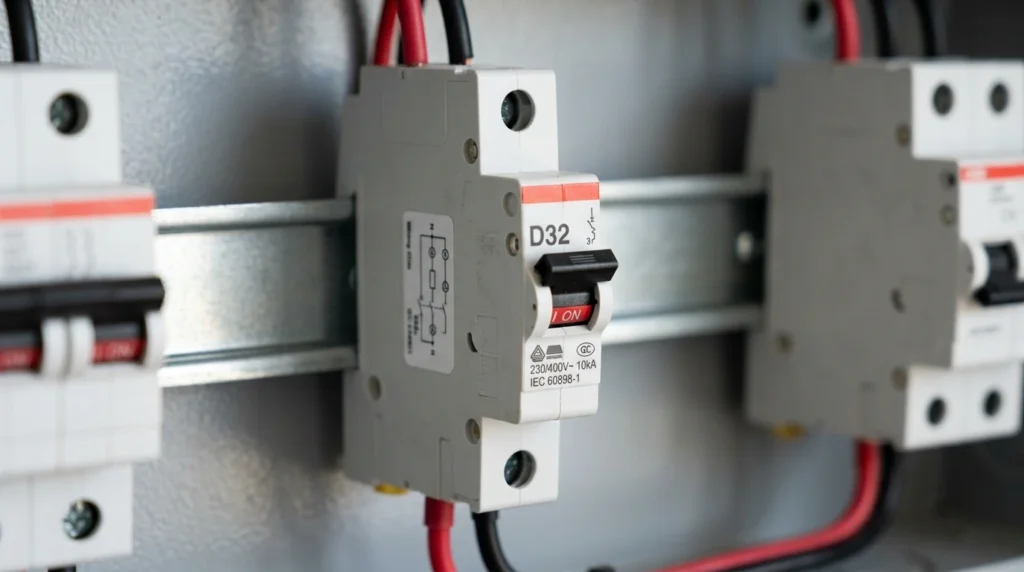
A Type D MCB (Miniature Circuit Breaker) is designed to trip when the current reaches approximately 10 to 20 times its rated current value. It is specially used in electrical circuits where very high inrush currents occur during switching on, such as heavy motors, transformers, X-ray machines, welding equipment, and large industrial machinery. Under normal conditions, the MCB allows current to flow safely without interruption. However, when a severe overload or short circuit happens, the thermal and magnetic tripping mechanism operates to disconnect the circuit and protect the system from damage. Type D MCBs are highly suitable for industrial environments because they can withstand large temporary current surges without nuisance tripping, while still providing reliable protection against real fault conditions.
- High current tolerance
- Used in heavy industrial loads
5. Main Components
Fuse Components
- Fuse Wire: Melts during fault
- Fuse Holder: Holds fuse securely
- Terminals: Connect to circuit
MCB Components
- Bimetal Strip: Detects overload
- Magnetic Coil: Detects short circuit
- Switch Mechanism: Trips circuit
- Arc Chute: Extinguishes arc
- Housing: Provides insulation
6. Advantages
Fuse Advantages
- Simple and low cost
- Easy to install
- Fast operation during faults
- No mechanical parts
MCB Advantages
- Reusable (no replacement needed)
- Quick and reliable operation
- Provides both overload and short circuit protection
- Easy to reset
- Safer and more user-friendly
7. Disadvantages / Limitations
Fuse Disadvantages
- Must be replaced after operation
- Not reusable
- Less accurate protection
- Risk of wrong fuse wire selection
MCB Disadvantages
- Higher initial cost
- More complex than fuse
- Requires proper selection and installation
8. Applications
Fuse Applications
Home Use
- Old wiring systems
- Small appliances
Industrial Use
- Backup protection
- High-current systems
MCB Applications
Home Use
- Modern electrical panels
- Lighting and socket circuits
Industrial Use
- Machines and equipment
- Motor protection systems
Modern Technology
- Smart electrical systems
- Automated distribution boards
9. Comparison Section
Difference Between Fuse and MCB
| Feature | Fuse | MCB |
| Working Principle | Melting of wire | Thermal + magnetic tripping |
| Reusability | Not reusable | Reusable |
| Cost | Low | Higher |
| Operation Speed | Very fast | Fast and controlled |
| Maintenance | Needs replacement | Minimal |
| Safety | Less safe | More safe |
| Accuracy | Less precise | Highly accurate |
| Application | Simple systems | Modern electrical systems |
10. Selection Guide
Choosing between fuse and MCB depends on your needs.
Tips for Beginners
- Use fuse for:
- Low-cost applications
- Simple circuits
- Use MCB for:
- Home wiring
- Safety-critical systems
Key Factors to Consider
- Load current
- Fault level
- Budget
- Safety requirements
- Ease of maintenance
Practical Advice
- Prefer MCB for modern installations
- Use correct rating for both devices
- Avoid overloading circuits
11. Common Problems & SolutionsWhy does a fuse blow frequently?
Overload
Short circuit
Check load and replace with correct rating.
Why does MCB trip repeatedly?
- Faulty appliance
- Overload
Identify and fix the faulty device.
Can fuse replace MCB?
Yes, but not recommended for modern systems.
Why is MCB safer than fuse?
It provides controlled and reusable protection.
What happens if wrong rating is used?
- Too high → No protection
- Too low → Frequent tripping
12. Future Trends
Electrical protection systems are evolving rapidly.
Key Trends
- Smart MCBs: Remote monitoring and control
- IoT Integration: Real-time fault detection
- Energy Management Systems: Efficient power usage
- Advanced Protection Devices: Combination of multiple protections
- Automation: Self-diagnosing electrical panels
Future systems will focus on smart, efficient, and automated protection.
13. Conclusion
Understanding the Difference Between Fuse and MCB is essential for safe and efficient electrical system design. While both devices protect circuits from overcurrent, their working principles and features are quite different.
Fuses are simple, low-cost, and fast but require replacement after operation. MCBs, on the other hand, are reusable, safer, and more reliable, making them ideal for modern electrical systems.
By learning the difference between fuse and MCB, their working principles, applications, and limitations, you can make better decisions in real-world scenarios. Always choose the right protection device based on safety, cost, and application needs.
Developing a strong understanding of these basics will help you build a solid foundation in electrical engineering.