
Imagine a distribution transformer supplying power to your home all day. Even when no appliances are running, the transformer still consumes energy. You might wonder—where is that energy going? The answer lies in transformer losses.
In any electrical system, no device is 100% efficient. Transformers, although highly efficient, still lose some energy in the form of heat. These losses reduce efficiency, increase operating cost, and can affect the lifespan of the transformer if not properly managed.
Understanding Transformer Losses Explained is very important for electrical students, engineers, and technicians. It helps in improving efficiency, selecting the right transformer, and reducing energy waste in practical systems.
In this article, you will learn the complete transformer losses explained working principle, types of losses, components involved, advantages and disadvantages, applications, and practical solutions. By the end, you will clearly understand where losses occur and how to minimize them in real-world electrical systems.
2. What is Transformer Losses Explained?
Transformer losses refer to the energy lost inside a transformer during operation, mainly in the form of heat.
Simple Explanation
When electrical energy is transferred from primary to secondary winding, some part of it is wasted due to resistance, magnetic effects, and other factors.
Practical Example
If a transformer receives 100 kW power and delivers 97 kW, the remaining 3 kW is lost as heat. This is called transformer loss.
3. Working Principle
The transformer losses explained working principle is based on how energy is converted and partially lost during operation.
Step-by-Step Explanation
- AC supply enters primary winding
- Magnetic field is created in the core
- Energy is transferred to secondary winding
- During this process:
- Some energy is lost in windings (heat)
- Some energy is lost in the core (magnetic losses)
- Output power is slightly less than input power
Efficiency Formula
\eta = \frac{\text{Output Power}}{\text{Input Power}} \times 100
Easy Analogy
Think of a water pipe:
- Water enters at one end
- Some leaks occur along the pipe
- Less water reaches the output
Transformer losses act like these leaks.
4. Types / Classification
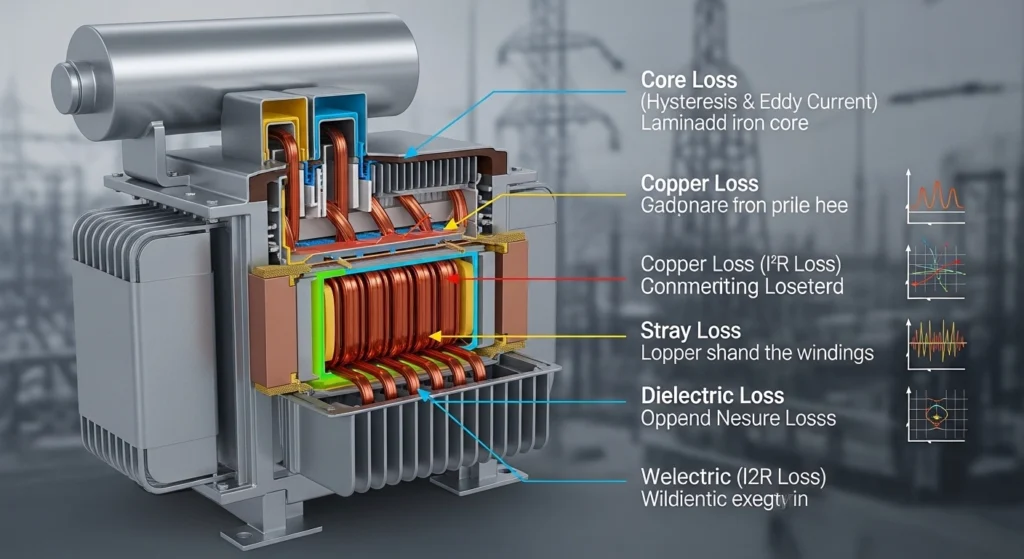
Transformer losses are mainly classified into two categories.
Core Losses (Iron Losses)
These losses occur in the transformer core and are constant.
Hysteresis Loss
- Caused by repeated magnetization of the core
- Depends on material and frequency
Eddy Current Loss
- Caused by circulating currents in the core
- Reduced by using laminated core
Copper Losses
- Occur in transformer windings
- Caused by resistance of wires
- Increases with load
Stray Losses
- Caused by leakage magnetic fields
- Occur in structural parts
Dielectric Losses
- Occur in insulation materials
- More significant in high-voltage transformers
5. Main Components
Core
- Main source of hysteresis and eddy current losses
- Made of laminated steel
Windings
- Cause copper losses
- Resistance produces heat
Insulation
- Causes dielectric losses
- Ensures safe operation
Tank and Structural Parts
- Experience stray losses
- Affect overall efficiency
Cooling System
- Removes heat generated by losses
- Maintains safe temperature
6. Advantages
Transformer Losses Explained Advantages
(Understanding losses provides these benefits)
- Helps improve transformer efficiency
- Reduces energy wastage
- Increases equipment lifespan
- Enables better design and selection
- Improves system reliability
- Saves operational costs
7. Disadvantages / Limitations
Transformer Losses Explained Disadvantages
- Energy wastage is unavoidable
- Causes heating in transformer
- Requires cooling systems
- Reduces overall efficiency
- Increases maintenance requirements
8. Applications
Transformer Losses Explained Applications
Understanding losses is useful in:
Home Systems
- Efficient power usage
- Reduced electricity bills
Industrial Systems
- Power plant efficiency
- Load management
Modern Technology
- Smart grids
- Renewable energy systems
- Energy audits and optimization
Loss analysis is critical in all electrical systems.
9. Comparison Section
Difference Between Core Loss and Copper Loss
| Feature | Core Loss | Copper Loss |
| Cause | Magnetic effects | Electrical resistance |
| Dependence | Constant (independent of load) | Varies with load |
| Location | Core | Windings |
| Type | Hysteresis + Eddy current | I²R loss |
| Control Method | Better core material | Thick conductors, cooling |
10. Selection Guide
Reducing losses starts with proper transformer selection.
Tips for Beginners
- Choose high-efficiency transformers
- Use proper load rating
- Avoid overloading
Key Factors to Consider
- Core material quality
- Winding resistance
- Cooling system
- Operating conditions
- Load profile
Practical Advice
- Use laminated cores to reduce eddy losses
- Use copper windings for lower resistance
- Maintain proper cooling
11. Common Problems & Solutions
Why does transformer heat up?
Due to core and copper losses.
Improve cooling and reduce load.
What causes high copper loss?
Overloading or high resistance.
Use proper conductor size and reduce load.
How to reduce core losses?
Use high-quality core material.
Why efficiency decreases?
Increase in losses.
Regular maintenance and proper loading.
Can losses be eliminated?
No, but they can be minimized.
12. Future Trends
Transformer efficiency is improving with new technologies.
Key Trends
- Amorphous Core Materials: Reduce core losses
- Superconducting Transformers: Near-zero losses
- Smart Monitoring Systems: Real-time loss tracking
- Advanced Cooling Systems: Better heat management
- Energy Optimization Tools: Efficient operation
Future transformers aim for minimum losses and maximum efficiency.
13. Conclusion
Understanding Transformer Losses Explained is essential for improving electrical system performance. Losses occur mainly in the core and windings, reducing efficiency and generating heat.
By learning the transformer losses explained working principle, types, and solutions, you can design better systems and reduce energy waste. While losses cannot be completely eliminated, they can be minimized through proper design, materials, and maintenance.
For electrical students and professionals, mastering this topic is crucial for building efficient and reliable systems. Focus on practical understanding and real-world applications to strengthen your expertise.