
Imagine you are pushing a child on a swing. If you push at the right moment, the swing goes higher with less effort. But if your timing is off, your effort is wasted. This “timing difference” is very similar to what we call phase angle in electrical systems.
In AC circuits, voltage and current do not always reach their peak values at the same time. This difference in timing is known as the phase angle. It plays a major role in power systems, motor performance, and energy efficiency.
Understanding what is phase angle is essential for electrical students, engineers, and technicians. It helps in analyzing circuits, improving power factor, and designing efficient electrical systems.
In this article, you will learn the complete phase angle working principle, types, components involved, applications, advantages and disadvantages, and practical troubleshooting. By the end, you will have a strong and clear understanding of how phase angle affects real-world electrical systems.
2. What is Phase Angle?
Phase angle is the angular difference between two sinusoidal waveforms, usually voltage and current, in an AC circuit.
Simple Explanation
It shows how much one waveform leads or lags behind another.
Practical Example
- In a purely resistive circuit, voltage and current are in sync → phase angle = 0°
- In inductive circuits, current lags behind voltage
- In capacitive circuits, current leads voltage
3. Working Principle
The phase angle working principle is based on how voltage and current behave in different circuit elements.
Step-by-Step Explanation
- AC voltage is applied to a circuit
- Current flows depending on circuit components
- In resistors → current follows voltage
- In inductors → current lags
- In capacitors → current leads
- The difference between voltage and current is measured as phase angle
Mathematical Expression
\phi = \tan^{-1}\left(\frac{X}{R}\right)
Where:
- φ = Phase angle
- X = Reactance
- R = Resistance
Easy Analogy
Think of two runners:
- If both run together → no difference (0° phase angle)
- If one is ahead → leading
- If one is behind → lagging
4. Types / Classification
Zero Phase Angle
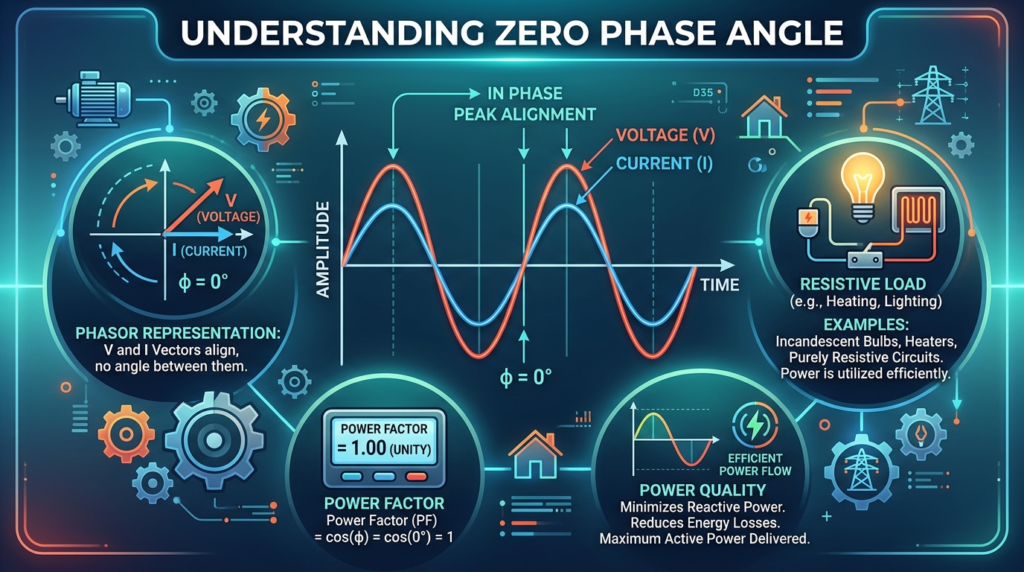
Zero phase angle refers to a condition in an alternating current (AC) circuit where the voltage and current waveforms are perfectly in phase with each other, meaning there is no time difference or phase shift between them. In simple words, both voltage and current reach their maximum, minimum, and zero values at the same time. This condition usually occurs in purely resistive circuits where there is no inductance or capacitance to cause a phase difference. For example, when a heater or incandescent bulb is connected to an AC supply, the current and voltage are almost in phase, resulting in a zero phase angle. At this point, the power factor of the system becomes unity, which means maximum power is efficiently used without reactive losses. Understanding zero phase angle is important in electrical engineering because it helps in analyzing power factor, circuit efficiency, and overall system performance in AC circuits.
- Voltage and current are in phase
- Occurs in purely resistive circuits
Lagging Phase Angle
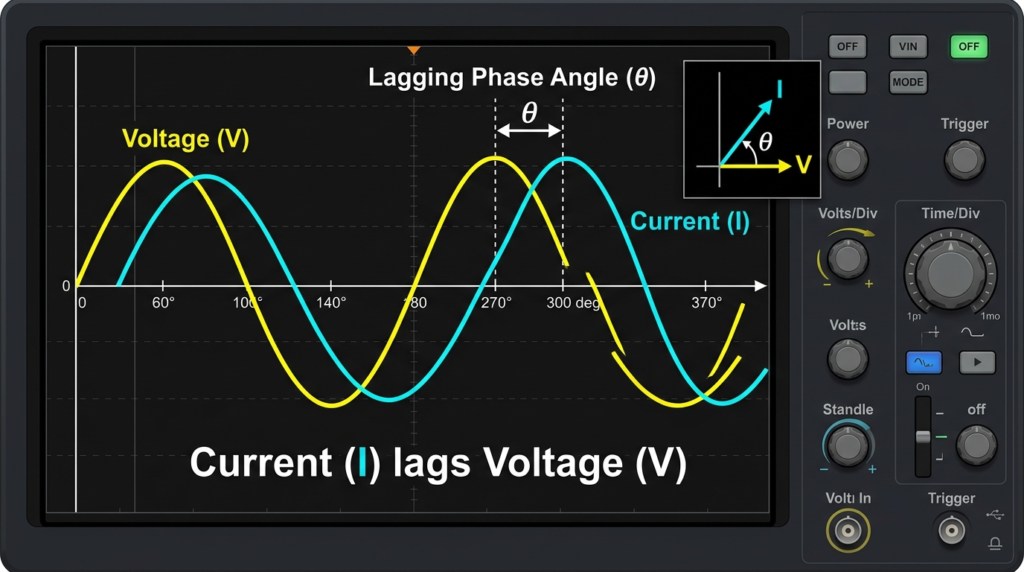
Lagging phase angle refers to a condition in an alternating current (AC) circuit where the current waveform reaches its peak value after the voltage waveform. In simple words, current “lags behind” voltage due to the presence of inductive elements like coils, motors, or transformers in the circuit. This happens because inductors resist changes in current, causing a delay in its response compared to voltage. For example, in an electric motor or transformer, the current does not immediately follow the voltage, resulting in a lagging power factor. The greater the inductive load, the larger the lagging phase angle becomes. This condition is important in electrical engineering because it affects power efficiency and system performance. A lagging phase angle increases reactive power in the system, which can lead to higher losses if not corrected. Capacitor banks are often used in electrical systems to improve power factor and reduce the effects of lagging phase angle.
- Current lags behind voltage
- Occurs in inductive circuits
Leading Phase Angle
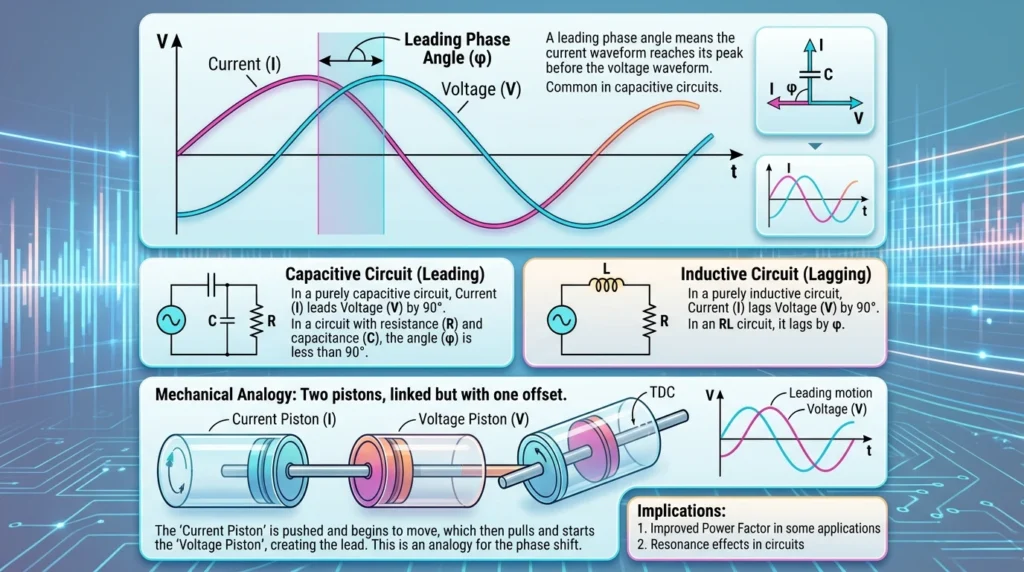
Leading phase angle refers to a condition in an alternating current (AC) circuit where the current waveform reaches its peak value before the voltage waveform. In simple words, current “leads” the voltage due to the presence of capacitive elements such as capacitors in the circuit. This happens because capacitors store and release electrical energy quickly, causing the current to rise earlier than the voltage. For example, in capacitor banks used for power factor correction, the current leads the voltage, resulting in a leading power factor. The larger the capacitive effect in a circuit, the greater the leading phase angle becomes. This condition is important in electrical systems because it helps balance lagging loads like motors and transformers. Proper control of leading and lagging phase angles improves overall power factor, reduces energy losses, and enhances system efficiency in electrical networks and industrial applications.
- Current leads voltage
- Occurs in capacitive circuits
5. Main Components
Phase angle depends on circuit elements.
Resistor
- Does not create phase difference
- Voltage and current remain in phase
Inductor
- Causes current to lag
- Stores energy in magnetic field
Capacitor
- Causes current to lead
- Stores energy in electric field
Power Source
- Provides AC voltage
- Determines waveform frequency
6. Advantages
Phase Angle Advantages
- Helps in analyzing AC circuits
- Improves power factor correction
- Enhances system efficiency
- Enables proper load management
- Essential for motor performance
- Supports accurate power calculations
7. Disadvantages / Limitations
Phase Angle Disadvantages
- Causes power loss in systems
- Reduces efficiency if not controlled
- Complicates circuit analysis
- Requires additional equipment for correction
- Can affect motor performance
8. Applications
Phase Angle Applications
Home Applications
- Power factor correction in appliances
- Efficient energy usage
Industrial Applications
- Motor control systems
- Power distribution networks
- Reactive power management
Modern Technology
- Smart grids
- Renewable energy systems
- Electric vehicles
- Power electronics
Phase angle is critical in all AC systems.
9. Comparison Section
Difference Between Leading and Lagging Phase Angle
| Feature | Leading Phase Angle | Lagging Phase Angle |
| Definition | Current leads voltage | Current lags voltage |
| Circuit Type | Capacitive | Inductive |
| Power Factor | Leading | Lagging |
| Application | Capacitor banks | Motors, transformers |
10. Selection Guide
Managing phase angle is important for system efficiency.
Tips for Beginners
- For inductive loads → Use capacitors
- For capacitive loads → Use inductors
- Maintain power factor close to unity
Key Factors to Consider
- Load type
- Power factor
- System efficiency
- Voltage level
- Energy cost
Practical Advice
- Monitor power factor regularly
- Use correction devices when needed
- Avoid excessive reactive power
11. Common Problems & Solutions
Why is power factor low?
High phase angle due to inductive loads.
Use capacitor banks.
Why do motors consume more power?
Lagging phase angle.
Improve power factor.
What causes leading power factor?
Excess capacitors.
Balance the system.
How to measure phase angle?
Using power analyzers or oscilloscopes.
Why phase angle is important?
It affects efficiency and power usage.
12. Future Trends
Phase angle management is becoming more advanced.
Key Trends
- Smart Power Systems: Automatic phase correction
- IoT Monitoring: Real-time analysis
- AI-Based Optimization: Intelligent control
- Renewable Integration: Better phase management
- Advanced Power Electronics: Precise control
Future systems aim for minimum phase difference and maximum efficiency.
13. Conclusion
Understanding what is phase angle is essential for analyzing and improving AC electrical systems. It represents the difference between voltage and current and directly affects power factor and efficiency.
By learning the phase angle working principle, types, and applications, you can design better systems and reduce energy losses. While phase angle can create challenges, proper management ensures efficient and reliable operation.
As electrical systems become smarter, phase angle control will play an even bigger role in optimizing performance. Focus on practical understanding and real-world applications to strengthen your expertise in this important topic.