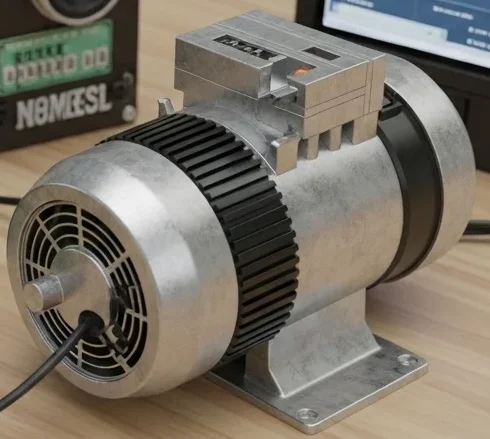

Imagine starting a large industrial motor directly on full voltage. The sudden high current can damage the motor and cause voltage drops in the system. To solve this, engineers use special connection methods like star and delta connections to control voltage and current effectively.
In three-phase electrical systems, how we connect windings plays a major role in performance, safety, and efficiency. The two most common methods are star (Y) connection and delta (Δ) connection. Each has its own characteristics and is used in different situations.
Understanding Star vs Delta Connection is essential for electrical students, engineers, technicians, and beginners. It helps in designing circuits, selecting motors, and analyzing power systems.
In this article, you will learn the complete star vs delta connection working principle, types, components, applications, advantages and disadvantages, and practical selection tips. By the end, you will clearly understand the difference between star and delta connection and when to use each one.
2. What is Star vs Delta Connection?
Star vs Delta Connection refers to the comparison between two methods of connecting three-phase electrical systems.
Star (Y) Connection
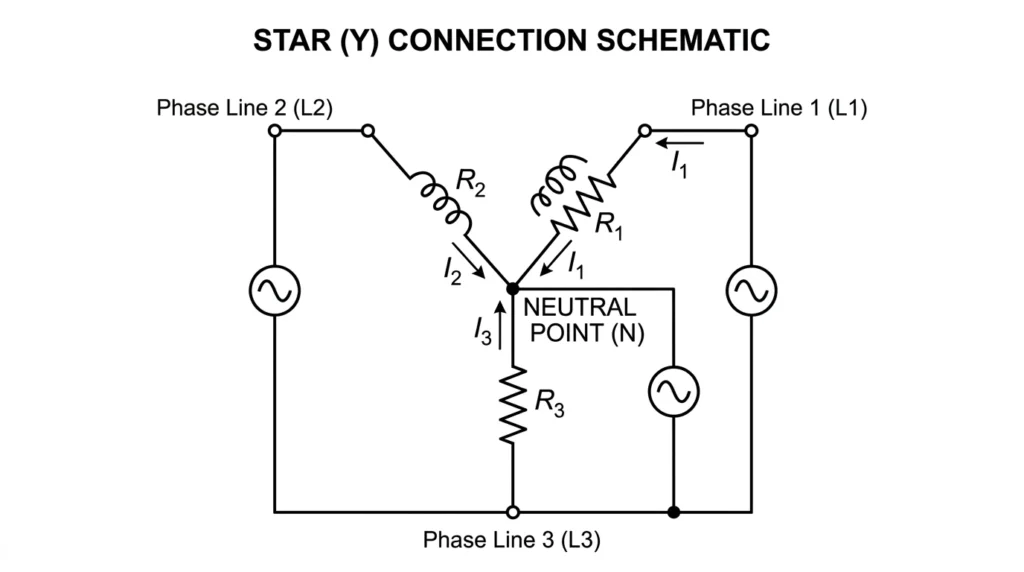
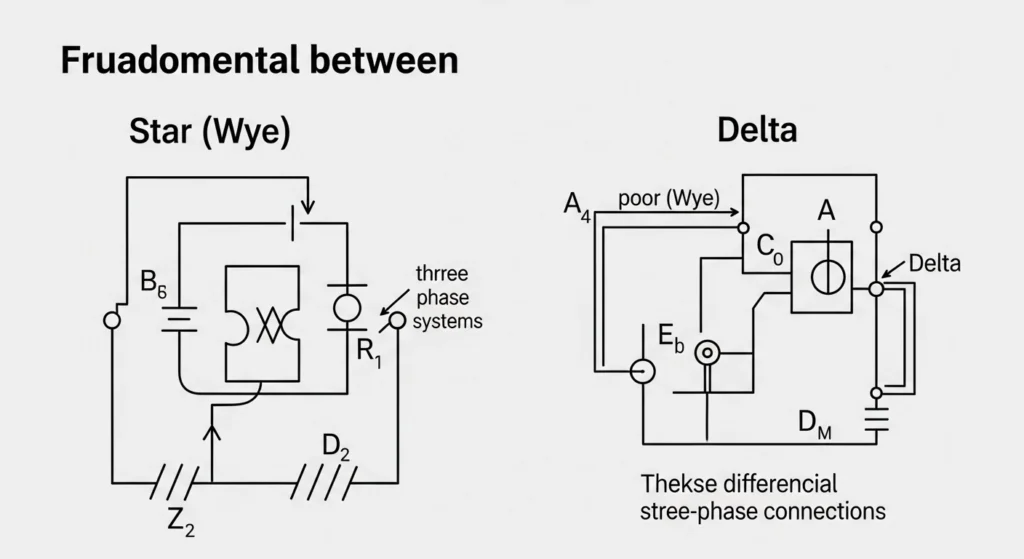
Star (Y) connection is a three-phase electrical connection method in which one end of each of the three windings is connected together to form a common point called the neutral point, while the other ends are connected to the three-phase supply lines. In simple words, the windings are arranged in a shape that resembles the letter “Y,” which is why it is called a Star or Y connection. This connection is widely used in power generation, transmission, and distribution systems because it provides both line voltage and phase voltage and allows the use of a neutral wire for single-phase loads. In a star-connected system, the line voltage is √3 times greater than the phase voltage, making it suitable for high-voltage applications. Star connections offer advantages such as reduced insulation requirements, better fault protection, and the ability to supply both three-phase and single-phase loads. They are commonly used in transformers, alternators, and electrical distribution networks for efficient and reliable power delivery.In a star connection, one end of each winding is connected to a common point called the neutral point.
Delta (Δ) Connection
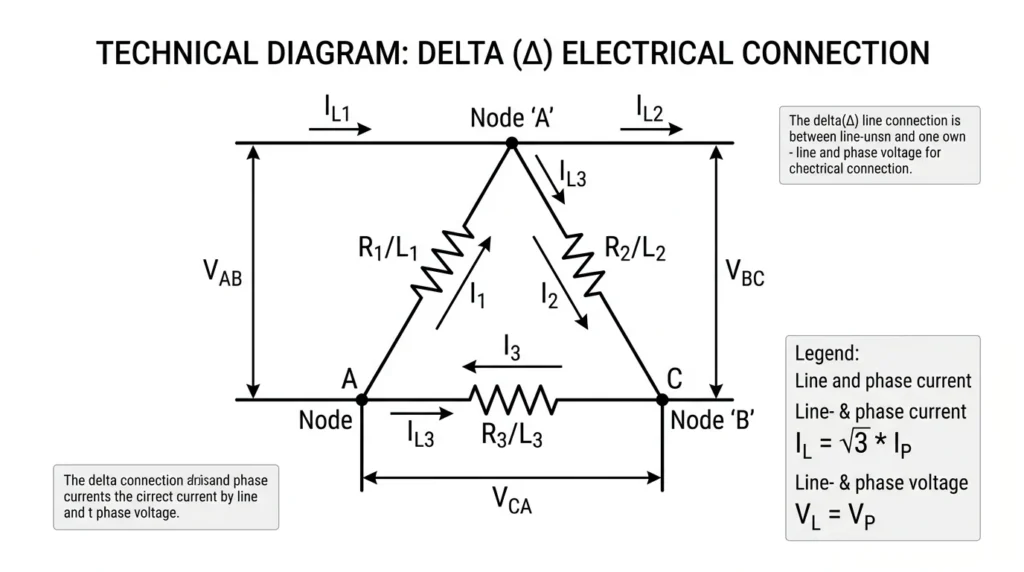
Delta (Δ) connection is a three-phase electrical connection method in which the end of each winding is connected to the beginning of the next winding, forming a closed loop that resembles the shape of the Greek letter Delta (Δ). In simple words, the three windings are connected end-to-end in a triangular arrangement without a neutral point. This connection is widely used in industrial power systems, motors, and transformers because it can handle high currents and provide reliable operation under heavy loads. In a delta-connected system, the line voltage is equal to the phase voltage, while the line current is √3 times greater than the phase current. One major advantage of the delta connection is that it continues operating even if one winding becomes faulty in certain conditions, improving system reliability. Delta connections are commonly used for powering large motors, industrial machinery, and distribution transformers where high power capacity and efficient performance are required.In a delta connection, windings are connected in a closed loop, forming a triangle shape.
Simple Explanation
- Star → Common neutral point
- Delta → Closed loop
Practical Example
- Star connection is used in power transmission
- Delta connection is used in industrial motors
3. Working Principle
The star vs delta connection working principle is based on how voltage and current are distributed in the system.
Star Connection Working
- Three windings connected at a common neutral
- Line voltage is higher than phase voltage
V_L = \sqrt{3} ; V_{ph}
Delta Connection Working
- Windings connected in loop
- Line voltage equals phase voltage
V_L = V_{ph}
Easy Analogy
Think of water pipes:
- Star → water distributed from a central tank
- Delta → water circulates in a closed loop
Key Points
- Star reduces voltage per phase
- Delta provides full voltage
- Current distribution differs
4. Types / Classification
Star Connection Types
Balanced Star Connection
- Equal load on all phases
Unbalanced Star Connection
- Unequal load
- Neutral carries current
Delta Connection Types
Balanced Delta Connection
- Equal load
- Stable operation
Open Delta Connection
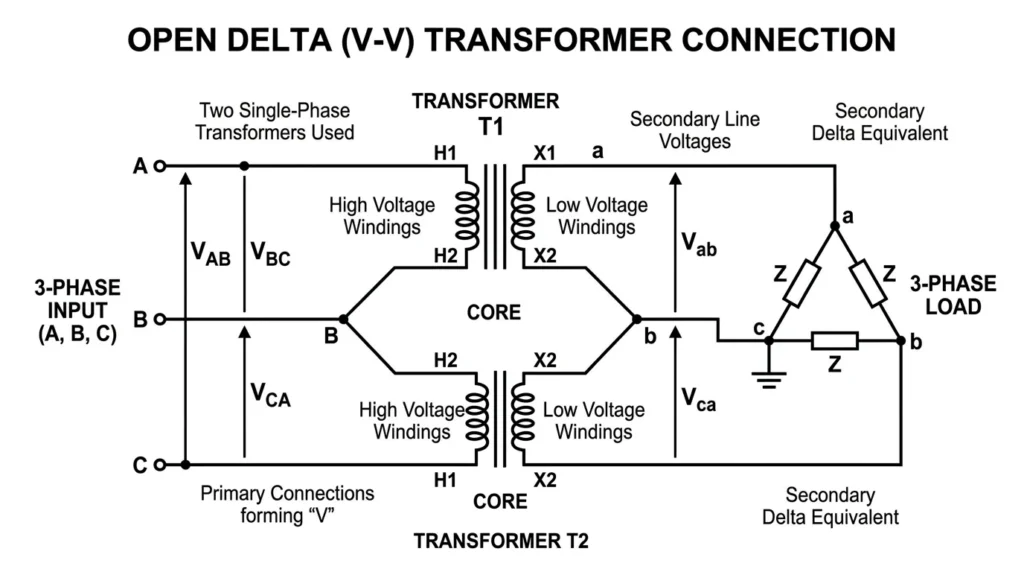
Open Delta Connection, also known as V-V connection, is a special type of three-phase transformer connection that operates using only two transformers instead of three. It is usually used when one transformer in a delta-delta system becomes unavailable due to maintenance or failure, or when the power demand is relatively low. In this configuration, the two transformers are connected in such a way that they can still supply three-phase power, although with reduced capacity. An open delta connection can deliver approximately 57.7% of the power capacity of a complete closed delta system. Its main advantage is that it allows continuous operation without requiring an immediate replacement of the faulty transformer, which improves system reliability and reduces downtime. However, it is less efficient and has lower load-handling capability compared to a full delta connection. Open delta connections are commonly used as temporary solutions, in small industrial installations, and in locations where future load expansion is expected.
- Uses two transformers
- Reduced capacity
5. Main Components
Windings
- Conductors forming phases
- Connected in star or delta
Neutral Point (Star Only)
- Common connection point
- Provides return path
Line Conductors
- Carry current to load
- Connect system to supply
Load
- Electrical equipment
- Determines current flow
Insulation
- Protects windings
- Ensures safety
6. Advantages
Star Connection Advantages
- Lower phase voltage
- Safer for insulation
- Suitable for long-distance transmission
- Neutral point available
- Reduced starting current
Delta Connection Advantages
- Higher power output
- No neutral required
- Better efficiency
- Suitable for heavy loads
- Continuous operation even if one phase fails
7. Disadvantages / Limitations
Star Connection Disadvantages
- Lower power output
- Requires neutral wire
- Not suitable for heavy loads
Delta Connection Disadvantages
- Higher insulation requirement
- No neutral point
- Higher starting current
- More stress on equipment
8. Applications
Star vs Delta Connection Applications
Home Applications
- Star connection for domestic supply
- Neutral used for single-phase loads
Industrial Applications
- Delta connection for motors
- Star-delta starters for motors
Modern Technology
- Power transmission systems
- Transformer connections
- Renewable energy systems
Both connections are widely used depending on requirement.
9. Comparison Section
Difference Between Star and Delta Connection
| Feature | Star Connection | Delta Connection |
| Structure | Common neutral point | Closed loop |
| Voltage | Lower phase voltage | Full phase voltage |
| Current | Lower | Higher |
| Neutral | Available | Not available |
| Application | Transmission | Industrial loads |
| Safety | Higher | Lower |
10. Selection Guide
Choosing between star and delta connection depends on application.
Tips for Beginners
- For safety → Use star connection
- For high power → Use delta connection
Key Factors to Consider
- Voltage requirement
- Load type
- Safety
- Efficiency
- System design
Practical Advice
- Use star for starting motors
- Switch to delta for running
- Ensure proper insulation
11. Common Problems & Solutions
Why motor draws high current?
Direct delta starting.
:
Use star-delta starter.
Why voltage is low?
Star connection reduces voltage.
Use delta connection if needed.
Why neutral current flows?
Balance the load.
Why equipment overheats?
High current in delta.
Check load and cooling.
Which is better?
Depends on application.
12. Future Trends
Electrical systems are evolving with new technologies.
Key Trends
- Smart Power Distribution Systems
- Automated Star-Delta Switching
- Energy-Efficient Motor Control
- IoT-Based Monitoring Systems
- Advanced Transformer Designs
Future systems will focus on efficiency, automation, and reliability.
13. Conclusion
Understanding Star vs Delta Connection is essential for working with three-phase electrical systems. Both connections have unique characteristics that affect voltage, current, and performance.
By learning the star vs delta connection working principle, types, and applications, you can make better decisions in system design and operation. Star connection is safer and suitable for transmission, while delta connection is ideal for heavy loads and industrial use.
As technology advances, both methods continue to play a critical role in modern power systems. Focus on practical understanding to build strong expertise in electrical engineering.