
Think about a car driving at night with headlights, music system, and charging ports all working at the same time. While the battery helps start the car, it cannot supply power continuously. So, what keeps everything running while the engine is on? The answer is an alternator.
An alternator is one of the most important electrical machines used in vehicles and power systems. It converts mechanical energy into electrical energy and ensures a continuous power supply. Without alternators, modern transportation and power generation systems would not function efficiently.
Understanding what is alternator is essential for electrical students, engineers, technicians, and beginners. It helps in understanding power generation, system design, and troubleshooting electrical machines.
In this article, you will learn the complete alternator working principle, types, components, applications, advantages and disadvantages, and practical selection guide. By the end, you will have a strong understanding of how alternators work and their importance in real-world electrical systems.
2. What is Alternator?
An alternator is an electrical machine that converts mechanical energy into alternating current (AC) electrical energy.
Simple Explanation
It produces electricity when its rotor rotates inside a magnetic field.
Practical Example
- In cars, the alternator generates electricity while the engine runs
- In power plants, large alternators generate electricity for cities
3. Working Principle
The alternator working principle is based on Faraday’s Law of Electromagnetic Induction.
Step-by-Step Explanation
- Mechanical energy is applied to rotate the rotor
- Rotor creates a rotating magnetic field
- This field cuts the stator windings
- An electromotive force (EMF) is induced
- AC voltage is generated in stator windings
EMF Equation
E = N \frac{d\Phi}{dt}
Easy Analogy
Think of a bicycle dynamo:
- When wheel rotates → light glows
- Rotation produces electricity
Key Points
- Faster rotation → higher voltage
- Stronger magnetic field → more output
- Output is AC
4. Types / Classification
Automotive Alternator
- Used in vehicles
- Charges battery and powers systems
Synchronous Alternator
- Used in power plants
- Produces constant frequency AC
Brushless Alternator
- No brushes
- Low maintenance and high efficiency
Portable Alternator
- Used in generators
- For temporary power supply
Marine Alternator
- Used in ships
- Designed for harsh environments
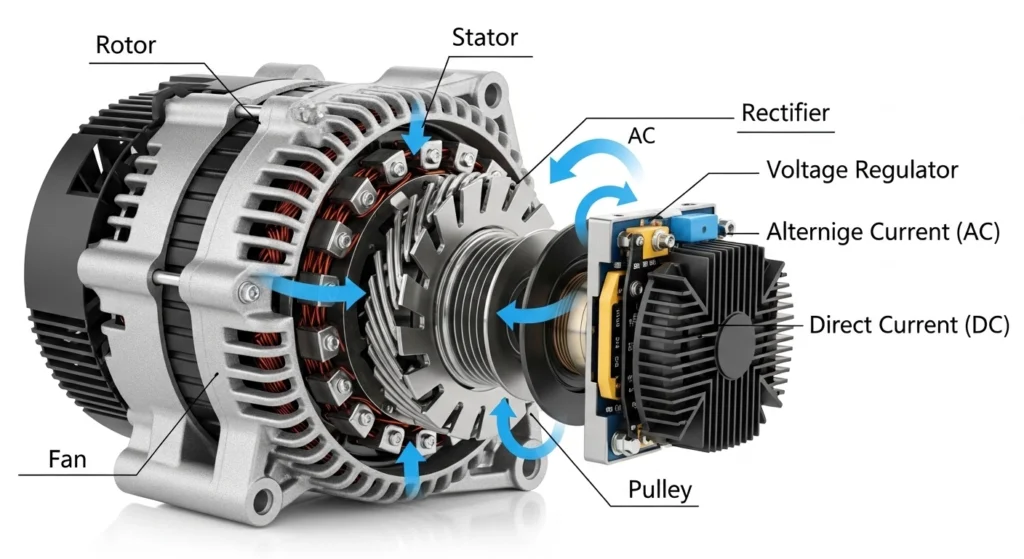
5. Main Components
Rotor
- Rotating part
- Produces magnetic field
Stator
- Stationary part
- Contains windings where voltage is induced
Slip Rings
- Transfer current to rotor
- Used in some types
Brushes
- Conduct electricity
- Used in conventional alternators
Rectifier
- Converts AC to DC (in vehicles)
Voltage Regulator
- Controls output voltage
- Maintains stable supply
Cooling System
- Removes heat
- Ensures safe operation
6. Advantages
Alternator Advantages
- High efficiency
- Reliable operation
- Continuous power generation
- Low maintenance (especially brushless types)
- Compact design
- Suitable for high power applications
7. Disadvantages / Limitations
Alternator Disadvantages
- Requires mechanical input
- Initial cost can be high
- Brush wear in some models
- Needs regular maintenance
- Output depends on speed
8. Applications
Alternator Applications
Home Applications
- Backup generators
- Small power supply units
Industrial Applications
- Power plants
- Manufacturing systems
- Heavy machinery
Modern Technology
- Electric vehicles (hybrid systems)
- Renewable energy systems
- Marine and aviation systems
Alternators are essential in power generation systems.
9. Comparison Section
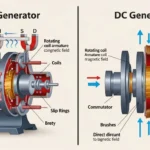
Difference Between Alternator and Generator
| Feature | Alternator | Generator |
| Output | AC | AC or DC |
| Efficiency | Higher | Lower |
| Maintenance | Low | Higher |
| Design | Simple | Complex |
| Application | Vehicles, power plants | Backup systems |
10. Selection Guide
Choosing the right alternator is important.
Tips for Beginners
- For vehicles → Automotive alternator
- For power plants → Synchronous alternator
- For low maintenance → Brushless alternator
Key Factors to Consider
- Power rating
- Efficiency
- Speed requirements
- Cooling system
- Application type
Practical Advice
- Always match alternator rating with load
- Ensure proper cooling
- Use voltage regulator
11. Common Problems & Solutions
Why battery is not charging?
Check connections and replace faulty parts.
Why voltage is unstable?
Defective voltage regulator.
Replace regulator.
Why alternator overheats?
Overloading or poor cooling.
Reduce load and improve ventilation.
Why noise occurs?
Worn bearings.
Replace bearings.
How to increase alternator life?
- Regular maintenance
- Proper loading
- Good cooling
12. Future Trends
Alternators are improving with new technologies.
Key Trends
- Brushless Technology
- High-Efficiency Designs
- Smart Voltage Control Systems
- Integration with Renewable Energy
- Compact and Lightweight Designs
Future alternators will focus on efficiency, durability, and smart control.
13. Conclusion
Understanding what is alternator is essential for anyone in the electrical field. Alternators play a key role in converting mechanical energy into electrical energy, making them vital in vehicles, power plants, and modern systems.
By learning the alternator working principle, types, components, and applications, you can better understand power generation systems. Each type of alternator has its own advantages and limitations, so selecting the right one is important.
As technology advances, alternators are becoming more efficient and reliable. Building strong knowledge in this area will help you grow as a skilled engineer or technician.