
Switch on a large induction motor directly and two unpleasant things happen: the lights dim across the building and the motor shudders as if it has been kicked. That kick is the inrush current — five to eight times the normal running current — slamming into the windings in the first fraction of a second. A soft starter exists to remove that kick, letting the motor glide up to full speed smoothly.
Soft starters sit between the old star-delta starter and the modern variable-frequency drive: smarter than one, cheaper than the other. This guide explains what a soft starter is, how it controls motor voltage during starting, the types available, and where it earns its place in real installations.
What Is a Soft Starter?
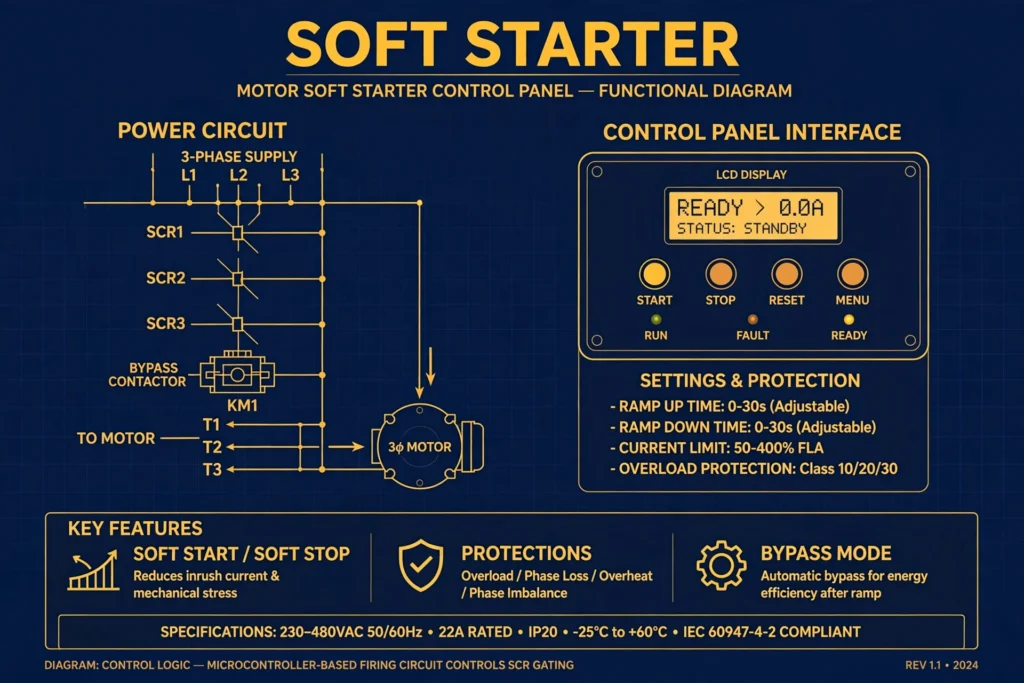
A soft starter is an electronic device that controls the voltage applied to an AC motor during starting and stopping. Instead of hitting the motor with full voltage instantly, it ramps the voltage up gradually over a few seconds, so the current — and the mechanical shock — stay within safe limits. Once the motor reaches full speed, most soft starters switch in a bypass contactor that carries the running current, taking the electronics out of the circuit to avoid heat losses.
Soft starters are used almost entirely with three-phase squirrel-cage induction motors, from small pump motors up to machines of several hundred kilowatts. If you are new to motor starting problems, our guide to starting methods of induction motors explains why limiting inrush current matters in the first place.
Why Motors Need Soft Starting
At standstill, an induction motor looks almost like a short circuit to the supply. The result is a starting current of 500–800% of full-load current and a starting torque surge that hammers couplings, belts, gearboxes and the driven machine itself. Repeated hard starts overheat windings, loosen mechanical joints and cause voltage dips that trip sensitive equipment nearby.
Utilities also penalize large direct-on-line starts because the sudden demand disturbs the network. A soft starter solves the electrical and mechanical problems together: current stays controlled, torque builds smoothly, and the whole drivetrain lasts longer. It is one of the simplest motor protection techniques that also saves maintenance money.
Soft Starter Working Principle
The heart of a soft starter is a set of back-to-back thyristors (SCRs) — one pair in series with each phase of the motor supply. A thyristor is an electronic switch that can be turned on at any chosen point in each AC half-cycle. By delaying the switch-on point, the controller chops away part of each sine wave and reduces the effective voltage reaching the motor.
Here is the sequence, step by step:
- Start command: the controller begins firing the thyristors late in each half-cycle, so the motor initially receives only 30–50% of supply voltage.
- Voltage ramp: over the set ramp time (typically 5–30 seconds), the firing point advances earlier in each cycle, smoothly raising the motor voltage toward 100%.
- Current limit: a current sensor watches the motor current. If it threatens to exceed the set limit (often 3–4 times full-load current), the ramp pauses until the current falls back.
- Bypass: when the motor reaches full speed, an internal or external contactor closes across the thyristors. Running current now flows through the contactor, and the SCRs cool down.
- Soft stop (optional): on stopping, the process reverses — voltage ramps down gradually so pumps do not suffer water hammer and conveyors do not jerk to a halt.
Because torque in an induction motor is roughly proportional to the square of the voltage, halving the voltage cuts the starting kick to about one quarter — a dramatic softening. For background on the switching devices involved, note that the same thyristor phase-control idea appears in light dimmers, only scaled up enormously.
Main Components of a Soft Starter
- Thyristor (SCR) pairs: two per phase, conducting alternate half-cycles to control voltage in both directions.
- Bypass contactor: carries full-load current after starting, eliminating thyristor heating during normal running.
- Control board: sets ramp time, initial voltage, current limit and soft-stop; handles start/stop commands.
- Current transformers: measure motor current for the current-limit function and overload protection.
- Protection circuits: guard against phase loss, over-temperature, shorted thyristor and stalled rotor.
- Heat sink and fan: remove heat generated in the thyristors during the ramp.
Types of Soft Starters
1. Primary-resistor / reactor starters (old electromechanical type): resistors or reactors are inserted in series with the motor and shorted out in steps. Cheap but jerky — largely replaced by electronics.
2. Part-winding starters: energize one of two parallel stator windings first, then the second. Simple but limited to specially wound motors.
3. Solid-state (thyristor) soft starters: the modern standard described above — smooth voltage ramp, current limit, soft stop, and built-in protections in one compact unit.
4. Soft starters with built-in bypass: integrate the bypass contactor inside the same enclosure, saving panel space and wiring on smaller ratings.
Soft Starter vs Star-Delta vs VFD
| Feature | Soft Starter | Star-Delta Starter | VFD |
|---|---|---|---|
| Starting current | Limited to 3–4× FLC, smooth | ~3× FLC but with a torque dip at changeover | Fully controlled, ~1.5× FLC |
| Speed control | No — full speed only | No | Yes, full variable speed |
| Smoothness | Very smooth ramp | Jerky at star-to-delta switching | Perfectly smooth |
| Cost | Medium | Low | High |
| Energy saving while running | None (bypassed) | None | Large on variable-torque loads |
| Best for | Pumps, fans, conveyors needing gentle starts | Budget jobs with light starting loads | Anything needing speed control |
Choose a soft starter when you need gentle starting and stopping but not speed control — it is the sweet spot of price versus performance. If the application also needs the motor to run at different speeds, the VFD is the honest answer despite its cost.
Advantages and Limitations
Advantages: smooth, stepless acceleration; adjustable ramp time and current limit; soft stop prevents water hammer in pumping systems; compact panel footprint; built-in motor protections reduce extra relays; less mechanical stress means longer belt, bearing and gearbox life.
Limitations: cannot control running speed; still draws 3–4 times full-load current (better than 6–8×, but not magic); generates harmonics during the ramp; thyristors need cooling and are sensitive to voltage spikes; not suitable for motors that must start under very heavy load — a VFD or direct starting may be required. Watch also for motor overload settings, which must be coordinated with the soft starter’s own protection.
Typical Applications
- Centrifugal pumps: soft stop eliminates water hammer that bursts pipes.
- Fans and blowers: high inertia loads accelerate without belt slip.
- Conveyors: no load spillage from sudden jerks.
- Compressors: unloaded starts extend valve and bearing life.
- Mixers and crushers: controlled torque protects gearboxes.
FAQs
Does a soft starter save energy?
Not during normal running — once the bypass contactor closes, the motor runs at full voltage like any direct-started motor. The savings come from reduced mechanical maintenance and fewer voltage-dip problems, not from the electricity meter.
Can a soft starter control motor speed?
No. It controls voltage only during starting and stopping. For continuous speed control you need a variable-frequency drive.
What is the difference between a soft starter and a VFD?
A soft starter ramps voltage up and down at fixed frequency for gentle starts; a VFD varies both voltage and frequency to control speed continuously. Soft starters are cheaper and simpler when speed control is not needed.
How long should the ramp time be?
Typically 5–30 seconds. Too short and you lose the soft-start benefit; too long and the motor and thyristors overheat from prolonged high slip. Follow the manufacturer’s guidance for the load inertia.
Can I use a soft starter on a single-phase motor?
Standard three-phase soft starters are designed for three-phase induction motors. Single-phase motors need specially designed units, and many small single-phase motors start gently enough not to need one.
What happens if a thyristor fails shorted?
The motor would receive uncontrolled voltage on that phase. Good soft starters detect this with internal monitoring and trip; that is one reason to buy units with built-in diagnostics rather than bare-bones models.
Conclusion
A soft starter is the civilized way to start a large motor: thyristors trim the voltage cycle by cycle, current stays within limits, and torque builds smoothly instead of arriving as a hammer blow. It will not give you speed control or energy savings, but for pumps, fans, conveyors and compressors it extends equipment life and keeps the supply network happy at a fraction of a VFD’s price. Size it correctly, set the ramp sensibly, and it will quietly do its job for years.
Further reading: Motor soft starter — Wikipedia.