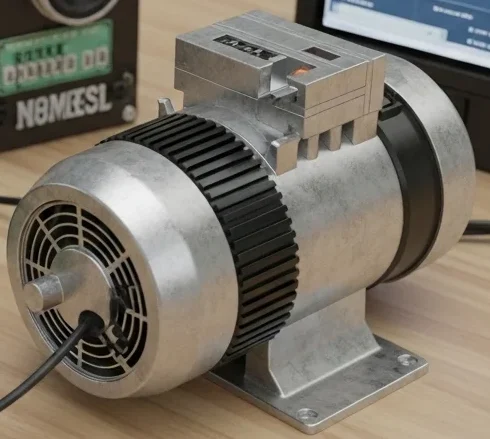

Two motors sit at the heart of almost every factory, pump station and workshop: the synchronous motor and the induction motor. Both run on alternating current, both have a stator and a rotor, and both convert electrical energy into mechanical rotation. Yet they behave so differently that choosing the wrong one can waste energy, damage equipment or inflate your electricity bill.
Students mix them up because textbooks introduce them side by side. Technicians mix them up because both look like heavy steel cylinders with terminal boxes. This guide clears the confusion with 12 practical differences, explained in plain language, so you can tell them apart and pick the right one for any job.
What Is a Synchronous Motor?
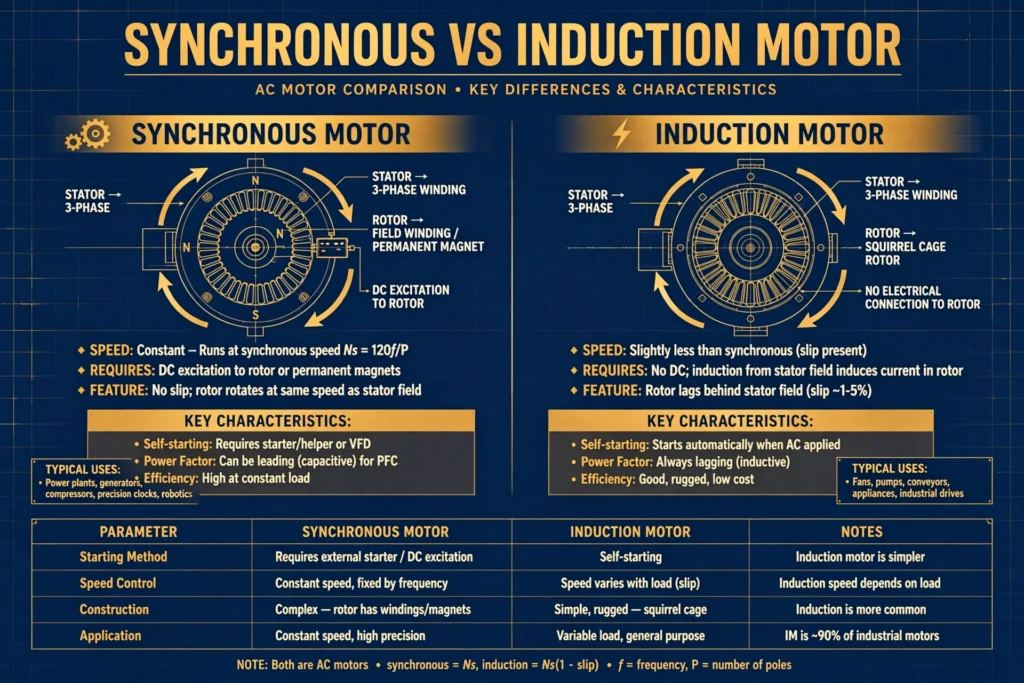
A synchronous motor is an AC motor whose rotor spins at exactly the same speed as the rotating magnetic field of the stator. That speed, called the synchronous speed, depends only on the supply frequency and the number of poles: Ns = 120f / P. If the frequency is 50 Hz and the motor has 4 poles, the rotor turns at exactly 1500 RPM — no more, no less — as long as the motor stays in step.
The rotor of a synchronous motor carries its own magnetic field, created either by electromagnets fed with DC through slip rings or by permanent magnets. Because the rotor field locks onto the stator’s rotating field, the two rotate together in perfect synchronism. You can read the full construction details in our guide to the synchronous motor.
What Is an Induction Motor?
An induction motor is an AC motor whose rotor spins slightly slower than the stator’s rotating magnetic field. The stator field induces current in the rotor conductors by electromagnetic induction — the same principle as a transformer — and that induced current creates the rotor’s magnetic field. No brushes, no slip rings, no separate DC supply are needed for the basic squirrel-cage design.
The small speed difference between the field and the rotor is called slip, and it is essential: without slip there is no induction, and without induction there is no torque. If you want the deeper physics, see our explanation of the working principle of the induction motor and what slip in an induction motor really means.
12 Key Differences at a Glance
| Feature | Synchronous Motor | Induction Motor |
|---|---|---|
| 1. Rotor speed | Exactly equal to synchronous speed (Ns = 120f/P) | Always slightly less than synchronous speed (slip of 2–5%) |
| 2. Speed constancy | Speed stays constant from no load to full load | Speed drops slightly as load increases |
| 3. Rotor excitation | Needs separate DC excitation for the rotor field | No separate excitation; rotor currents are induced |
| 4. Slip rings / brushes | Required (except permanent-magnet types) | Not needed in squirrel-cage design |
| 5. Starting | Not self-starting; needs damper winding, pony motor or VFD | Self-starting; connects directly to the supply |
| 6. Power factor | Can be adjusted — leading, lagging or unity — by changing field current | Always lagging; worsens at light load |
| 7. Construction | More complex: field winding, slip rings, exciter | Simple and rugged, especially squirrel-cage rotor |
| 8. Cost | Expensive, especially below 100 kW | Cheap and mass-produced |
| 9. Maintenance | Higher: brushes, slip rings and exciter need attention | Very low: almost maintenance-free |
| 10. Efficiency at full load | Slightly higher, excellent for large constant-speed drives | Very good, but a little lower than synchronous |
| 11. Typical sizes | Large machines: hundreds of kW to tens of MW | All sizes: fractional HP to several MW |
| 12. Main applications | Power-factor correction, compressors, constant-speed drives | Pumps, fans, conveyors, machine tools — general purpose |
Speed Behavior: Why It Matters
The defining difference is speed discipline. A synchronous motor is like a train locked to a timetable: whatever the load, it holds synchronous speed until it is overloaded so badly that it falls out of step and stalls. An induction motor is more flexible: add load and it slows down a little, increasing its slip so it can develop more torque.
This makes synchronous motors ideal where exact speed matters — clocks, recorders, and drives synchronized to other machines. Induction motors suit the other 90% of jobs, where a small speed change under load is harmless. For a closer look at the most common industrial type, see our guide to the three-phase induction motor.
Starting Methods Compared
Here the induction motor wins on simplicity: a small one starts with a direct-on-line connection, while larger ones use star-delta starters or soft starters to limit inrush current. The synchronous motor cannot start on its own because at standstill the rotor cannot lock onto a field rotating at full speed. It is usually started as an induction motor using damper (amortisseur) windings embedded in the rotor pole faces, then the DC field is switched on near synchronous speed to pull it into step. Modern installations often use a variable-frequency drive to ramp the stator frequency up gently from zero.
Power Factor: The Synchronous Motor’s Superpower
An over-excited synchronous motor draws leading reactive power, which means it can cancel out the lagging reactive power drawn by induction motors and transformers elsewhere in the plant. Run without any mechanical load, it becomes a synchronous condenser — essentially a rotating power-factor correction device. An induction motor can never do this; it always draws lagging current, and its power factor is poorest exactly when it is lightly loaded, which is most of the time in real plants.
Applications: Where Each Motor Wins
Choose a synchronous motor for large, constant-speed, high-power drives — cement mill crushers, air compressors, and refinery pumps — and anywhere the plant needs power-factor correction. Choose an induction motor for nearly everything else: water pumps, ventilation fans, conveyors, lifts, lathes, and household appliances. Roughly nine out of ten motors running in industry today are induction motors, simply because they are cheap, tough and need almost no attention.
Which One Should You Choose?
Ask three questions. First, must the speed stay exactly constant under varying load? If yes, lean synchronous. Second, is the rating large (above roughly 100 kW) and running for long hours? The synchronous motor’s higher efficiency and power-factor benefits can pay back its higher price. Third, do you need simple, fit-and-forget reliability? The induction motor is the default answer for general-purpose drives, and it is the right answer most of the time.
FAQs
Can a synchronous motor run as an induction motor?
Briefly, yes. During starting, the damper winding lets a synchronous motor accelerate like a squirrel-cage induction motor. But it only becomes a true synchronous motor once DC excitation is applied and the rotor locks to synchronous speed.
Why is the induction motor more popular?
It is cheaper to build, needs no DC excitation or brushes, starts by itself, and survives dust, moisture and neglect. For general-purpose work that combination is unbeatable.
What happens if a synchronous motor is overloaded?
It falls out of step — the rotor can no longer follow the rotating field — and stalls. This is called pulling out of synchronism, and protection must trip the motor before damage occurs.
Do synchronous motors have slip?
In normal operation, no. Slip is zero because the rotor turns at synchronous speed. Slip appears only during starting, when the damper winding is doing the work of an induction motor rotor.
Which motor has better power factor?
The synchronous motor, because its power factor is adjustable from leading through unity to lagging. The induction motor always operates at lagging power factor, which drops further at light loads.
Can I replace an induction motor with a synchronous motor?
Only after checking starting torque, the excitation supply, and control requirements. Synchronous motors suit constant-speed, high-power applications; for ordinary variable loads the induction motor remains the simpler choice.
Conclusion
The difference between synchronous motor and induction motor comes down to one idea: lockstep versus flexibility. The synchronous motor holds exact speed and can even correct your plant’s power factor, but it costs more and needs help to start. The induction motor gives up a little speed accuracy in exchange for simplicity, ruggedness and low cost — which is why it powers most of the industrial world. Understand these 12 differences and you will never confuse the two again, whether in an exam hall or on the plant floor.
Further reading: Synchronous motor — Wikipedia.