
Here is a puzzle: take two identical copper wires, pass 100 amps of direct current through one and 100 amps of alternating current through the other. The AC wire gets hotter. Why? The current is the same, the copper is the same — yet the AC wire behaves as if it had higher resistance. The culprit is the skin effect.
Skin effect is the tendency of alternating current to crowd toward the outer surface (“skin”) of a conductor, leaving the center carrying little current. It raises the effective AC resistance of every wire, cable, and busbar in the power system — wasting energy as heat. This guide explains what causes it, what it does, and the clever ways engineers minimize it.
What Is Skin Effect?
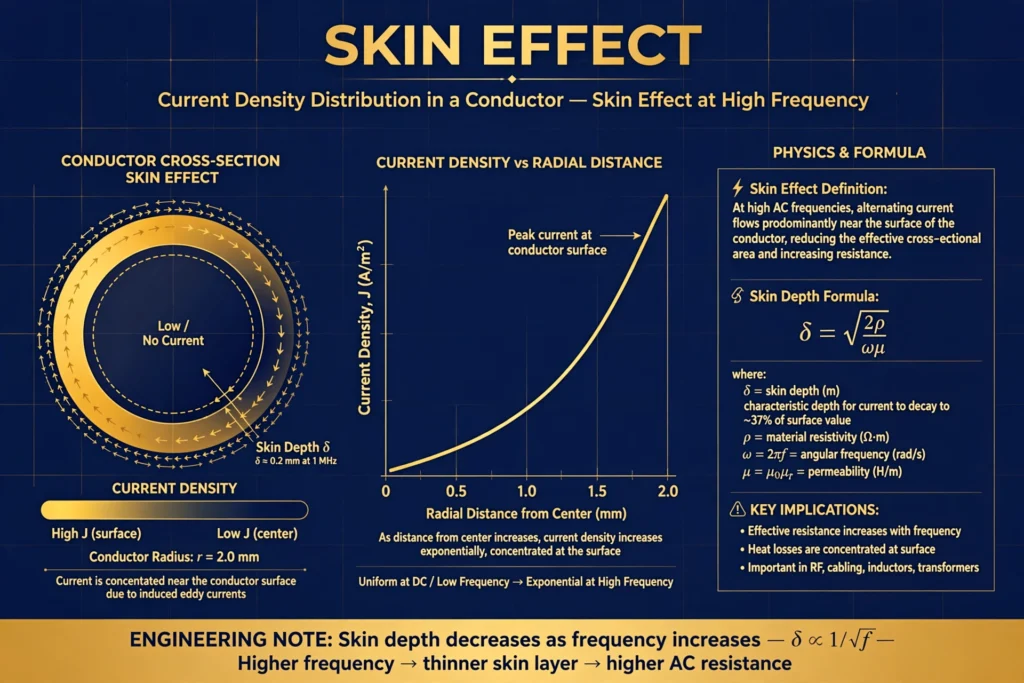
When direct current flows through a conductor, it distributes itself uniformly across the entire cross-section — every square millimeter carries its fair share. But when alternating current flows, the current density becomes non-uniform: maximum at the surface, decaying exponentially toward the center. At high frequencies, the center of the conductor may carry almost no current at all.
The current is effectively confined to a thin outer layer called the skin depth (δ) — the depth at which current density falls to about 37% (1/e) of its surface value. Skin depth shrinks as frequency rises:
δ = √(2ρ / ωμ) — where ρ is resistivity, ω is angular frequency (2πf), and μ is magnetic permeability.
For copper at 50 Hz, skin depth is about 9.3 mm — so in ordinary power wiring (a few mm thick), skin effect is mild. But in large busbars, transmission conductors, and high-frequency circuits, it dominates. The alternating waveform itself — constantly reversing 100 times per second — is what drives the whole phenomenon.
What Causes Skin Effect?
The cause is electromagnetic induction within the conductor itself. Here is the chain of reasoning, step by step:
- Alternating current in the conductor creates an alternating magnetic field around and inside the conductor.
- This changing magnetic flux links with the conductor’s own cross-section, inducing eddy currents inside the metal (Faraday’s law — the same law behind Faraday’s laws).
- The induced eddy currents flow in loops: in the center of the conductor they oppose the main current (reducing it), while near the surface they aid it (increasing it).
- The net result: current is pushed outward. The higher the frequency, the stronger the induction, and the harder the push.
A useful mental image: the conductor’s own magnetic field “strangles” its center. The middle of the wire is linked by the most magnetic flux, so it suffers the most opposition; the surface is linked by the least, so current flows there most freely.
Effects of Skin Effect
1. Increased AC resistance
The headline effect. Since current uses only part of the cross-section, the effective AC resistance (Rac) exceeds the DC resistance (Rdc). The ratio Rac/Rdc grows with frequency and conductor size. A large aluminum busbar at 50 Hz can have 20–50% higher AC resistance than its DC value — pure wasted energy.
2. Higher power losses and heating
Losses follow I²R, so higher effective resistance means more heat. Transformers, motors, and transmission lines all run hotter than their DC resistance would predict. Thermal design of busbars and windings must account for skin effect, or equipment overheats.
3. Reduced current-carrying capacity
Because the center copper is “wasted,” a solid conductor carries less AC current than its size suggests. Engineers must either oversize conductors or use the mitigation techniques below.
4. Proximity effect (the close cousin)
When two conductors run near each other (as in cables or transformer windings), each conductor’s magnetic field distorts the other’s current distribution too — current crowds toward the facing sides. This proximity effect adds to skin effect and is a major loss source in transformer windings and bundled cables.
5. Frequency-dependent behavior in electronics
At radio frequencies, skin depth shrinks to micrometers — current flows in a literal skin. This is why RF circuits use silver-plated conductors, hollow tubes, and special Litz wire.
Skin Effect vs Proximity Effect
| Feature | Skin Effect | Proximity Effect |
|---|---|---|
| Caused by | Conductor’s own magnetic field | Neighboring conductor’s magnetic field |
| Current crowds toward | Outer surface, all around | The side facing the neighbor |
| Occurs in | Even a single isolated conductor | Only when conductors are close together |
| Worsens with | Higher frequency, larger diameter | Higher frequency, closer spacing |
| Main victim | Large busbars, transmission lines | Transformer windings, multi-core cables |
How to Minimize Skin Effect
Engineers have several practical countermeasures:
- Use stranded conductors: A bundle of thin insulated strands has far less skin effect than one solid bar of the same total area, because each thin strand is smaller than the skin depth. This is why transmission conductors and electrical wires are stranded, not solid.
- Use hollow or tubular conductors: Since the center carries little current anyway, removing it saves weight and cost with almost no loss penalty. Tubular busbars are standard in substations.
- Litz wire: For high-frequency work (induction heaters, RF transformers), Litz wire weaves hundreds of individually insulated fine strands so each strand spends equal time at the surface and center — defeating skin effect almost entirely.
- Laminated busbars: Thin parallel plates, sometimes interleaved, keep each current path thin relative to skin depth.
- Keep conductors thin relative to skin depth: At 50 Hz (δ ≈ 9.3 mm in copper), conductors under ~6 mm see only mild skin effect — which is why ordinary wiring is barely affected.
- Use lower-resistivity layouts: Wider, flatter conductors (foil windings in transformers) distribute current better than round ones of equal area.
- Increase spacing: Separating parallel conductors reduces the proximity effect that compounds skin losses.
Skin Effect in Real Equipment
- Transmission lines: ACSR conductors (aluminum strands around a steel core) are naturally skin-effect-friendly — the steel core carries the mechanical load while current flows in the aluminum skin.
- Transformer windings: Large power transformers use subdivided, transposed conductors (continuously transposed cable) to fight both skin and proximity effects.
- Induction furnaces: Here skin effect is a feature — high-frequency current heats only the surface of the metal being melted or hardened (induction hardening).
- Busbars: Substation busbars are sized using AC resistance (including skin effect), not DC resistance — a classic exam trap.
FAQs
Does skin effect occur with DC?
No. Skin effect needs a changing magnetic field to induce the opposing eddy currents, and DC produces a steady field. DC distributes uniformly across the conductor — which is one small efficiency advantage sometimes cited for HVDC transmission.
Why does AC resistance exceed DC resistance?
Because skin effect confines AC to part of the cross-section. Less copper actually carrying current means higher effective resistance — exactly as if the wire were thinner.
At what frequency does skin effect become significant?
It depends on conductor size. For thin wires (under ~3 mm) at 50/60 Hz it is negligible (under 1–2%). It becomes significant for conductors thicker than about half the skin depth — roughly above 5 mm at power frequencies — and dominant at kHz frequencies and above.
What is skin depth in simple terms?
Skin depth is the depth below the conductor surface at which the current density drops to about 37% of its surface value. Lower frequency, lower resistivity, and lower magnetic permeability all give deeper penetration.
How does stranded wire reduce skin effect?
Each thin strand is small compared to the skin depth, so current distributes fairly evenly within each strand. The bundle as a whole therefore uses its copper far more effectively than a solid bar of equal area — though if the strands are uninsulated and touching, the benefit is partial.
Is skin effect related to corona?
Only loosely — both involve high-voltage AC conductors. Corona is about the electric field ionizing surrounding air; skin effect is about the magnetic field redistributing current inside the metal. They are independent phenomena that happen to coexist on transmission lines.
Conclusion
Skin effect is a quiet tax that alternating current pays on every conductor: the current crowds to the surface, the effective resistance rises, and energy is lost as heat. Its cause — self-induced eddy currents opposing the center — is a direct consequence of the same electromagnetic laws that make transformers and motors work.
The practical takeaways are simple: AC resistance is always higher than DC resistance, the difference grows with frequency and conductor size, and engineers beat it with stranded, hollow, laminated, or Litz conductors. Whether you are sizing a busbar, winding a transformer, or answering an exam question, remembering that current “prefers the skin” will keep your reasoning — and your designs — on solid ground. For the underlying field theory, Wikipedia’s skin effect article derives the mathematics rigorously.