
Imagine you are installing a ceiling fan in your home. You buy the fan, switch, and accessories, but when it is time to connect the wires, you feel confused. Which wire should you use? Is every wire the same? Can the wrong wire cause damage?
Many electrical accidents happen not because of faulty appliances, but because of wrong wiring. Using the wrong type of wire can lead to overheating, short circuits, power loss, and even fire.
That is why understanding the Types of Electrical Wires and Their Uses is very important for students, technicians, and engineers. Proper wire selection improves safety, efficiency, and system life.
In this article, you will learn:
- What electrical wires are
- How they work
- Different types of wires
- Their advantages and disadvantages
- Where to use each type
- How to select the right wire
This guide is written from practical field experience to help you work confidently and safely.
Let us start with the basics.
2. What is Types of Electrical Wires and Their Uses?
Definition
The Types of Electrical Wires and Their Uses refers to different kinds of conductors used to carry electrical current safely in various applications.
An electrical wire is a metal conductor covered with insulation that allows electricity to flow from one point to another.
Simple Explanation
Think of an electrical wire like a water pipe.
- Water flows inside a pipe.
- Electricity flows inside a wire.
The pipe must be strong and leak-proof.
Similarly, a wire must be strong and well-insulated.
Practical Example
- Thin wire → Mobile charger
- Medium wire → Home lighting
- Thick wire → Air conditioner
Each load needs a specific wire type.
3. Working Principle
Types of Electrical Wires Working Principle
Electrical wires work on the principle of electrical conduction.
Step-by-step explanation:
- Power is generated at a station.
- Electricity enters the wire.
- Metal core allows electrons to move.
- Insulation prevents leakage.
- Current reaches the appliance.
Easy Analogy
Imagine a road:
- Cars = Electrons
- Road = Wire
- Road sides = Insulation
If the road is damaged, accidents happen.
If insulation is damaged, electric shock happens.
Key Points
- Metal carries current
- Insulation provides safety
- Thickness controls capacity
- Quality affects efficiency
This explains the Types of Electrical Wires working principle.
4. Types / Classification
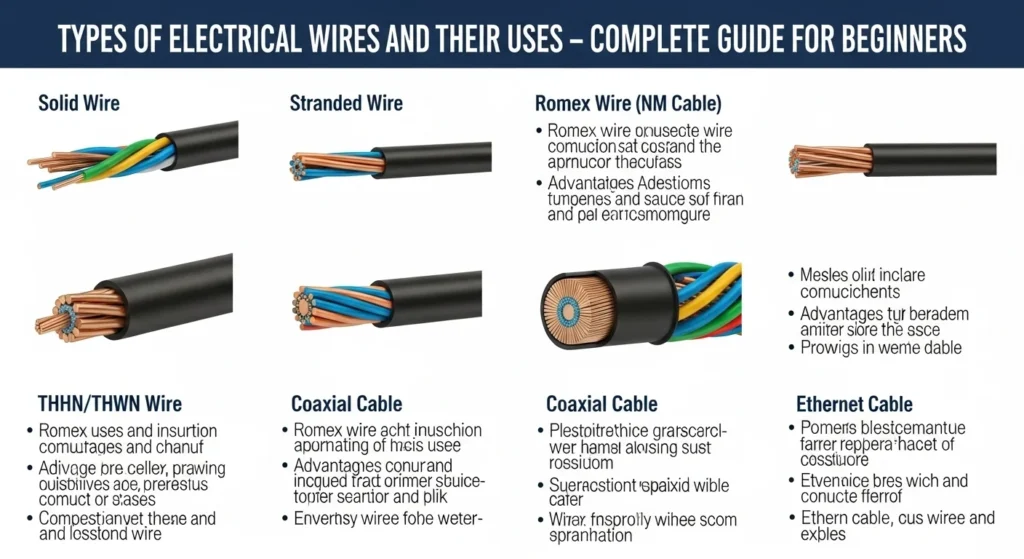
Electrical wires are classified based on structure, insulation, and usage.
Solid Wire
Solid Wire
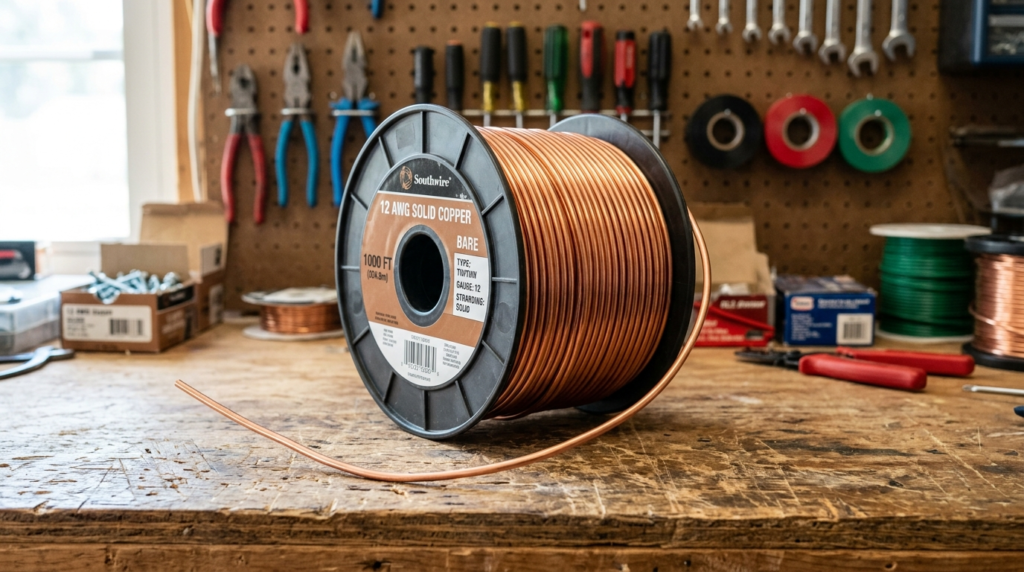
Solid wire is an electrical wire made from a single solid piece of metal, usually copper or aluminum. It is widely used in residential wiring, electrical panels, circuit boards, and fixed installations because of its strength and reliable electrical conductivity. Unlike stranded wire, solid wire has only one conductor, which makes it more rigid and durable for permanent connections. It offers low electrical resistance, better current flow, and stable performance over long distances. Solid wire is commonly used in homes for switches, sockets, lighting circuits, and power distribution systems. However, because it is less flexible, it is not ideal for applications where frequent bending or movement is required. Solid wire is preferred in situations where strong, long-lasting, and secure electrical connections are important.
Description:
- Made of single metal core
- Hard and stiff
Uses:
- House wiring
- Switch boards
- Wall conduits
Features:
- Low resistance
- Long life
- Difficult to bend
Stranded Wire
Stranded Wire
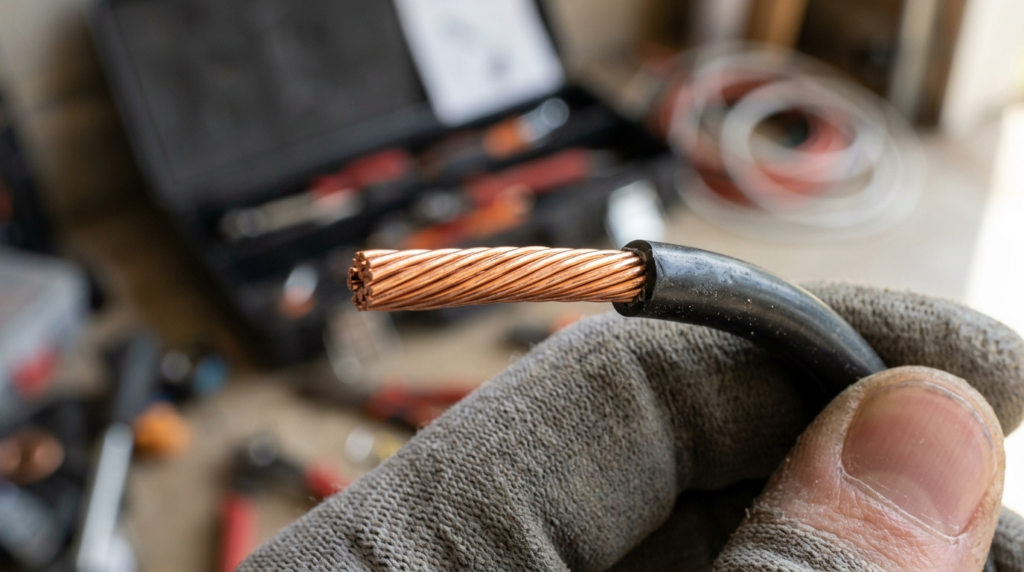
Stranded wire is an electrical wire made of multiple thin strands of metal twisted together to form a single conductor. It is commonly made from copper or aluminum and is widely used in applications where flexibility is important. Unlike solid wire, stranded wire can bend easily without breaking, making it ideal for movable equipment, automotive wiring, robotics, extension cords, and portable electrical devices. It provides good conductivity while offering better resistance to vibration and mechanical stress. Because of its flexible structure, stranded wire is easier to install in tight spaces and complex wiring systems. However, it is usually more expensive than solid wire and may have slightly higher resistance due to the small gaps between strands. Stranded wire is the preferred choice for applications requiring flexibility, durability, and repeated movement.
Description:
- Made of many thin strands
- Flexible
Uses:
- Extension cords
- Portable devices
- Control panels
Features:
- Easy bending
- High flexibility
- Slightly higher resistance
PVC Insulated Wire
PVC Insulated Wire
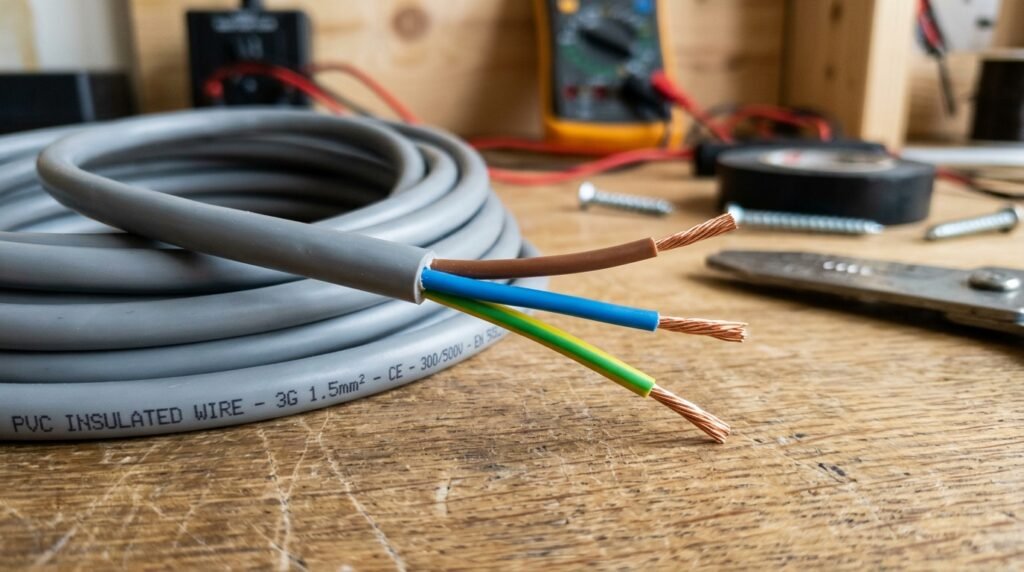
PVC insulated wire is an electrical wire covered with a layer of Polyvinyl Chloride (PVC) insulation to protect the conductor from moisture, heat, chemicals, and electrical leakage. It is one of the most commonly used wires in residential, commercial, and industrial electrical installations because of its durability, flexibility, and low cost. The inner conductor is usually made of copper or aluminum, while the PVC coating acts as a protective barrier and provides electrical insulation for safe operation. PVC insulated wires are widely used in house wiring, control panels, appliances, lighting systems, and power distribution circuits. These wires are resistant to corrosion, abrasion, and environmental damage, making them suitable for long-term use. However, at very high temperatures, PVC insulation may soften or release harmful fumes when burned. Due to their safety, reliability, and affordability, PVC insulated wires are widely preferred in modern electrical systems.
Description:
- Covered with PVC plastic
Uses:
- Domestic wiring
- Offices
- Commercial buildings
Features:
- Waterproof
- Low cost
- Heat resistant
XLPE Cable
Description:
- Cross-linked polyethylene insulation
Uses:
- Power plants
- High-voltage lines
- Industries
Features:
- High temperature resistance
- Long life
- High efficiency
Armored Cable
Description:
- Metal armor protection
Uses:
- Underground wiring
- Outdoor supply
- Industrial plants
Features:
- Mechanical strength
- Rodent protection
- High safety
Flexible Wire
Description:
- Very thin strands
- Soft insulation
Uses:
- Irons
- Heaters
- Extension boards
Features:
- Easy movement
- Portable use
- Low durability
Coaxial Cable
Description:
- Central conductor with shield
Uses:
- TV signals
- CCTV systems
- Internet
Features:
- Low noise
- Signal clarity
- Good shielding
Twisted Pair Cable
Description:
- Two twisted copper wires
Uses:
- Telephone
- LAN networks
Features:
- Noise reduction
- Cheap
- Easy installation
Optical Fiber Cable
Description:
- Uses light instead of current
Uses:
- Internet
- Communication systems
Features:
- High speed
- No interference
- Long distance
5. Main Components
Main Components of Electrical Wires
- Conductor
- Copper or aluminum
- Carries current
- Copper or aluminum
- Insulation
- PVC, rubber, XLPE
- Prevents leakage
- PVC, rubber, XLPE
- Sheath
- Outer protection
- Against moisture
- Outer protection
- Armoring (if present)
- Steel tape/wire
- Mechanical safety
- Steel tape/wire
- Filler Material
- Maintains shape
- Improves strength
- Maintains shape
Each part improves wire performance and safety.
6. Advantages
Types of Electrical Wires Advantages
- Safe power transmission
- Reduced energy loss
- Fire protection
- Easy installation
- Long service life
- Supports modern equipment
- Reliable performance
These benefits show the Types of Electrical Wires advantages and disadvantages clearly.
7. Disadvantages / Limitations
Limitations of Electrical Wires
- Poor quality causes overheating
- Expensive high-grade cables
- Damage due to moisture
- Insulation aging
- Difficult replacement
- Improper selection risk
Always choose certified and tested wires.
8. Applications
Types of Electrical Wires Applications
Home Uses
- Lighting circuits
- Socket wiring
- Fans and AC
- Kitchen appliances
Industrial Uses
- Motors
- Control panels
- Machines
- Transformers
Commercial Uses
- Offices
- Malls
- Hospitals
- Hotels
Modern Technology
- Data centers
- Solar plants
- EV charging
- Smart homes
Wires are the backbone of all electrical systems.
9. Comparison Section
Difference Between Solid Wire and Stranded Wire
| Feature | Solid Wire | Stranded Wire |
| Structure | Single core | Multiple strands |
| Flexibility | Low | High |
| Installation | Fixed | Portable |
| Durability | High | Medium |
| Cost | Low | Medium |
| Usage | House wiring | Appliances |
This table explains the difference between solid wire and stranded wire.
10. Selection Guide
How to Choose the Right Electrical Wire
1. Check Load Rating
- Low load → Thin wire
- High load → Thick wire
2. Consider Voltage Level
- Low voltage → PVC wire
- High voltage → XLPE cable
3. Environment
- Indoor → Normal cable
- Outdoor → Armored cable
4. Safety Standards
- ISI/IEC certified
- Fire-resistant
5. Budget
- Balance cost and quality
Tips for Beginners
- Never compromise on quality
- Use proper wire gauge
- Follow color codes
- Consult professionals
- Test before use
11. Common Problems & Solutions
Q1: Why does wire heat up?
Cause: Overload or thin wire
Solution: Use correct size cable
Q2: Why insulation cracks?
Cause: Aging or heat
Solution: Replace damaged wire
Q3: Why does breaker trip?
Cause: Short circuit
Solution: Inspect wiring
Q4: Why is voltage low?
Cause: Long cable length
Solution: Increase wire size
Q5: Can aluminum replace copper?
Yes, but copper is better for safety and efficiency.
12. Future Trends
Future Developments in Electrical Wiring
- Fire-resistant cables
- Smart monitoring wires
- Eco-friendly insulation
- High-efficiency conductors
- AI-based fault detection
- Nano-coated cables
Industry Direction
- Smart buildings
- Renewable energy systems
- Electric vehicles
- Digital grids
- Underground cabling
Future wiring will focus on safety, speed, and sustainability.
13. Conclusion
Understanding the Types of Electrical Wires and Their Uses is essential for safe and reliable electrical systems. Different wires are designed for different purposes, and using the correct one improves performance and reduces risks.
Solid wires are best for fixed installations, while stranded wires are ideal for flexible connections. PVC and XLPE cables are widely used for power distribution, and armored cables provide extra protection in harsh environments.
As an electrical engineer, I strongly recommend selecting wires based on load, environment, and safety standards. Never compromise on quality, because wiring is the foundation of every electrical system.
Keep learning, practicing, and following safety rules to become a skilled and trusted professional.


Pingback: Types of Insulators in Transmission Lines Explained