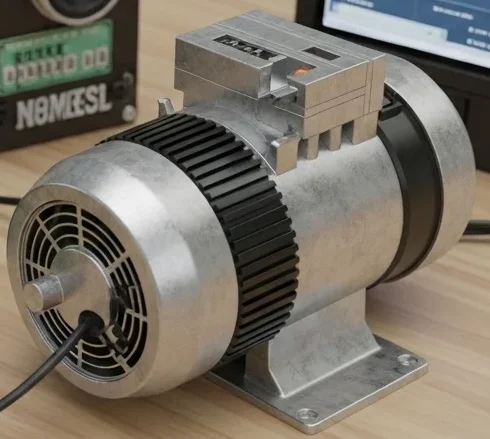

Imagine you switch on a DC motor connected to a fan. At the moment of startup, the motor draws a large current, but after a few seconds, the current reduces automatically even though the supply voltage remains the same. What causes this behavior? The answer lies in a phenomenon called Back EMF.
Back EMF (Electromotive Force) is a very important concept in electrical machines, especially motors. It directly affects motor performance, current consumption, efficiency, and safety. Without back EMF, motors would draw excessive current and quickly get damaged.
Understanding what is back EMF is essential for electrical students, engineers, technicians, and beginners. It helps in analyzing motor operation, designing control systems, and troubleshooting electrical faults.
In this article, you will learn the complete back EMF working principle, types, components, applications, advantages and disadvantages, and practical problem-solving techniques. By the end, you will have a clear and practical understanding of how back EMF works in real-world electrical systems.
2. What is Back EMF?
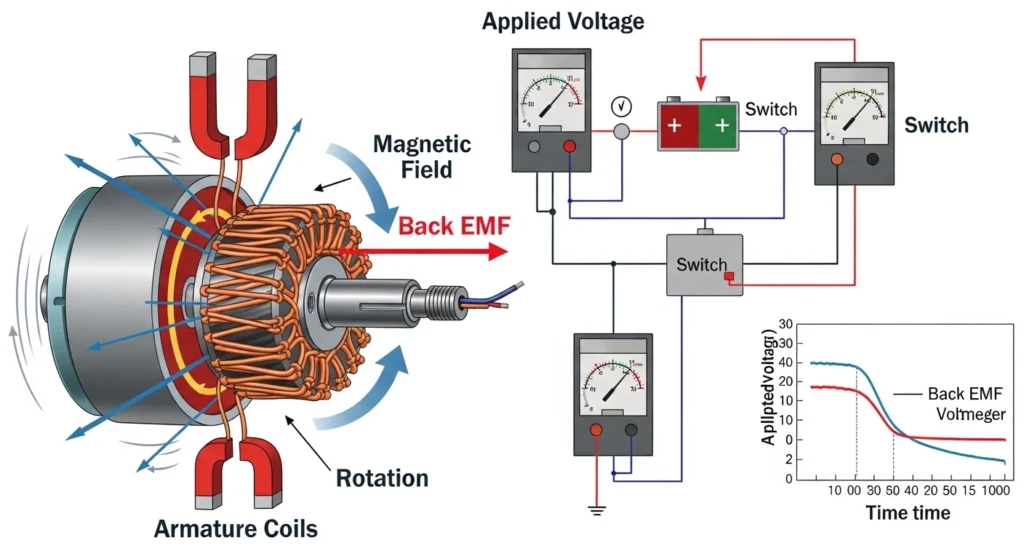
Back EMF (Back Electromotive Force) is the voltage generated in a motor that opposes the applied supply voltage.
Simple Explanation
When a motor rotates, it acts like a generator and produces voltage in the opposite direction of the supply.
Practical Example
- When a DC motor starts → back EMF is zero → high current flows
- As speed increases → back EMF increases → current decreases
3. Working Principle
The back EMF working principle is based on Faraday’s Law of Electromagnetic Induction.
Step-by-Step Explanation
- Supply voltage is applied to motor
- Current flows through armature
- Motor starts rotating
- Rotation creates a magnetic field interaction
- Voltage is induced in opposite direction
- This induced voltage is called back EMF
Back EMF Equation
E_b = V – I R
EMF Relation with Speed
E_b \propto \Phi N
Easy Analogy
Think of riding a bicycle uphill:
- The harder you pedal, the more resistance you feel
- Back EMF acts like this resistance in motors
Key Points
- Back EMF increases with speed
- It limits motor current
- Essential for safe operation
4. Types / Classification
Back EMF in AC Motors
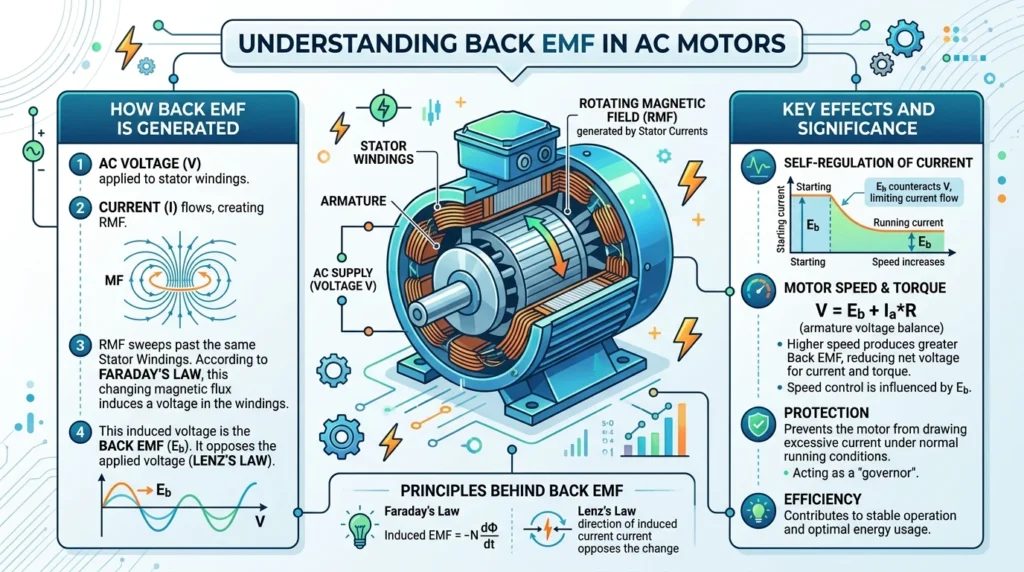
Back EMF in AC Motors is the voltage induced in the stator winding due to the changing magnetic field produced by the rotating rotor. In AC motors, especially induction motors, the alternating current creates a rotating magnetic field in the stator, and as the rotor begins to rotate, it cuts these magnetic lines of force, generating an induced voltage that opposes the applied supply voltage. This opposing voltage is known as back EMF in AC motors. It plays an important role in controlling the motor current, improving efficiency, and stabilizing motor operation. As the motor speed increases, the back EMF also increases, reducing the net current drawn from the supply and helping the motor run smoothly under different load conditions.
Back EMF in DC Motors
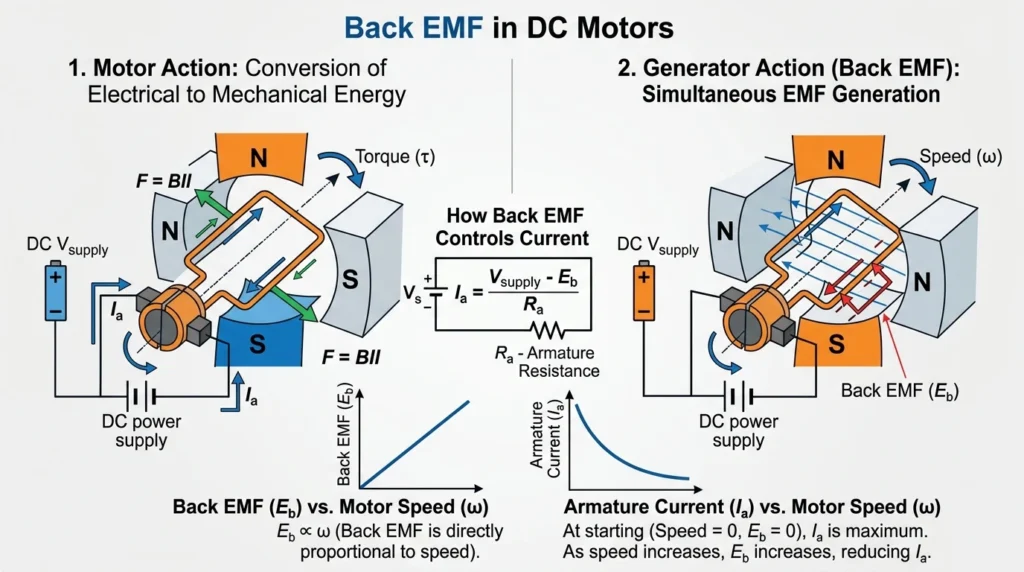
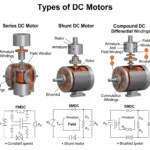
Back EMF in DC Motors is the voltage generated in the armature winding of a DC motor as it rotates within a magnetic field. According to Faraday’s law of electromagnetic induction, the rotating armature conductors cut magnetic flux and produce an induced voltage that opposes the applied supply voltage. This opposing voltage is called Back Electromotive Force (Back EMF). As the motor speed increases, the back EMF also increases, reducing the armature current and helping regulate the motor’s operation automatically. Back EMF plays a crucial role in controlling motor speed, improving efficiency, and preventing excessive current from flowing through the armature, thereby protecting the motor from overheating and damage.
- Occurs in induction and synchronous motors
- Related to rotating magnetic field
Dynamic Back EMF
Dynamic Back EMF is the electromotive force (EMF) generated in a motor’s armature or winding due to its motion within a magnetic field during operation. As the motor rotates, the conductors cut magnetic flux and induce a voltage that opposes the applied supply voltage, according to Faraday’s law of electromagnetic induction. This opposing voltage is called dynamic back EMF because it varies with the speed of the motor. When the motor speed increases, the back EMF also increases, reducing the current drawn from the power source. Dynamic back EMF helps regulate motor speed, improves energy efficiency, and protects the motor from excessive current and overheating, making it an essential factor in the operation of DC and many AC motors.
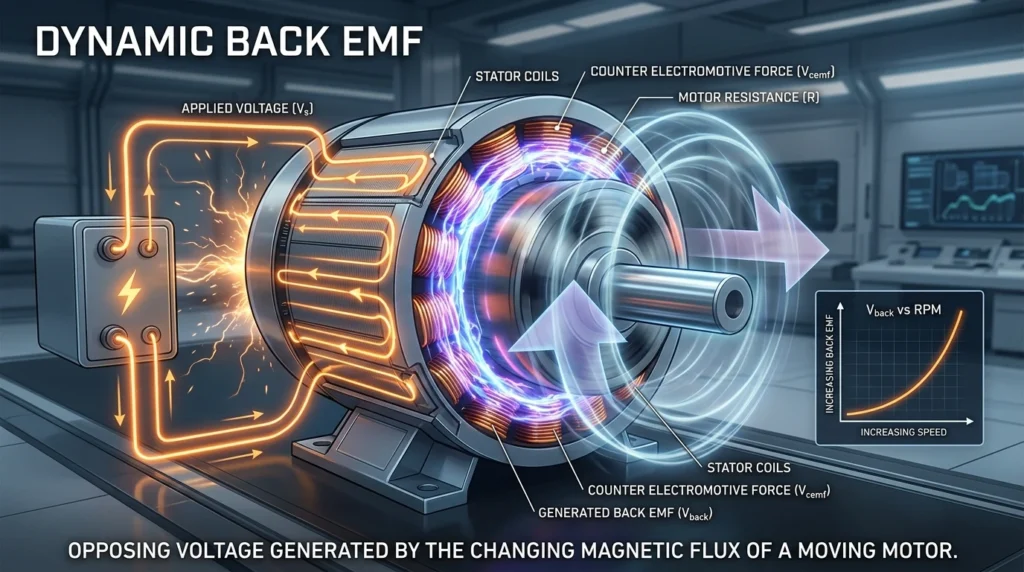
- Changes with load and speed
- Used in control systems
Regenerative Back EMF
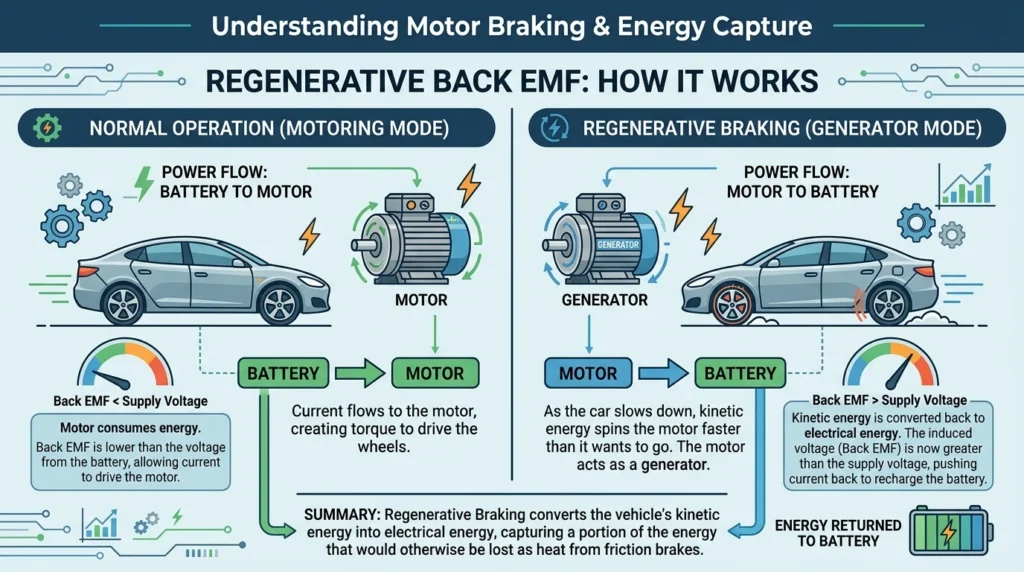
Regenerative Back EMF is the type of back electromotive force generated in an electric motor when it operates in reverse energy flow mode, meaning the motor acts as a generator and returns energy back to the power supply or battery. This happens mainly during braking or when the motor is driven by an external force, such as in electric vehicles going downhill or industrial systems slowing down heavy loads. In this condition, the rotating motor produces a high back EMF that not only opposes the supply voltage but also feeds electrical energy back into the system. Regenerative Back EMF helps improve overall energy efficiency, reduces power consumption, and supports energy recovery in modern electric drive systems and regenerative braking applications.
- Used in energy recovery systems
- Seen in electric vehicles
5. Main Components
Armature
- Rotating part
- Generates back EMF
Magnetic Field
- Produced by field windings or magnets
- Essential for induction
Supply Voltage
- Drives the motor
- Opposed by back EMF
Load
- Affects motor speed
- Changes back EMF value
Conductors
- Carry current
- Participate in EMF generation
6. Advantages
Back EMF Advantages
- Limits excessive current
- Protects motor from damage
- Improves efficiency
- Enables speed control
- Reduces power loss
- Essential for stable operation
7. Disadvantages / Limitations
Back EMF Disadvantages
- Causes starting current surge
- Limits maximum torque
- Depends on speed
- Complex for beginners to understand
- Requires control systems in advanced applications
8. Applications
Back EMF Applications
Home Applications
- Fans and appliances
- Speed regulation
Industrial Applications
- Motor control systems
- Conveyor systems
- Machine tools
Modern Technology
- Electric vehicles (regenerative braking)
- Robotics
- Automation systems
- Smart motor drives
Back EMF plays a key role in all motor-based systems.
9. Comparison Section
Difference Between EMF and Back EMF
| Feature | EMF | Back EMF |
| Definition | Applied voltage | Opposing voltage |
| Direction | Same as supply | Opposite to supply |
| Function | Drives current | Limits current |
| Occurrence | External source | Inside motor |
| Role | Starts operation | Regulates operation |
10. Selection Guide
Understanding back EMF helps in motor selection.
Tips for Beginners
- Choose motors with proper back EMF characteristics
- Ensure good speed control
- Avoid overloading
Key Factors to Consider
- Motor type
- Load conditions
- Speed requirements
- Efficiency
- Control system
Practical Advice
- Use soft starters to reduce current surge
- Monitor motor speed
- Ensure proper cooling
11. Common Problems & Solutions
Why motor draws high current at start?
Back EMF is zero.
Use starter or controller.
Why motor slows under load?
Back EMF decreases.
Reduce load or increase supply.
Why motor overheats?
Check load and cooling.
Why speed fluctuates?
Variable back EMF.
Use speed controller.
Can back EMF be increased?
Yes, by increasing speed.
12. Future Trends
Back EMF is becoming more useful with advanced technologies.
Key Trends
- Sensorless Motor Control using Back EMF
- Electric Vehicles with Regenerative Systems
- Smart Motor Drives
- AI-Based Speed Control
- Energy Recovery Systems
Future systems will use back EMF for efficient and intelligent motor control.
13. Conclusion
Understanding what is back EMF is essential for working with electrical motors. Back EMF is the voltage generated inside a motor that opposes the supply and controls current flow.
By learning the back EMF working principle, types, and applications, you can better understand motor behavior and improve system performance. It plays a crucial role in efficiency, safety, and control of electrical machines.
For electrical students and professionals, mastering back EMF is key to designing and maintaining reliable systems. Focus on practical applications to strengthen your expertise.