
Think about a small electric toy car or a conveyor belt in a factory. Both use motors, but not all motors are the same. Some provide high speed, others give high torque, and some are designed for precise control. This is where understanding the types of DC motor becomes important.
DC motors are widely used because of their simple design, easy speed control, and reliable performance. However, different applications require different motor characteristics. Choosing the wrong type can lead to poor performance, overheating, or even system failure.
For electrical students, engineers, technicians, and beginners, knowing the types of DC motor is essential. It helps in selecting the right motor for specific applications, improving efficiency, and ensuring smooth operation.
In this article, you will learn the complete types of DC motor working principle, classifications, components, applications, advantages and disadvantages, and practical selection tips. By the end, you will clearly understand the difference between types of DC motor and how to use them effectively in real-world systems.
2. What is Types of DC Motor?
Types of DC motor refers to the classification of DC motors based on their field winding connection and method of operation.
Simple Explanation
DC motors convert electrical energy into mechanical energy, and their types depend on how the magnetic field is produced.
Practical Example
- Electric fans use simple DC motors
- Cranes use high torque DC motors
- Robotics uses precision DC motors
3. Working Principle
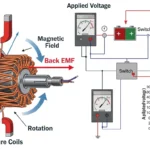
The types of DC motor working principle is based on electromagnetic force.
Step-by-Step Explanation
- DC supply is given to motor
- Current flows through armature winding
- Magnetic field is produced
- Interaction of magnetic field and current creates force
- Rotor starts rotating
Easy Analogy
Think of pushing a wheel:
- More force → more rotation
- Same idea applies to motor torque
Key Points
- Based on Fleming’s left-hand rule
- Torque depends on current and magnetic field
- Speed depends on voltage
4. Types / Classification
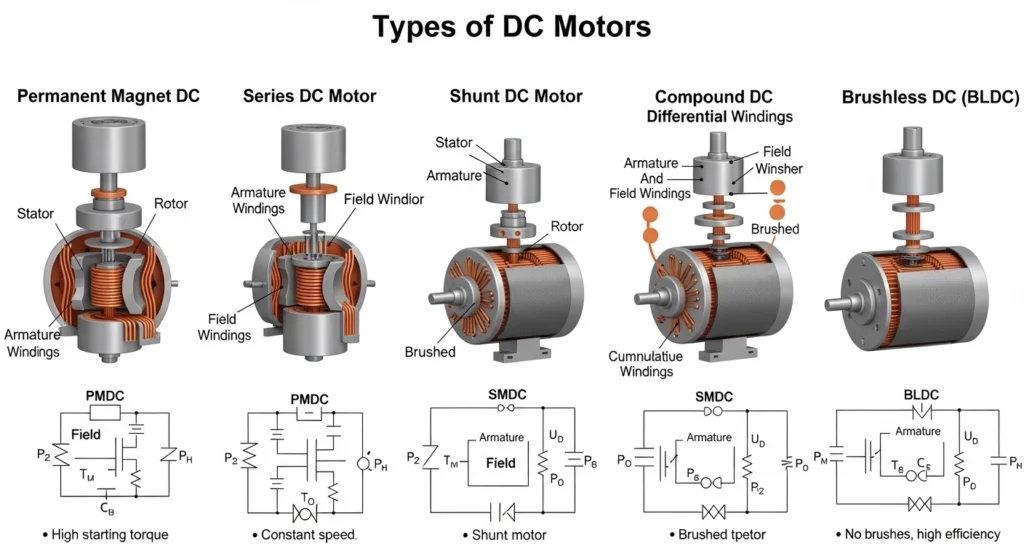
DC motors are mainly classified based on field winding connections.
Separately Excited DC Motor
- Field winding powered by separate source
Features:
- Independent control of field and armature
- Precise speed control
Self-Excited DC Motors
These motors use the same supply for both field and armature.
Shunt DC Motor
- Field winding connected parallel to armature
Features:
- Constant speed
- Low starting torque
Series DC Motor
- Field winding connected in series with armature
Features:
- High starting torque
- Speed varies with load
Compound DC Motor
Combination of series and shunt windings.
Cumulative Compound Motor
- Fields assist each other
Features:
- Good starting torque
- Stable speed
Differential Compound Motor
- Fields oppose each other
Features:
- Rarely used
- Unstable operation
Permanent Magnet DC Motor (PMDC)
- Uses permanent magnets instead of field winding
Features:
- Simple design
- Compact size
5. Main Components
Armature
- Rotating part
- Produces torque
Field Winding / Magnets
- Creates magnetic field
Commutator
- Converts AC to DC in armature
- Maintains rotation
Brushes
- Transfer current to armature
Shaft
- Transfers mechanical power
Housing
- Protects internal parts
6. Advantages
Types of DC Motor Advantages
- Easy speed control
- High starting torque (series motor)
- Simple construction
- Reliable operation
- Wide range of applications
- Good performance in variable loads
7. Disadvantages / Limitations
Types of DC Motor Disadvantages
- Requires maintenance (brushes)
- Sparking issues
- Not suitable for explosive environments
- Higher cost compared to some AC motors
- Limited speed range in some types
8. Applications
Types of DC Motor Applications
Home Applications
- Fans
- Toys
- Small appliances
Industrial Applications
- Cranes (series motor)
- Lathes (shunt motor)
- Elevators (compound motor)
Modern Technology
- Electric vehicles
- Robotics
- Automation systems
- Battery-operated devices
9. Comparison Section
Difference Between Series and Shunt DC Motor
| Feature | Series Motor | Shunt Motor |
| Connection | Series | Parallel |
| Starting Torque | High | Low |
| Speed | Variable | Constant |
| Application | Heavy loads | Constant speed systems |
| Stability | Less stable | More stable |
10. Selection Guide
Choosing the right motor depends on application.
Tips for Beginners
- Use series motor for high torque
- Use shunt motor for constant speed
- Use compound motor for mixed requirements
Key Factors to Consider
- Load type
- Speed requirement
- Torque requirement
- Cost
- Maintenance
Practical Advice
- Avoid series motor without load
- Maintain brushes regularly
- Choose PMDC for compact devices
11. Common Problems & Solutions
Why motor sparks?
Brush contact issue.
Clean and adjust brushes.
Why motor speed fluctuates?
Improper load or supply.
Stabilize load and voltage.
Why motor overheats?
Overload or poor ventilation.
Reduce load and improve cooling.
Why motor not starting?
Supply or connection issue.
Check wiring and power.
Which motor is best?
Depends on application.
12. Future Trends
DC motor technology is evolving.
Key Trends
- Brushless DC Motors (BLDC)
- Energy-Efficient Designs
- Smart Motor Control Systems
- IoT-Based Monitoring
- Electric Vehicle Applications
Future motors will focus on efficiency, automation, and reliability.
13. Conclusion
Understanding the types of DC motor is essential for selecting the right motor for different applications. Each type has unique characteristics that affect speed, torque, and performance.
By learning the types of DC motor working principle, classifications, and applications, you can make better decisions in system design and operation. While DC motors offer excellent control and performance, proper selection and maintenance are key to long-term reliability.
As technology advances, modern DC motors are becoming more efficient and intelligent. Focus on practical understanding to build strong expertise in electrical engineering.