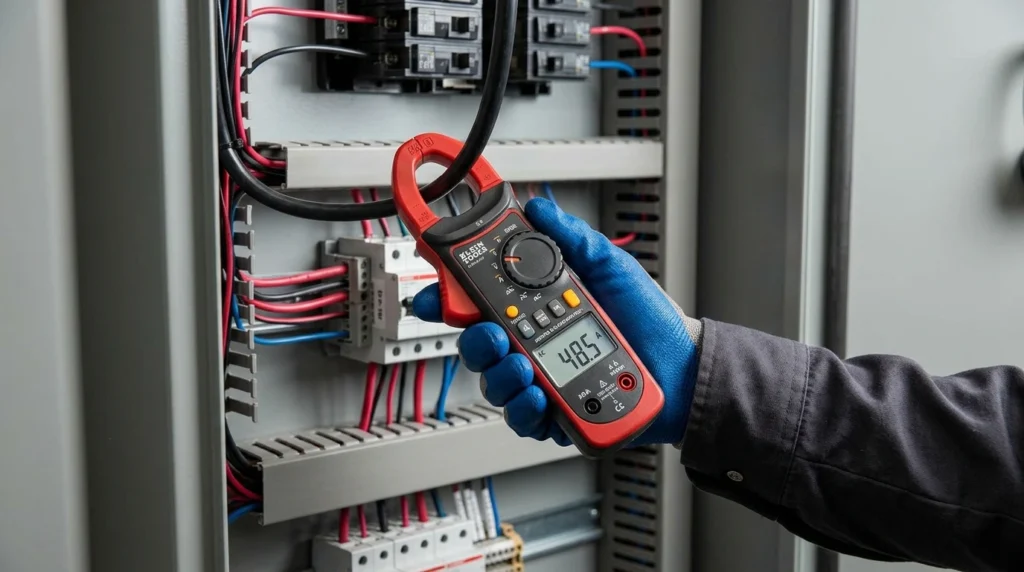

Imagine an electrician troubleshooting a running industrial motor. The motor is operating under load, and the technician needs to measure the current flowing through the circuit. Using a traditional ammeter would require disconnecting the wire and connecting the meter in series, which can be time-consuming and potentially dangerous. Instead, the technician simply opens the jaws of a clamp meter, places them around the conductor, and instantly reads the current value without touching the live wire.
This simple yet powerful measuring technique makes clamp meters one of the most valuable tools in electrical engineering. They provide a safe, quick, and convenient way to measure electrical current in residential, commercial, and industrial systems.
For electrical students, engineers, technicians, and beginners, understanding clamp meter working is essential because current measurement is a fundamental part of electrical testing, maintenance, and troubleshooting. Whether you are diagnosing motor faults, checking load conditions, or verifying power consumption, a clamp meter helps you perform measurements safely and accurately.
In this article, you will learn the clamp meter working principle, types, components, applications, advantages and disadvantages, troubleshooting methods, and future developments in simple and practical language.
What is Clamp Meter Working?
A clamp meter is an electrical measuring instrument used to measure current without physically disconnecting the conductor from the circuit.
In simple words, a clamp meter allows you to measure the flow of electrical current by clamping its jaws around a wire.
The clamp meter working principle is based on detecting the magnetic field produced by current flowing through a conductor.
Practical Example
Suppose an air conditioning unit is not cooling properly. An electrician can use a clamp meter to measure the motor current without disconnecting any wires. The reading helps determine whether the motor is operating normally or drawing excessive current.
This ability makes clamp meters extremely useful for electrical maintenance and troubleshooting.
Clamp Meter Working Principle
The clamp meter working principle is based on electromagnetic induction or Hall Effect sensing, depending on the meter type.
Simple Analogy
Think of a river flowing through a pipe.
- You can estimate the water flow by observing the movement around the pipe.
- Similarly, a clamp meter measures current by sensing the magnetic field surrounding a conductor.
The conductor does not need to be disconnected.
Step-by-Step Clamp Meter Working Principle
Current Flows Through Conductor
Electric current passes through a wire.
Magnetic Field is Generated
According to electromagnetic principles, every current-carrying conductor produces a magnetic field around it.
Clamp Jaws Surround the Conductor
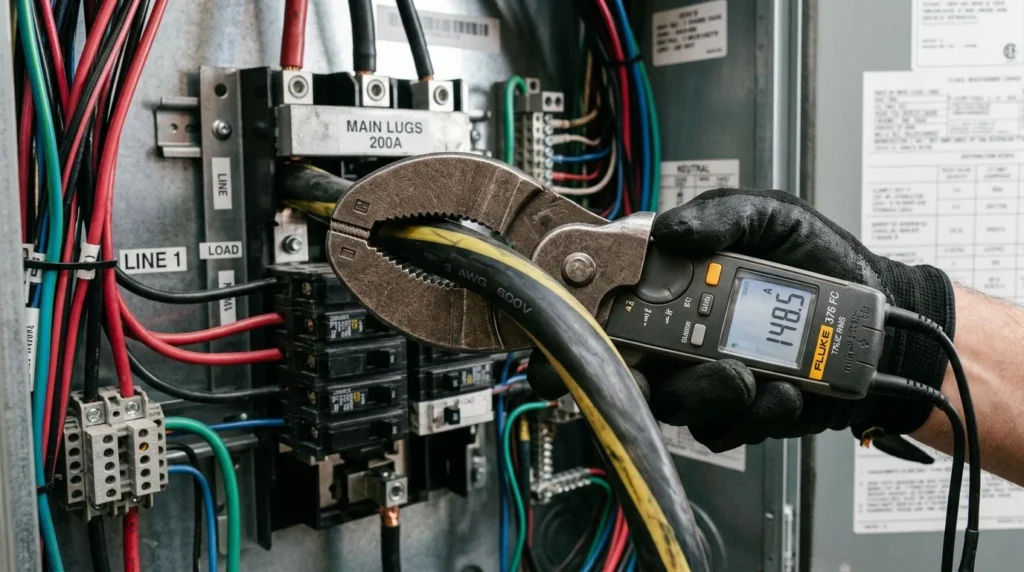
The clamp jaws of a clamp meter are designed to surround a single electrical conductor without making direct electrical contact. When the conductor carrying current passes through the clamp jaws, it creates a magnetic field that is detected by the meter’s sensor. The meter then converts this magnetic field into an electrical signal and displays the current value on the screen. This non-contact measurement method allows electricians and technicians to measure current safely and accurately without disconnecting the circuit.
The jaws of the clamp meter are placed around a single conductor.
Magnetic Field is Detected
The clamp sensor detects the magnetic field produced by the current.
Signal Conversion
The detected magnetic field is converted into an electrical signal.
Measurement Processing
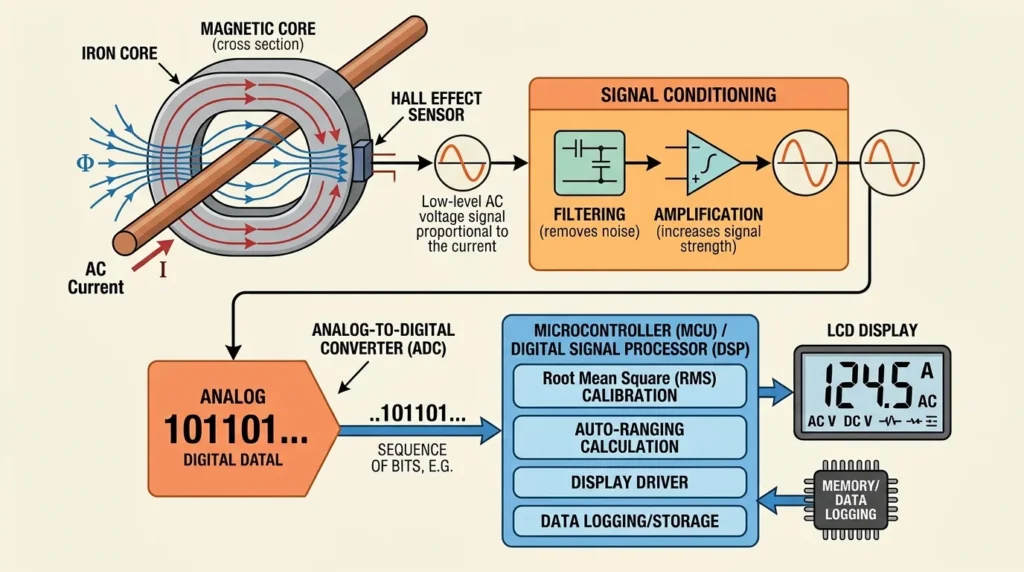
Measurement processing in a clamp meter begins when the clamp jaws detect the magnetic field produced by the current flowing through a conductor. The internal sensor converts this magnetic field into an electrical signal, which is then amplified and processed by the meter’s electronic circuitry. An Analog-to-Digital Converter (ADC) converts the processed analog signal into a digital value. Finally, the microprocessor calculates the current accurately and displays the measured value on the LCD screen. This process ensures fast, safe, and reliable current measurement without disconnecting the electrical circuit.
The internal circuitry processes the signal and calculates the current value.
Reading Display
The measured current appears on the display screen.
Key Features of Clamp Meter Working Principle
- No direct electrical contact required
- Fast current measurement
- Safe operation on live circuits
- Suitable for maintenance work
- Non-invasive testing method
Types / Classification of Clamp Meters
Different clamp meters are available for different applications.
AC Clamp Meter
An AC clamp meter is an electrical measuring instrument used to measure alternating current (AC) without disconnecting the circuit. It works by clamping its jaws around a single conductor, where it detects the magnetic field produced by the AC current flowing through the wire. The internal sensor converts this magnetic field into an electrical signal, which is processed and displayed as the current value on the digital screen. AC clamp meters are widely used by electricians and technicians for testing, troubleshooting, and maintaining electrical systems because they provide safe, quick, and accurate current measurements.
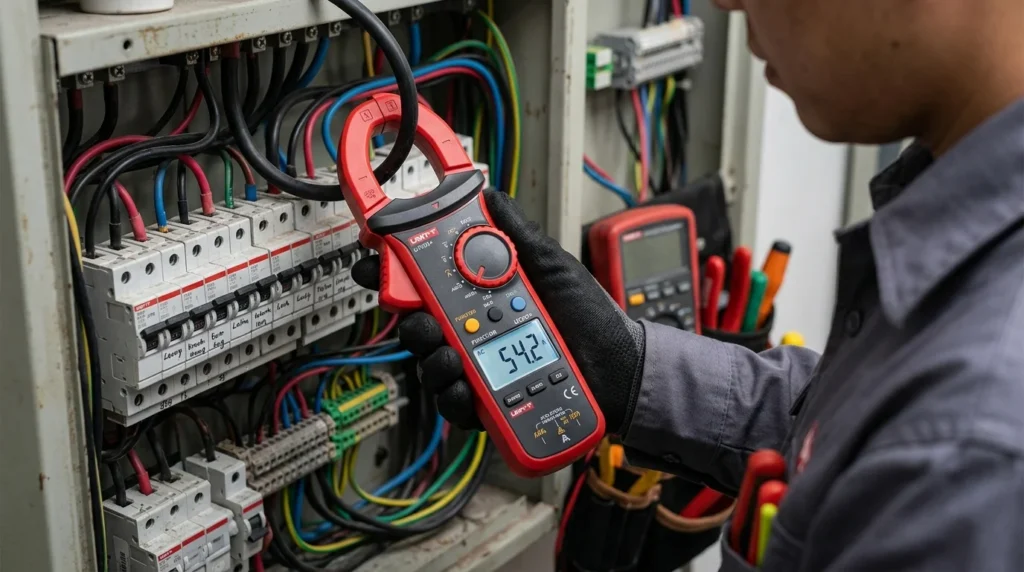
Measures alternating current only.
Features
- Uses current transformer technology
- Simple operation
Applications
- Residential wiring
- Industrial motors
AC/DC Clamp Meter
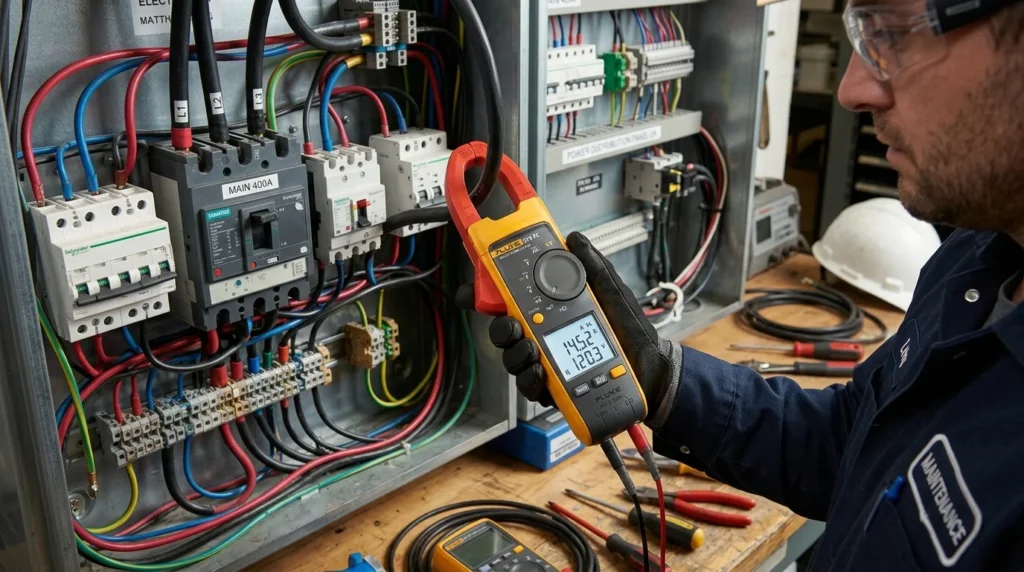
An AC/DC clamp meter is a versatile electrical measuring instrument that can measure both alternating current (AC) and direct current (DC) without disconnecting the circuit. It uses clamp jaws with a current sensor, such as a Hall-effect sensor, to detect the magnetic field produced by the conductor and convert it into an electrical signal. The signal is then processed and displayed as a digital reading on the LCD screen. In addition to measuring current, most AC/DC clamp meters can also measure voltage, resistance, continuity, frequency, and capacitance. They are widely used by electricians, technicians, and engineers for safe, accurate, and efficient testing, troubleshooting, and maintenance of electrical and electronic systems.
Measures both AC and DC current.
Features
- Uses Hall Effect sensors
- More versatile
Applications
- Battery systems
- Solar installations
- Industrial equipment
Digital Clamp Meter
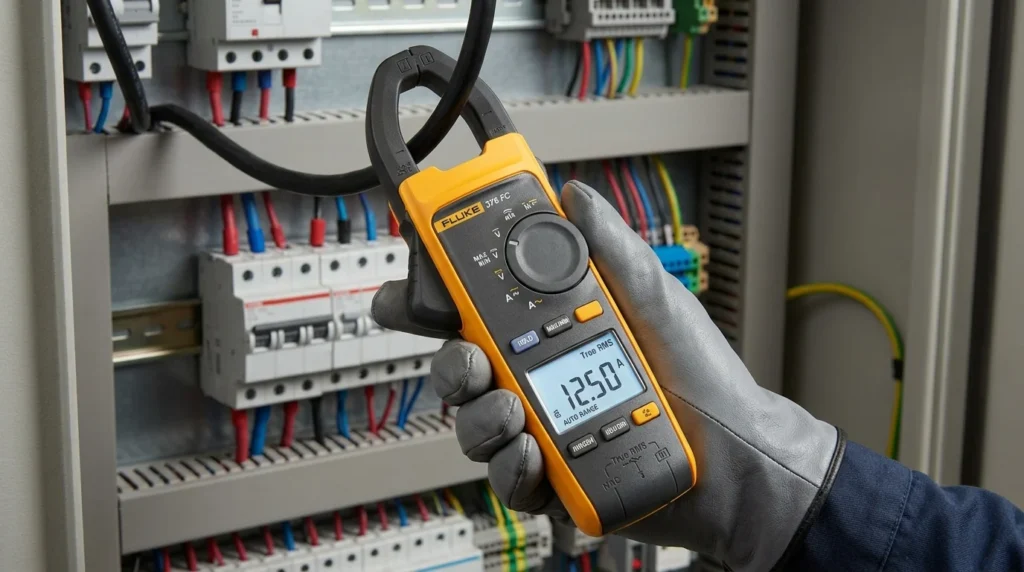
A digital clamp meter is a portable electrical measuring instrument used to measure AC and, in many models, DC current without disconnecting the circuit. It uses clamp jaws to detect the magnetic field around a conductor and converts the measured signal into a digital value that is displayed on an LCD screen. In addition to measuring current, many digital clamp meters can also measure voltage, resistance, continuity, frequency, and capacitance. Due to their accuracy, safety, and ease of use, digital clamp meters are widely used by electricians, technicians, and engineers for electrical testing, troubleshooting, and maintenance.
Modern electronic clamp meter with digital display.
Features
- High accuracy
- Easy reading
Applications
- Professional electrical testing
Analog Clamp Meter
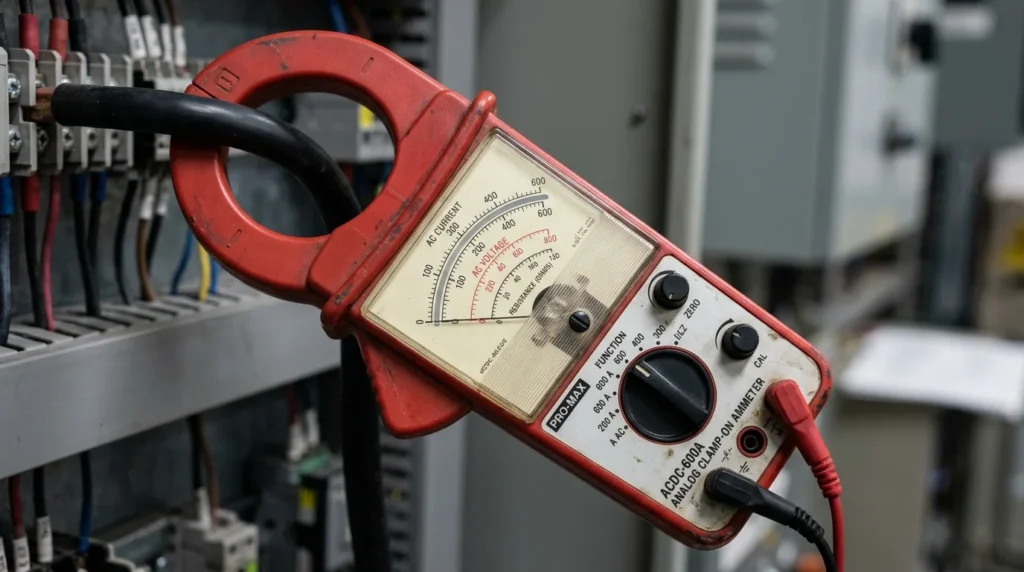
An analog clamp meter is an electrical measuring instrument used to measure alternating current (AC) without disconnecting the circuit. It operates by detecting the magnetic field produced by the current flowing through a conductor and displaying the measured value using a moving pointer on a calibrated scale. The clamp jaws surround the conductor, allowing current to be measured safely without direct electrical contact. Although analog clamp meters are less common today, they are still valued for their simple operation, durability, and ability to show gradual changes in current during electrical testing and maintenance.
Uses a moving pointer for indication.
Features
- Simple construction
- No battery required for basic measurement
Applications
- Traditional testing systems
Power Clamp Meter
Measures additional electrical parameters.
Features
- Current measurement
- Voltage measurement
- Power measurement
Applications
- Energy analysis
Leakage Current Clamp Meter
Designed for low-current measurements.
Features
- High sensitivity
Applications
- Insulation testing
- Leakage detection
Main Components
Understanding clamp meter components helps users understand how the instrument operates.
Clamp Jaws
The jaws surround the conductor.
Function
- Detect magnetic field generated by current flow
Hall Effect Sensor
Used in AC/DC clamp meters.
Function
- Measures magnetic field strength
Current Transformer
Used in AC clamp meters.
Function
- Converts magnetic field into measurable current
Display Screen
Shows measurement results.
Function
- Displays current values and other parameters
Function Selector Switch
Used for selecting measurement modes.
Function
- Current measurement
- Voltage measurement
- Resistance measurement
Internal Electronic Circuit
Processes measurement signals.
Function
- Converts sensor output into readable values
Test Leads
Provided for additional measurements.
Function
- Voltage and resistance testing
Advantages
Understanding clamp meter advantages and disadvantages helps users select the right measuring instrument.
Advantages of Clamp Meter
- Safe current measurement
- No circuit disconnection required
- Fast testing process
- Easy to use
- Portable design
- Suitable for live circuits
- Reduces troubleshooting time
- Supports industrial maintenance
Real-World Benefits
Improved Safety
Electricians can measure current without touching exposed conductors.
Faster Troubleshooting
Measurements can be taken within seconds.
Reduced Downtime
Industrial equipment can remain operational during testing.
Convenience
Large current values can be measured easily.
Disadvantages / Limitations
Despite many advantages, clamp meters also have limitations.
Clamp Meter Advantages and Disadvantages
Disadvantages
- Less accurate than specialized laboratory instruments
- Sensitive to external magnetic fields
- Limited low-current accuracy
- Incorrect readings if multiple conductors are clamped
- High-end models can be expensive
Practical Limitations
Single Conductor Requirement
Only one conductor should be placed inside the clamp.
Sensor Sensitivity
Nearby magnetic fields may influence readings.
Calibration Requirements
Periodic calibration ensures measurement accuracy.
Clamp Meter Applications
Clamp meter applications are found throughout the electrical industry.
Residential Applications
- Household wiring inspection
- Appliance testing
- Circuit load measurement
Commercial Applications
- Building maintenance
- HVAC testing
- Electrical audits
Industrial Applications
- Motor testing
- Machine maintenance
- Load monitoring
Renewable Energy Applications
- Solar power systems
- Battery banks
- Inverter testing
Utility Applications
- Distribution system maintenance
- Transformer testing
Automotive Applications
- Battery charging systems
- Electric vehicles
Clamp meter applications continue expanding as electrical systems become more advanced.
Comparison Section
Difference Between Clamp Meter and Multimeter
| Feature | Clamp Meter | Multimeter |
| Current Measurement | Without disconnecting circuit | Requires series connection |
| Safety | Higher | Moderate |
| Speed | Fast | Slower |
| Large Current Measurement | Excellent | Limited |
| Portability | High | High |
| Voltage Measurement | Yes | Yes |
| Resistance Measurement | Some models | Yes |
| Industrial Use | Extensive | Common |
Understanding the difference between clamp meter and multimeter helps users choose the proper testing instrument.
Selection Guide
Choosing the correct clamp meter depends on application requirements.
Current Range
Choose according to expected current levels.
AC or AC/DC Capability
Select based on system type.
Measurement Accuracy
Higher accuracy is important for professional applications.
Jaw Size
Larger conductors require larger clamp openings.
Additional Features
Consider:
- Voltage measurement
- Resistance measurement
- Power measurement
- Data logging
Tips for Beginners
- Always clamp around a single conductor.
- Verify meter ratings before use.
- Follow electrical safety procedures.
- Learn basic current measurement techniques.
- Practice with low-voltage systems first.
Common Problems & Solutions
Incorrect Current Reading
Causes
- Multiple conductors inside clamp
- Improper jaw closure
Solution
- Clamp only one conductor
- Fully close the jaws
Display Not Working
Causes
- Weak battery
- Internal fault
Solution
- Replace battery
- Check meter condition
Unstable Readings
Causes
- External magnetic interference
Solution
- Move away from interference sources
Zero Offset Error
Causes
- Sensor drift
Solution
- Perform zero adjustment
Low Accuracy
Causes
- Calibration issues
Solution
- Recalibrate the meter
Future Trends
Clamp meter technology continues evolving rapidly.
Smart Clamp Meters
Modern instruments offer:
- Wireless communication
- Mobile connectivity
- Cloud data storage
IoT Integration
Future meters will connect directly to monitoring systems.
Benefits
- Remote diagnostics
- Real-time analysis
Advanced Data Logging
Automatic recording of electrical parameters improves maintenance planning.
AI-Based Diagnostics
Artificial intelligence will help identify electrical faults automatically.
Renewable Energy Support
Future clamp meters will include specialized features for:
- Solar systems
- Battery storage systems
- Electric vehicle charging stations
Enhanced Safety Features
New designs will provide improved protection for technicians working in high-voltage environments.
The future of clamp meter applications is closely linked with smart electrical systems, predictive maintenance, and digital monitoring technologies.
Conclusion
The clamp meter working principle is based on measuring the magnetic field produced by current flowing through a conductor. This allows electricians, technicians, and engineers to measure current safely without disconnecting the circuit. Because of their speed, convenience, and safety, clamp meters have become one of the most widely used electrical testing instruments in homes, commercial buildings, industries, and renewable energy systems.
This article explained the clamp meter working principle, types, components, applications, advantages and disadvantages, troubleshooting methods, and future developments in simple and practical language. You also learned the difference between clamp meter and multimeter and how to select the right clamp meter for different applications.
For electrical students, engineers, technicians, and beginners, mastering clamp meter operation is an important step toward becoming skilled in electrical testing, maintenance, and troubleshooting.