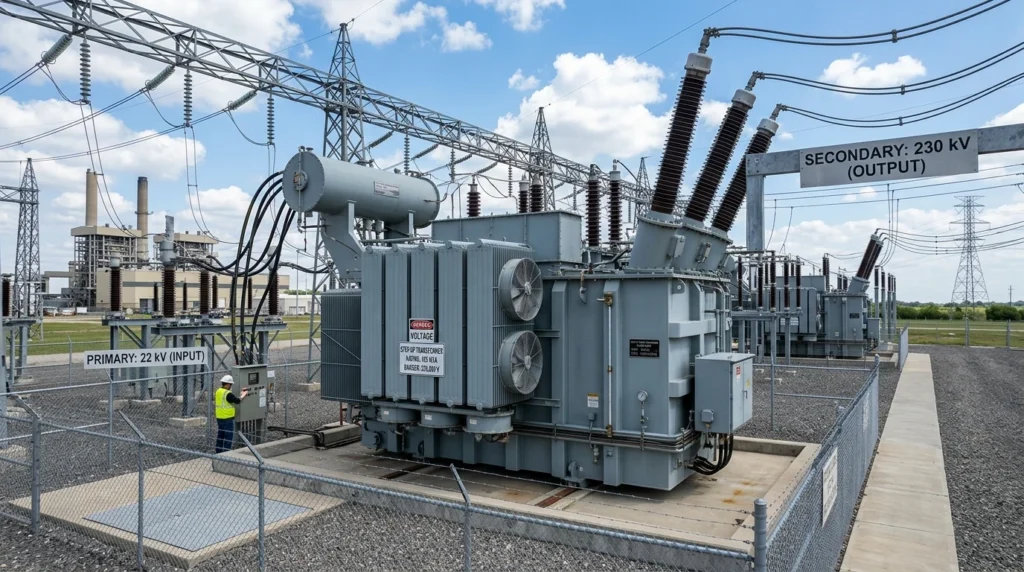

Imagine electricity generated at a power station needing to travel hundreds of kilometers to reach cities, factories, and homes. If this electrical power were transmitted at low voltage, massive energy losses would occur in transmission lines. To solve this problem, engineers use a step-up transformer to increase voltage before long-distance power transmission.
A step-up transformer is one of the most important devices in electrical power systems. It helps improve transmission efficiency, reduce power losses, and support reliable electricity distribution. Without step-up transformers, modern electrical grids would not be able to deliver power economically over large distances.
For electrical students, technicians, engineers, and beginners, understanding step-up transformers is essential because these devices are widely used in power plants, substations, renewable energy systems, and industrial applications. Knowledge of transformer operation also helps in understanding voltage control, electromagnetic induction, and power transmission systems.
In this article, you will learn the step-up transformer working principle, types, components, applications, advantages and disadvantages, troubleshooting methods, and future technologies in simple and clear English. The explanations are practical and designed to help junior learners understand real-world electrical engineering systems confidently.
What is a Step-Up Transformer?
A step-up transformer is an electrical device that increases the voltage from the primary winding to the secondary winding while reducing the current proportionally.
In simple words, it converts low-voltage electricity into high-voltage electricity.
A step-up transformer works on the principle of electromagnetic induction and uses two windings:
- Primary winding
- Secondary winding
In a step-up transformer, the secondary winding has more turns than the primary winding.
For example, if a transformer receives 11 kV at the primary side and delivers 132 kV at the secondary side, it is operating as a step-up transformer.
These transformers are commonly installed at generating stations where voltage must be increased for efficient transmission through power lines.
Step-Up Transformer Working Principle
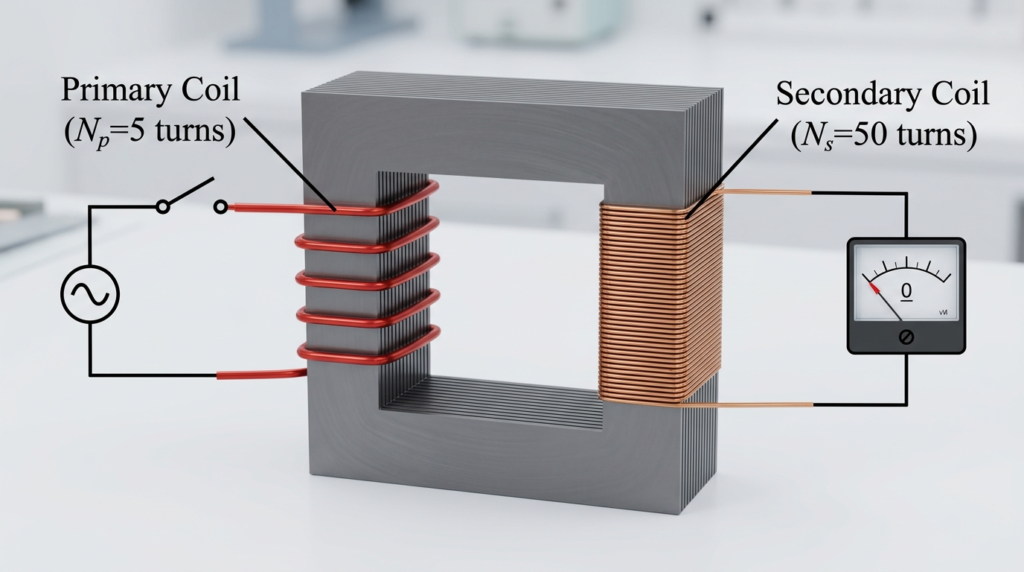
The step-up transformer working principle is based on electromagnetic induction discovered by Michael Faraday.A step-up transformer works on the principle of electromagnetic induction. When alternating current (AC) flows through the primary winding, it produces a changing magnetic field in the transformer core. This changing magnetic field induces a voltage in the secondary winding. Since the secondary winding has more turns than the primary winding, the output voltage is higher than the input voltage, while the output current decreases proportionally. Step-up transformers are widely used in power transmission systems to increase voltage, reduce transmission losses, and improve the efficiency of electricity distribution.
Simple Analogy
Think of a bicycle gear system:
- A small gear driving a larger gear increases rotational speed.
- Similarly, a step-up transformer increases electrical voltage.
Step-by-Step Working Principle
AC Voltage is Applied to Primary Coil
Alternating current flows through the primary winding.
Magnetic Field is Produced
The alternating current creates a changing magnetic field around the primary winding.
Magnetic Field Passes Through Core
The transformer core transfers magnetic flux efficiently from the primary winding to the secondary winding.
Voltage is Induced in Secondary Winding
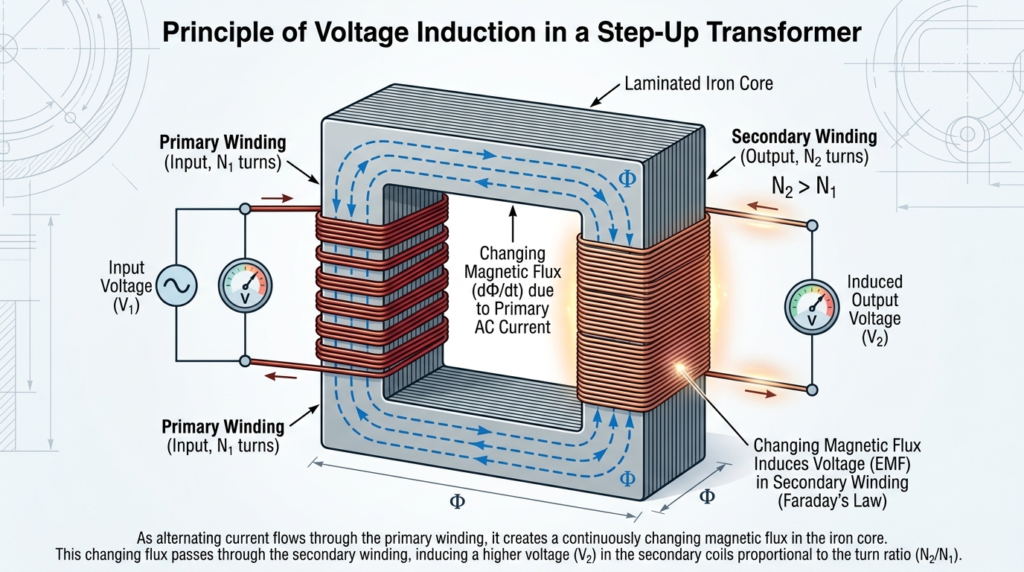
In a step-up transformer, voltage is induced in the secondary winding through the principle of electromagnetic induction. When alternating current (AC) flows through the primary winding, it creates a continuously changing magnetic field in the transformer core. This changing magnetic field links with the secondary winding and induces an electromotive force (EMF) in it. Since the secondary winding has more turns than the primary winding, the induced voltage in the secondary winding is higher than the input voltage. This process enables the transformer to increase voltage efficiently while decreasing the output current.
According to electromagnetic induction, changing magnetic flux induces voltage in the secondary coil.
The transformer voltage relationship is:
\frac{V_s}{V_p}=\frac{N_s}{N_p}
Where:
- (V_s) = Secondary voltage
- (V_p) = Primary voltage
- (N_s) = Secondary turns
- (N_p) = Primary turns
Voltage Increases
Since the secondary winding has more turns, the output voltage becomes higher than the input voltage.
Current Decreases
As voltage increases, current decreases proportionally to maintain power balance.
Important Features of Step-Up Transformer Working Principle
- Operates only with AC supply
- Uses electromagnetic induction
- Increases voltage efficiently
- Reduces transmission losses
Types / Classification of Step-Up Transformers
Step-up transformers are classified based on construction, application, and cooling methods.
Power Step-Up Transformer
These transformers are used in generating stations.
Features
- High voltage operation
- Large power handling capability
Applications
- Power transmission systems
Distribution Step-Up Transformer
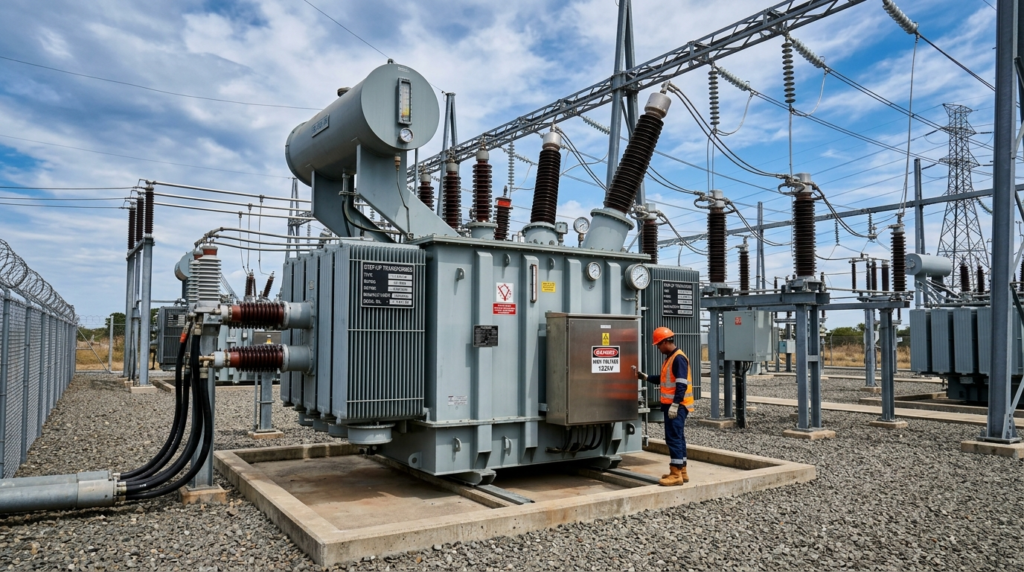
A distribution step-up transformer is an electrical transformer used to increase voltage for the efficient transmission of electrical power over long distances. It operates on the principle of electromagnetic induction by converting low-voltage electrical energy into a higher voltage while reducing the current. Increasing the voltage minimizes power losses in transmission lines and improves the overall efficiency of the power distribution system. Distribution step-up transformers are commonly installed at power generation stations before electricity is transmitted through high-voltage transmission networks.
Used in smaller electrical distribution systems.
Features
- Moderate voltage increase
- Compact size
Applications
- Commercial distribution systems
Single-Phase Step-Up Transformer
Operates on single-phase AC supply.
Applications
- Small electrical systems
- Laboratories
- Residential equipment
Three-Phase Step-Up Transformer
Operates on three-phase power systems.
Features
- High efficiency
- Large power capacity
Applications
- Industries
- Power plants
- Substations
Oil-Cooled Step-Up Transformer
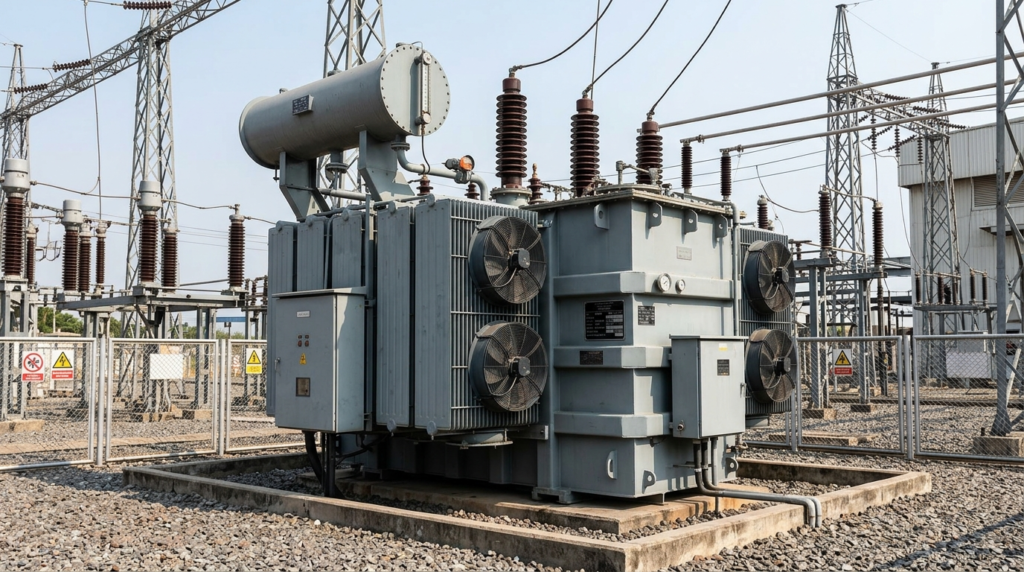
An oil-cooled step-up transformer is a transformer that uses insulating mineral oil to cool its internal components and provide electrical insulation. During operation, the transformer oil absorbs the heat generated by the windings and core and transfers it to the outer tank, where it is dissipated into the surrounding air through cooling fins or radiators. This cooling method prevents overheating, improves efficiency, and extends the transformer’s service life. Oil-cooled step-up transformers are widely used in power generation stations, substations, and high-voltage transmission systems because they can handle large power loads safely and reliably.
Uses transformer oil for cooling.
Features
- Better heat dissipation
- Suitable for high loads
Applications
- Outdoor substations
- Transmission systems
Air-Cooled Step-Up Transformer
Uses air circulation for cooling.
Features
- Simpler maintenance
- Lower cost
Applications
- Indoor electrical systems
Main Components of a Step-Up Transformer
Understanding transformer components is essential for practical electrical engineering knowledge.
Primary Winding
The primary winding receives input voltage.
Function
- Produces magnetic flux
Secondary Winding
The secondary winding delivers increased voltage.
Function
- Supplies stepped-up voltage output
Magnetic Core
Usually made of laminated silicon steel.
Function
- Provides low-reluctance magnetic path
Insulation System
Separates electrical conductors safely.
Function
- Prevents short circuits
Transformer Tank
Protects internal components.
Function
- Holds oil and provides structural support
Cooling System
Maintains safe operating temperature.
Types
- Oil cooling
- Air cooling
Bushings
Provide safe external electrical connections.
Function
- Connect transformer windings to external circuits
Advantages
Understanding step-up transformer advantages and disadvantages helps engineers evaluate transformer performance.
Advantages of Step-Up Transformers
- Reduces transmission losses
- Improves transmission efficiency
- Supports long-distance power transfer
- Reliable voltage conversion
- High operational efficiency
- Reduces conductor size requirement
- Improves power system stability
- Long service life
Real-World Benefits
Efficient Power Transmission
Higher voltage reduces line current and minimizes power loss.
Power loss in transmission lines follows:
P = I^2R
Reducing current significantly lowers transmission losses.
Economic Benefits
Smaller conductors reduce installation costs.
Improved Grid Reliability
Step-up transformers help maintain stable voltage levels across power networks.
Disadvantages / Limitations
Despite their advantages, step-up transformers also have limitations.
Disadvantages of Step-Up Transformers
- Operates only on AC supply
- Large installation cost
- Requires regular maintenance
- Generates heat during operation
- Risk of insulation failure
- Oil leakage possibility in oil-cooled units
Practical Limitations
Cooling Requirement
High-power transformers require effective cooling systems.
Heavy Construction
Large transformers occupy significant space.
Fault Sensitivity
Overloading may damage insulation and windings.
Applications
Step-up transformer applications are found throughout modern electrical systems.
Power Generation Applications
- Power stations
- Hydroelectric plants
- Thermal power plants
Transmission Applications
- High-voltage transmission networks
- National electrical grids
Renewable Energy Applications
- Solar farms
- Wind energy systems
Industrial Applications
- Heavy electrical equipment
- Industrial substations
Laboratory Applications
- High-voltage testing equipment
- Research systems
Step-up transformer applications continue expanding with growing global electricity demand.
Comparison Section
Difference Between Step-Up Transformer and Step-Down Transformer
| Feature | Step-Up Transformer | Step-Down Transformer |
| Voltage Output | Increases voltage | Decreases voltage |
| Current Output | Decreases current | Increases current |
| Secondary Turns | More than primary | Fewer than primary |
| Main Use | Transmission systems | Distribution systems |
| Installation Area | Power stations | Consumer substations |
| Application | Long-distance transmission | Domestic supply |
| Conductor Requirement | Smaller conductors | Larger conductors |
| Efficiency Purpose | Reduce losses | Safe utilization |
Understanding the difference between step-up transformer and step-down transformer is very important in power system engineering.
Selection Guide
Selecting the correct step-up transformer depends on several engineering factors.
Voltage Rating
Choose according to required output voltage.
Examples:
- 11 kV to 132 kV
- 33 kV to 220 kV
Power Capacity
Select transformer rating based on load demand.
Cooling Method
- Oil cooling for high-power systems
- Air cooling for smaller systems
Installation Environment
Consider:
- Temperature
- Humidity
- Dust levels
- Indoor or outdoor installation
Efficiency Requirements
Higher efficiency reduces operational losses.
Tips for Beginners
- Learn transformer basics first
- Understand turns ratio concepts
- Study transformer protection systems
- Follow electrical safety rules
- Practice reading transformer nameplates
Common Problems & Solutions
Transformer Overheating
Causes
- Overloading
- Poor cooling
Solution
- Reduce load
- Improve cooling system
Insulation Failure
Causes
- Aging
- Moisture
Solution
- Replace damaged insulation
Oil Leakage
Causes
- Tank damage
- Loose fittings
Solution
- Repair leaks immediately
Voltage Fluctuation
Causes
- Load variation
- Winding issues
Solution
- Check tap changer settings
Unusual Noise
Causes
- Loose core laminations
- Mechanical vibration
Solution
- Tighten internal components
Future Trends
Step-up transformers are continuously improving with modern electrical technology.
Smart Transformers
Modern transformers now include:
- Digital monitoring
- Remote diagnostics
- Automated protection systems
Eco-Friendly Insulation
New insulating materials reduce environmental impact.
High-Efficiency Core Materials
Advanced magnetic materials improve transformer efficiency and reduce losses.
Renewable Energy Integration
Future step-up transformers will support:
- Smart grids
- Solar integration
- Wind energy systems
IoT-Based Monitoring
Sensors provide real-time monitoring of:
- Temperature
- Oil condition
- Load performance
This improves maintenance planning and reliability.
The future of step-up transformer applications is closely connected with smart power systems and renewable energy infrastructure.
Conclusion
A step-up transformer is one of the most important devices in electrical power systems because it increases voltage for efficient long-distance electricity transmission. By reducing transmission current, these transformers help minimize power losses and improve overall system efficiency.
This article explained the step-up transformer working principle, types, components, applications, advantages and disadvantages, troubleshooting methods, and future developments in simple and practical language. You also learned the difference between step-up and step-down transformers and how engineers select suitable transformers for different applications.
For electrical students, engineers, technicians, and beginners, understanding step-up transformers is essential because they form the foundation of modern power transmission systems. As renewable energy and smart grid technologies continue expanding, step-up transformers will remain critical components in future electrical engineering and sustainable power infrastructure.