
Imagine an electrical technician testing a motor in a factory. The motor is running, voltage is present, and current is flowing. However, the technician still needs to know how much real electrical power the motor is actually consuming. Measuring only voltage or current is not enough because electrical power depends on both quantities. This is where a wattmeter becomes an essential instrument.
A wattmeter is one of the most important measuring devices used in electrical engineering. It helps determine the actual power consumed by electrical equipment in watts. Whether you are testing household appliances, industrial motors, transformers, generators, or power distribution systems, a wattmeter provides valuable information about energy usage and system performance.
For electrical students, engineers, technicians, and beginners, understanding the wattmeter working principle is fundamental because power measurement is a core part of electrical analysis and troubleshooting. Accurate power measurement helps improve efficiency, reduce energy costs, and ensure proper equipment operation.
In this article, you will learn the wattmeter working principle, types, components, applications, advantages and disadvantages, selection criteria, troubleshooting methods, and future developments. The explanations are practical, simple, and based on real-world electrical engineering practices.
What is Wattmeter Working Principle?
The wattmeter working principle is based on measuring the interaction between voltage and current in an electrical circuit to determine the real power consumed by a load.
A wattmeter is an electrical measuring instrument used to measure electrical power in watts.
In simple words, a wattmeter calculates how much electrical energy is being converted into useful work by a device.
Practical Example
Suppose an electric heater operates on 230 volts and draws current from the power supply. A wattmeter connected to the circuit measures the actual power consumed by the heater and displays the result in watts.
This information helps engineers determine efficiency, energy consumption, and system performance.
Wattmeter Working Principle
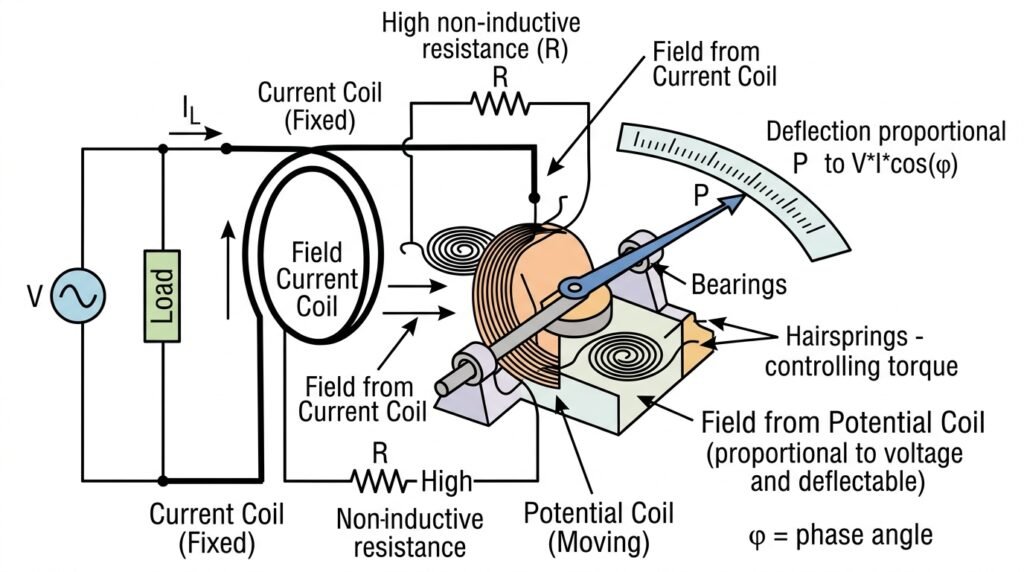
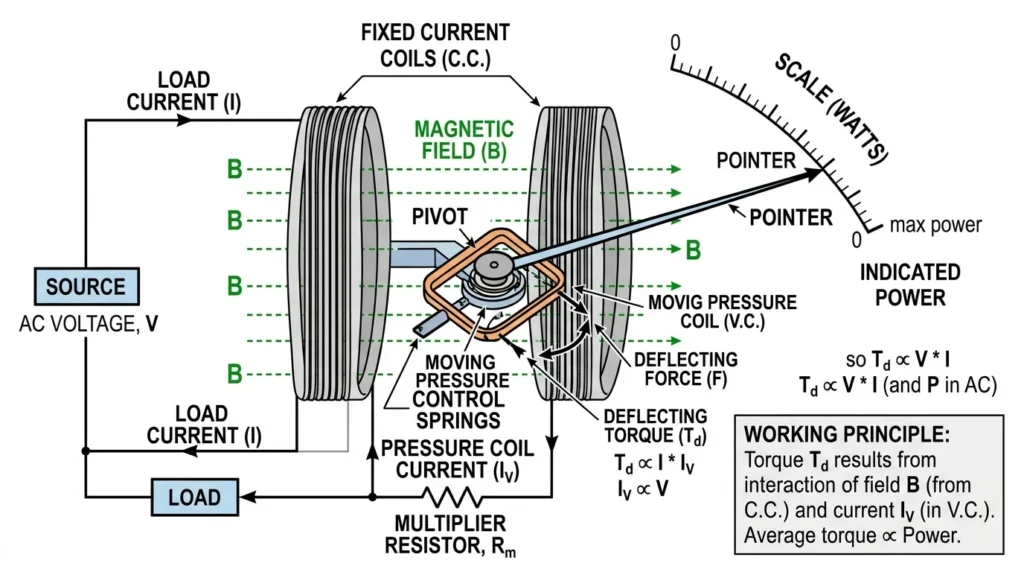
The wattmeter working principle depends on the combined effect of current and voltage acting inside the measuring mechanism. wattmeter works on the principle of the interaction between the magnetic fields produced by its current coil and voltage (pressure) coil. The current coil is connected in series with the load, while the voltage coil is connected in parallel across the load. When current flows through the circuit, the magnetic fields generated by both coils interact and produce a deflecting torque. This torque is proportional to the electrical power consumed by the load, causing the pointer (or digital display in electronic wattmeter) to indicate the power in watts. Wattmeter are widely used to measure the power consumption of electrical and electronic circuits accurately.
Simple Analogy
Think of a water system:
- Water pressure represents voltage.
- Water flow represents current.
- Useful water delivered represents power.
Both pressure and flow are required to determine how much useful work is being done.
Similarly, a wattmeter measures both voltage and current to calculate electrical power.
Step-by-Step Wattmeter Working Principle
Current Coil is Connected
The current coil is connected in series with the load.
Function
- Carries load current.
- Produces a magnetic field proportional to current.
Potential Coil is Connected
The potential coil is connected across the load.
Function
- Receives supply voltage.
- Produces a magnetic field proportional to voltage.
Magnetic Fields Interact
The magnetic fields created by both coils interact with each other.
Deflecting Torque is Produced
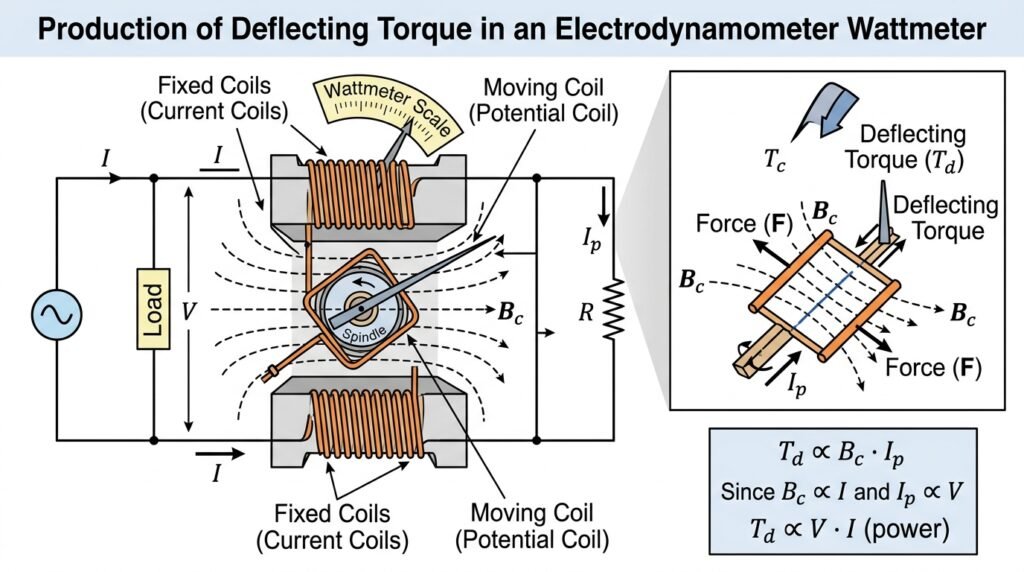
In a wattmeter, deflecting torque is produced by the interaction between the magnetic fields of the current coil and the voltage (pressure) coil. The current coil carries the load current, while the voltage coil is connected across the supply voltage. When both coils are energized, their magnetic fields interact and generate a mechanical torque that causes the moving system or pointer to deflect. The magnitude of this deflecting torque is directly proportional to the true electrical power consumed by the load. This principle enables the wattmeter to accurately measure power in electrical circuits.
The interaction generates a torque that moves the pointer.
Pointer Indicates Power
The pointer moves over a calibrated scale and displays power directly in watts.
Important Features of Wattmeter Working Principle
- Measures real power
- Uses voltage and current simultaneously
- Suitable for AC and DC measurements
- Provides direct power indication
Power Measurement Formula
The real power measured by a wattmeter is:
P = VI\cos\phi
Where:
- P = Power (Watts)
- V = Voltage
- I = Current
- cosφ = Power Factor
This relationship forms the basis of the wattmeter working principle in AC circuits.
Types / Classification of Wattmeters
Several types of wattmeters are available depending on the application and measurement requirements.
Electrodynamometer Wattmeter
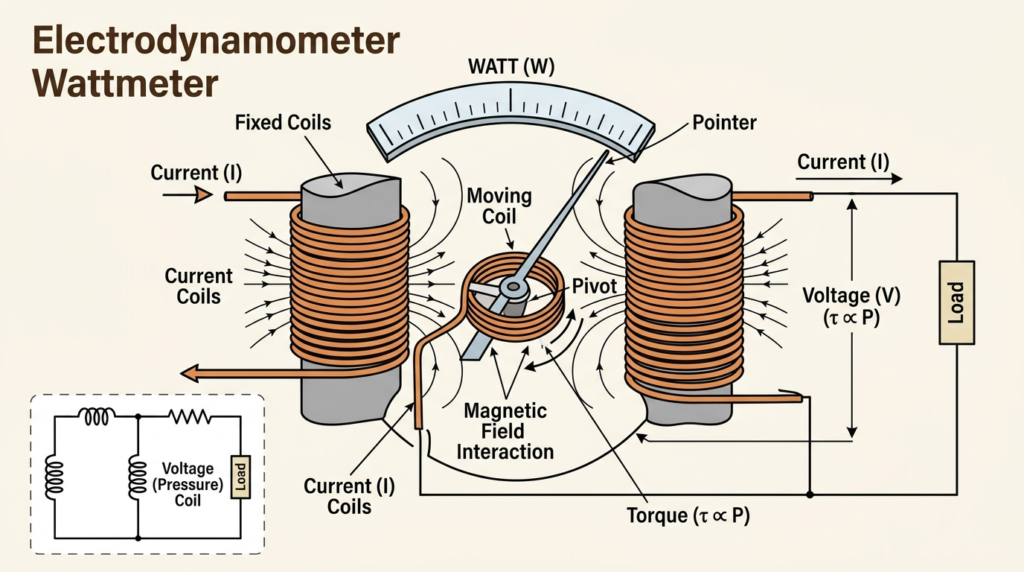
An electrodynamometer wattmeter is an instrument used to measure electrical power in both AC and DC circuits. It operates on the principle of the interaction between the magnetic fields produced by a fixed current coil and a moving voltage (pressure) coil. The current coil is connected in series with the load, while the voltage coil is connected in parallel across the load. The interaction of these magnetic fields produces a deflecting torque that is proportional to the true power consumed by the circuit. Electrodynamometer wattmeter are widely used in laboratories, industries, and electrical testing because of their high accuracy and ability to measure power in both alternating and direct current systems.
This is the most commonly used analog wattmeter.
Features
- High accuracy
- Suitable for AC and DC
Applications
- Laboratories
- Educational institutions
Induction Wattmeter
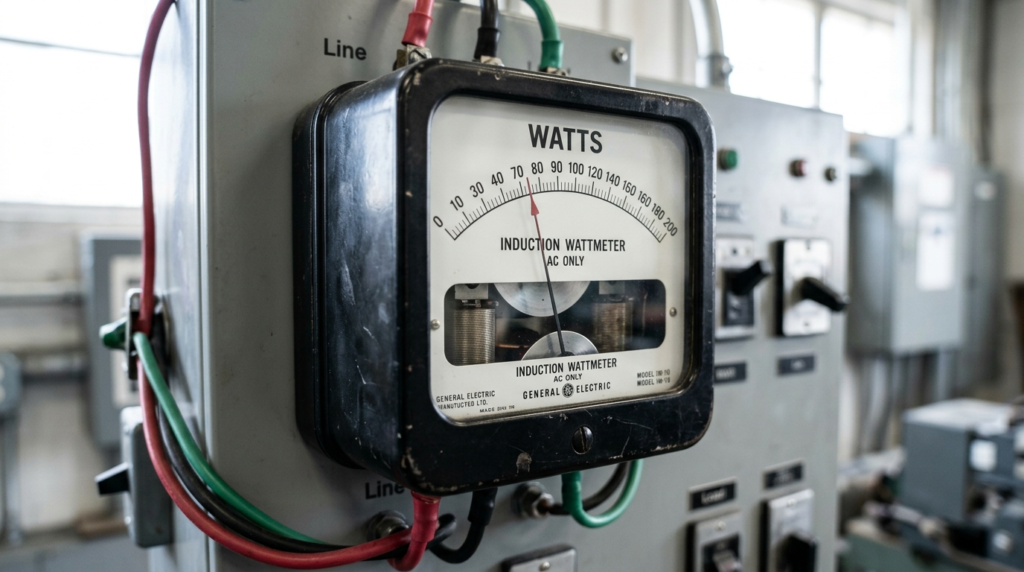
An induction wattmeter is an electrical instrument used to measure power in AC (alternating current) circuits. It works on the principle of electromagnetic induction, where alternating magnetic fields produced by the current coil and voltage (pressure) coil induce eddy currents in a lightweight aluminum disc. The interaction between these magnetic fields and the eddy currents produces a torque that rotates the disc, and the amount of rotation is proportional to the power consumed by the load. Induction wattmeters are simple, reliable, and commonly used for AC power measurement in electrical laboratories and industrial applications
Operates only on AC circuits.
Features
- Strong construction
- Reliable operation
Applications
- Industrial measurements
Digital Wattmeter
Uses electronic circuits and digital displays.
Features
- High accuracy
- Easy reading
- Fast response
Applications
- Modern electrical systems
- Power monitoring
Portable Wattmeter
Designed for field testing.
Features
- Lightweight
- Easy transportation
Applications
- Maintenance work
- Electrical inspections
Three-Phase Wattmeter
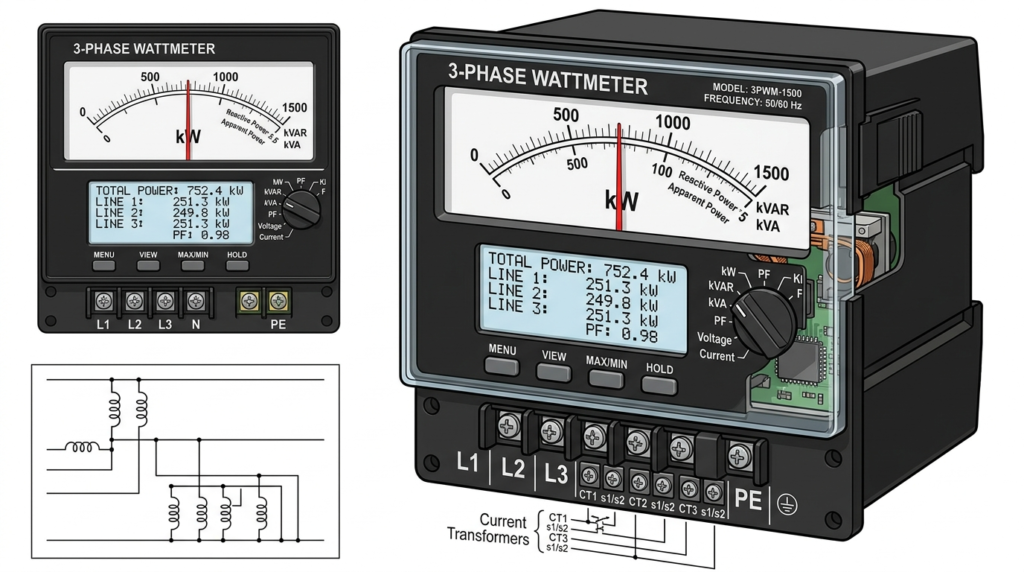
A three-phase wattmeter is an electrical instrument used to measure the total power consumed in a three-phase electrical system. It operates by measuring the voltage and current in each phase and calculating the total real power of the circuit. Depending on the type of three-phase system, it may use one, two, or three measuring elements, such as in the two-wattmeter or three-wattmeter method. Three-phase wattmeters are widely used in industrial plants, power stations, and commercial installations to monitor and measure the power consumption of motors, generators, transformers, and other three-phase electrical equipment accurately.
Measures power in three-phase systems.
Features
- Industrial use
- High-capacity measurements
Applications
- Factories
- Power plants
Main Components of a Wattmeter
Understanding wattmeter components helps users understand its operation more clearly.
Current Coil
Connected in series with the load.
Function
- Produces magnetic field proportional to current.
Potential Coil
Connected across the load.
Function
- Produces magnetic field proportional to voltage.
Moving System
Supports pointer movement.
Function
- Converts magnetic interaction into mechanical motion.
Control Springs
Provide controlling torque.
Function
- Return pointer to zero position.
Pointer
Indicates measured power.
Function
- Displays reading on scale.
Calibrated Scale
Marked in watts.
Function
- Allows direct reading of power.
Damping System
Prevents pointer oscillation.
Function
- Stabilizes readings quickly.
Advantages
Understanding wattmeter advantages and disadvantages helps engineers select the correct instrument.
Advantages of Wattmeters
- Direct power measurement
- High measurement accuracy
- Easy operation
- Suitable for AC and DC systems
- Reliable performance
- Useful for efficiency calculations
- Supports troubleshooting
- Available in analog and digital versions
Real-World Benefits
Energy Monitoring
Helps monitor electrical energy usage accurately.
Improved Efficiency
Identifies inefficient equipment.
Better Maintenance
Supports preventive maintenance programs.
Cost Reduction
Helps reduce electricity consumption.
Disadvantages / Limitations
Although wattmeters are highly useful, they also have some limitations.
Disadvantages of Wattmeters
- Analog models may have reading errors
- Sensitive to external magnetic fields
- Mechanical wear in moving parts
- Requires proper calibration
- Higher cost for precision instruments
- Limited measurement range in some models
Practical Limitations
Temperature Effects
Extreme temperatures can affect accuracy.
Calibration Requirements
Regular calibration ensures reliable readings.
Installation Complexity
Improper connections may cause inaccurate measurements.
Wattmeter Applications
Wattmeter applications are found in almost every area of electrical engineering.
Residential Applications
- Appliance testing
- Home energy monitoring
- Power consumption analysis
Industrial Applications
- Motor testing
- Equipment efficiency monitoring
- Process control systems
Power System Applications
- Generator testing
- Transformer performance evaluation
- Substation monitoring
Educational Applications
- Laboratory experiments
- Technical training
Renewable Energy Applications
- Solar power systems
- Wind energy installations
- Battery storage systems
Commercial Applications
- Building energy management
- Load monitoring systems
Wattmeter applications continue expanding as energy efficiency becomes increasingly important.
Comparison Section
Difference Between Wattmeter and Energy Meter
| Feature | Wattmeter | Energy Meter |
|---|---|---|
| Measures | Power | Energy |
| Unit | Watt (W) | Kilowatt-hour (kWh) |
| Reading Type | Instantaneous | Accumulated |
| Main Purpose | Power measurement | Energy billing |
| Response Time | Immediate | Continuous |
| Application | Testing and monitoring | Utility metering |
| Installation | Temporary or permanent | Usually permanent |
| Accuracy Focus | Power accuracy | Energy accuracy |
Understanding the difference between wattmeter and energy meter helps users select the appropriate measuring instrument.
Selection Guide
Choosing the correct wattmeter depends on several factors.
Voltage Rating
Select according to system voltage.
Examples:
- 230 V
- 415 V
- Higher industrial voltages
Current Rating
Choose based on expected load current.
AC or DC Measurement
Verify compatibility with the electrical system.
Accuracy Requirement
High-precision applications require advanced wattmeters.
Analog or Digital Type
Digital wattmeters generally provide easier reading and higher accuracy.
Tips for Beginners
- Always check instrument ratings.
- Verify wiring connections before use.
- Understand power factor concepts.
- Learn basic electrical safety practices.
- Calibrate instruments regularly.
Common Problems & Solutions
Incorrect Readings
Causes
- Loose connections
- Calibration issues
Solution
- Tighten connections
- Recalibrate instrument
Pointer Not Moving
Causes
- Damaged coil
- Internal mechanical fault
Solution
- Inspect internal components
Fluctuating Readings
Causes
- Unstable supply
- Poor connections
Solution
- Check power quality
- Verify wiring
Overheating
Causes
- Excessive current
Solution
- Operate within rated limits
Digital Display Failure
Causes
- Power supply issue
- Electronic fault
Solution
- Check internal circuitry
Future Trends
Power measurement technology continues advancing rapidly.
Smart Digital Wattmeters
Modern wattmeters offer:
- Higher accuracy
- Real-time monitoring
- Remote access
IoT Integration
Connected devices can transmit power data directly to monitoring systems.
Benefits
- Remote diagnostics
- Energy analysis
Wireless Monitoring
Future systems will reduce wiring requirements through wireless communication.
AI-Based Energy Analysis
Artificial intelligence will help:
- Detect abnormal power usage
- Predict equipment failures
- Improve efficiency
Smart Grid Compatibility
Modern wattmeters are becoming important components of smart electrical grids.
Renewable Energy Monitoring
Advanced wattmeters support:
- Solar energy systems
- Wind power systems
- Energy storage networks
The future of wattmeter applications is closely linked with digital power monitoring and intelligent energy management.
Conclusion
The wattmeter working principle is based on measuring the combined effect of voltage and current to determine the real power consumed by an electrical load. By accurately measuring power in watts, wattmeters help engineers, technicians, and students analyze system performance, monitor energy usage, and improve electrical efficiency.
This article explained the wattmeter working principle, types, components, applications, advantages and disadvantages, troubleshooting methods, and future developments in simple and practical language. You also learned the difference between wattmeter and energy meter and how to choose the correct wattmeter for various applications.
For electrical students, engineers, technicians, and beginners, understanding wattmeters is essential because power measurement is a fundamental part of electrical engineering. As smart grids, renewable energy systems, and digital monitoring technologies continue to grow, wattmeters will remain valuable tools for efficient power management and system analysis.