
Imagine electricity traveling from a power station to a residential area at a voltage of 132 kV. This high voltage is excellent for long-distance transmission because it reduces power losses. However, it would be extremely dangerous to supply this voltage directly to homes, offices, or electronic devices. Before the electricity reaches consumers, the voltage must be reduced to a safe and usable level. This important task is performed by a step-down transformer.
A step-down transformer is one of the most widely used electrical devices in power systems. From large electrical substations to mobile phone chargers, these transformers help convert high voltage into lower voltage suitable for various applications. Without step-down transformers, modern electrical distribution systems would not be practical or safe.
For electrical students, engineers, technicians, and beginners, understanding step-down transformers is essential because they are a fundamental part of power generation, transmission, and distribution networks. Learning how these transformers work helps build a strong foundation in electrical engineering concepts.
In this article, you will learn the step-down transformer working principle, types, components, applications, advantages and disadvantages, troubleshooting methods, and future developments in simple and easy English.
What is a Step-Down Transformer?
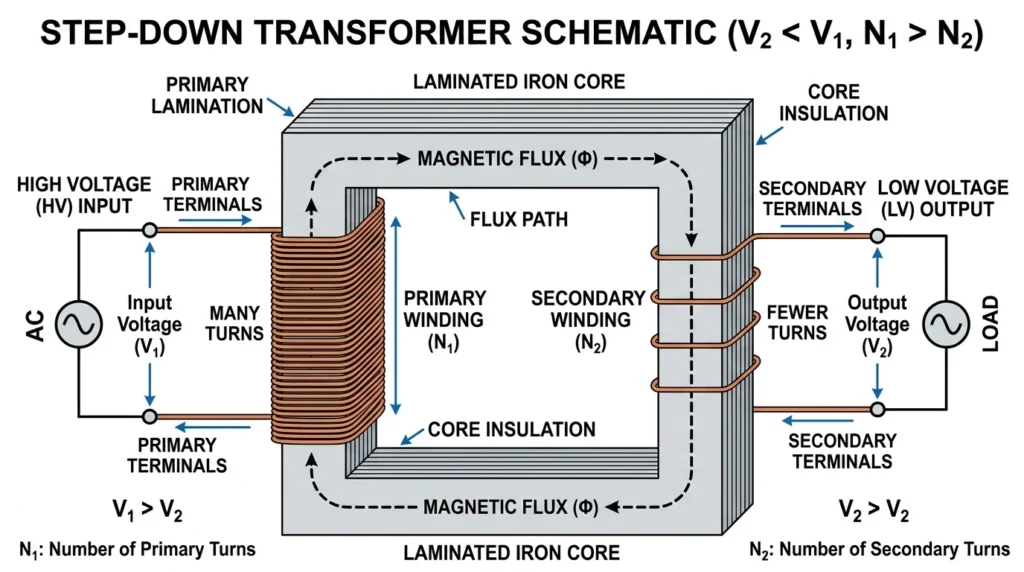
A step-down transformer is an electrical device that reduces the voltage from the primary winding to the secondary winding while increasing the current proportionally.
In simple words, it converts high-voltage electricity into lower-voltage electricity.
A step-down transformer operates using electromagnetic induction and consists of two main windings:
- Primary winding
- Secondary winding
In this transformer, the primary winding has more turns than the secondary winding.
For example, a transformer may reduce a voltage of 11 kV to 415 V for industrial distribution or from 230 V to 12 V for electronic equipment.
Step-down transformers are commonly used in electrical substations, factories, homes, power supplies, and electronic devices.
Step-Down Transformer Working Principle
The step-down transformer working principle is based on electromagnetic induction.
Simple Analogy
Think of water flowing from a high-pressure pipeline into a smaller distribution system.
- High pressure is reduced to a safer level.
- Water remains useful for consumers.
Similarly, a step-down transformer reduces voltage while making electricity suitable for practical use.
Step-by-Step Working Principle
AC Voltage is Applied to the Primary Winding
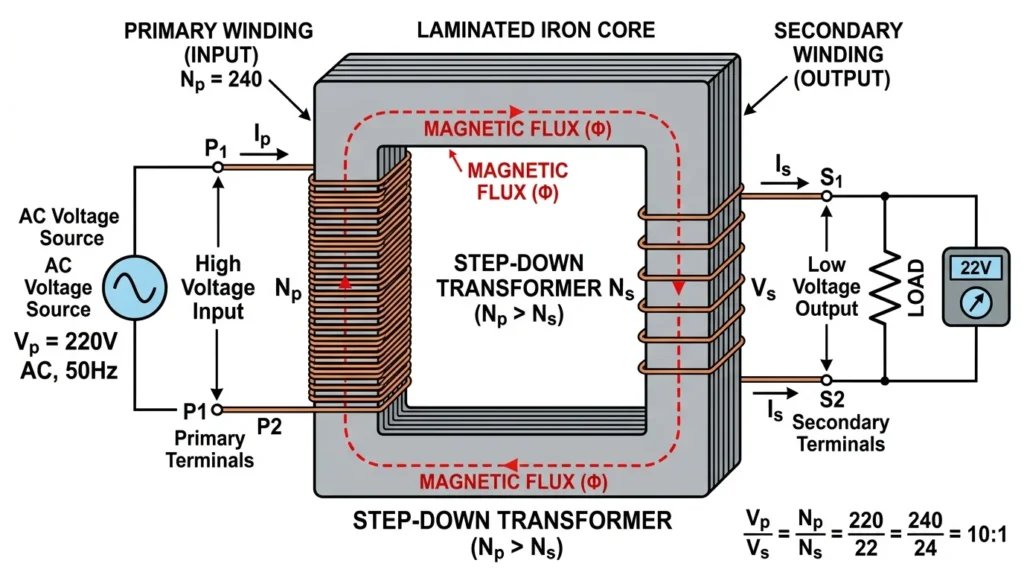
The working process of a step-down transformer begins when an alternating current (AC) voltage is applied to its primary winding. As the AC flows through the primary coil, it creates a continuously changing magnetic field around the transformer core. This changing magnetic field passes through the laminated iron core and links with the secondary winding. According to the principle of electromagnetic induction, the varying magnetic field induces an alternating voltage in the secondary winding. Since the secondary winding has fewer turns than the primary winding, the induced voltage is lower than the input voltage, while the current increases proportionally. This process allows the transformer to efficiently reduce high transmission voltage to a lower voltage suitable for safe distribution and use, without changing the frequency of the AC supply.
An alternating voltage is connected to the primary coil.
Magnetic Field is Produced
The alternating current creates a changing magnetic field around the primary winding.
Magnetic Flux Passes Through the Core
The transformer core provides an efficient path for magnetic flux.
Voltage is Induced in the Secondary Winding
The changing magnetic field induces voltage in the secondary coil.
The transformer voltage ratio is:
\frac{V_s}{V_p}=\frac{N_s}{N_p}
Where:
- (V_s) = Secondary voltage
- (V_p) = Primary voltage
- (N_s) = Secondary turns
- (N_p) = Primary turns
Voltage is Reduced
Since the secondary winding has fewer turns than the primary winding, the output voltage becomes lower.
Current Increases
As voltage decreases, current increases proportionally while maintaining power transfer efficiency.
Key Features of Step-Down Transformer Working Principle
- Works only with AC supply
- Uses electromagnetic induction
- Reduces voltage safely
- Improves electrical utilization
Types / Classification of Step-Down Transformers
Step-down transformers are available in several types depending on their application and construction.
Power Step-Down Transformer
These transformers are installed in substations.
Features
- High voltage reduction capability
- Large power ratings
Applications
- Transmission and distribution systems
Distribution Transformer
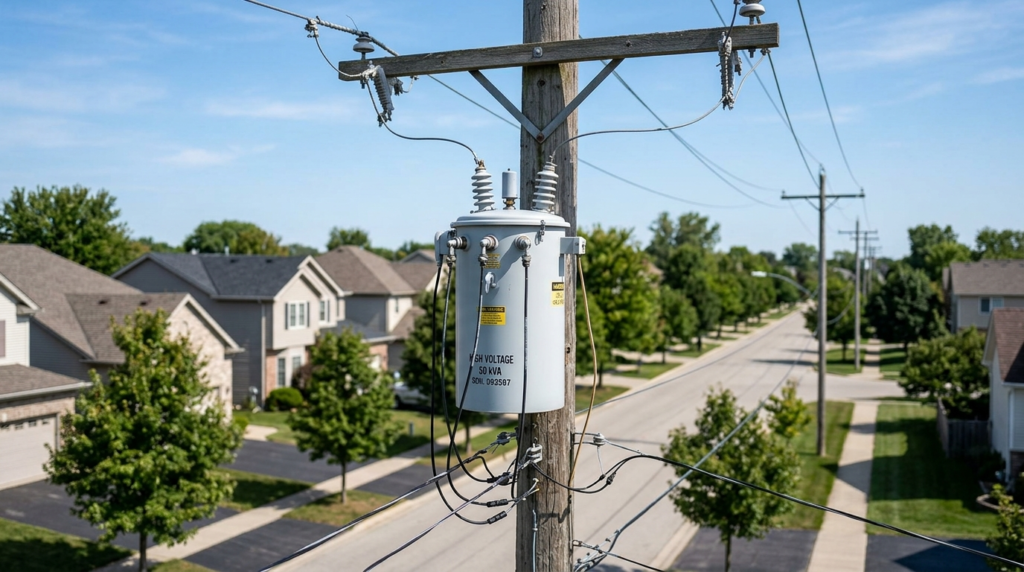
A Distribution Transformer is an electrical transformer used to reduce medium-voltage electricity from the distribution network to low-voltage levels suitable for homes, commercial buildings, and small industries. It is the final voltage transformation stage before electricity reaches consumers, typically stepping down voltages such as 11kV or 33kV to 400V/230V. Distribution transformers operate continuously and are designed to achieve high efficiency under varying load conditions. They work on the principle of electromagnetic induction, providing a safe and stable power supply while minimizing energy losses. These transformers are commonly installed on utility poles, ground-mounted platforms, and distribution substations, playing a vital role in delivering reliable electricity for everyday residential, commercial, and industrial applications.
Distribution transformers provide voltage suitable for consumers.
Features
- Continuous operation
- High efficiency
Applications
- Residential and commercial supply
Single-Phase Step-Down Transformer
Operates on single-phase AC supply.
Applications
- Homes
- Small offices
- Electronic equipment
Three-Phase Step-Down Transformer
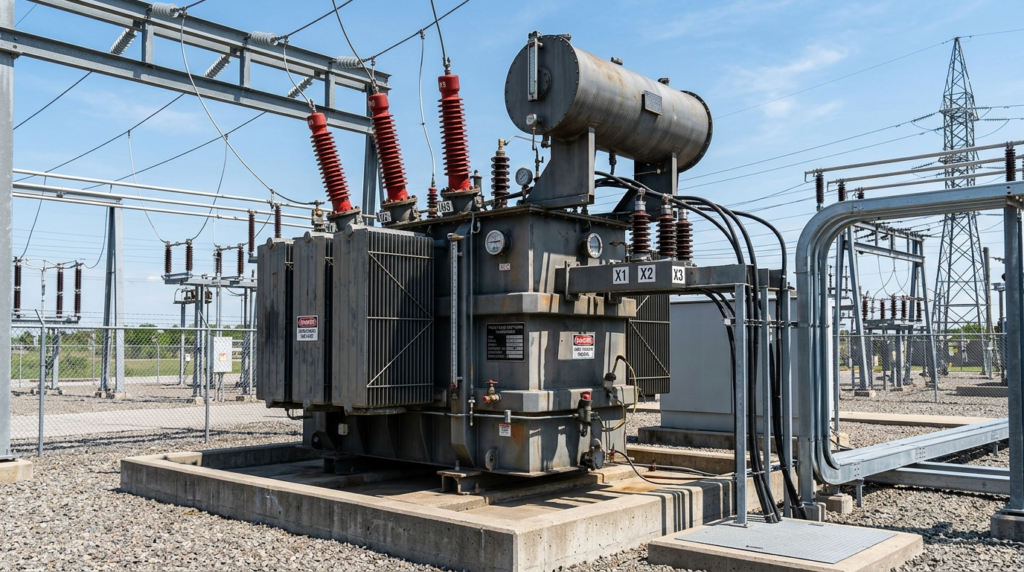
A Three-Phase Step-Down Transformer is a power transformer that reduces high transmission voltage to a lower voltage suitable for distribution and industrial use while operating on a three-phase electrical system. It works on the principle of electromagnetic induction, transferring electrical energy from the primary winding to the secondary winding without changing the frequency. In a 132kV or 66kV grid station, this transformer is one of the most important components because it steps down the incoming high voltage, such as 132kV, to lower levels like 66kV, 33kV, or 11kV for safe and efficient power distribution. Three-phase step-down transformers offer high efficiency, reliable performance, and the ability to handle large power loads, making them essential in power transmission networks, industrial plants, commercial facilities, and electrical distribution systems.
Operates on three-phase electrical systems.
Features
- High power handling
- Better efficiency
Applications
- Industries
- Manufacturing plants
Isolation Transformer
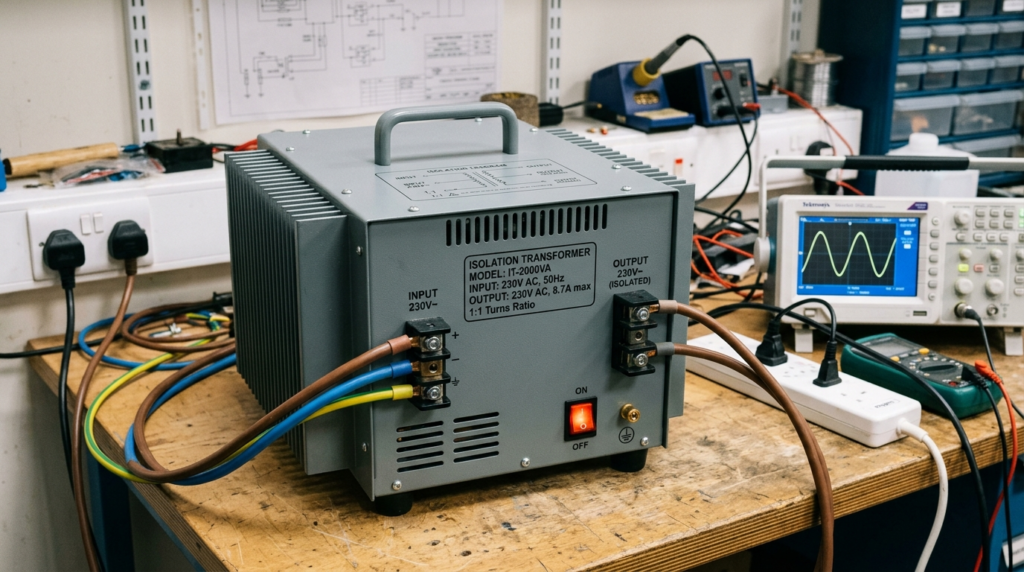
An Isolation Transformer is a special type of transformer that electrically separates the primary circuit from the secondary circuit while transferring electrical power through electromagnetic induction. Unlike conventional transformers, there is no direct electrical connection between the input and output windings, which improves safety by reducing the risk of electric shock and protecting equipment from electrical faults. Isolation transformers are commonly used in hospitals, laboratories, industrial control systems, maintenance workshops, and sensitive electronic equipment where stable and safe power is essential. They also help reduce electrical noise, suppress voltage spikes, and minimize ground loop problems, making them ideal for applications that require clean and reliable power supply.
Provides voltage transformation with electrical isolation.
Features
- Improved safety
- Noise reduction
Applications
- Medical equipment
- Sensitive electronics
Auto Transformer
Uses a single winding with taps.
Features
- Compact design
- Lower cost
Applications
- Voltage control systems
Main Components of a Step-Down Transformer
Understanding the components helps in learning transformer operation and maintenance.
Primary Winding
Receives high-voltage input.
Function
- Produces magnetic flux
Secondary Winding
Provides reduced voltage output.
Function
- Supplies power to the load
Magnetic Core
Usually made of laminated silicon steel.
Function
- Transfers magnetic flux efficiently
Insulation System
Separates conductors safely.
Function
- Prevents short circuits
Transformer Tank
Protects internal components.
Function
- Provides mechanical protection
Cooling System
Maintains safe operating temperature.
Types
- Air cooling
- Oil cooling
Bushings
Connect internal windings to external circuits.
Function
- Provide insulated electrical connections
Advantages
Understanding step-down transformer advantages and disadvantages helps engineers evaluate their performance.
Advantages of Step-Down Transformers
- Provides safe voltage levels
- High operational efficiency
- Reliable power distribution
- Long service life
- Low maintenance requirements
- Supports various electrical loads
- Improves consumer safety
- Reduces equipment damage risk
Real-World Benefits
Safe Electrical Supply
High transmission voltage becomes suitable for homes and industries.
Protection of Equipment
Electrical devices receive voltage within their operating limits.
Reliable Distribution
Supports stable operation of electrical networks.
Disadvantages / Limitations
Despite their many advantages, step-down transformers have some limitations.
Disadvantages of Step-Down Transformers
- Operates only with AC power
- Initial installation cost can be high
- Generates heat during operation
- Requires insulation maintenance
- Oil-cooled units may leak
- Large units require considerable space
Practical Limitations
Overloading Risks
Excessive load can cause overheating and insulation damage.
Voltage Regulation Issues
Heavy load variations may affect output voltage.
Maintenance Requirements
Regular inspection is necessary for long service life.
Applications
Step-down transformer applications are found in almost every electrical system.
Residential Applications
- Home electrical supply
- Household appliances
- Consumer distribution systems
Industrial Applications
- Motor control systems
- Manufacturing plants
- Industrial machinery
Commercial Applications
- Shopping centers
- Office buildings
- Hospitals
Electronic Applications
- Battery chargers
- Power adapters
- Electronic circuits
Renewable Energy Applications
- Solar power systems
- Wind energy installations
Transportation Applications
- Railway systems
- Electric vehicle charging stations
Step-down transformer applications continue expanding as electrical infrastructure grows worldwide.
Comparison Section
Difference Between Step-Down Transformer and Step-Up Transformer
| Feature | Step-Down Transformer | Step-Up Transformer |
| Voltage | Decreases voltage | Increases voltage |
| Current | Increases current | Decreases current |
| Primary Turns | More turns | Fewer turns |
| Secondary Turns | Fewer turns | More turns |
| Main Application | Distribution systems | Transmission systems |
| Consumer Use | Directly used by consumers | Used before transmission |
| Safety Purpose | Provides usable voltage | Supports efficient transmission |
| Installation Location | Near consumers | Near power stations |
Understanding the difference between step-up transformer and step-down transformer is fundamental in electrical engineering.
Selection Guide
Choosing the right step-down transformer requires careful consideration.
Voltage Rating
Select according to input and output voltage requirements.
Examples:
- 11 kV to 415 V
- 230 V to 12 V
Power Rating
Choose based on expected load demand.
Cooling Method
- Air-cooled for smaller systems
- Oil-cooled for high-power systems
Installation Environment
Consider:
- Indoor or outdoor use
- Temperature
- Humidity
- Dust levels
Efficiency Requirements
Higher efficiency reduces operational losses.
Tips for Beginners
- Learn transformer nameplate ratings
- Understand voltage ratios
- Study load calculations
- Follow electrical safety practices
- Understand transformer protection systems
Common Problems & Solutions
Transformer Overheating
Causes
- Overloading
- Cooling failure
Solution
- Reduce load
- Improve cooling performance
Low Output Voltage
Causes
- Excessive load
- Winding issues
Solution
- Check load conditions
- Inspect windings
Oil Leakage
Causes
- Damaged seals
- Tank corrosion
Solution
- Repair leaks immediately
Unusual Noise
Causes
- Loose core components
- Mechanical vibration
Solution
- Tighten internal parts
Insulation Failure
Causes
- Aging
- Moisture contamination
Solution
- Replace damaged insulation
Future Trends
Step-down transformers continue evolving with modern technology.
Smart Transformers
Advanced transformers now include:
- Digital monitoring
- Remote diagnostics
- Intelligent control systems
IoT-Based Monitoring
Sensors continuously monitor:
- Temperature
- Load conditions
- Oil quality
This improves maintenance planning.
Eco-Friendly Insulation Materials
New insulation technologies reduce environmental impact and improve safety.
High-Efficiency Core Materials
Advanced magnetic materials reduce energy losses and improve performance.
Renewable Energy Integration
Future transformers will support:
- Smart grids
- Solar systems
- Wind energy networks
- Energy storage systems
The future of step-down transformer applications is closely connected with digital power systems and sustainable energy infrastructure.
Conclusion
A step-down transformer is a vital electrical device that reduces high voltage to safer and more usable levels for homes, industries, and commercial facilities. It plays a critical role in power distribution systems by ensuring that electrical energy can be used safely and efficiently by consumers.
This article explained the step-down transformer working principle, types, components, applications, advantages and disadvantages, troubleshooting methods, and future developments in simple and practical language. You also learned the difference between step-up transformer and step-down transformer and how engineers select suitable transformers for various applications.
For electrical students, technicians, engineers, and beginners, understanding step-down transformers is essential because they are found throughout modern electrical systems. As smart grids, renewable energy systems, and advanced electrical networks continue to develop, step-down transformers will remain a key part of efficient and reliable power distribution.