
Imagine a large manufacturing plant producing thousands of products every day. Hundreds of motors, conveyor belts, welding machines, pumps, compressors, HVAC systems, and automated machines may operate at the same time. All of this equipment requires a reliable electrical supply to keep production running safely and efficiently.
A properly designed industrial power distribution system delivers electrical energy from the utility grid, generators, or other power sources to different areas of an industrial facility. It also controls, protects, and monitors the electrical supply so that equipment can operate within safe limits.
A fault in the distribution system can interrupt production, damage expensive equipment, create safety hazards, and result in significant downtime. For this reason, industrial power distribution is one of the most important parts of an industrial electrical system.
For electrical students, engineers, electricians, technicians, and beginners, understanding industrial power distribution provides a strong foundation for learning industrial electrical systems, maintenance, protection, and automation.
In this complete guide, you will learn the industrial power distribution working principle, types, main components, distribution system arrangements, applications, advantages and disadvantages, common problems, troubleshooting methods, and future trends.
What Is Industrial Power Distribution?
Industrial power distribution is the process of receiving electrical energy from a utility supply, generator, or other power source and distributing it safely to different machines, equipment, buildings, and electrical loads within an industrial facility.
In simple terms, an industrial power distribution system is the electrical network that moves power from the main incoming supply to the equipment that needs it.
A typical system may include:
- Incoming utility supply
- Industrial substations
- Power transformers
- Switchgear
- Circuit breakers
- Busbars
- Protective relays
- Distribution panels
- Motor control centers
- Cables and conductors
- Energy meters
- Earthing systems
- Power factor correction equipment
The exact arrangement depends on the size of the facility, voltage requirements, type of loads, reliability requirements, and future expansion plans.
Practical Example
Consider a large manufacturing plant receiving electrical power at 132 kV from the utility network. A high-voltage substation and transformer can reduce the voltage to a medium-voltage level such as 11 kV. The 11 kV supply can then be distributed to different sections of the plant.
Additional transformers may reduce the voltage further to approximately 415 V for low-voltage equipment and distribution panels.
The resulting network can supply motors, pumps, compressors, lighting, HVAC systems, control panels, and other industrial loads.
Industrial Power Distribution Working Principle
The industrial power distribution working principle involves receiving electrical power, transforming it to suitable voltage levels, controlling the supply, protecting the system against faults, and distributing electricity to different industrial loads.
The basic power flow can be represented as:
Utility Grid → Incoming Switchgear → Transformer → Medium-Voltage Switchgear → Distribution Transformer → Low-Voltage Switchboard → MCC/Distribution Panels → Industrial Loads
The exact configuration varies from one facility to another.
Step-by-Step Working Principle
Power Is Received
Electrical energy enters the industrial facility through an incoming supply from sources such as:
- Utility grid
- Diesel or gas generators
- Solar power systems
- Battery energy storage systems
- Other onsite generation systems
The incoming voltage depends on the size and electrical requirements of the facility.
Voltage Is Transformed
Power transformers change the voltage to levels suitable for industrial distribution.
For example, a large facility may receive power at 132 kV and reduce it to 11 kV for medium-voltage distribution. Distribution transformers can then reduce the voltage to approximately 415 V for low-voltage equipment.
Higher voltage levels allow the same amount of power to be transferred with lower current, which helps reduce conductor losses.
Power Is Controlled
Switchgear controls the flow of electrical power and provides isolation when equipment needs to be inspected or maintained.
Switchgear may contain circuit breakers, disconnectors or isolators, protective relays, meters, and other control equipment.
Fault Protection Is Provided
Protection devices continuously monitor electrical conditions.
Depending on the system, protection may detect:
- Short circuits
- Overloads
- Ground faults
- Overcurrent
- Undervoltage
- Overvoltage
- Transformer faults
When a serious fault is detected, the appropriate circuit breaker can disconnect the affected section.
Power Is Distributed
After voltage transformation and protection, electrical power is distributed through:
- Busbars
- Feeders
- Cables
- Distribution boards
- Switchboards
- Motor control centers
These circuits supply different sections of the industrial facility.
Loads Receive Power
Finally, electricity reaches industrial loads such as:
- Motors
- Pumps
- Compressors
- Conveyors
- Furnaces
- Welding machines
- HVAC equipment
- Lighting systems
- Automation equipment
- Control systems
The System Is Monitored
Modern industrial facilities use meters, sensors, protection systems, and digital monitoring platforms to track:
- Voltage
- Current
- Frequency
- Power factor
- Active power
- Reactive power
- Energy consumption
- Equipment status
This information helps operators identify abnormal conditions and improve energy management.
Industrial Power Distribution System Diagram
A basic industrial power distribution arrangement can be understood as:
Utility Supply
↓
Incoming High-Voltage Switchgear
↓
Main Transformer
↓
Medium-Voltage Switchgear
↓
Distribution Transformers
↓
Low-Voltage Switchboard
↓
MCC / Distribution Panels
↓
Motors, Pumps, Lighting, HVAC, and Other Loads
A real industrial facility may contain multiple transformers, switchboards, feeders, generators, automatic transfer systems, and redundant power paths.
Types of Industrial Power Distribution
Industrial power distribution systems can be classified according to voltage level and distribution arrangement.
High-Voltage Distribution System
A high-voltage distribution system transfers electrical power at relatively high voltage levels to substations or large industrial facilities.
Depending on the utility and region, industrial facilities may receive supplies such as 33 kV, 66 kV, or 132 kV. The actual voltage depends on the utility network and plant requirements.
Using higher voltage reduces current for a given power level, which helps reduce resistive losses and allows more efficient transmission over longer distances.
High-voltage systems may include:
- High-voltage switchgear
- Circuit breakers
- Power transformers
- Current transformers
- Voltage transformers
- Protective relays
- Busbars
- Surge protection
- Earthing equipment
Applications
High-voltage supplies are commonly used for:
- Large manufacturing plants
- Steel plants
- Oil and gas facilities
- Mining operations
- Large processing plants
- Major industrial complexes
Medium-Voltage Distribution System
A medium-voltage distribution system distributes electrical power within an industrial facility at voltage levels above low voltage and below high-voltage transmission levels.
Common industrial levels include 3.3 kV, 6.6 kV, and 11 kV, although the actual voltage depends on the facility and local standards.
Medium-voltage systems are often used to supply large motors and distribution transformers.
Applications
- Large motors
- Industrial substations
- Process plants
- Pumps
- Compressors
- Large production equipment
Low-Voltage Distribution System
A low-voltage distribution system supplies electrical equipment at low-voltage levels, generally up to 1,000 V AC under commonly used international classifications.
In many industrial facilities, three-phase 400/415 V systems are used for low-voltage distribution, depending on the local electrical standard.
Applications
- Small and medium motors
- Lighting
- Control panels
- HVAC equipment
- General industrial equipment
- Office and auxiliary loads
Radial Distribution System
In a radial distribution system, each load or group of loads is normally supplied through a single main path.
Advantages
- Simple design
- Lower installation cost
- Easy to understand
- Straightforward protection
Disadvantages
- A fault in the main supply path can interrupt downstream loads
- Less redundancy than interconnected systems
Radial systems are commonly suitable where simplicity and cost are important.
Ring Main Distribution System
A ring main distribution system connects distribution points in a loop. Depending on the design, power can be supplied from more than one direction.
Advantages
- Improved supply flexibility
- Better continuity of service
- Easier isolation of some faulted sections
Ring systems can be useful in larger industrial facilities where reliability is important.
Network Distribution System
A network distribution system uses interconnected feeders and multiple supply paths.
This arrangement can provide a high level of supply continuity when properly designed and protected.
Applications
- Critical manufacturing processes
- Large industrial complexes
- Facilities where interruption of power can cause major production losses
Network systems are more complex and generally require sophisticated protection and control.
Main Components of Industrial Power Distribution
Understanding the components of an industrial electrical distribution system is essential for electrical engineers and technicians.
Power Transformers
Transformers change electrical voltage from one level to another.
They may be used to:
- Step down incoming voltage
- Supply medium-voltage networks
- Provide low-voltage power
- Isolate selected circuits where required
Switchgear
Switchgear controls, protects, and isolates electrical equipment.
Typical switchgear components include:
- Circuit breakers
- Disconnectors
- Isolators
- Protective relays
- Current transformers
- Voltage transformers
- Metering equipment
Circuit Breakers
Circuit breakers automatically interrupt electrical circuits when dangerous conditions occur.
They can provide protection against faults such as:
- Short circuits
- Overcurrent
- Ground faults
- Overloads, depending on the protection arrangement
Common industrial circuit breaker technologies include:
- Air circuit breakers
- Molded-case circuit breakers
- Vacuum circuit breakers
- Gas-insulated circuit breakers
Busbars
Busbars are conductors designed to carry and distribute large electrical currents inside switchboards and switchgear assemblies.
They provide a convenient connection point for incoming supplies and outgoing feeders.
Distribution Panels and Switchboards
Distribution panels and switchboards divide electrical power into multiple outgoing circuits.
They may supply:
- Motors
- Lighting panels
- HVAC systems
- Production equipment
- Control panels
- Auxiliary loads
Motor Control Centers
A Motor Control Center (MCC) is an assembly used to control and protect multiple electric motors from a centralized location.
An MCC may contain:
- Motor starters
- Circuit breakers
- Contactors
- Overload relays
- Variable frequency drives
- Control circuits
- Protection devices
MCCs are widely used in manufacturing, water treatment, mining, and process industries.
Protective Relays
Protective relays monitor electrical parameters and send trip commands to circuit breakers when abnormal conditions are detected.
They may provide functions such as:
- Overcurrent protection
- Earth-fault protection
- Differential protection
- Undervoltage protection
- Overvoltage protection
Cables and Conductors
Cables carry electrical power from transformers and switchboards to industrial equipment.
Cable selection depends on factors such as:
- Current capacity
- Voltage rating
- Installation method
- Cable length
- Ambient temperature
- Voltage drop
- Short-circuit withstand capability
Isolators and Disconnectors
Isolators or disconnectors provide visible or defined electrical isolation for maintenance and safety purposes. They are generally not intended to interrupt fault current unless specifically designed for that function.
Energy Meters
Energy meters measure electrical consumption and operating parameters.
Industrial energy monitoring can help identify:
- High energy consumption
- Peak demand
- Poor power factor
- Abnormal operating conditions
Capacitor Banks
Capacitor banks are commonly installed to provide reactive power compensation and improve power factor.
Improving power factor can help reduce reactive power demand and may improve the utilization of the electrical distribution system.
Earthing and Grounding System
An industrial electrical system requires an appropriate grounding and bonding arrangement.
It helps provide a controlled path for fault current and supports the operation of protective devices while reducing electrical shock hazards.
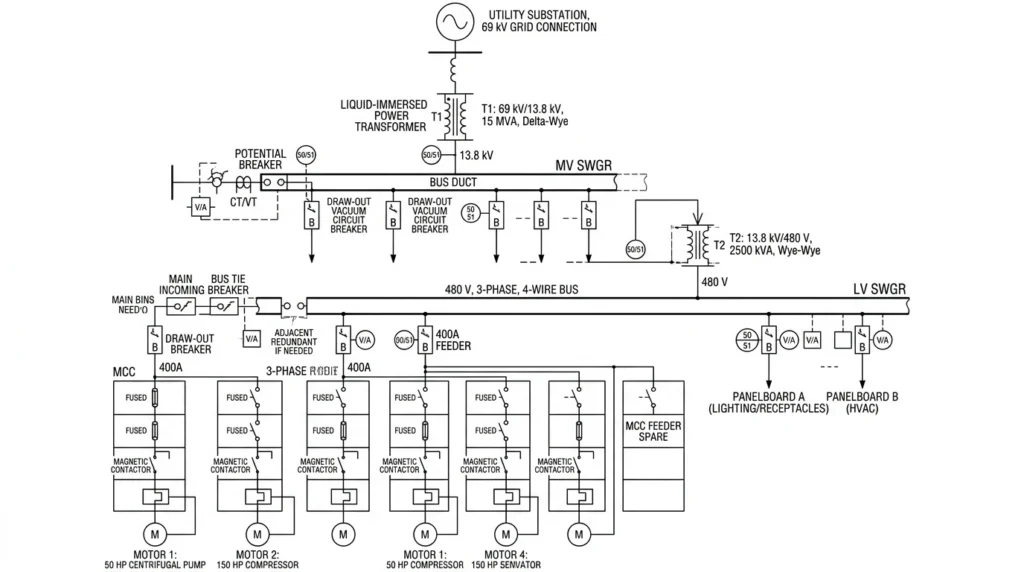
Single-Line Diagram in Industrial Power Distribution
A single-line diagram (SLD) is a simplified drawing used to represent an electrical power distribution system.
Instead of showing every conductor separately, a single line can represent a three-phase circuit.
An industrial SLD may show:
- Utility incoming supply
- Transformers
- Circuit breakers
- Busbars
- Feeders
- Generators
- MCCs
- Distribution panels
- Motors
- Protection equipment
Electrical engineers and technicians use single-line diagrams for system design, maintenance, troubleshooting, protection studies, and electrical safety planning.
Advantages of Industrial Power Distribution
A properly designed industrial power distribution system provides several important benefits.
Reliable Power Delivery
A suitable distribution arrangement helps maintain a stable supply to critical industrial loads.
Improved Electrical Safety
Circuit breakers, protective relays, grounding systems, and isolation equipment help reduce electrical hazards.
Equipment Protection
Protection systems can disconnect faulty circuits before faults cause greater damage.
Reduced Downtime
Good system design and proper fault isolation can reduce the area affected by an electrical fault.
Better Energy Management
Meters and monitoring systems help identify inefficient equipment and excessive energy consumption.
Easier Maintenance
Well-organized switchboards, MCCs, panels, and feeders make inspection and maintenance easier.
Future Expansion
A properly planned system can provide capacity for additional machines and production lines.
Disadvantages and Limitations
Industrial power distribution also has some limitations.
- High installation cost
- Complex engineering requirements
- Regular inspection and maintenance
- Requirement for trained personnel
- Large physical space for electrical equipment
- Protection coordination requirements
- High cost of major equipment
- Potential production losses during major electrical failures
The complexity increases as the facility becomes larger and more critical.
Industrial Power Distribution Applications
Industrial power distribution applications cover many sectors.
Manufacturing Plants
Manufacturing facilities use distribution systems to supply:
- Motors
- Conveyors
- CNC machines
- Welding equipment
- Assembly lines
- Automation systems
Oil and Gas Facilities
Refineries and processing plants require reliable power for:
- Pumps
- Compressors
- Process equipment
- Control systems
- Safety systems
Chemical and Fertilizer Plants
Electrical distribution supplies process equipment, motors, pumps, instrumentation, and control systems.
Mining Operations
Mining facilities can require large amounts of electrical power for:
- Crushers
- Conveyors
- Pumps
- Ventilation systems
- Excavation equipment
Data Centers
Data centers use highly reliable electrical distribution systems for:
- Servers
- Cooling systems
- UPS systems
- Networking equipment
- Emergency power systems
Renewable Energy Facilities
Solar farms, wind facilities, and battery energy storage systems require electrical distribution equipment to connect generation and storage systems to internal loads or the utility network.
Industrial vs Commercial Power Distribution
| Feature | Industrial Power Distribution | Commercial Power Distribution |
|---|---|---|
| Typical loads | Motors, machinery, process equipment | Lighting, HVAC, office equipment |
| Power demand | Often high | Usually lower |
| System complexity | Often high | Generally lower |
| Motor loads | Significant | Usually limited |
| Protection | May require extensive coordination | Depends on building requirements |
| Reliability requirements | Often critical to production | Important for building operation |
| Maintenance | Specialized industrial maintenance | Generally simpler |
| Installation cost | Often higher | Usually lower |
The actual design of either system depends on the facility, electrical loads, applicable codes, and reliability requirements.
How to Select an Industrial Power Distribution System
Selecting an industrial distribution system requires detailed electrical planning.
Assess the Electrical Load
Engineers should determine:
- Connected load
- Maximum demand
- Motor loads
- Starting currents
- Critical loads
- Future expansion requirements
Select Suitable Voltage Levels
Voltage selection depends on:
- Plant size
- Utility supply
- Equipment ratings
- Power demand
- Distribution distance
Consider Reliability
Critical processes may require:
- Multiple incoming supplies
- Backup generators
- UPS systems
- Automatic transfer systems
- Redundant feeders
Plan Protection
Protection should be designed to detect faults and isolate affected equipment while minimizing unnecessary interruptions.
Protection studies may include:
- Short-circuit analysis
- Load-flow analysis
- Protection coordination
- Arc-flash analysis where applicable
Consider Environmental Conditions
Electrical equipment may need to withstand:
- High temperature
- Dust
- Moisture
- Corrosive chemicals
- Outdoor exposure
- Hazardous locations where applicable
Common Problems in Industrial Power Distribution
Voltage Drop
Common causes:
- Long cable runs
- Undersized conductors
- High load current
- Poor connections
Possible solutions:
- Use appropriately sized conductors
- Reduce excessive cable length where practical
- Improve system voltage regulation
- Review the distribution arrangement
Overloading
Common causes:
- Too many loads connected to one feeder
- Increased production demand
- Incorrect load calculations
Possible solutions:
- Redistribute loads
- Increase system capacity where required
- Add additional feeders
- Review transformer and switchboard ratings
Circuit Breaker Tripping
Possible causes:
- Short circuit
- Ground fault
- Overload
- Faulty equipment
- Incorrect protection settings
Possible solution:
The fault should be identified and corrected before the circuit is returned to service. Repeatedly resetting a breaker without finding the cause can create serious safety risks.
Poor Power Factor
Common causes:
- Induction motors
- Transformers
- Other inductive loads
Possible solutions:
- Install appropriately designed capacitor banks
- Use power factor correction equipment
- Monitor the facility’s reactive power demand
Equipment Overheating
Common causes:
- Overloading
- Loose connections
- Poor ventilation
- Harmonic currents
- High ambient temperature
Possible solutions:
- Inspect connections
- Check loading
- Improve ventilation or cooling
- Investigate harmonic distortion where applicable
Safety Considerations
Industrial power distribution involves high electrical energy and can present serious hazards.
Important safety practices include:
- Follow applicable electrical codes and standards.
- Use appropriate personal protective equipment.
- De-energize equipment before maintenance whenever possible.
- Apply lockout/tagout procedures.
- Verify absence of voltage before working on equipment.
- Maintain proper grounding and bonding.
- Keep electrical panels accessible and properly labeled.
- Perform regular inspections and testing.
- Only qualified personnel should perform work appropriate to their training and authorization.
Electrical safety procedures should always follow the requirements applicable to the facility and jurisdiction.
Future Trends in Industrial Power Distribution
Industrial power distribution is becoming more digital, automated, and energy-aware.
Smart Power Distribution
Modern electrical systems can use intelligent meters, sensors, and protection devices to provide real-time information about electrical conditions.
Benefits can include:
- Real-time monitoring
- Remote operation
- Faster fault identification
- Energy analysis
IoT Integration
Industrial Internet of Things (IIoT) devices can collect electrical and equipment data.
This data can support:
- Predictive maintenance
- Energy monitoring
- Equipment diagnostics
- Condition monitoring
Digital Substations
Digital substation technologies can improve monitoring, protection, communication, and automation.
Renewable Energy Integration
Industrial facilities are increasingly integrating:
- Solar power
- Wind power
- Battery energy storage
- Onsite generation
These technologies require careful coordination with the existing electrical distribution system.
AI-Based Energy Management
Artificial intelligence and advanced analytics can help identify patterns in energy consumption and equipment operation.
Potential applications include:
- Load forecasting
- Energy optimization
- Anomaly detection
- Predictive maintenance
Smart Grid Connectivity
Industrial facilities are increasingly becoming active participants in modern electrical networks. Advanced controls can help facilities manage generation, storage, loads, and energy consumption more efficiently.
Frequently Asked Questions
What is industrial power distribution?
Industrial power distribution is the process of receiving electrical power from a utility or generation source and distributing it through transformers, switchgear, feeders, panels, and other equipment to industrial loads.
What are the main components of industrial power distribution?
The main components include transformers, switchgear, circuit breakers, busbars, protective relays, cables, distribution panels, MCCs, meters, capacitor banks, and grounding systems.
What voltage is commonly used in industrial power distribution?
Industrial facilities can use several voltage levels. Medium-voltage systems commonly include 3.3 kV, 6.6 kV, and 11 kV, while low-voltage systems may use 400/415 V three-phase power. The actual voltage depends on the facility and local electrical standards.
What is the purpose of an industrial transformer?
An industrial transformer changes voltage from one level to another so that electrical power can be transmitted and distributed at suitable voltage levels for different equipment.
What is an MCC in industrial power distribution?
An MCC, or Motor Control Center, is an electrical assembly used to control and protect multiple motors from a centralized location.
Why are circuit breakers used in industrial distribution systems?
Circuit breakers interrupt electrical circuits when abnormal conditions such as short circuits or overcurrent occur, helping protect equipment and conductors.
What is a single-line diagram?
A single-line diagram is a simplified representation of an electrical distribution system. It shows major equipment and electrical connections without drawing every conductor separately.
How can industrial power distribution improve energy efficiency?
Energy efficiency can be improved through proper transformer selection, appropriate cable sizing, power factor correction, load management, energy monitoring, efficient motors, and modern control systems.
What is Industrial Power Distribution?
Industrial power distribution is the process of receiving electrical energy from a utility source or power plant and distributing it safely and efficiently to various industrial loads, machines, and equipment.
In simple words, it is the electrical network inside an industrial facility that delivers power from the main source to the point where it is needed.
The system includes transformers, switchgear, circuit breakers, cables, busbars, protection devices, and control equipment.
Practical Example
Consider a steel manufacturing plant receiving power at 132 kV from the utility grid. This voltage is stepped down through transformers and distributed to motors, furnaces, lighting systems, and automation equipment operating at different voltage levels.
Without industrial power distribution, large factories would not be able to operate safely or efficiently.
Industrial Power Distribution Working Principle
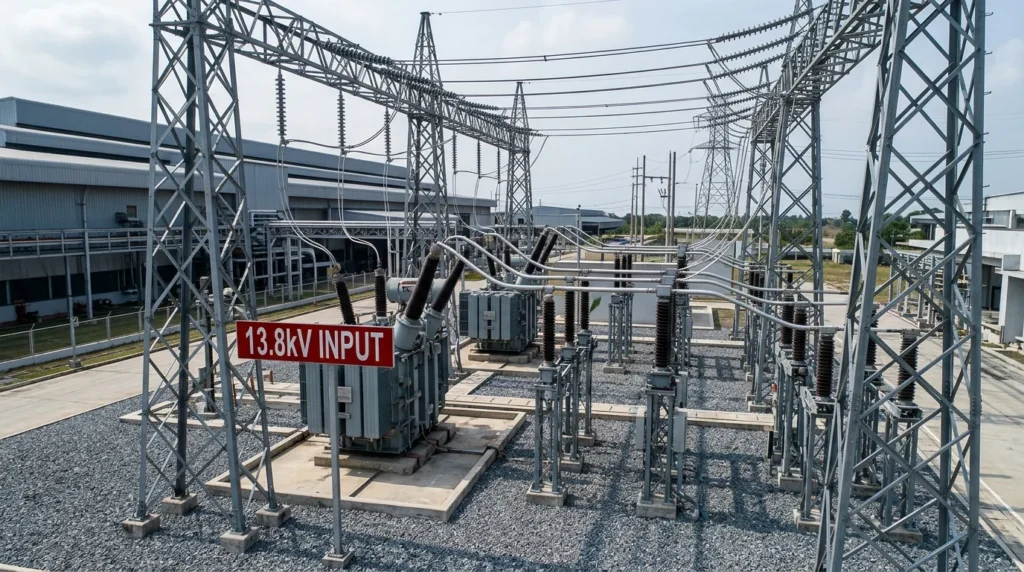
The Industrial Power Distribution Working Principle involves receiving high-voltage electrical power from the transmission network, reducing it to suitable voltage levels, and safely distributing it to various industrial loads. The process begins when electricity enters an industrial substation or grid station through high-voltage transmission lines. A power transformer then steps down the voltage to medium or low voltage levels required by industrial equipment. The electrical power passes through switchgear, circuit breakers, protective relays, and busbars, which control power flow and protect the system from faults such as short circuits and overloads. Finally, electricity is supplied through distribution panels and feeders to motors, machinery, lighting systems, HVAC units, and other industrial equipment. This organized distribution system ensures a reliable, efficient, and uninterrupted power supply while maintaining the safety of both electrical equipment and personnel.
The industrial power distribution working principle involves receiving electrical power, controlling it, protecting it, and delivering it to various loads within an industrial facility.
Simple Analogy
Think of a city water supply system:
- A main pipeline carries water into the city.
- Smaller pipes distribute water to homes and businesses.
- Valves control the flow.
Industrial power distribution works similarly by distributing electricity through a network of equipment and cables.
Step-by-Step Working Principle
Power is Received
Electrical energy enters the industrial facility from:
- Utility grid
- Generator system
- Renewable energy source
Voltage Transformation
Transformers adjust voltage levels according to plant requirements.
For example:
- 132 kV to 11 kV
- 11 kV to 415 V
Power Protection
Switchgear and protection devices monitor electrical conditions.
They protect against:
- Short circuits
- Overloads
- Ground faults
Power Distribution
Electrical energy is distributed through:
- Busbars
- Distribution panels
- Cable networks
Load Supply
Power reaches:
- Motors
- Pumps
- Compressors
- HVAC systems
- Lighting systems
Continuous Monitoring
Modern systems continuously monitor:
- Voltage
- Current
- Power factor
- Energy consumption
Key Features of Industrial Power Distribution Working Principle
- Safe power delivery
- Voltage control
- Fault protection
- Efficient energy management
- Reliable operation
Types / Classification of Industrial Power Distribution
Industrial distribution systems can be classified based on voltage level and system arrangement.
High Voltage Distribution System
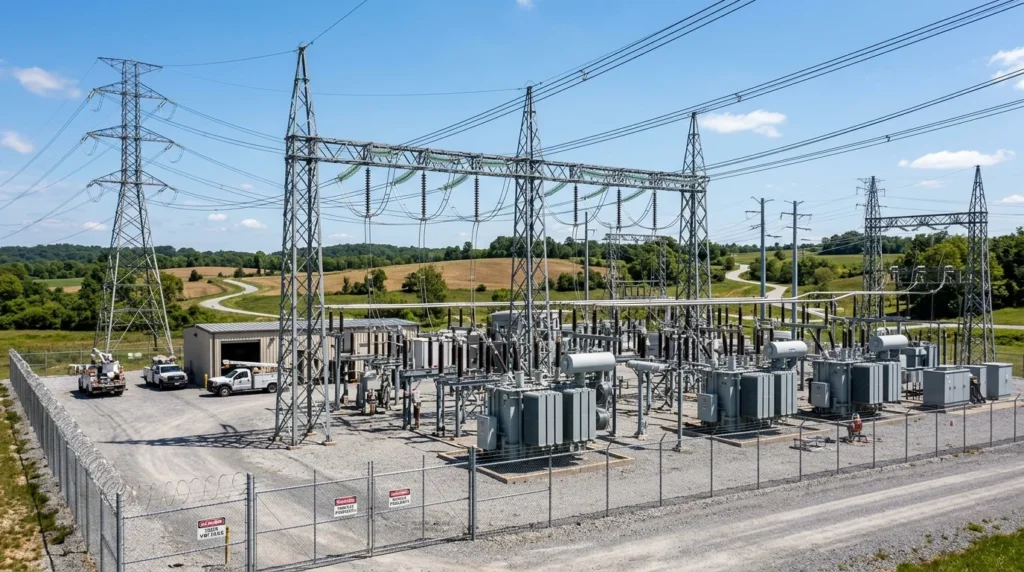
A High Voltage Distribution System is a part of the electrical power network that delivers electricity from transmission substations or grid stations to local distribution substations using high voltage levels, typically 33kV, 66kV, or 132kV. Transmitting power at high voltage reduces current flow, which minimizes power losses and improves the overall efficiency of the electrical system. The system consists of power transformers, transmission lines, switchgear, circuit breakers, busbars, protective relays, and distribution feeders that work together to ensure a safe and reliable power supply. After reaching the distribution substation, the voltage is stepped down to lower levels such as 11kV and finally to 400V/230V for residential, commercial, and industrial consumers. High voltage distribution systems play a vital role in maintaining voltage stability, supporting large electrical loads, and ensuring uninterrupted electricity delivery across cities, industries, and modern infrastructure.
These systems distribute power at high voltage levels.
Features
- Long-distance distribution
- Lower transmission losses
Applications
- Large industrial plants
- Heavy manufacturing facilities
Medium Voltage Distribution System
Used for internal plant power distribution.
Voltage Range
- Typically 1 kV to 33 kV
Applications
- Industrial substations
- Process industries
Low Voltage Distribution System
Provides power directly to equipment.
Voltage Range
- Up to 1000 V
Applications
- Motors
- Lighting
- Control systems
Radial Distribution System
Power flows through a single path.
Advantages
- Simple design
- Lower installation cost
Applications
- Small industries
Ring Main Distribution System
Power can flow from multiple directions.
Advantages
- Improved reliability
Applications
- Large industrial facilities
Network Distribution System
Uses interconnected feeders.
Advantages
- Highest reliability
Applications
- Critical industrial operations
Main Components of Industrial Power Distribution
Understanding system components is essential for every electrical professional.
Transformers
Transformers adjust voltage levels.
Function
- Voltage step-up
- Voltage step-down
Switchgear
Switchgear controls and protects electrical circuits.
Function
- Isolation
- Protection
- Switching
Circuit Breakers
Automatically disconnect faulty circuits.
Function
- Fault protection
Busbars
Conduct large amounts of electrical current.
Function
- Power distribution
Distribution Panels
Provide organized power distribution.
Function
- Load management
Cables and Conductors
Carry electrical power throughout the facility.
Function
- Power transmission
Protective Relays
Monitor system conditions.
Function
- Fault detection
Energy Meters
Measure electrical consumption.
Function
- Energy monitoring
Advantages
Understanding industrial power distribution advantages and disadvantages helps engineers design better systems.
Advantages of Industrial Power Distribution
- Reliable power delivery
- Improved safety
- Efficient energy management
- Better equipment protection
- Reduced downtime
- Flexible expansion capability
- Improved productivity
- Easier fault isolation
Real-World Benefits
Continuous Production
Factories experience fewer interruptions.
Improved Safety
Protection systems reduce electrical hazards.
Energy Efficiency
Power losses are minimized.
Equipment Reliability
Electrical equipment operates within safe limits.
Disadvantages / Limitations
Industrial power distribution systems also have certain limitations.
Disadvantages of Industrial Power Distribution
- High installation cost
- Complex design requirements
- Regular maintenance needed
- Skilled personnel required
- Large space requirements
- Protection coordination challenges
Practical Limitations
Initial Investment
Large facilities require significant capital investment.
Maintenance Costs
Regular inspections and testing are necessary.
System Complexity
Troubleshooting can be difficult in large installations.
Applications
Industrial power distribution applications extend across many sectors.
Manufacturing Industries
- Automotive plants
- Textile mills
- Steel industries
Oil and Gas Facilities
- Refineries
- Processing plants
- Drilling operations
Chemical Industries
- Chemical processing units
- Fertilizer plants
Mining Operations
- Crushers
- Conveyors
- Excavation equipment
Data Centers
- Server systems
- Cooling equipment
Renewable Energy Facilities
- Solar farms
- Wind farms
- Energy storage systems
Industrial power distribution applications continue expanding as industries adopt automation and digital technologies.
Comparison Section
Difference Between Industrial Power Distribution and Commercial Power Distribution
| Feature | Industrial Power Distribution | Commercial Power Distribution |
| Load Type | Heavy machinery | Lighting and office equipment |
| Power Demand | Very high | Moderate |
| Voltage Levels | Higher | Lower |
| System Complexity | High | Moderate |
| Protection Requirements | Extensive | Standard |
| Reliability Needs | Critical | Important |
| Maintenance Requirements | Higher | Lower |
| Installation Cost | Higher | Lower |
Understanding the difference between industrial power distribution and commercial power distribution helps in selecting the appropriate system design.
Selection Guide
Choosing the right industrial power distribution system requires careful planning.
Load Assessment
Calculate:
- Connected load
- Maximum demand
- Future expansion requirements
Voltage Level Selection
Choose suitable voltage based on:
- Plant size
- Equipment requirements
Reliability Requirements
Determine acceptable downtime limits.
Protection Requirements
- Circuit breakers
- Protective relays
- Surge protection devices
Environmental Conditions
- Temperature
- Dust
- Moisture
- Chemical exposure
Tips for Beginners
- Learn basic power distribution concepts.
- Understand single-line diagrams.
- Study protection systems carefully.
- Follow electrical safety standards.
- Gain practical experience with distribution panels.
Common Problems & Solutions
Voltage Drop
Causes
- Long cable runs
- Undersized conductors
Solution
- Increase conductor size
- Improve voltage regulation
Overloading
Causes
- Excessive equipment connection
Solution
- Balance loads
- Upgrade distribution capacity
Circuit Breaker Tripping
Causes
- Short circuit
- Ground fault
- Overload
Solution
- Locate and remove fault
Power Factor Problems
Causes
- Inductive loads
Solution
- Install capacitor banks
Equipment Overheating
Causes
- Poor ventilation
- Overloading
Solution
- Improve cooling
- Reduce load
Future Trends
Industrial power distribution is evolving rapidly with advanced technologies.
Smart Power Distribution Systems
Modern systems use intelligent monitoring devices.
Benefits
- Real-time monitoring
- Remote control
IoT Integration
Sensors collect data from electrical equipment.
Functions
- Predictive maintenance
- Energy analysis
Digital Substations
Digital technologies improve:
- Protection
- Monitoring
- Automation
Renewable Energy Integration
Future industrial systems will increasingly integrate:
- Solar power
- Wind energy
- Battery storage
AI-Based Energy Management
Artificial intelligence helps optimize:
- Load balancing
- Energy efficiency
- Fault prediction
Smart Grid Connectivity
Industrial facilities are becoming part of intelligent electrical networks that improve reliability and sustainability.
The future of industrial power distribution applications is closely connected with automation, renewable energy, and digital transformation.
Conclusion
Industrial power distribution is the foundation of every modern industrial facility. It ensures that electrical energy is delivered safely, efficiently, and reliably from the power source to machines, equipment, and production systems. Through transformers, switchgear, protection devices, cables, and distribution panels, industries can maintain continuous operation while protecting personnel and equipment.
This article explained the industrial power distribution working principle, types, components, applications, advantages and disadvantages, troubleshooting methods, and future trends in simple and practical language. You also learned the difference between industrial and commercial power distribution systems and how engineers select suitable distribution networks.
For electrical students, engineers, technicians, and beginners, understanding industrial power distribution is essential because it forms the backbone of industrial electrical engineering. As industries continue adopting smart technologies, renewable energy, and automation, advanced power distribution systems will become even more important in the future.