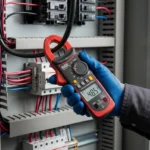

Imagine an electrician troubleshooting a faulty electrical outlet in a home. The lights are not working, and the homeowner suspects a wiring problem. Instead of guessing, the electrician takes out a digital multimeter, measures the voltage, checks continuity, and quickly identifies the fault. Within minutes, the issue is diagnosed and repaired safely.
This simple example shows why a digital multimeter is one of the most important tools in electrical engineering and maintenance. Whether you are testing batteries, checking electrical circuits, troubleshooting motors, or measuring resistance, a digital multimeter provides accurate and reliable measurements.
For electrical students, engineers, technicians, and beginners, learning how a digital multimeter works is essential. It is often the first measuring instrument used in electrical laboratories, workshops, industrial plants, and field maintenance tasks. Understanding its operation helps build strong troubleshooting and diagnostic skills.
In this article, you will learn what a digital multimeter is, the digital multimeter working principle, types, components, applications, advantages and disadvantages, selection tips, troubleshooting methods, and future developments. The explanations are simple, practical, and designed to help you understand the instrument like a professional electrical engineer.
What is Digital Multimeter?
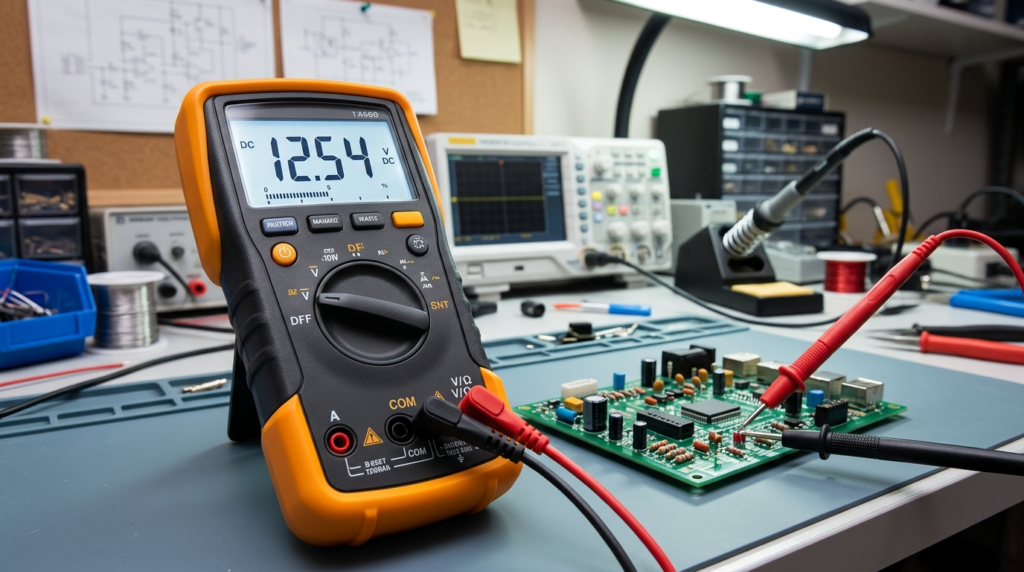
A Digital Multimeter (DMM) is an electronic measuring instrument used to measure various electrical quantities such as voltage, current, resistance, continuity, and other electrical parameters.
In simple words, a digital multimeter combines multiple measuring devices into a single instrument.
It replaces separate instruments such as:
- Voltmeter
- Ammeter
- Ohmmeter
Practical Example
Suppose a mobile phone charger is not working properly. A technician can use a digital multimeter to check whether the charger is receiving voltage, whether the output voltage is correct, and whether any internal component has failed.
Because of its versatility, the digital multimeter is considered an essential tool for every electrician and engineer.
Digital Multimeter Working Principle
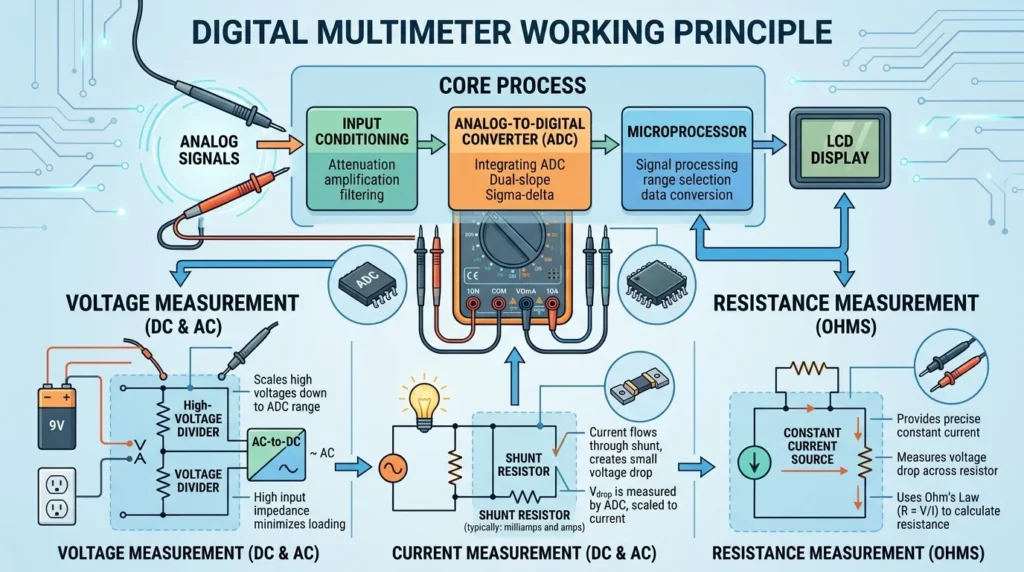
A digital multimeter (DMM) works on the principle of converting electrical quantities such as voltage, current, and resistance into digital signals using electronic circuits and an Analog-to-Digital Converter (ADC). When the test probes are connected to a circuit, the input signal is processed, measured, and converted into a digital value, which is then displayed on the LCD screen. Digital multimeters provide accurate and reliable measurements and are widely used for testing, troubleshooting, and maintaining electrical and electronic circuits. They also include protection features that help ensure safe operation during measurements.
The digital multimeter working principle is based on converting electrical signals into digital values that can be displayed on a screen.
Simple Analogy
Think of a translator converting one language into another.
- The electrical signal is the input language.
- The digital display is the output language.
The multimeter converts electrical quantities into readable numerical values.
Step-by-Step Working Principle
Input Signal is Applied
The electrical quantity being measured enters the multimeter through the test probes.
Signal Conditioning
The internal circuit adjusts the signal according to the selected measurement mode.
Examples:
- Voltage measurement
- Current measurement
- Resistance measurement
Analog-to-Digital Conversion
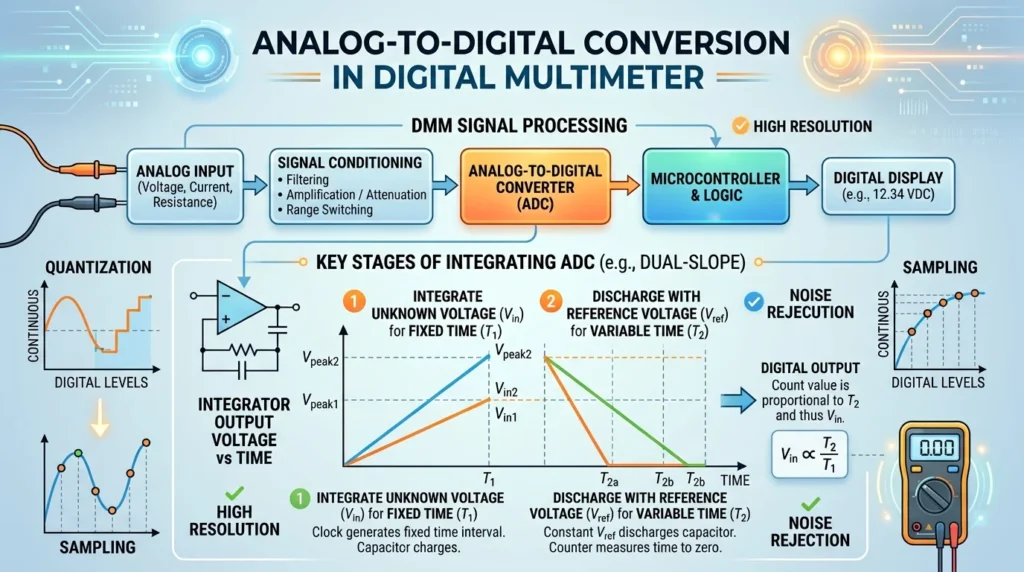
Analog-to-Digital Conversion (ADC) is the process by which a digital multimeter converts an analog electrical signal into a digital value for display. When the test probes measure voltage, current, or resistance, the input signal is first conditioned by the internal circuitry and then sent to the Analog-to-Digital Converter. The ADC samples the analog signal, converts it into a binary digital number, and sends the result to the display unit. This process enables the digital multimeter to provide accurate, stable, and easy-to-read measurements, making it an essential feature of modern electrical and electronic testing instruments.
The analog electrical signal is converted into digital form.
Microprocessor Processing
The internal processor calculates the measurement value.
Display Output
The calculated value is displayed on the LCD screen.
Key Features of Digital Multimeter Working Principle
- High measurement accuracy
- Digital display
- Fast readings
- Multiple measurement functions
- Easy operation
Types / Classification
Different types of digital multimeters are available depending on application requirements.
Handheld Digital Multimeter
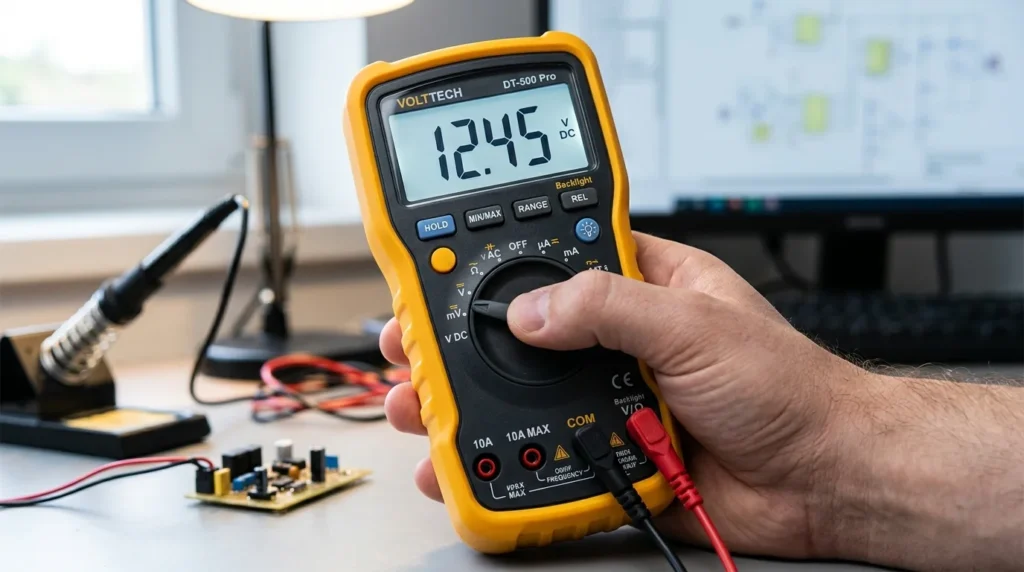
A handheld digital multimeter is a portable electronic measuring instrument used to measure electrical quantities such as voltage, current, resistance, continuity, and, in many models, capacitance, frequency, and diode performance. It features a digital display, rotary selector switch, and test probes, allowing users to perform accurate and reliable measurements in electrical and electronic circuits. Handheld digital multimeters are lightweight, battery-operated, and easy to carry, making them ideal for fieldwork, maintenance, troubleshooting, and laboratory applications. They are widely used by electricians, technicians, engineers, and students because of their accuracy, safety, and ease of use.
The most common type.
Features
- Portable
- Battery operated
Applications
- Field maintenance
- Electrical troubleshooting
Bench Digital Multimeter
Designed for laboratory use.
Features
- High accuracy
- Stable measurements
Applications
- Research laboratories
- Testing facilities
Auto-Ranging Digital Multimeter
Automatically selects measurement range.
Advantages
- Easy operation
- Reduced measurement errors
Applications
- General electrical work
Manual-Ranging Digital Multimeter
Requires manual range selection.
Advantages
- Lower cost
Applications
- Educational laboratories
Clamp Digital Multimeter
Combines clamp meter and multimeter functions.
Applications
- Current measurements
- Industrial maintenance
True RMS Digital Multimeter
Provides accurate readings for complex waveforms.
Applications
- Industrial electronics
- Variable frequency drives
Main Components
Understanding multimeter components helps users operate the instrument correctly.
Display Screen
Shows measured values.
Function
- Displays voltage, current, resistance, and other readings
Rotary Selector Switch
Used to select measurement mode.
Function
- Voltage
- Current
- Resistance
- Continuity
Test Probes
Connect the meter to the circuit.
Function
- Transfer electrical signals to the meter
Internal Circuitry
Processes measurement signals.
Function
- Signal conditioning
- Data conversion
Analog-to-Digital Converter (ADC)
Converts analog signals into digital values.
Function
- Enables digital display operation
Battery
Provides operating power.
Function
- Powers display and electronics
Protective Fuse
Protects the meter from overload.
Function
- Prevents damage during incorrect measurements
Advantages
Understanding digital multimeter advantages and disadvantages helps users evaluate the instrument effectively.
Advantages of Digital Multimeter
- High accuracy
- Easy-to-read display
- Multiple measurement functions
- Portable design
- Fast measurements
- Reliable performance
- Low maintenance
- Safe operation
Real-World Benefits
Faster Troubleshooting
Faults can be identified quickly.
Improved Safety
Accurate measurements reduce electrical hazards.
Reduced Equipment Costs
One instrument performs multiple measurement tasks.
Better Maintenance
Supports preventive maintenance programs.
Disadvantages / Limitations
Although highly useful, digital multimeters have some limitations.
Digital Multimeter Advantages and Disadvantages
Disadvantages
- Requires battery power
- Sensitive to impact
- Limited current measurement range
- Higher cost than basic analog meters
- Incorrect settings may damage internal fuse
Practical Limitations
Battery Dependence
A weak battery may affect performance.
Environmental Conditions
Extreme temperatures can influence accuracy.
Learning Curve
Beginners must understand measurement ranges and settings.
Digital Multimeter Applications
Digital multimeter applications cover nearly every field of electrical engineering.
Residential Applications
- Home wiring inspection
- Appliance testing
- Battery testing
Industrial Applications
- Motor maintenance
- Equipment troubleshooting
- Control panel testing
Electronics Applications
- Circuit testing
- PCB diagnostics
- Component verification
Automotive Applications
- Battery testing
- Charging system inspection
Renewable Energy Applications
- Solar system testing
- Inverter diagnostics
Educational Applications
- Laboratory experiments
- Technical training
Digital multimeter applications continue growing as electrical and electronic systems become more advanced.
Comparison Section
Difference Between Digital Multimeter and Analog Multimeter
| Feature | Digital Multimeter | Analog Multimeter |
| Display | Digital LCD | Pointer Scale |
| Accuracy | Higher | Lower |
| Reading Speed | Fast | Moderate |
| Power Requirement | Battery Required | Minimal |
| Ease of Reading | Very Easy | Requires Interpretation |
| Measurement Functions | More Functions | Fewer Functions |
| Maintenance | Low | Moderate |
| Popularity | Widely Used | Limited Use |
Understanding the difference between analog multimeter and digital multimeter helps users select the appropriate instrument.
Selection Guide
Choosing the right digital multimeter depends on application needs.
Measurement Requirements
Determine whether you need:
- Voltage measurement
- Current measurement
- Resistance measurement
Accuracy Level
Professional applications require higher accuracy.
Safety Rating
Choose appropriate CAT ratings for electrical environments.
Auto-Ranging Feature
Recommended for beginners.
Additional Functions
- Frequency measurement
- Temperature measurement
- Capacitance measurement
Tips for Beginners
- Always start with the highest range.
- Verify probe connections.
- Learn safety procedures.
- Read the user manual carefully.
- Practice on low-voltage circuits first.
Common Problems & Solutions
No Display
Causes
- Dead battery
Solution
- Replace battery
Incorrect Readings
Causes
- Wrong measurement range
Solution
- Select correct range
Continuity Test Not Working
Causes
- Blown fuse
Solution
- Replace fuse
Unstable Readings
Causes
- Loose probe connections
Solution
- Secure connections
Meter Not Measuring Current
Causes
- Damaged internal fuse
Solution
- Inspect and replace fuse
Future Trends
Digital multimeter technology continues evolving.
Smart Digital Multimeters
Modern meters now include:
- Wireless connectivity
- Mobile app integration
IoT Integration
Future meters will connect directly to cloud-based monitoring systems.
Data Logging
Advanced meters automatically store measurements.
AI-Assisted Diagnostics
Future instruments may identify electrical faults automatically.
Enhanced Safety Features
Improved protection systems will increase user safety.
Renewable Energy Compatibility
Modern meters are being optimized for:
- Solar power systems
- Battery storage systems
- Electric vehicles
The future of digital multimeter applications is closely linked with smart electrical systems and digital maintenance technologies.
Conclusion
A digital multimeter is one of the most essential instruments in electrical engineering because it combines voltage, current, resistance, continuity, and other measurements into a single device. Its accuracy, ease of use, and versatility make it valuable for students, technicians, engineers, and maintenance professionals.
This article explained the digital multimeter working principle, types, components, applications, advantages and disadvantages, troubleshooting methods, and future developments in simple and practical language. You also learned the difference between analog multimeter and digital multimeter and how to choose the right instrument for different applications.
For anyone entering the electrical field, mastering the use of a digital multimeter is a fundamental skill. It improves troubleshooting ability, enhances safety, and provides the confidence needed to work effectively with electrical and electronic systems.