
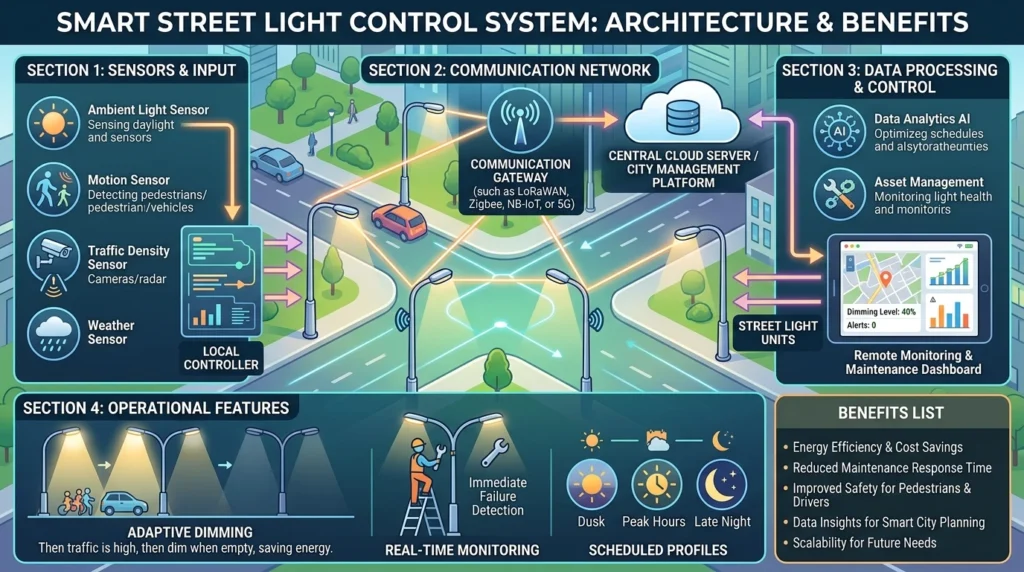

Imagine driving on a highway at sunset. As daylight gradually fades, the street lights automatically switch ON one by one, providing safe visibility for drivers and pedestrians. Later, when the sun rises in the morning, the lights automatically turn OFF, preventing unnecessary energy consumption. This automatic operation is made possible by a Street Light Control System.
Street lighting is an essential part of modern infrastructure. It improves road safety, reduces accidents, enhances public security, and supports transportation activities during nighttime. However, operating thousands of street lights continuously can result in significant electricity consumption and maintenance costs. This is why efficient street light control systems have become increasingly important for municipalities, industries, smart cities, and commercial facilities.
For electrical students, engineers, technicians, and beginners, understanding street light control systems is valuable because these systems combine electrical engineering, automation, sensors, control circuits, and energy management technologies. They are widely used in urban development projects and smart city applications.
In this article, you will learn the Street Light Control System working principle, types, components, applications, advantages and disadvantages, troubleshooting methods, selection guidelines, and future technological developments in simple and practical language.
What is a Street Light Control System?
A Street Light Control System is an electrical and electronic system used to automatically or manually control the operation of street lights based on environmental conditions, timing schedules, or intelligent monitoring systems.
In simple words, it is a system that manages when street lights turn ON, OFF, brighten, or dim.
The primary goal is to provide proper illumination while reducing energy consumption and maintenance costs.
Practical Example
A photocell sensor installed on a street light pole detects decreasing sunlight during the evening. When the light level falls below a preset value, the controller automatically switches ON the street lights. At sunrise, the system switches them OFF automatically.
This simple automation saves electricity and eliminates the need for manual operation.
Street Light Control System Working Principle
The Street Light Control System working principle is based on detecting environmental conditions or programmed schedules and controlling street lights accordingly.
Simple Analogy
Think of automatic headlights in a modern car.
When it becomes dark, the headlights automatically turn ON.
When daylight returns, they switch OFF.
A street light control system works in a similar manner but controls multiple lighting units simultaneously.
Step-by-Step Street Light Control System Working Principle
Environmental Monitoring
Sensors continuously monitor surrounding light conditions.
Common sensors include:
- LDR (Light Dependent Resistor)
- Photocell sensors
- Light intensity sensors
Signal Detection
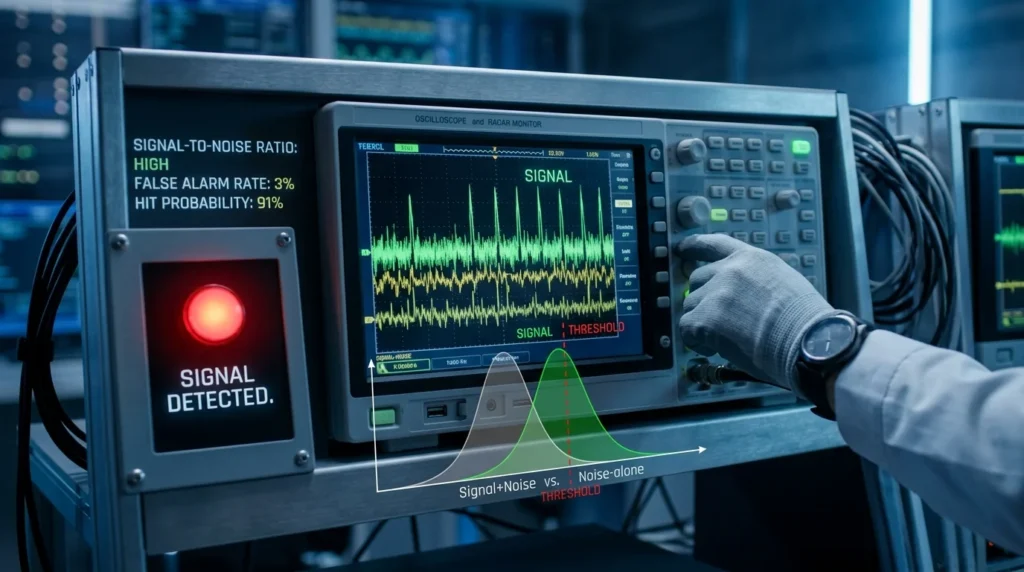
Signal detection is the process of identifying the presence of a signal in the presence of background noise or interference. It helps determine whether a received signal contains useful information or is simply random noise. Signal detection is widely used in fields such as telecommunications, radar systems, medical diagnostics, psychology, and engineering. The effectiveness of signal detection depends on factors such as signal strength, noise level, and the sensitivity of the detection system. Accurate signal detection improves decision-making, enhances communication reliability, and reduces the chances of false alarms or missed detections.
The sensor detects changes in ambient light levels.
Controller Processing
The controller compares the detected light level with preset values.
Decision Making
The controller determines whether the lights should be:
- Turned ON
- Turned OFF
- Dimmed
- Brightened
Switching Operation
The controller activates relays, contactors, or electronic switches.
Street Light Operation
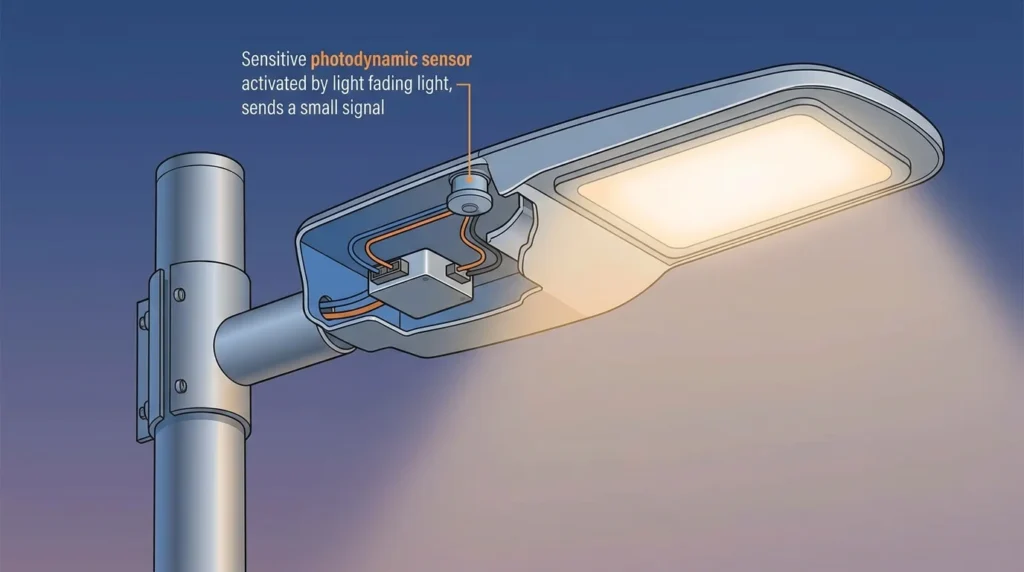
Street light operation is the automatic or manual control of street lights to provide illumination during nighttime and low-light conditions. Modern street lighting systems commonly use light sensors (LDRs), timers, or smart controllers to switch the lights on at sunset and off at sunrise. This automation helps save energy, reduces electricity costs, and minimizes human effort. Street lights improve road safety, enhance visibility for drivers and pedestrians, and contribute to public security by reducing the risk of accidents and crime in urban and rural areas.
Street lights operate according to system commands.
Continuous Monitoring
The system continuously checks conditions and adjusts operation automatically.
Key Features of Street Light Control System Working Principle
- Automatic operation
- Energy saving
- Improved lighting efficiency
- Reduced manual intervention
- Enhanced safety
Types / Classification
Street light control systems are available in several configurations.
Manual Street Light Control System
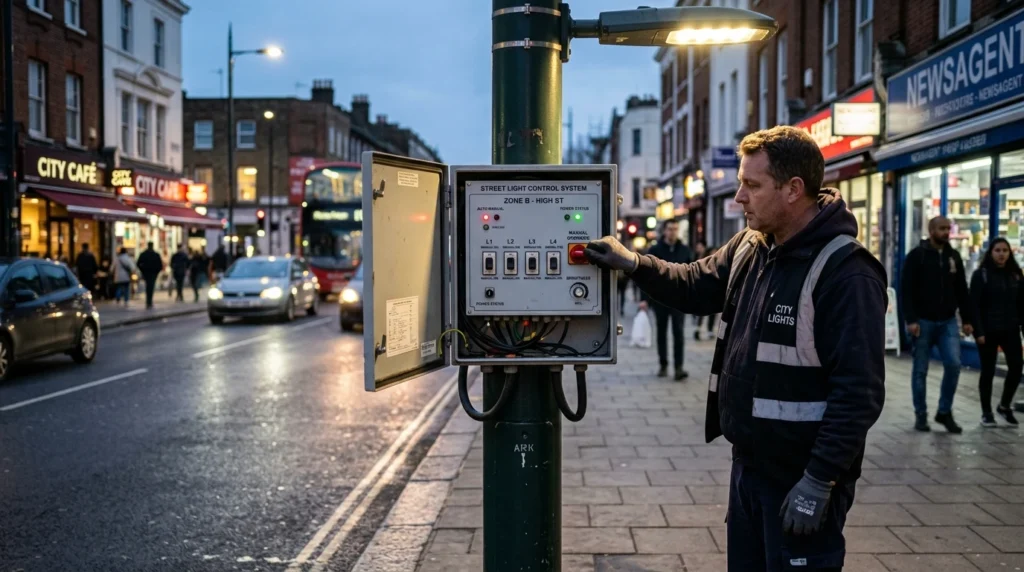
vA manual street light control system is a simple method of operating street lights in which they are switched ON and OFF manually by an operator using a switch, circuit breaker, or control panel. The system does not rely on automatic sensors or timers, so the lights are controlled according to a fixed schedule or the operator’s judgment. Manual street light control systems are easy to install, low in cost, and require minimal equipment, making them suitable for small towns, rural areas, temporary installations, and locations with limited automation. However, they require continuous human involvement and are less energy-efficient than automatic control systems because lights may be switched on or off at incorrect times, leading to unnecessary energy consumption.
Requires human operation.
Features
- Simple design
- Low installation cost
Applications
- Small facilities
- Temporary lighting systems
Photocell-Based Street Light Control System
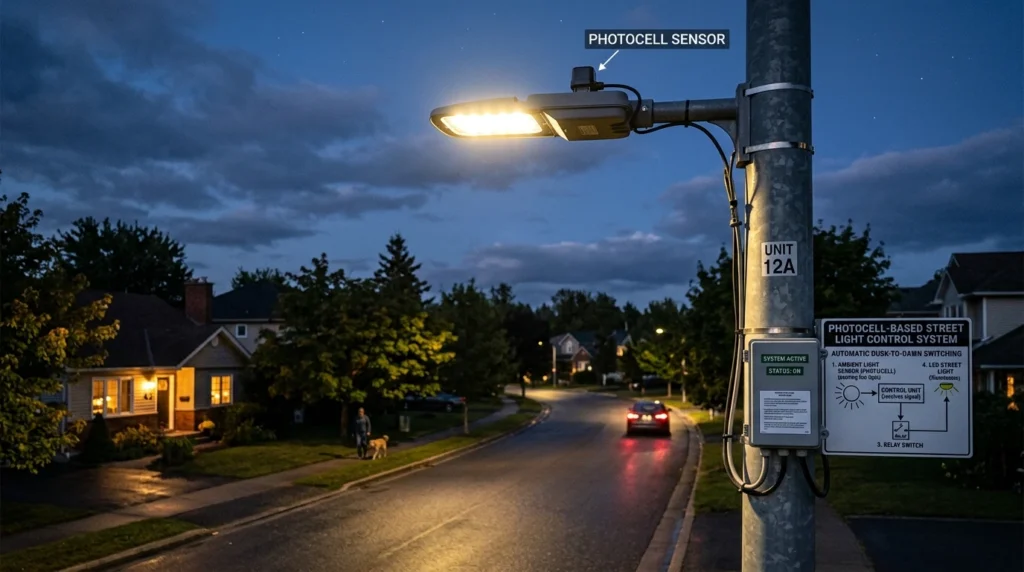
A photocell-based street light control system is an automatic lighting system that uses a photocell (light sensor) to switch street lights ON at sunset and OFF at sunrise. The photocell continuously monitors the surrounding light intensity. When the natural light level falls below a preset value, the sensor sends a signal to the control circuit or relay, which turns the street lights on automatically. As daylight increases in the morning, the photocell detects the higher light intensity and switches the lights off. This system eliminates the need for manual operation, improves energy efficiency, reduces electricity consumption, and ensures reliable lighting. Photocell-based street light control systems are widely used on roads, highways, parking areas, residential communities, public parks, and commercial complexes for convenient and automatic outdoor lighting.
Uses light sensors for automatic operation.
Features
- Automatic switching
- Reliable operation
Applications
- Public streets
- Residential communities
Timer-Based Street Light Control System
Uses preset timing schedules.
Features
- Predictable operation
- Easy programming
Applications
- Industrial facilities
- Parks
Motion Sensor-Based Street Light Control System
Uses occupancy detection.
Features
- Energy-efficient operation
- Smart lighting control
Applications
- Parking areas
- Pathways
PLC-Based Street Light Control System
Uses programmable logic controllers.
Features
- Advanced control
- Flexible programming
Applications
- Smart cities
- Industrial complexes
Smart IoT-Based Street Light Control System
Uses internet-connected monitoring and control.
Features
- Remote operation
- Real-time monitoring
Applications
- Smart city infrastructure
- Municipal networks
Main Components
Understanding system components is important for installation and maintenance.
Light Sensor
Detects ambient light levels.
Function
- Measures environmental brightness
Controller Unit
Acts as the control center.
Function
- Processes sensor data
Relay or Contactor
Controls power to street lights.
Function
- Switching operation
Street Light Fixtures
Provide illumination.
Function
- Lighting roads and public areas
Power Supply Unit
Provides operating power.
Function
- Energizes the control system
Timer Module
Controls operation based on schedules.
Function
- Time-based switching
Communication Module
Supports remote monitoring.
Function
- Data transmission
Protection Devices
Ensure electrical safety.
Function
- Protect against faults and surges
Advantages
Understanding Street Light Control System advantages and disadvantages helps engineers evaluate system performance.
Advantages of Street Light Control System
- Significant energy savings
- Automatic operation
- Reduced maintenance costs
- Improved road safety
- Longer lamp life
- Better lighting management
- Lower operating expenses
- Smart monitoring capability
Real-World Benefits
Reduced Electricity Bills
Lights operate only when required.
Increased Equipment Life
Optimized operation reduces wear.
Improved Public Safety
Proper illumination improves visibility.
Lower Labor Costs
Manual switching is eliminated.
Disadvantages / Limitations
Although highly useful, these systems have certain limitations.
Street Light Control System Advantages and Disadvantages
Disadvantages
- Higher initial installation cost
- Sensor maintenance requirements
- Dependence on electronic components
- Communication challenges in remote areas
- Technical expertise required
Practical Limitations
Sensor Failure
Faulty sensors may cause improper operation.
Environmental Effects
Dust and weather can affect sensor performance.
Communication Issues
Smart systems depend on reliable network connections.
Street Light Control System Applications
Street Light Control System applications continue expanding in modern infrastructure.
Municipal Applications
- City roads
- Public streets
- Highways
Residential Applications
- Housing societies
- Gated communities
Commercial Applications
- Shopping centers
- Business districts
Industrial Applications
- Factory premises
- Industrial parks
Transportation Applications
- Airports
- Railway stations
- Bus terminals
Smart City Applications
- Intelligent urban lighting
- Energy-efficient infrastructure
Street Light Control System applications are becoming essential for sustainable urban development.
Comparison Section
Difference Between Manual Street Lighting and Automatic Street Light Control System
| Feature | Manual Street Lighting | Street Light Control System |
| Operation | Human-controlled | Automatic |
| Energy Efficiency | Lower | Higher |
| Labor Requirement | High | Low |
| Reliability | Moderate | High |
| Monitoring | Manual | Automatic |
| Response Time | Slow | Fast |
| Maintenance Cost | Higher | Lower |
| Smart Features | None | Available |
Understanding the difference between manual street lighting and automatic street light control system helps engineers select the most suitable solution.
Selection Guide
Choosing the right street light control system requires careful planning.
Project Size
Determine the number of street lights.
Automation Requirements
Choose between manual, automatic, or smart systems.
Energy Saving Goals
Evaluate expected electricity savings.
Communication Needs
Consider remote monitoring requirements.
Environmental Conditions
Assess climate and installation location.
Tips for Beginners
- Choose reliable sensors.
- Use proper surge protection.
- Plan future expansion.
- Select energy-efficient LED lighting.
- Conduct regular maintenance.
Common Problems & Solutions
Street Lights Not Turning ON
Causes
- Sensor failure
- Power supply interruption
Solution
- Inspect sensor operation
- Verify power availability
Street Lights Remain ON During Daytime
Causes
- Faulty photocell sensor
Solution
- Replace or recalibrate sensor
Flickering Lights
Causes
- Loose connections
- Voltage fluctuations
Solution
- Tighten connections
- Check power quality
Communication Failure
Causes
- Network issues
Solution
- Inspect communication modules
Excessive Energy Consumption
Causes
- Incorrect programming
Solution
- Optimize operating schedules
Future Trends
Street lighting technology continues evolving rapidly.
Smart City Integration
Future systems will be fully integrated into smart city infrastructure.
IoT-Based Monitoring
Remote control and monitoring will become standard features.
Artificial Intelligence
AI will optimize lighting based on traffic and weather conditions.
Adaptive Lighting
Light intensity will adjust automatically according to road usage.
Solar-Powered Street Lighting
Renewable energy integration will increase sustainability.
Predictive Maintenance
Advanced analytics will identify problems before failures occur.
The future of Street Light Control System applications is closely connected with intelligent transportation systems, smart cities, renewable energy integration, and digital infrastructure development.
Conclusion
A Street Light Control System is an essential technology for modern lighting infrastructure. By automatically controlling street lights based on environmental conditions, schedules, or intelligent monitoring systems, it improves safety, reduces energy consumption, and lowers maintenance costs. These systems play a critical role in smart cities, industrial facilities, transportation networks, and public infrastructure projects.
This article explained the Street Light Control System working principle, types, components, applications, advantages and disadvantages, troubleshooting methods, and future developments in simple and practical language. You also learned the difference between manual street lighting and automated street light control systems and how to select the right system for different projects.
For electrical students, engineers, technicians, and beginners, understanding street light control systems provides valuable knowledge of automation, energy management, and modern electrical infrastructure. As cities continue adopting smart technologies, these systems will become even more important in creating efficient and sustainable urban environments.