
Imagine charging your smartphone in the morning and using it throughout the day without worrying about the battery running out quickly. The same battery technology that powers your smartphone is also used in electric vehicles, solar energy storage systems, laptops, medical devices, and even spacecraft. This technology is known as Lithium-Ion Battery Technology, one of the most important innovations in modern electrical and electronic engineering.
As the world moves toward renewable energy, electric transportation, and portable electronic devices, efficient energy storage has become more important than ever. Traditional battery technologies often suffer from low energy density, heavy weight, and shorter service life. Lithium-ion batteries have solved many of these challenges by providing high energy storage capacity, fast charging capability, and longer operational life.
For electrical students, engineers, technicians, and beginners, understanding lithium-ion battery technology is essential because it plays a major role in modern power systems, electric vehicles, smart devices, and renewable energy projects. Knowledge of this technology helps professionals design safer, more efficient, and reliable energy systems.
In this article, you will learn the Lithium-Ion Battery Technology working principle, types, components, applications, advantages and disadvantages, troubleshooting methods, selection guidelines, and future industry developments.
What is Lithium-Ion Battery Technology?
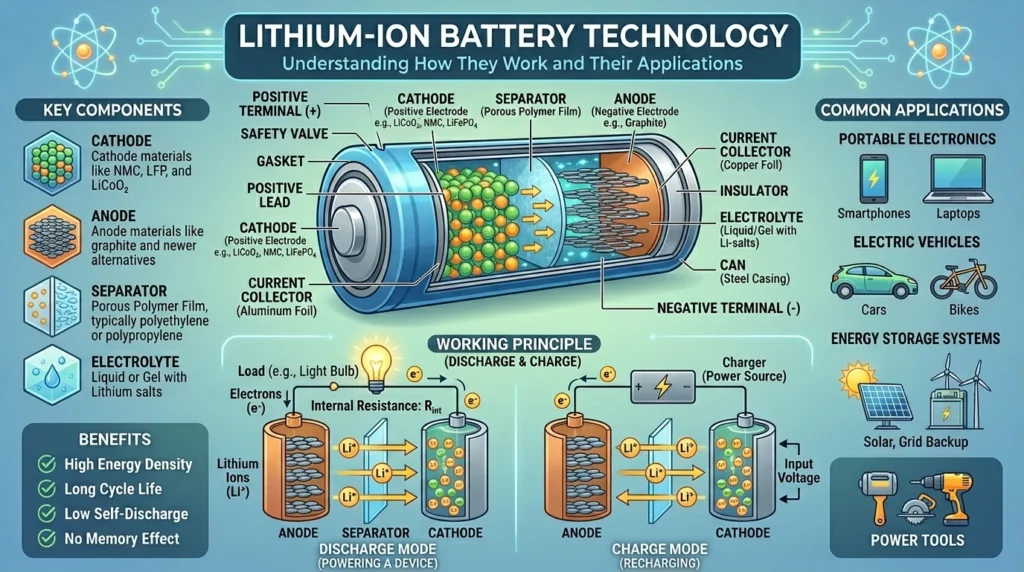
Lithium-Ion Battery Technology is a rechargeable energy storage technology that uses lithium ions to transfer energy between two electrodes during charging and discharging.
In simple words, a lithium-ion battery stores electrical energy chemically and releases it when needed to power electrical devices.
Unlike traditional batteries that may have lower energy capacity and shorter life cycles, lithium-ion batteries offer higher efficiency, lighter weight, and better performance.
Practical Example
When you charge a smartphone, lithium ions move and store energy inside the battery. When you use the phone, the stored energy is released to power the device.
The same operating principle is used in electric vehicles, solar battery banks, and industrial energy storage systems.
Lithium-Ion Battery Technology Working Principle
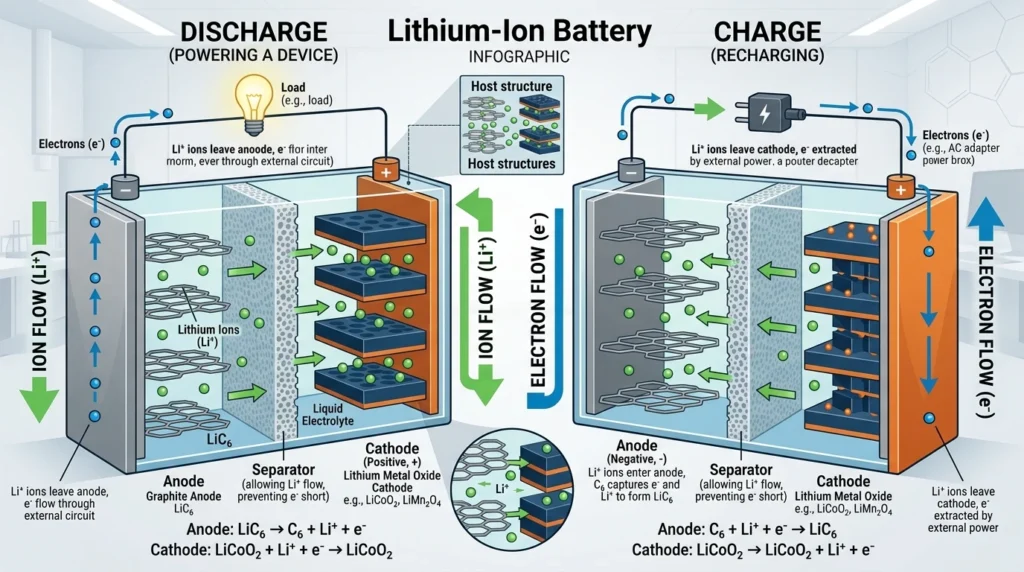
The working principle of lithium-ion battery technology is based on the movement of lithium ions between the positive electrode (cathode) and the negative electrode (anode) through an electrolyte during charging and discharging. When the battery is charging, lithium ions move from the cathode to the anode, where they are stored. During discharge, the ions travel back to the cathode, while electrons flow through the external circuit to provide electrical power to connected devices. This reversible movement of ions allows the battery to be recharged and used repeatedly with high efficiency. Lithium-ion batteries offer a high energy density, fast charging capability, low self-discharge, and a long service life, making them widely used in smartphones, laptops, electric vehicles, solar energy storage systems, and portable electronic devices.The Lithium-Ion Battery Technology working principle is based on the movement of lithium ions between the positive electrode (cathode) and negative electrode (anode).
Simple Analogy
Think of lithium ions as passengers traveling between two stations.
- During charging, passengers move to one station.
- During discharging, they travel back.
This movement creates electrical energy that powers devices.
Step-by-Step Lithium-Ion Battery Technology Working Principle
Charging Process Begins
An external charger supplies electrical energy to the battery.
Lithium Ion Movement
Lithium ions move from the cathode to the anode through the electrolyte.
Energy Storage
The battery stores electrical energy in chemical form.
Charging Completion
When fully charged, most lithium ions are stored in the anode.
Discharging Process Starts
When a load is connected, the battery begins supplying energy.
Ion Movement Reverses
Lithium ions move back from the anode to the cathode.
Electrical Energy Production
Electrons flow through the external circuit and power the connected device.
Key Features of Lithium-Ion Battery Technology Working Principle
- Rechargeable operation
- High energy density
- Fast charging capability
- Efficient energy transfer
- Long service life
Types / Classification
Several lithium-ion battery chemistries are available for different applications.
Lithium Iron Phosphate (LiFePO4)
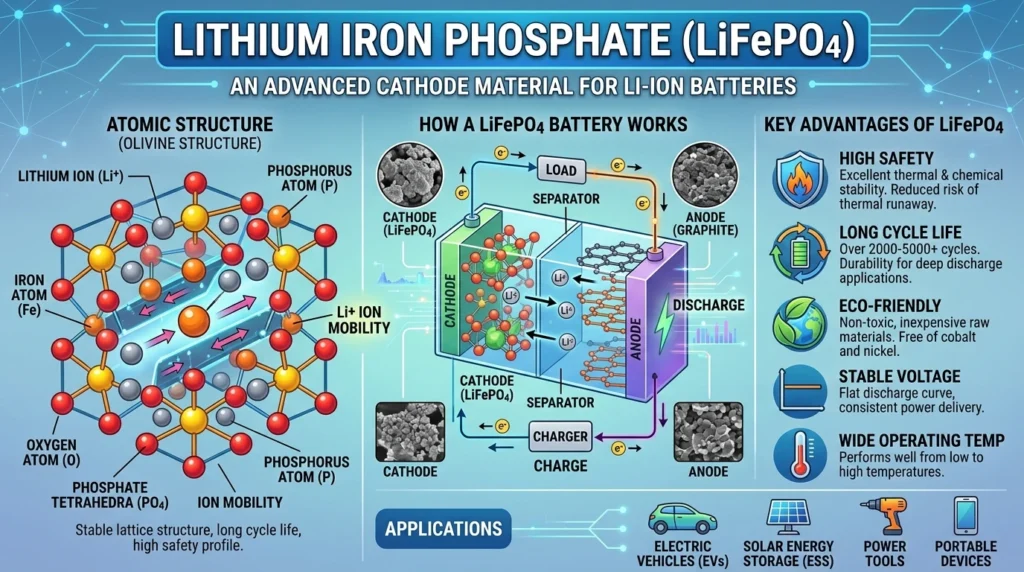
Lithium Iron Phosphate (LiFePO4) is a type of lithium-ion battery that uses lithium iron phosphate as the cathode material. It is known for its excellent safety, long cycle life, high thermal stability, and reliable performance. LiFePO4 batteries can withstand thousands of charge and discharge cycles while maintaining a high level of capacity, making them ideal for long-term use. They also have a lower risk of overheating or thermal runaway compared to many other lithium-ion battery chemistries. Although their energy density is slightly lower than some alternatives, they provide consistent power output, fast charging, and require minimal maintenance. LiFePO4 batteries are widely used in solar energy storage systems, electric vehicles, uninterruptible power supplies (UPS), marine applications, recreational vehicles (RVs), and industrial backup power systems due to their durability, efficiency, and enhanced safety.
One of the safest lithium battery technologies.
Features
- Excellent thermal stability
- Long cycle life
- High safety
Applications
- Solar storage systems
- Electric vehicles
- Industrial backup systems
Lithium Nickel Manganese Cobalt (NMC)
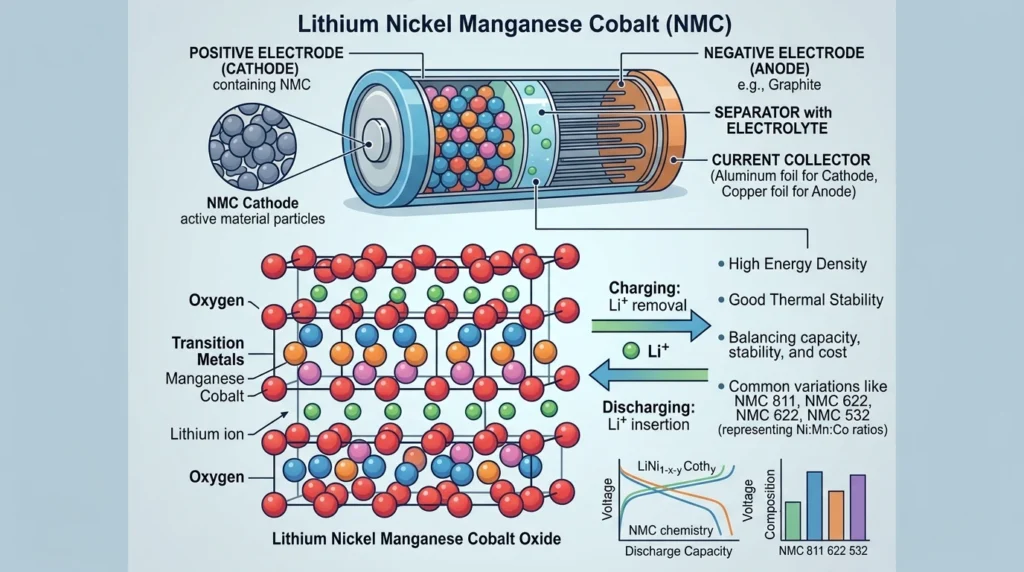
Lithium Nickel Manganese Cobalt (NMC) is a popular type of lithium-ion battery that uses a combination of nickel, manganese, and cobalt as the cathode material. This battery chemistry offers an excellent balance of high energy density, long cycle life, good power output, and reliable performance. Nickel increases energy capacity, manganese improves stability and safety, while cobalt enhances battery life and overall efficiency. NMC batteries support fast charging and deliver consistent performance over many charge and discharge cycles. Due to their high energy storage capability and lightweight design, they are widely used in electric vehicles (EVs), battery energy storage systems (BESS), power tools, medical equipment, portable electronics, and renewable energy storage. Their combination of performance, efficiency, and durability makes NMC batteries one of the most widely adopted lithium-ion battery technologies worldwide.
A widely used battery chemistry.
Features
- High energy density
- Good performance
Applications
- Electric vehicles
- Portable electronics
Lithium Cobalt Oxide (LCO)
Common in consumer electronics.
Features
- High energy density
- Compact design
Applications
- Smartphones
- Laptops
- Tablets
Lithium Manganese Oxide (LMO)
Provides high discharge capability.
Features
- Good thermal stability
Applications
- Power tools
- Medical devices
Lithium Titanate (LTO)
Known for ultra-fast charging.
Features
- Exceptional cycle life
- Fast charging
Applications
- Specialized industrial systems
Lithium Nickel Cobalt Aluminum (NCA)
Used in high-performance applications.
Features
- Very high energy density
Applications
- Electric vehicles
- Energy storage systems
Main Components
Understanding battery components helps explain how lithium-ion batteries function.
Cathode
The positive electrode.
Function
- Stores lithium ions during discharge
Anode
The negative electrode.
Function
- Stores lithium ions during charging
Electrolyte
Allows ion movement between electrodes.
Function
- Conducts lithium ions
Separator
Thin insulating layer.
Function
- Prevents short circuits
Current Collectors
Conduct electrical current.
Function
- Transfer electrons
Battery Management System (BMS)
Electronic protection system.
Function
- Monitors voltage, current, and temperature
Battery Housing
Protective enclosure.
Function
- Provides mechanical protection
Thermal Management System
Controls battery temperature.
Function
- Improves safety and performance
Advantages
Understanding Lithium-Ion Battery Technology advantages and disadvantages helps engineers select suitable battery systems.
Advantages of Lithium-Ion Battery Technology
- High energy density
- Lightweight design
- Long cycle life
- Fast charging capability
- Low self-discharge rate
- High efficiency
- Minimal maintenance
- Environmentally friendly compared to many traditional batteries
Real-World Benefits
Longer Device Runtime
Devices operate for extended periods between charges.
Reduced Weight
Ideal for portable electronics and electric vehicles.
Better Energy Storage
Stores more energy in less space.
Renewable Energy Support
Enhances solar and wind energy systems.
Disadvantages / Limitations
Despite many advantages, lithium-ion batteries have certain limitations.
Lithium-Ion Battery Technology Advantages and Disadvantages
Disadvantages
- Higher initial cost
- Sensitive to extreme temperatures
- Requires protection circuits
- Performance degrades with age
- Thermal runaway risk if damaged
Practical Limitations
Temperature Sensitivity
Very high temperatures can reduce battery life.
Aging Effects
Capacity gradually decreases over time.
Safety Concerns
Improper charging may damage the battery.
Lithium-Ion Battery Technology Applications
Lithium-Ion Battery Technology applications are rapidly expanding across multiple industries.
Residential Applications
- Home solar storage systems
- UPS systems
- Backup power solutions
Consumer Electronics Applications
- Smartphones
- Laptops
- Tablets
- Smartwatches
Industrial Applications
- Automated equipment
- Robotics
- Industrial backup systems
Transportation Applications
- Electric vehicles
- Electric buses
- Electric bicycles
Renewable Energy Applications
- Solar energy storage
- Wind energy storage
Medical Applications
- Portable medical devices
- Emergency equipment
Lithium-Ion Battery Technology applications continue growing as industries demand more efficient energy storage solutions.
Comparison Section
Difference Between Lithium-Ion Battery and Lead-Acid Battery
| Feature | Lithium-Ion Battery | Lead-Acid Battery |
| Energy Density | High | Low |
| Weight | Lightweight | Heavy |
| Charging Speed | Fast | Slow |
| Cycle Life | Long | Short |
| Maintenance | Minimal | Regular |
| Efficiency | High | Moderate |
| Initial Cost | Higher | Lower |
| Long-Term Cost | Lower | Higher |
Understanding the difference between lead-acid battery and lithium-ion battery helps engineers choose the best technology for specific applications.
Selection Guide
Choosing the right lithium-ion battery requires careful evaluation.
Capacity Requirement
Determine required energy storage.
Measured in:
- Ampere-hours (Ah)
- Kilowatt-hours (kWh)
Voltage Requirement
Match battery voltage with system voltage.
Operating Temperature
Consider environmental conditions.
Safety Features
Choose batteries with advanced BMS protection.
Cycle Life Requirement
Evaluate expected service life.
Tips for Beginners
- Select batteries from reputable manufacturers.
- Avoid overcharging.
- Verify BMS availability.
- Consider future expansion.
- Follow safety guidelines.
Common Problems & Solutions
Battery Not Charging
Causes
- Charger failure
- BMS protection activation
Solution
- Verify charger operation
- Check battery status
Reduced Capacity
Causes
- Aging
- Frequent deep discharge
Solution
- Replace aging batteries when necessary
Overheating
Causes
- Excessive charging current
- Poor ventilation
Solution
- Improve cooling conditions
Voltage Imbalance
Causes
- Cell mismatch
Solution
- Perform battery balancing
Fast Discharge
Causes
- Internal degradation
Solution
- Inspect battery health
Future Trends
Lithium-ion battery technology continues evolving rapidly.
Solid-State Batteries
Future batteries may replace liquid electrolytes with solid materials.
Benefits
- Improved safety
- Higher energy density
Fast Charging Technology
Charging times continue decreasing.
Advanced Battery Management Systems
Smarter electronics improve battery protection.
AI-Based Battery Monitoring
Artificial intelligence enhances performance prediction.
Second-Life Battery Applications
Used EV batteries can support energy storage systems.
Sustainable Recycling
Improved recycling methods reduce environmental impact.
The future of Lithium-Ion Battery Technology applications is closely connected with electric vehicles, renewable energy systems, smart grids, and advanced energy storage infrastructure.
Conclusion
Lithium-Ion Battery Technology has revolutionized modern energy storage by providing high energy density, fast charging capability, long service life, and excellent efficiency. From smartphones and laptops to electric vehicles and renewable energy storage systems, lithium-ion batteries have become a critical part of modern electrical engineering and technology.
This article explained the Lithium-Ion Battery Technology working principle, types, components, applications, advantages and disadvantages, troubleshooting methods, and future developments in simple and practical language. You also learned the difference between lead-acid battery and lithium-ion battery and how to select the right battery system for different applications.
For electrical students, engineers, technicians, and beginners, understanding lithium-ion battery technology is essential for working with modern energy storage systems. As the world continues adopting renewable energy and electric transportation, lithium-ion batteries will remain one of the most important technologies shaping the future of electrical power systems.



Pingback: Synonyms for Charge: Battery & Capacitor Terms