
Imagine installing a new air conditioner in a home or connecting a large motor in an industrial facility. If the electrical cable selected is too small, it may overheat, cause excessive voltage drop, damage equipment, or even create a fire hazard. On the other hand, choosing an oversized cable can significantly increase installation costs without providing additional benefits. This is why cable sizing calculation is one of the most important tasks in electrical design and installation.
Electrical cables act as the pathways that carry electrical energy from the source to the load. Their size directly affects system safety, efficiency, voltage regulation, and long-term reliability. Whether you are designing a residential wiring system, an industrial power distribution network, or a renewable energy installation, proper cable sizing is essential.
For electrical students, engineers, technicians, and beginners, understanding cable sizing calculation is a fundamental skill. It helps ensure compliance with electrical standards, protects equipment, and minimizes power losses.
In this article, you will learn what cable sizing calculation is, the cable sizing calculation working principle, methods, types, components, applications, advantages and disadvantages, selection guidelines, troubleshooting tips, and future industry trends.
What is Cable Sizing Calculation?
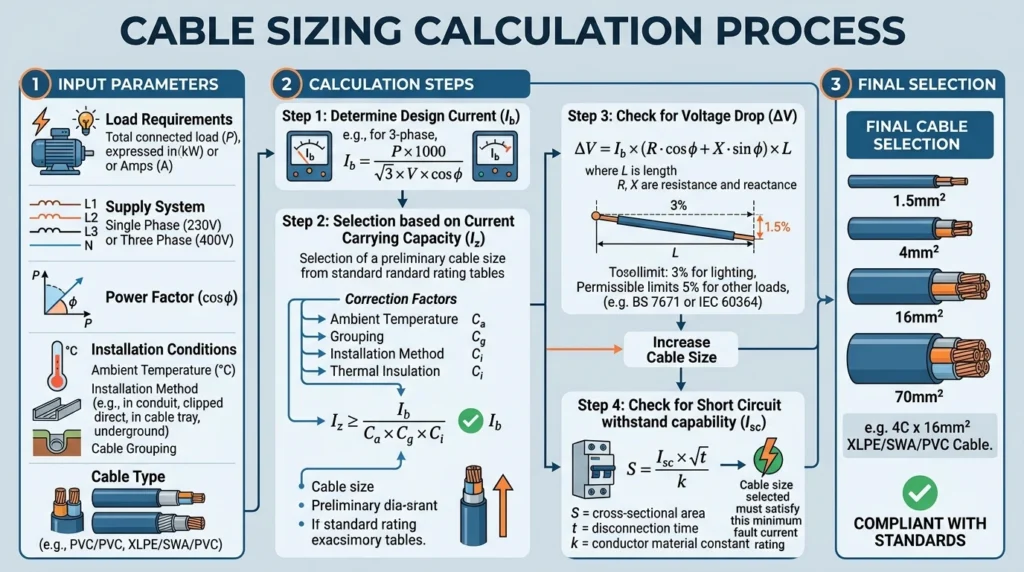
Cable sizing calculation is the process of determining the correct cross-sectional area of an electrical cable based on the load current, voltage drop, installation conditions, and safety requirements.
In simple words, it is the method used to select a cable that can safely carry electrical current without overheating or causing excessive power loss.
The goal is to ensure:
- Safe operation
- Efficient power transmission
- Minimal voltage drop
- Long equipment life
Practical Example
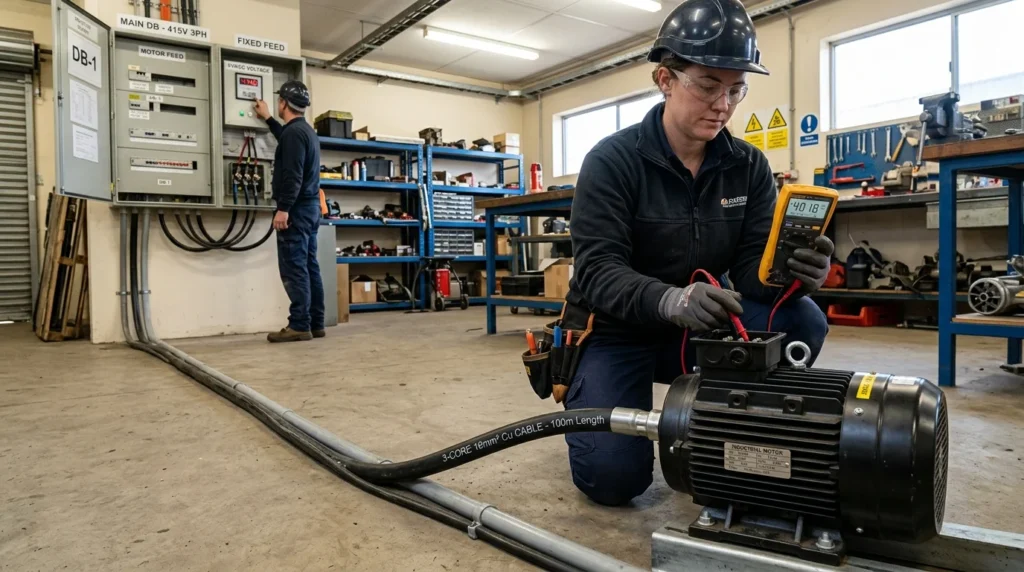
Suppose a 10 kW motor operates on a 400 V three-phase supply. The cable connected to the motor must be large enough to carry the required current safely while maintaining acceptable voltage levels. Cable sizing calculation helps determine the correct cable size for this application.
Cable Sizing Calculation Working Principle
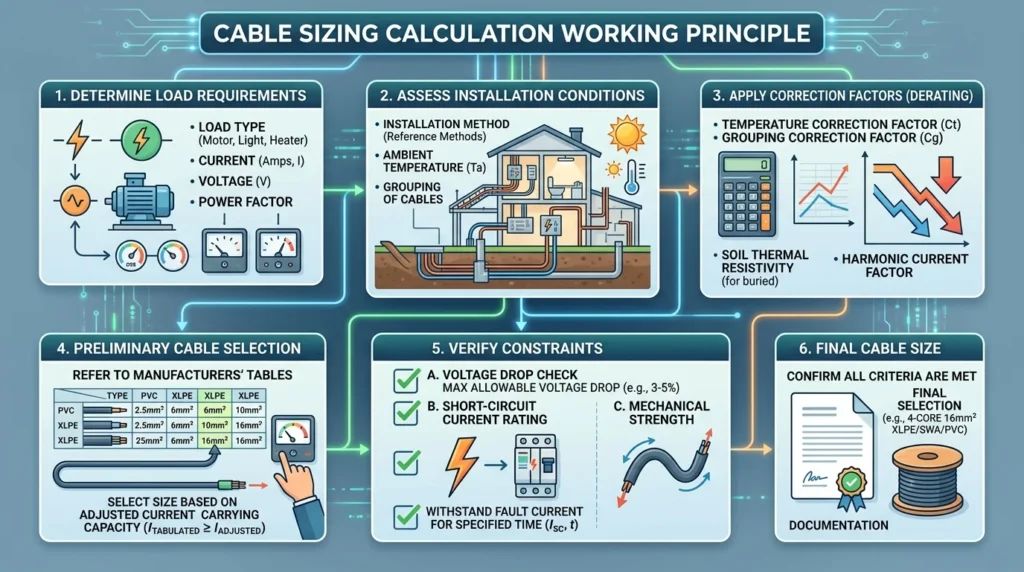
The Cable Sizing Calculation Working Principle is based on selecting a cable that can safely carry the required electrical current without overheating, causing excessive voltage drop, or creating safety hazards. The process begins by calculating the total electrical load and the current required by the connected equipment. Next, factors such as cable length, installation method, ambient temperature, voltage drop, short-circuit capacity, and future load expansion are considered. These factors determine the minimum conductor size needed to ensure efficient and reliable power transmission. A properly sized cable reduces power losses, improves equipment performance, increases the lifespan of the electrical system, and complies with electrical safety standards. In simple terms, cable sizing ensures that the cable is neither too small, which can lead to overheating and failure, nor unnecessarily large, which increases installation costs. This systematic approach helps engineers and electricians design safe, efficient, and long-lasting electrical installations.
The cable sizing calculation working principle is based on matching the cable’s current-carrying capacity with the electrical load while considering environmental and installation factors.
Simple Analogy
Think of a water pipe carrying water.
- A small pipe restricts water flow.
- A larger pipe allows more water to flow safely.
Similarly, electrical cables must be sized properly to carry current safely.
Step-by-Step Cable Sizing Calculation Working Principle
Determine Load Power
Identify the total power consumed by the load.
Formula:
Single Phase:
P = VI
Three Phase:
P = \sqrt{3}VI\cos\phi
Calculate Load Current
Current is calculated based on power and voltage.
The calculated current becomes the starting point for cable selection.
Consider Installation Conditions
Factors include:
- Ambient temperature
- Cable grouping
- Underground installation
- Conduit installation
Check Voltage Drop
Checking the voltage drop is an important step in cable sizing because excessive voltage loss can reduce the performance and efficiency of electrical equipment. As electricity flows through a cable, a small amount of voltage is lost due to the cable’s resistance, especially over long distances. After selecting a cable based on its current-carrying capacity, the voltage drop should be calculated and compared with the maximum allowable limit specified by electrical standards. If the calculated voltage drop is too high, a larger cable size should be selected to reduce resistance and ensure the equipment receives the required operating voltage. Proper voltage drop calculation improves energy efficiency, prevents equipment malfunction, and ensures a safe and reliable electrical installation.The cable must maintain acceptable voltage at the load.
Verify Short Circuit Capacity
The cable must withstand fault currents safely.
Apply Safety Factors
Correction factors are used to improve reliability.
Select Suitable Cable Size
Choose the nearest standard cable size that meets all requirements.
Key Factors in Cable Sizing Calculation Working Principle
- Load current
- Voltage drop
- Cable length
- Installation method
- Ambient temperature
- Fault current level
for more detilas click Medium Line Model
Types / Classification
Cable sizing calculations can be classified according to application and system type.
Single-Phase Cable Sizing
Used in residential and small commercial systems.
Applications
- Homes
- Shops
- Offices
Three-Phase Cable Sizing
Used for larger electrical loads.
Applications
- Motors
- Factories
- Industrial facilities
Low Voltage Cable Sizing
Applies to systems below 1000 V.
Applications
- Building wiring
- Distribution systems
Medium Voltage Cable Sizing
Used for power distribution networks.
Applications
- Substations
- Industrial plants
Underground Cable Sizing
Requires additional thermal considerations.
Applications
- Utility systems
- Urban power networks
Renewable Energy Cable Sizing
Used in solar and wind energy installations.
Applications
- Solar farms
- Battery systems
Main Components
Several factors and data inputs are required for cable sizing calculations.
Load Data
Includes power consumption information.
Function
- Determines current requirements
Cable Material
Typically copper or aluminum.
Function
- Affects current carrying capacity
Cable Insulation
Provides electrical protection.
Function
- Determines temperature limits
Installation Method
Defines cable placement.
Function
- Influences heat dissipation
Voltage Level
System operating voltage.
Function
- Used for current calculations
Cable Length
Distance between source and load.
Function
- Affects voltage drop
Protection Devices
Circuit breakers and fuses.
Function
- Protect cables from overload
Correction Factors
Environmental adjustment values.
Function
- Improve sizing accuracy
Advantages
Understanding cable sizing calculation advantages and disadvantages helps engineers appreciate its importance.
Advantages of Cable Sizing Calculation
- Improved electrical safety
- Reduced overheating
- Lower voltage drop
- Better efficiency
- Longer equipment life
- Compliance with standards
- Reduced energy losses
- Enhanced system reliability
Real-World Benefits
Safer Installations
Correct cable sizes reduce fire risks.
Better Equipment Performance
Proper voltage reaches connected loads.
Lower Operating Costs
Reduced power losses improve efficiency.
Extended Cable Life
Prevents insulation damage caused by overheating.
Disadvantages / Limitations
Although essential, cable sizing calculations have some limitations.
Cable Sizing Calculation Advantages and Disadvantages
Disadvantages
- Requires accurate load data
- Can be time-consuming
- Environmental factors complicate calculations
- Design errors can affect results
Practical Limitations
Future Load Expansion
Future loads may require larger cables.
Installation Variations
Actual conditions may differ from design assumptions.
Cost Considerations
Larger cables increase installation expenses.
Cable Sizing Calculation Applications
Cable sizing calculation applications are found in nearly every electrical project.
Residential Applications
- House wiring
- Air conditioning circuits
- Lighting systems
Commercial Applications
- Office buildings
- Shopping centers
Industrial Applications
- Motors
- Control panels
- Manufacturing plants
Utility Applications
- Distribution networks
- Substations
Renewable Energy Applications
- Solar power systems
- Battery storage installations
Infrastructure Applications
- Airports
- Railways
- Data centers
Cable sizing calculation applications are critical wherever electrical energy is transmitted.
Comparison Section
Difference Between Copper Cable and Aluminum Cable
| Feature | Copper Cable | Aluminum Cable |
| Conductivity | Higher | Lower |
| Current Capacity | Higher | Lower |
| Weight | Heavier | Lighter |
| Cost | Higher | Lower |
| Durability | Excellent | Good |
| Voltage Drop | Lower | Higher |
| Installation | Easier Termination | Requires Care |
| Common Use | Buildings & Industry | Utilities & Large Feeders |
Understanding the difference between copper cable and aluminum cable helps engineers choose the most suitable conductor material.
Selection Guide
Choosing the right cable requires careful evaluation.
Determine Load Current
Always calculate actual operating current.
Consider Cable Length
Longer distances require larger cable sizes.
Evaluate Voltage Drop
Maintain acceptable voltage levels.
Check Environmental Conditions
Account for temperature and installation methods.
Verify Fault Current Rating
Ensure fault protection compatibility.
Tips for Beginners
- Never select cables based only on current.
- Always consider voltage drop.
- Use correction factors.
- Follow local electrical standards.
- Allow capacity for future expansion.
Common Problems & Solutions
Cable Overheating
Causes
- Undersized cable
- Excessive load
Solution
- Increase cable size
- Reduce load
Excessive Voltage Drop
Causes
- Long cable runs
- Small conductors
Solution
- Use larger cable sizes
Frequent Breaker Tripping
Causes
- Overloaded circuits
Solution
- Verify load calculations
Insulation Damage
Causes
- High temperatures
Solution
- Improve ventilation
- Use higher-rated cables
Unexpected Energy Losses
Causes
- Incorrect cable selection
Solution
- Recalculate system requirements
Future Trends
Cable sizing methods continue evolving with modern electrical technologies.
Smart Design Software
Advanced software automates calculations.
AI-Based Electrical Design
Artificial intelligence improves accuracy.
Digital Twin Technology
Virtual models optimize cable systems before installation.
Smart Grid Integration
Future networks require more advanced cable planning.
High-Efficiency Conductors
New materials improve performance.
Renewable Energy Expansion
Solar and battery systems are increasing demand for specialized cable sizing methods.
The future of cable sizing calculation applications is closely connected with smart grids, renewable energy systems, digital engineering tools, and advanced power distribution networks.
Conclusion
Cable sizing calculation is one of the most important aspects of electrical system design. Selecting the correct cable size ensures safe operation, minimizes voltage drop, reduces energy losses, and protects electrical equipment from damage. Whether designing residential wiring, industrial power systems, renewable energy installations, or utility networks, proper cable sizing plays a critical role in system reliability and efficiency.
This article explained the cable sizing calculation working principle, types, components, applications, advantages and disadvantages, troubleshooting methods, and future developments in simple and practical language. You also learned the difference between copper cable and aluminum cable and how to select the appropriate cable size based on current, voltage drop, environmental conditions, and fault levels.
For electrical students, engineers, technicians, and beginners, mastering cable sizing calculation is an essential skill that supports safe, efficient, and professional electrical design. As power systems become more advanced, accurate cable sizing will remain a fundamental requirement in every electrical project.