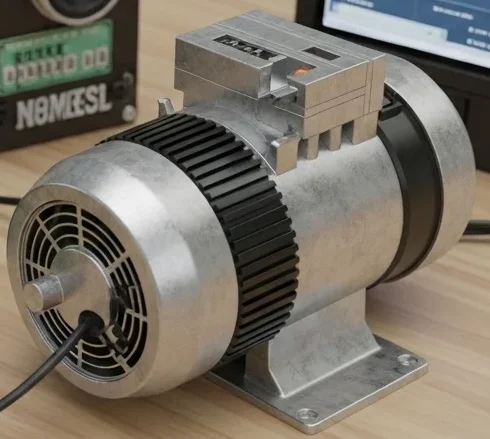
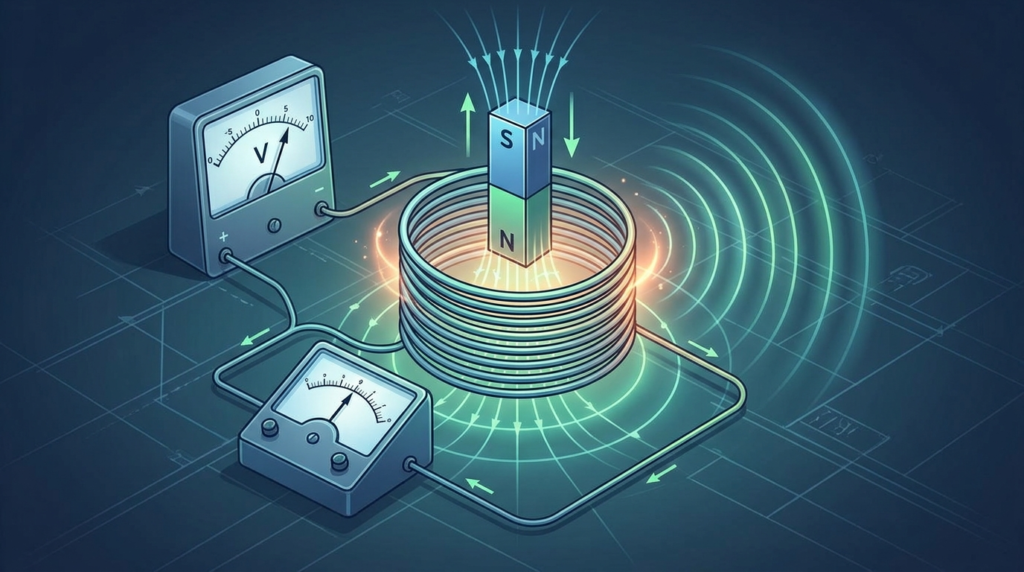

Imagine a hydroelectric power plant generating electricity for thousands of homes. As the turbine rotates, a generator converts mechanical motion into electrical energy. This process works because of one of the most important principles in electrical engineering called Faraday Law. Without this law, modern electricity generation, transformers, motors, and many electronic systems would not exist.
Faraday Law is the foundation of electromagnetic induction and plays a major role in almost every electrical system used today. From mobile chargers and transformers to industrial generators and renewable energy systems, this principle is used everywhere. Understanding Faraday Law is essential for electrical students, engineers, technicians, and beginners because it explains how electricity can be generated through magnetic fields.
The Faraday Law working principle helps engineers design efficient generators, transformers, induction motors, and modern energy systems. It also improves understanding of power transmission and electromagnetic devices.
In this article, you will learn everything about Faraday Law, including its definition, working principle, types, components, applications, advantages and disadvantages, troubleshooting concepts, comparison with related laws, and future technological developments in simple and easy English.
What is Faraday Law?
Faraday Law, also known as Faraday’s Law of Electromagnetic Induction, states that whenever the magnetic flux linked with a conductor changes, an electromotive force (EMF) or voltage is induced in the conductor.
In simple words, changing magnetic fields produce electricity.
Simple Explanation
If a conductor moves through a magnetic field, or if the magnetic field around the conductor changes continuously, voltage is generated inside the conductor.
This process is called electromagnetic induction.
Practical Example
A practical example of Faraday Law is an electric generator.
Inside the generator:
A coil rotates in a magnetic field
Magnetic flux changes continuously
Voltage is induced in the coil
Electricity is produced
This principle is widely used in power plants around the world.
Faraday Law Working Principle
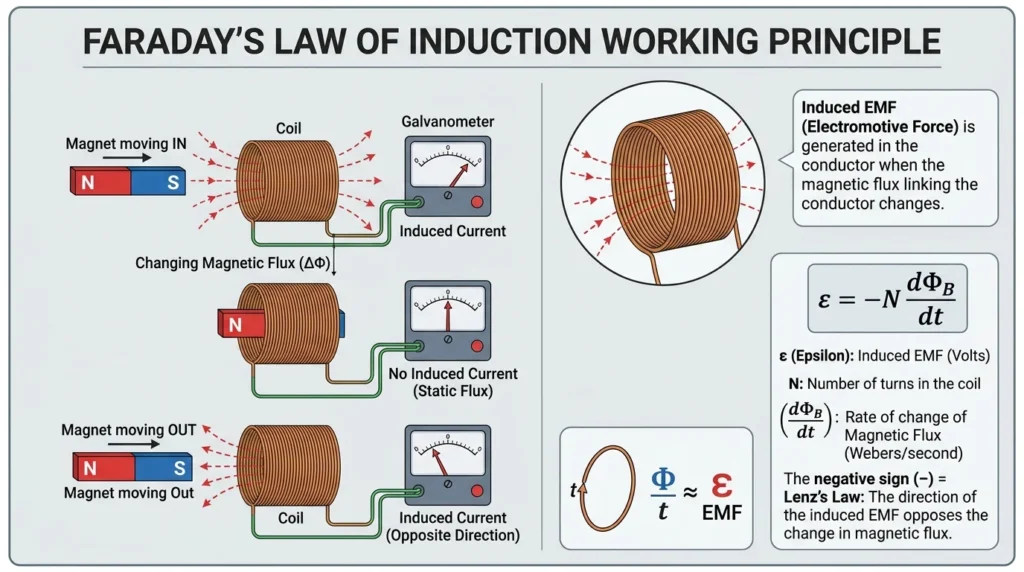
The Faraday Law working principle is based on electromagnetic induction caused by changing magnetic flux.The Faraday Law working principle states that whenever there is a change in magnetic flux linked with a conductor or coil, an electromotive force (EMF) is induced in it, and if the circuit is closed, current flows. In simple words, electricity is generated when a conductor experiences a changing magnetic field. This principle is the basic foundation of electromagnetic induction and is used in many electrical machines and devices. According to Faraday’s Law, the magnitude of the induced voltage depends on how quickly the magnetic flux changes and the number of turns in the coil. A faster change in magnetic field produces a higher induced EMF. This principle is widely used in generators, transformers, induction motors, and many power generation systems. Understanding the Faraday Law working principle is very important for electrical students and engineers because it explains how mechanical energy is converted into electrical energy and forms the basis of modern electrical power systems.
Step-by-Step Working Process
Magnetic Field is Produced
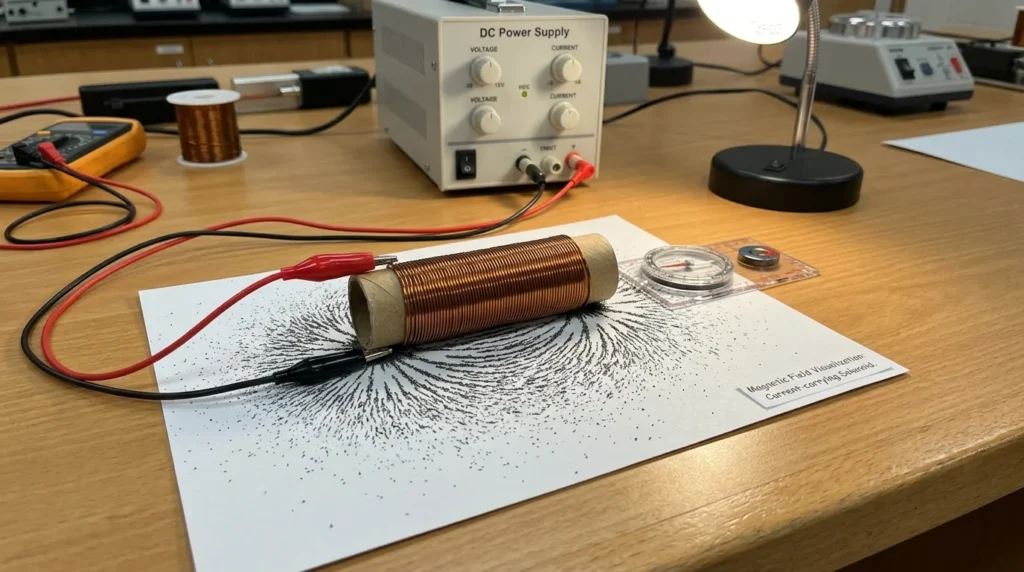
A magnet or electromagnet creates a magnetic field around a conductor.A magnetic field is produced whenever an electric current flows through a conductor or when a magnetic material is present. When current passes through a wire or coil, it creates invisible lines of force around it, known as a magnetic field. The strength of this magnetic field depends on the amount of current, the number of turns in the coil, and the type of core material used. If the coil is wound around an iron core, the magnetic field becomes stronger because the core concentrates the magnetic flux. In simple words, whenever electricity flows, it automatically generates a magnetic field around the conductor. This principle is the foundation of many electrical devices such as motors, transformers, relays, solenoids, and generators. Understanding how a magnetic field is produced is very important for electrical students and engineers because it explains how electrical energy can be converted into mechanical energy and how many electromagnetic systems operate in real-world applications.
Relative Motion Occurs
Either:
The conductor moves through the magnetic field
The magnetic field changes around the conductor
Magnetic Flux Changes
The number of magnetic lines passing through the conductor changes.
Voltage is Induced
An electromotive force (EMF) is produced in the conductor.
Current Flows
If the conductor forms a closed circuit, electrical current begins flowing.
Faraday Law Formula
E = -N \frac{d\Phi}{dt}
Where:
E = Induced EMF
N = Number of turns
Φ = Magnetic flux
dΦ/dt = Rate of magnetic flux change
The negative sign represents Lenz’s Law, which opposes the cause producing the induced current.
Easy Analogy
Think of magnetic flux like wind flowing through a windmill.
Faster wind creates more rotation
Faster magnetic flux change creates more voltage
This is how electromagnetic induction works.
Types / Classification
Faraday Law can be classified based on how electromagnetic induction occurs.
Dynamically Induced EMF
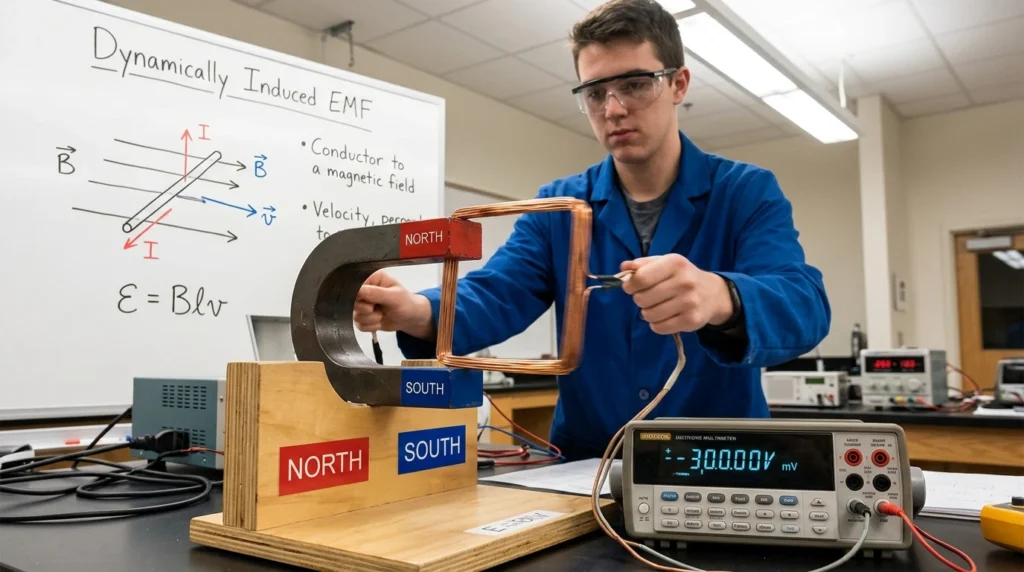
Voltage is generated when a conductor physically moves inside a magnetic field.Dynamically induced EMF is the electromotive force (EMF) that is generated when a conductor moves through a magnetic field or when a magnetic field moves past a stationary conductor. This type of induction occurs due to the relative motion between the conductor and the magnetic field, which causes a continuous change in magnetic flux linkage. According to Faraday’s law of electromagnetic induction, this change in flux induces a voltage in the conductor. In simple words, dynamically induced EMF is produced when motion between a magnet and a conductor cuts magnetic lines of force. The magnitude of the induced EMF depends on the strength of the magnetic field, the speed of movement, and the length of the conductor within the field. This principle is widely used in electrical machines such as generators and alternators, where mechanical energy is converted into electrical energy. Understanding dynamically induced EMF is important for electrical students and engineers because it forms the basis of energy conversion in many practical electrical systems.
Features
Requires mechanical motion
Used in generators
Applications
Alternators
Power generators
Statically Induced EMF
Voltage is induced without physical movement of the conductor.
Features
Magnetic field changes with time
Common in transformers
Applications
Transformers
Induction coils
Self-Induction
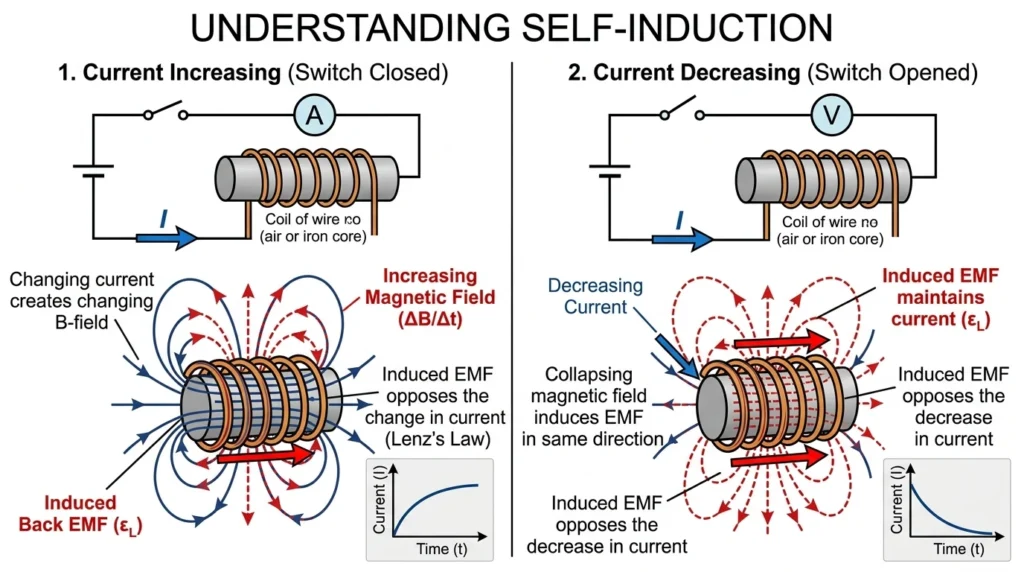
A changing current in the same coil induces voltage within itself.Self-induction is the property of a coil or circuit by which a change in current flowing through it induces an electromotive force (EMF) in the same coil. This induced EMF always opposes the change in current, according to Lenz’s Law. In simple words, when the current in a coil increases or decreases, the coil itself generates a voltage that resists this change. Self-induction occurs due to the change in magnetic field created by the coil’s own current, which links back with the same coil and produces the induced EMF. The effect of self-induction is measured by a property called inductance. Coils with more turns or iron cores have higher inductance and stronger self-induction effects. This principle is widely used in electrical devices such as inductors, transformers, relays, and AC circuits. Understanding self-induction is important for electrical students and engineers because it explains how circuits respond to changing current and helps in designing stable and efficient electrical systems.
Applications
Chokes
Inductors
Mutual Induction
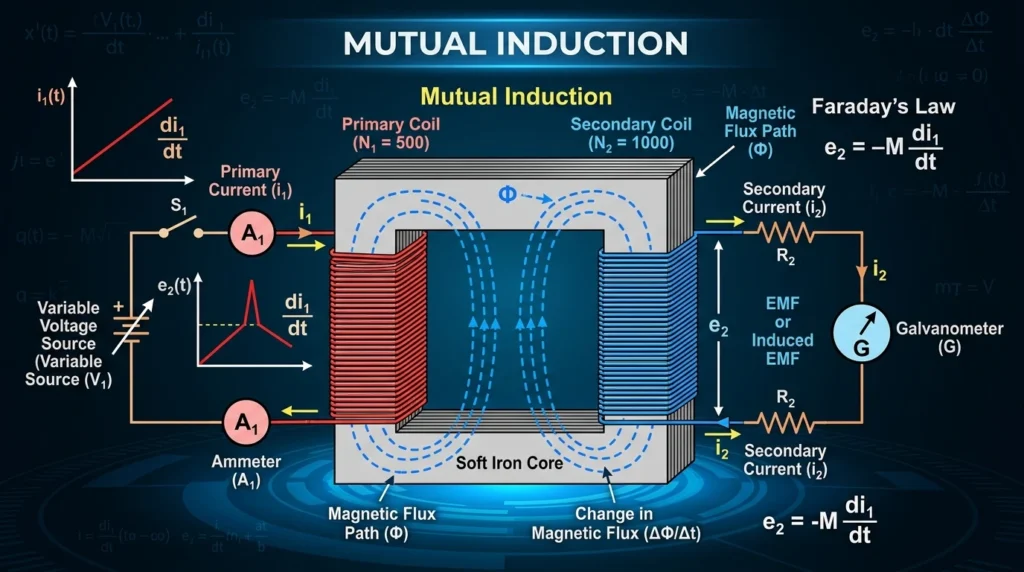
A changing current in one coil induces voltage in another nearby coil.Mutual induction is the process in which a change in current in one coil induces an electromotive force (EMF) in another nearby coil. This happens when two coils are placed close to each other so that the magnetic field produced by the first coil links with the second coil. When the current in the first coil increases or decreases, its magnetic field also changes, and this changing magnetic field cuts the second coil, producing an induced voltage in it. In simple words, mutual induction is the transfer of electrical energy from one coil to another through a changing magnetic field. The strength of mutual induction depends on the distance between the coils, the number of turns, and the presence of a magnetic core. This principle is widely used in transformers, wireless charging systems, and many electrical communication devices. Understanding mutual induction is important for electrical students and engineers because it explains how energy can be transferred without direct electrical contact.
Applications
Transformers
Wireless charging systems
Main Components
Several components are required for electromagnetic induction systems.
Magnetic Field Source
Creates magnetic flux.
Examples
Permanent magnets
Electromagnets
Conductor
The material where voltage is induced.
Common Materials
Copper
Aluminum
Coil or Winding
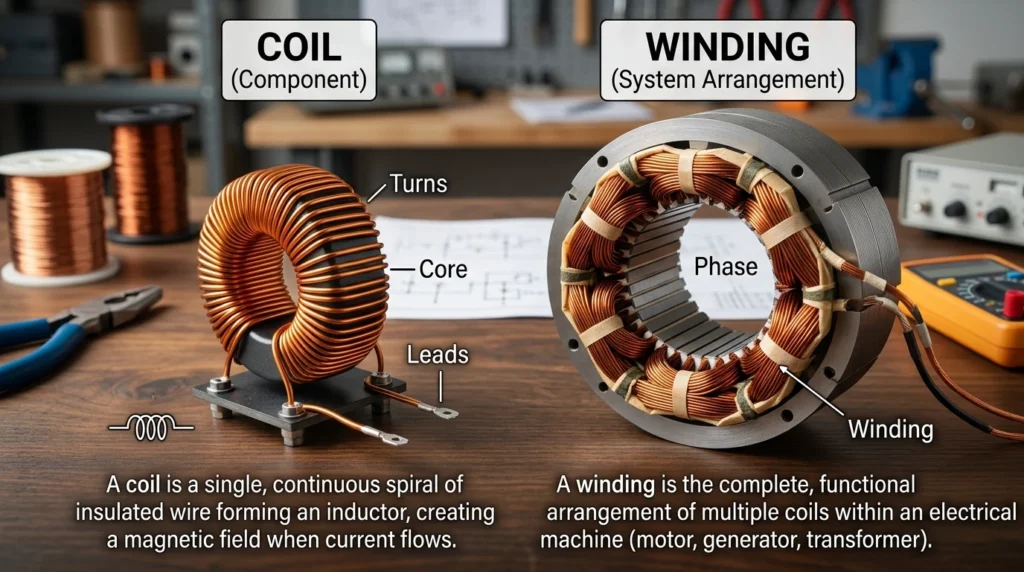
A coil or winding is a length of insulated conductor, usually copper or aluminum wire, that is wound in a circular or helical shape to produce a magnetic field when electric current flows through it. The main purpose of a coil is to increase the strength of the magnetic field by concentrating the magnetic flux. When current passes through the winding, it behaves like an electromagnet and is widely used in electrical and electronic devices. The performance of a coil depends on factors such as the number of turns, type of core material, and amount of current flowing through it. In simple words, a coil or winding is a structured wire arrangement that helps generate or control magnetic fields in electrical systems. Coils are commonly used in transformers, motors, generators, relays, inductors, and solenoids. Understanding coils and windings is very important for electrical students and engineers because they are the fundamental building blocks of many electromagnetic devices used in modern electrical engineering.
Multiple turns help increase induced voltage.
Magnetic Core
Provides a low-reluctance path for magnetic flux.
Common Core Materials
Soft iron
Ferrite
Motion Mechanism
Provides movement between conductor and magnetic field.
Electrical Load
Uses the generated electrical energy.
Advantages
Understanding Faraday Law advantages and disadvantages is important for electrical system design.
Advantages of Faraday Law
Enables electricity generation
Supports transformer operation
Allows wireless power transfer
Improves power transmission
Forms basis of electric motors
Essential for renewable energy systems
Enables industrial automation
Supports electromagnetic devices
Reduces mechanical complexity
Improves energy conversion efficiency
Disadvantages / Limitations
Although Faraday Law is highly useful, some practical limitations exist.
Disadvantages of Faraday Law
Requires changing magnetic fields
Heat losses occur in conductors
Eddy current losses may develop
Magnetic saturation limits performance
High-speed motion may be necessary
Strong magnetic systems can be expensive
Electromagnetic interference may occur
Faraday Law Applications
Faraday Law applications are found in almost every electrical and electronic system.
Power Generation Applications
Generators use electromagnetic induction to produce electrical energy.
Examples
Thermal power plants
Hydroelectric stations
Wind turbines
Transformer Applications
Transformers transfer electrical energy using mutual induction.
Motor Applications
Electric motors operate using electromagnetic principles.
Home Applications
Mobile chargers
Induction cookers
Doorbells
Industrial Applications
Welding equipment
Conveyor systems
Automation systems
Renewable Energy Applications
Wind energy systems
Solar power systems
Communication Applications
Wireless charging
Inductive communication devices
Comparison Section
Difference Between Faraday Law and Lenz Law
| Feature | Faraday Law | Lenz Law |
| Main Purpose | Explains induced voltage | Explains direction of current |
| Principle | Changing magnetic flux induces EMF | Induced current opposes the cause |
| Focus | Magnitude of EMF | Direction of induced current |
| Applications | Generators, transformers | Electromagnetic braking |
| Energy Principle | Electromagnetic induction | Conservation of energy |
Selection Guide
Understanding proper electromagnetic induction design improves system efficiency.
Use Strong Magnetic Fields When
Higher voltage generation is needed.
Increase Coil Turns When
More induced EMF is required.
Use High-Quality Core Materials
Better cores improve magnetic flux flow.
Choose Good Conductors
Copper reduces electrical resistance and losses.
Tips for Beginners
Understand Magnetic Flux Clearly
Flux change is the most important concept in Faraday Law.
Study Generator Operation
Generators are the best practical example of electromagnetic induction.
Learn Transformer Basics
Transformers directly use mutual induction principles.
Perform Small Experiments
Simple induction experiments improve practical understanding.
Common Problems & Solutions
Why Is No Voltage Generated?
causes:
No magnetic field change
Broken conductor
Incorrect connection
Solution
Increase magnetic motion
Check wiring
Improve magnetic strength
Why Is Voltage Too Low?
causes:
- Weak magnetic field
- Low rotational speed
- Few coil turns
Solution
Use stronger magnets
Increase speed
Add more winding turns
Why Does Overheating Occur?
High current may produce heat losses.
Solution
Improve cooling
Use proper conductor size
Why Do Eddy Currents Develop?
Changing magnetic fields create unwanted circulating currents.
Solution
Use laminated cores
Why Does Magnetic Saturation Occur?
Excessive magnetic flux overloads the core material.
Solution
Use larger magnetic cores
Improve magnetic design
Future Trends
Modern electrical technology continues improving electromagnetic induction systems.
Wireless Charging Technology
Faraday Law supports modern wireless energy transfer systems.
Examples
Wireless mobile charging
Electric vehicle charging
Smart Transformers
Digital transformers improve monitoring and power efficiency.
Renewable Energy Expansion
Wind and hydroelectric systems heavily depend on electromagnetic induction.
Advanced Magnetic Materials
New magnetic materials reduce losses and improve efficiency.
AI-Based Electrical Monitoring
Artificial intelligence improves fault detection and energy management.
High-Efficiency Generators
Modern generators provide better power output with reduced losses.
Conclusion
Faraday Law is one of the most important principles in electrical engineering and modern power systems. It explains how changing magnetic flux can generate electrical voltage through electromagnetic induction. This simple principle made electricity generation, transformers, motors, and modern electrical technology possible.
The Faraday Law working principle is widely used in power plants, renewable energy systems, industrial machinery, communication systems, and household appliances. Understanding Faraday Law applications, advantages and disadvantages, and electromagnetic induction concepts helps electrical students, engineers, technicians, and beginners build strong practical and theoretical knowledge.
As electrical technology continues advancing, Faraday Law will remain essential in renewable energy, wireless charging, smart electrical systems, and future power generation technologies around the world.



Pingback: Skin Effect in Conductors: Causes & How to Reduce It