
Imagine you are working on an important office presentation or attending an online class when suddenly the electricity goes OFF. Your computer shuts down instantly, the internet disconnects, and all your work may be lost. In another room, the lights and fans stop working, creating discomfort during hot weather. These situations show why backup power systems such as UPS and inverters are important in modern life.
Understanding UPS vs inverter systems is essential for electrical students, engineers, technicians, and beginners because both devices provide backup power during electrical failures, but they work differently and serve different purposes. Choosing the wrong system can lead to equipment damage, poor backup performance, or unnecessary expenses.
The UPS vs inverter working principle explains how electrical energy is stored, converted, and supplied to appliances during power outages. These systems are widely used in homes, offices, hospitals, industries, schools, and data centers to ensure uninterrupted electrical operation.
In this article, you will learn everything about UPS vs inverter systems, including definitions, working principles, types, components, advantages and disadvantages, applications, comparisons, troubleshooting, selection guides, and future technologies using simple and easy English.
What is UPS vs Inverter?
UPS and inverter systems are electrical backup devices used to supply power when the main electricity supply fails.
However, there is a major difference between UPS and inverter systems.
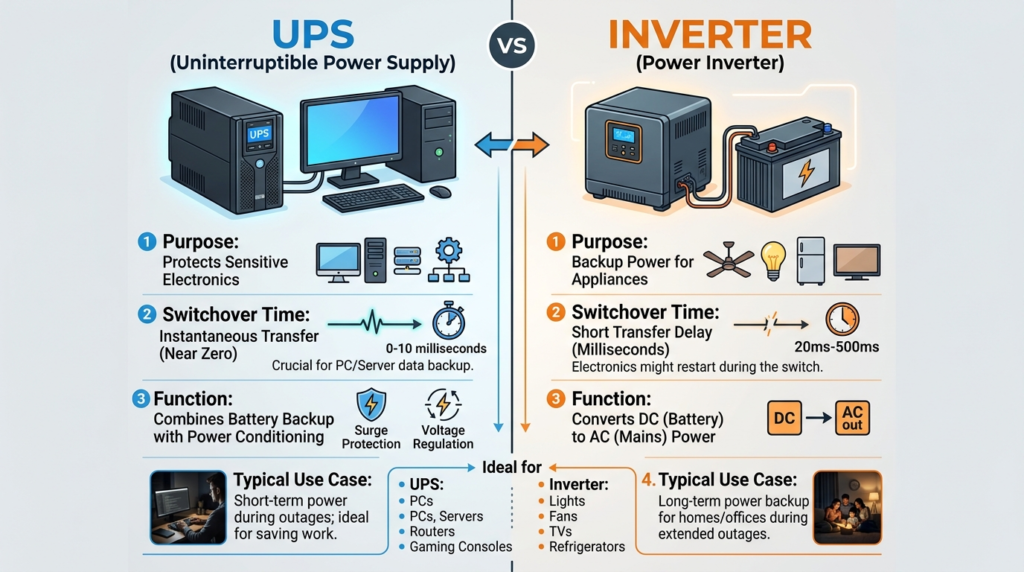
A UPS provides instant backup power without interruption.
An inverter provides backup power with a small switching delay.
Simple Explanation
Both UPS and inverter systems use batteries to store electrical energy.
When electricity fails:
The UPS switches immediately to battery power
The inverter switches after a short delay
Practical Example
UPS Example
A computer connected to a UPS continues running without restarting during a power outage.
Inverter Example
A fan or light connected to an inverter may turn OFF briefly and then start again.
UPS vs Inverter Working Principle
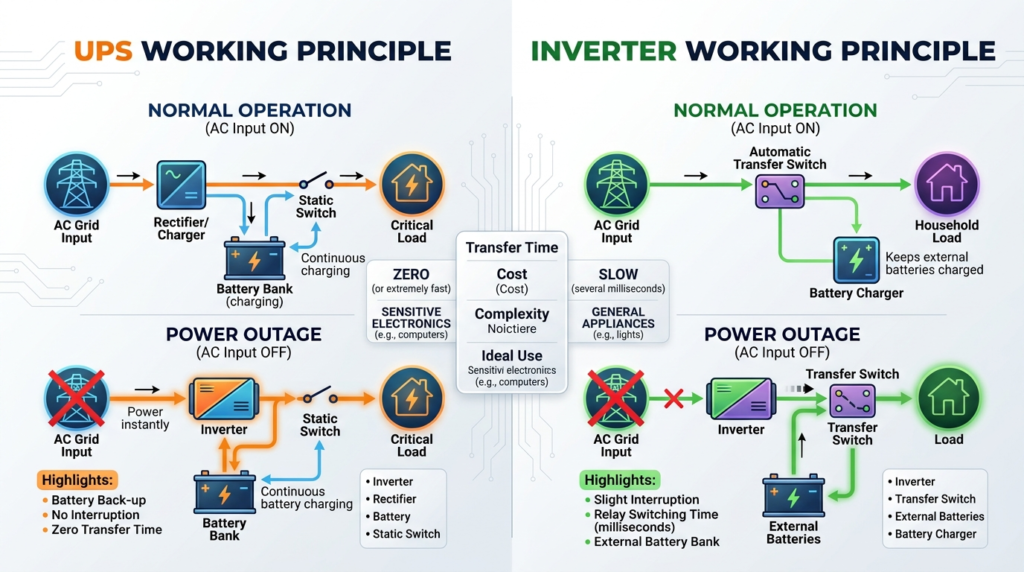
The UPS (Uninterruptible Power Supply) and inverter both provide backup power during a power outage, but their working principles are different. A UPS continuously supplies power to connected devices by instantly switching to its battery when the main AC supply fails, resulting in almost zero transfer time. This makes it ideal for sensitive equipment such as computers, servers, medical devices, and networking systems. In contrast, an inverter stores energy in a battery while AC power is available and converts the battery’s DC (Direct Current) into AC (Alternating Current) when the mains supply is interrupted. Most inverters have a short switching delay of a few milliseconds, making them suitable for household appliances like lights, fans, and televisions. While a UPS focuses on uninterrupted power for critical equipment, an inverter is designed to provide longer backup power for general residential and commercial electrical loads.
The UPS vs inverter working principle is based on storing electrical energy in batteries and supplying it during power failure.
Step-by-Step Working Process
Main Power Supply Operates Normally
Electricity flows from the utility supply to connected devices.
Batteries Charge Automatically
The UPS or inverter charges batteries while utility power is available.
Power Failure Occurs
The main electrical supply stops due to:
Load shedding
Faults
Storms
Voltage problems
Backup System Activates
UPS switches instantly
Inverter switches after a short delay
DC Power Converts to AC Power
The battery supplies DC power.
The inverter circuit converts it into AC power for appliances.
Utility Power Returns
The system reconnects to the main supply and recharges batteries.
Easy Analogy
Think of UPS and inverter systems like emergency lighting systems:
UPS is like an emergency light that turns ON immediately
Inverter is like a backup generator that takes a few seconds to start
Types / Classification
Different types of UPS and inverter systems are available depending on application and power requirements.
Types of UPS Systems
Offline UPS
The most basic UPS system.
Features
Low cost
Suitable for home computers
Small switching time
Applications
Personal computers
Home electronics
Line-Interactive UPS
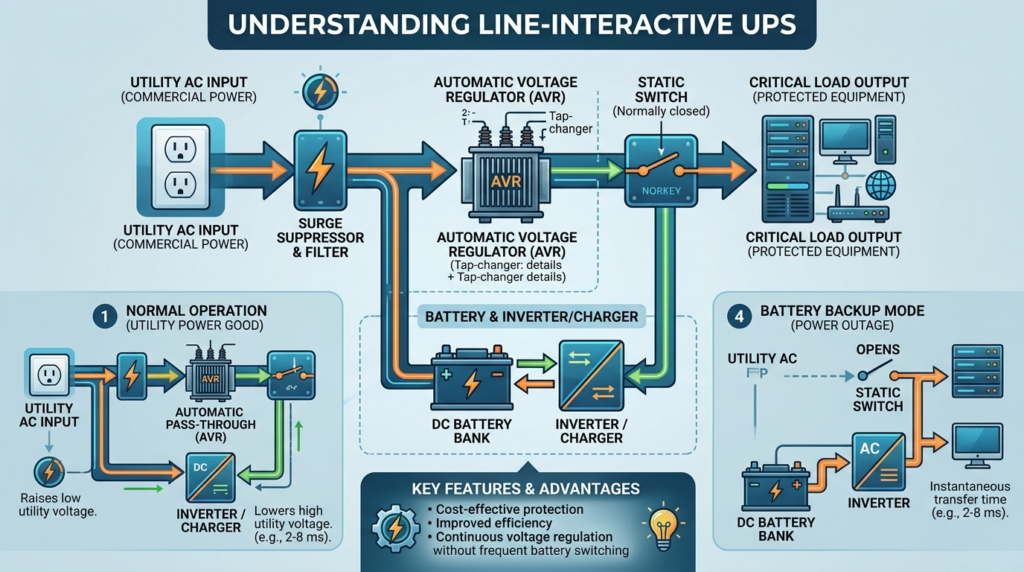
A Line-Interactive UPS (Uninterruptible Power Supply) is a backup power system that provides continuous electricity while protecting connected devices from power outages, voltage fluctuations, and electrical disturbances. Unlike a basic standby UPS, it features an Automatic Voltage Regulator (AVR) that corrects low and high input voltage without immediately switching to battery power. During normal operation, the utility power supplies the load while simultaneously charging the battery. If the main power fails, the UPS quickly switches to battery power, and the inverter converts the battery’s DC (Direct Current) into AC (Alternating Current) to keep connected equipment running with minimal interruption. Line-interactive UPS systems are widely used for desktop computers, servers, networking equipment, security systems, and office electronics because they offer improved voltage regulation, longer battery life, higher efficiency, and reliable protection against common power problems.
Provides voltage correction and battery backup.
Features
Better voltage regulation
Improved protection
Applications
Offices
Networking equipment
Online UPS
Provides continuous power without interruption.
Features
Zero transfer time
Highest protection level
Applications
Hospitals
Data centers
Industrial systems
Types of Inverter Systems
Square Wave Inverter
Produces square waveform output.
Features
Simple design
Low cost
Limitation
Not suitable for sensitive electronics.
Modified Sine Wave Inverter
Produces improved waveform output.
Features
Moderate efficiency
Common household use
Pure Sine Wave Inverter
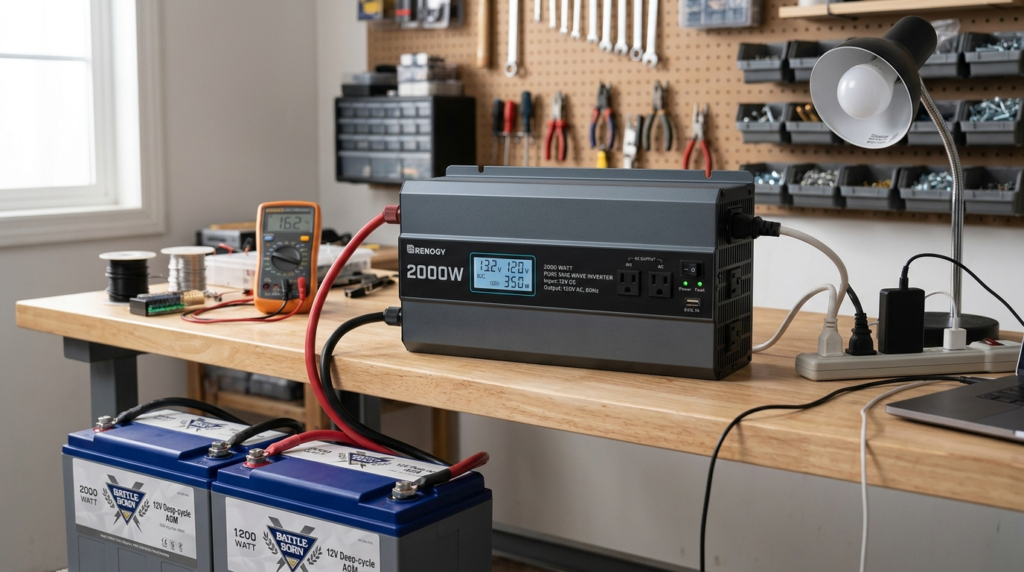
A Pure Sine Wave Inverter is an advanced inverter that converts DC (Direct Current) from a battery or solar power system into a smooth and stable AC (Alternating Current) output that closely matches the electricity supplied by the utility grid. It produces a clean sine wave, making it ideal for operating sensitive electronic devices such as computers, laptops, medical equipment, refrigerators, air conditioners, audio systems, and industrial machinery. Pure sine wave inverters provide higher efficiency, quieter operation, and better compatibility with appliances that use motors or microprocessors. They also reduce electrical noise, overheating, and equipment wear, helping to extend the lifespan of connected devices. Although they are more expensive than modified sine wave inverters, their superior performance, reliable power quality, and energy efficiency make them the preferred choice for homes, offices, solar energy systems, and critical backup power applications.
Produces smooth AC output similar to utility power.
Features
Best performance
Safe for sensitive devices
Applications
Modern electronics
Medical equipment
Main Components
Understanding system components helps in installation and troubleshooting.
Battery
Stores electrical energy for backup operation.
Common Battery Types
Lead-acid battery
Lithium-ion battery
Inverter Circuit
Converts DC battery power into AC power.
Charger Circuit
Charges batteries during normal operation.
Rectifier
Converts AC power into DC power in UPS systems.
Transformer
Adjusts voltage levels when needed.
Control Unit
Manages system switching and protection.
Cooling Fan
Removes excess heat from the system.
Protection Devices
Protect against overload and short circuit conditions.
Advantages
Understanding UPS vs inverter advantages and disadvantages helps users select suitable systems.
Advantages of UPS
Instant backup power
Protects sensitive electronics
Prevents data loss
Stable voltage output
Better power quality
Advantages of Inverter
Longer backup duration
Supports larger household loads
Cost-effective solution
Suitable for home appliances
Easy installation
Disadvantages / Limitations
Both systems have limitations depending on application.
Disadvantages of UPS
Higher cost
Limited backup time
Lower support for heavy loads
Battery replacement expense
Disadvantages of Inverter
Small switching delay
May restart sensitive devices
Voltage fluctuations in low-quality systems
Larger battery space requirement
UPS vs Inverter Applications
UPS vs inverter applications are widely found in homes, industries, and modern technology systems.
UPS Applications
Home Applications
Desktop computers
Wi-Fi routers
Commercial Applications
Offices
Banking systems
Industrial Applications
Automation systems
Data centers
Medical Applications
ICU equipment
Laboratory systems
Inverter Applications
Home Applications
Fans
Lights
Refrigerators
Commercial Applications
Shops
Small businesses
Industrial Applications
Backup lighting
Small machinery
Comparison Section
Difference Between UPS and Inverter
| Feature | UPS | Inverter |
| Switching Time | Instant | Small delay |
| Main Purpose | Sensitive devices | General backup |
| Output Stability | Very stable | Moderate |
| Backup Duration | Short to medium | Medium to long |
| Cost | Higher | Lower |
| Load Capacity | Lower | Higher |
| Best Applications | Computers, servers | Homes, appliances |
| Waveform Quality | Better | Depends on type |
Selection Guide
Choosing between UPS and inverter systems depends on load type and application.
Choose UPS When
Computers require protection
No interruption is acceptable
Sensitive electronics are used
Data safety is important
Choose Inverter When
Household backup is needed
Long backup duration is required
Large appliances must operate
Choose Online UPS When
Critical industrial equipment is used
Medical systems require stable power
Tips for Beginners
Calculate Power Load
Select backup capacity according to appliance wattage.
Choose Quality Batteries
Better batteries improve reliability and lifespan.
Use Proper Wiring
Correct wiring improves safety and efficiency.
Install Ventilation
Backup systems generate heat during operation.
Maintain Batteries Regularly
Regular inspection improves system performance.
Common Problems & Solutions
Why Is the UPS Beeping Continuously?
causes:
Overload
Weak battery
Internal fault
Solution
Reduce load
Replace battery
Check system status
Why Does the Inverter Shut Down?
causes:
Low battery voltage
Overheating
Excessive load
Solution
Recharge battery
Improve ventilation
Reduce connected appliances
Why Is Backup Time Very Short?
Battery condition may be poor.
Solution
Replace old batteries
Check charging system
Why Does the UPS Heat Excessively?
causes:
Overloading
Fan failure
Solution
Reduce load
Inspect cooling system
Why Are Sensitive Devices Restarting?
The inverter switching delay may affect electronics.
Solution
Use UPS instead of inverter
Future Trends
Modern backup power technology is improving rapidly.
Smart UPS Systems
Modern UPS systems now support:
Mobile monitoring
Remote diagnostics
Automatic alerts
Lithium-Ion Battery Technology
Lithium batteries provide:
Faster charging
Longer lifespan
Reduced maintenance
Solar Hybrid Inverters
Future systems combine:
Solar panels
Battery storage
Smart energy management
AI-Based Power Management
Artificial intelligence improves backup efficiency and fault prediction.
IoT-Connected Backup Systems
Internet-based monitoring improves maintenance and performance tracking.
Conclusion
Understanding UPS vs inverter systems is essential for electrical students, engineers, technicians, and beginners working with backup power solutions. Both systems provide electrical backup during power failures, but they are designed for different applications and performance requirements.
The UPS vs inverter working principle explains how batteries, inverter circuits, and control systems provide backup power during outages. UPS systems offer instant power supply and better protection for sensitive electronics, while inverter systems provide longer backup duration and support larger household loads.
As electrical technology continues to evolve, smart backup systems, lithium-ion storage, AI-based monitoring, and renewable energy integration are improving the efficiency and reliability of power backup solutions. Learning the difference between UPS and inverter systems helps users select the right backup technology for safe, efficient, and reliable electrical operation.