
Imagine working on your computer at home when suddenly the lights become dim and bright repeatedly. A few moments later, your television turns OFF automatically, or your refrigerator starts making unusual sounds. These are common signs of voltage fluctuation problems. Voltage fluctuations are one of the most frequent electrical issues found in homes, offices, industries, hospitals, and commercial buildings.
Understanding voltage fluctuation problems is important for electrical students, engineers, technicians, and beginners because unstable voltage can damage sensitive electrical equipment, reduce system efficiency, and create safety risks. Modern electronic devices such as computers, air conditioners, LED lights, industrial machines, and smart appliances require stable voltage for safe and reliable operation.
The voltage fluctuation problems working principle explains how changes in electrical voltage affect current flow and equipment performance. Learning this topic helps users identify voltage-related faults, improve electrical protection systems, and reduce equipment damage.
In this article, you will learn everything about voltage fluctuation problems, including working principles, types, causes, components, advantages and disadvantages, applications, troubleshooting methods, selection guides, comparison tables, and future electrical protection technologies in simple and easy English.
What are Voltage Fluctuation Problems?
Voltage fluctuation problems occur when the electrical voltage in a power system rises above or falls below the normal operating level repeatedly or suddenly.
In simple words, voltage becomes unstable instead of remaining constant.
Simple Explanation
Electrical equipment is designed to operate at a specific voltage level.
example:
220V systems
230V systems
120V systems
When voltage changes continuously or unexpectedly, electrical devices may not operate properly.
Practical Example
If the voltage drops too low:
Fans rotate slowly
Lights become dim
Motors overheat
If voltage becomes too high:
Bulbs may burn out
Electronic devices may get damaged
Appliances may fail
Voltage Fluctuation Problems Working Principle
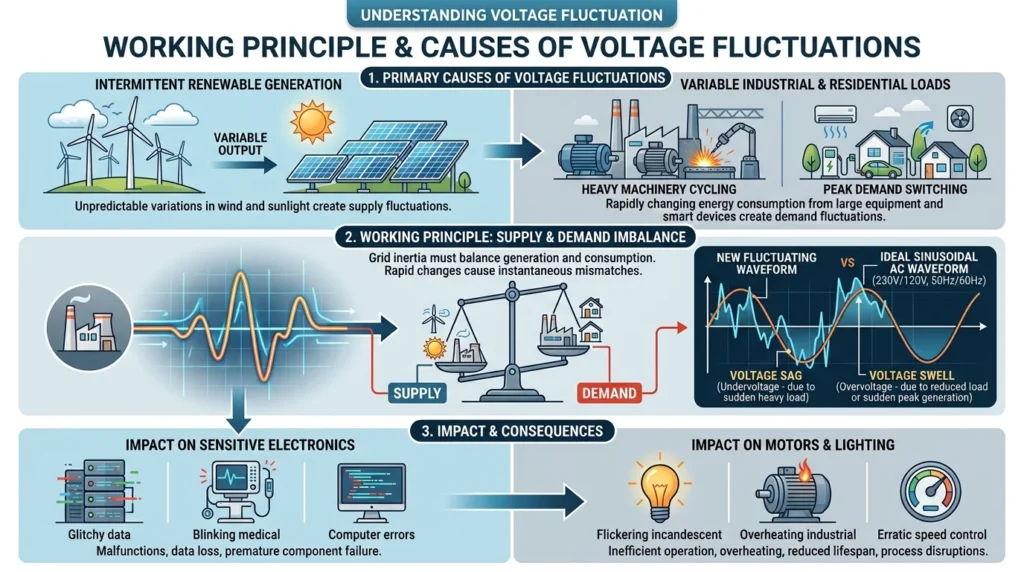
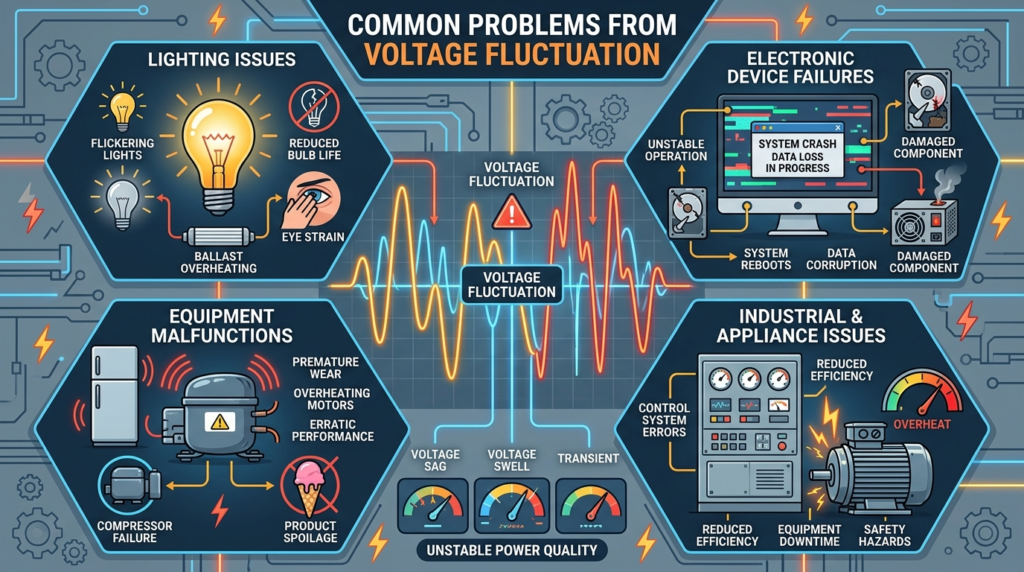
The working principle of voltage fluctuation problems is based on changes in the electrical supply voltage caused by variations in power demand or disturbances in the power system. Under normal conditions, electrical equipment receives a stable voltage for efficient operation. However, when large loads such as motors, pumps, air conditioners, or industrial machines are switched on or off, the voltage may suddenly rise or fall. Faults in the power grid, overloaded circuits, poor wiring, or unstable utility supply can also cause voltage fluctuations. These rapid voltage changes can lead to flickering lights, overheating of electrical equipment, reduced motor performance, malfunction of sensitive electronic devices, and a shorter equipment lifespan. To minimize these problems, power systems use voltage stabilizers, Automatic Voltage Regulators (AVRs), UPS systems, surge protection devices, and proper load management. Maintaining a stable voltage supply ensures the safe, reliable, and efficient operation of electrical appliances in residential, commercial, and industrial applications.
The voltage fluctuation problems working principle is based on changes in electrical supply conditions that affect voltage levels.
Step-by-Step Working Process
Electrical Supply Enters the System
Power is supplied from the electrical grid or generator.
Load Conditions Change
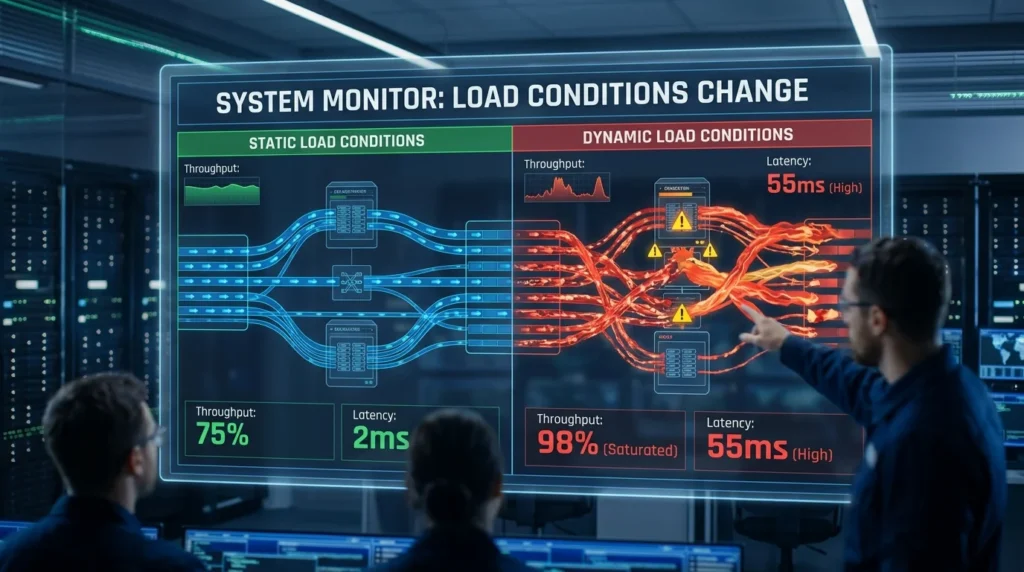
Load Conditions Change when the amount of electrical power demanded by connected devices increases or decreases during operation. These changes occur as electrical equipment such as motors, air conditioners, pumps, heaters, lighting systems, or industrial machinery is switched on or off. As the load varies, the current drawn from the power source also changes, which can affect voltage levels, power quality, and the overall performance of the electrical system. Sudden load changes may cause voltage drops, voltage rises, or temporary fluctuations, especially in weak or heavily loaded power networks. Modern power systems use devices such as Automatic Voltage Regulators (AVRs), UPS systems, inverters, and smart controllers to maintain a stable power supply during changing load conditions. Proper load management helps improve energy efficiency, protect electrical equipment, and ensure the reliable operation of residential, commercial, and industrial electrical systems.
Large electrical loads switch ON or OFF.
Examples include:
Air conditioners
Motors
Industrial machines
Voltage Level Changes
Heavy loads or supply disturbances cause voltage to rise or fall.
Electrical Equipment Responds
Sensitive devices react to unstable voltage.
effects:
Flickering lights
Equipment overheating
Reduced performance
Protection Systems Activate
Voltage stabilizers or protective devices attempt to maintain safe voltage levels.
Easy Analogy
Think of voltage like water pressure in a pipe:
Stable pressure gives smooth water flow
Low pressure reduces flow
High pressure may damage pipes
Similarly, stable voltage ensures proper electrical operation.
Types / Classification
Different voltage fluctuation conditions occur depending on supply disturbances and load behavior.
Overvoltage
Voltage rises above the normal level.
Causes
Lightning
Faulty transformers
Sudden load disconnection
Effects
Equipment damage
Bulb failure
Insulation stress
Undervoltage
Voltage falls below the required level.
Causes
Heavy load demand
Long transmission lines
Weak power supply
Effects
Slow motor operation
Reduced efficiency
Motor overheating
Voltage Sag
A temporary short-duration voltage drop.
Applications
Common during motor starting conditions.
Voltage Swell
A temporary increase in voltage level.
Effects
May damage electronic equipment.
Rapid Voltage Fluctuation
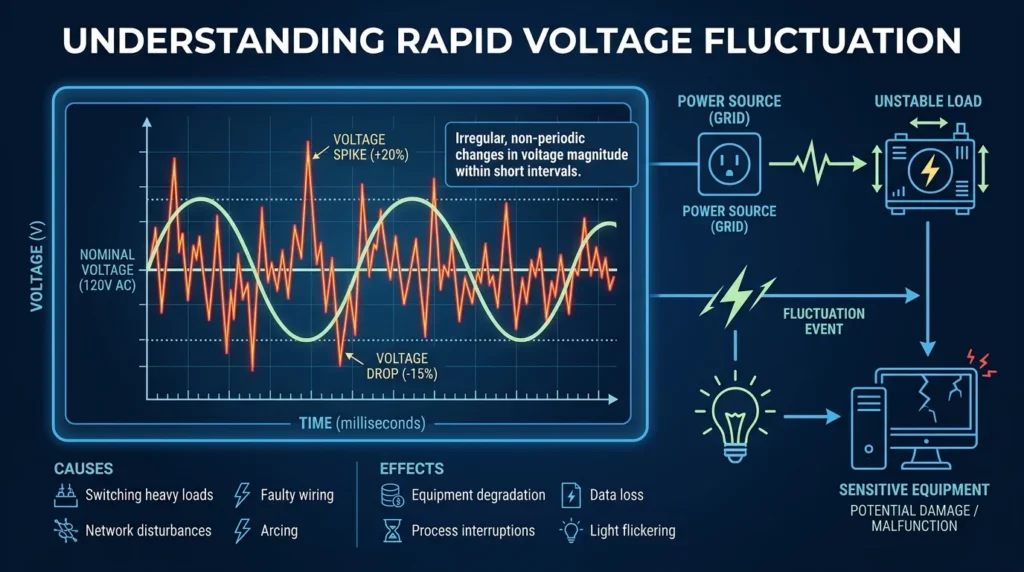
Rapid Voltage Fluctuation is a condition in which the supply voltage changes quickly and repeatedly above or below its normal value within a short period. These fluctuations are commonly caused by sudden changes in electrical load, large motor starting, faulty wiring, switching operations, unstable utility power, or problems within the electrical distribution system. Frequent voltage fluctuations can cause lights to flicker, reduce the performance of electrical equipment, overheat motors, and damage sensitive electronic devices such as computers, televisions, and industrial control systems. To minimize the effects of rapid voltage fluctuations, voltage stabilizers, Automatic Voltage Regulators (AVRs), UPS systems, surge protection devices, and proper electrical system maintenance are commonly used. Maintaining a stable voltage supply improves equipment reliability, extends the lifespan of electrical devices, and ensures the safe and efficient operation of residential, commercial, and industrial power systems.
Continuous and repeated voltage changes.
Effects
Flickering lights
Unstable machine operation
Main Components
Several electrical components are involved in managing and controlling voltage fluctuation problems.
Power Supply System
Provides electrical energy to the load.
Examples
Utility grid
Generator
Solar inverter
Transformer
Adjusts voltage levels in power systems.
Voltage Stabilizer
Maintains stable output voltage.
Function
Protects appliances from voltage variations.
Circuit Breaker
Disconnects faulty circuits during dangerous conditions.
Capacitor Bank
Improves voltage stability and power factor.
Wiring System
Poor wiring can worsen voltage fluctuations.
Load Equipment
Electrical devices affected by unstable voltage.
Advantages
Although voltage fluctuations are generally considered harmful, understanding and controlling them offers several practical benefits.
Advantages of Voltage Monitoring and Control
Protects electrical equipment
Improves system reliability
Reduces maintenance costs
Prevents equipment failure
Increases appliance lifespan
Improves energy efficiency
Enhances industrial productivity
Supports stable lighting systems
Reduces overheating risks
Improves electrical safety
Disadvantages / Limitations
Voltage fluctuation problems can create serious operational and safety issues.
Disadvantages of Voltage Fluctuation Problems
Damages electronic devices
Causes motor overheating
Reduces equipment lifespan
Creates flickering lights
Interrupts industrial operations
Increases maintenance expenses
Causes data loss in computers
Reduces system efficiency
Creates unstable appliance performance
May lead to fire hazards
Voltage Fluctuation Problems Applications
Voltage fluctuation problems applications are important in electrical protection, monitoring, and power quality systems.
Home Applications
Refrigerator protection
Air conditioner safety
Television voltage protection
Commercial Applications
Office power systems
Shopping malls
Hospitals
Industrial Applications
Motor protection
Machine safety
Automation systems
Modern Technology Applications
Smart grids
Renewable energy systems
Data centers
Electric vehicle charging systems
Comparison Section
Difference Between Overvoltage and Undervoltage
| Feature | Overvoltage | Undervoltage |
| Voltage Level | Higher than normal | Lower than normal |
| Main Cause | Supply surge | Heavy load demand |
| Effect on Equipment | Insulation damage | Overheating |
| Lighting Effect | Very bright lights | Dim lights |
| Motor Behavior | Excess stress | Slow operation |
| Common Risk | Equipment burnout | Reduced efficiency |
| Protection Method | Surge protection | Voltage stabilizer |
Selection Guide
Choosing proper voltage protection systems depends on load type and application.
Choose Voltage Stabilizer When
Home appliances need protection
Voltage changes frequently
Sensitive electronics are used
Choose UPS Systems When
Continuous power supply is required
Computers and servers are used
Data protection is important
Choose Surge Protection Devices When
Lightning risk exists
Electronic equipment is sensitive
Tips for Beginners
Monitor Supply Voltage
Use a voltmeter regularly to check voltage levels.
Avoid Overloading Circuits
Too many devices increase voltage drop risks.
Use Quality Wiring
Poor wiring creates additional voltage problems.
Install Proper Grounding
Grounding improves electrical safety.
Maintain Electrical Connections
Loose connections increase fluctuation issues.
Common Problems & Solutions
Why Are Lights Flickering?
causes:
Voltage fluctuation
Loose wiring
Overloaded circuits
Solution
Inspect wiring
Reduce load
Use stabilizer
Why Does the Refrigerator Stop Frequently?
Low voltage may affect compressor operation.
Solution
Install voltage stabilizer
Check supply condition
Why Do Motors Overheat?
Undervoltage increases motor current.
Solution
Improve voltage stability
Reduce excessive load
Why Are Electronic Devices Damaged?
High voltage surges may damage sensitive circuits.
Solution
Use surge protectors
Install UPS systems
Why Does the Circuit Breaker Trip Repeatedly?
Voltage instability or overload may trigger protection devices.
Solution
Check load conditions
Inspect electrical system
Future Trends
Modern power systems are improving voltage control and electrical protection technologies.
Smart Voltage Stabilizers
Advanced stabilizers provide:
Automatic voltage correction
Digital monitoring
Remote operation
Smart Grid Technology
Modern smart grids improve voltage regulation and power quality.
IoT-Based Monitoring Systems
Internet-connected systems monitor voltage conditions in real time.
AI-Based Power Management
Artificial intelligence helps predict and control voltage fluctuations automatically.
Renewable Energy Integration
Advanced control systems maintain stable voltage in solar and wind power systems.
Conclusion
Understanding voltage fluctuation problems is essential for electrical students, engineers, technicians, and beginners involved in electrical installation, maintenance, and power system operation. Voltage fluctuations occur when supply voltage rises or falls outside normal limits, affecting electrical equipment performance and safety.
The voltage fluctuation problems working principle explains how unstable voltage conditions impact motors, lighting systems, electronic devices, and industrial machinery. Proper voltage control systems such as stabilizers, UPS units, surge protectors, and smart monitoring systems help improve safety, reliability, and energy efficiency.
As modern electrical systems continue to evolve, smart grids, AI-based monitoring, and advanced protection technologies are becoming increasingly important for maintaining stable power quality. Learning about voltage fluctuation causes, protection methods, and troubleshooting techniques helps build strong practical electrical knowledge for safe and efficient system operation.