
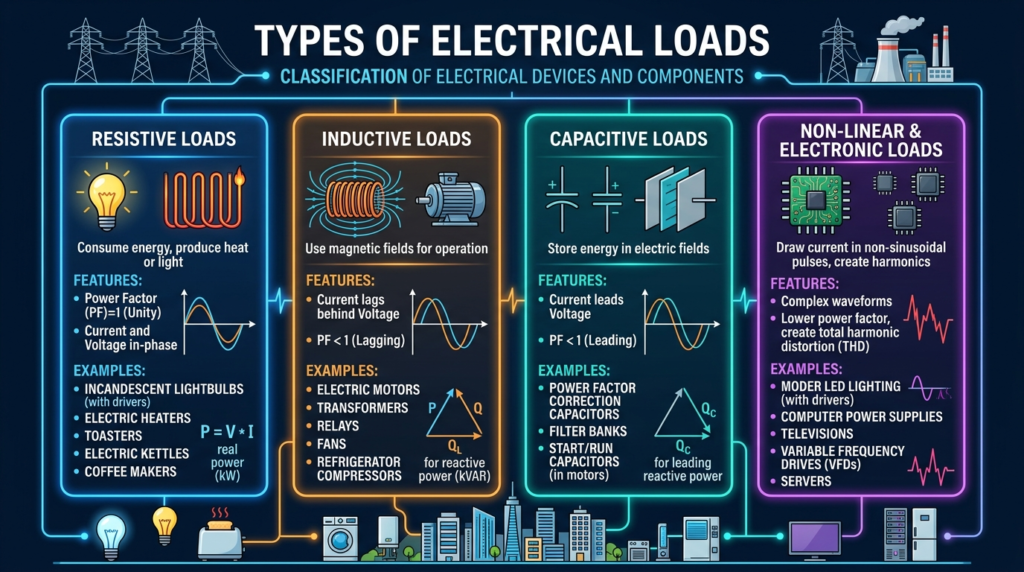

Imagine switching ON different electrical devices in your home such as a fan, electric heater, refrigerator, LED bulb, or air conditioner. Although all these devices use electricity, they do not consume electrical power in the same way. Some devices convert electrical energy into heat, some create motion, while others produce light or store energy temporarily. In electrical engineering, these devices are called electrical loads.
Understanding the types of electrical loads is very important for electrical students, engineers, technicians, and beginners because electrical loads directly affect power consumption, wiring design, circuit protection, power factor, and overall system efficiency. Proper knowledge of load types helps in selecting suitable generators, transformers, cables, and protection devices.
The types of electrical loads working principle also explains how different loads behave in AC and DC circuits. Electrical loads can influence voltage stability, current flow, and energy efficiency in homes, industries, and commercial buildings.
In this article, you will learn everything about types of electrical loads, including definitions, working principles, classifications, components, advantages and disadvantages, applications, troubleshooting, comparison tables, and future electrical load technologies in simple and easy English.
What are Electrical Loads?
Electrical loads are devices or equipment that consume electrical energy and convert it into another form of energy such as heat, light, motion, or sound.
In simple words, any device that uses electricity is called an electrical load.
Simple Explanation
When electrical current flows through a device and performs useful work, that device acts as an electrical load.
Electrical loads may:
Produce heat
Create motion
Generate light
Operate electronic systems
Practical Example
Examples of electrical loads include:
Bulbs
Fans
Motors
Air conditioners
Heaters
Computers
Each load uses electrical energy differently.
Types of Electrical Loads Working Principle
The working principle of different types of electrical loads is based on how they consume electrical energy and convert it into useful forms such as heat, light, motion, or sound. When an electrical load is connected to a power source, it draws current according to its power requirement and electrical characteristics. Resistive loads, such as electric heaters and incandescent bulbs, convert electrical energy directly into heat and light. Inductive loads, including motors, fans, and transformers, use magnetic fields to produce mechanical motion or transfer energy. Capacitive loads, commonly found in capacitor banks and electronic circuits, store and release electrical energy in an electric field to improve power quality and circuit performance. Many modern appliances, such as computers, televisions, LED lighting, and mobile chargers, are electronic loads that use semiconductor devices to regulate and control power efficiently. Understanding the working principle of electrical loads helps engineers and technicians select the right power source, improve energy efficiency, and ensure the safe operation of electrical systems.
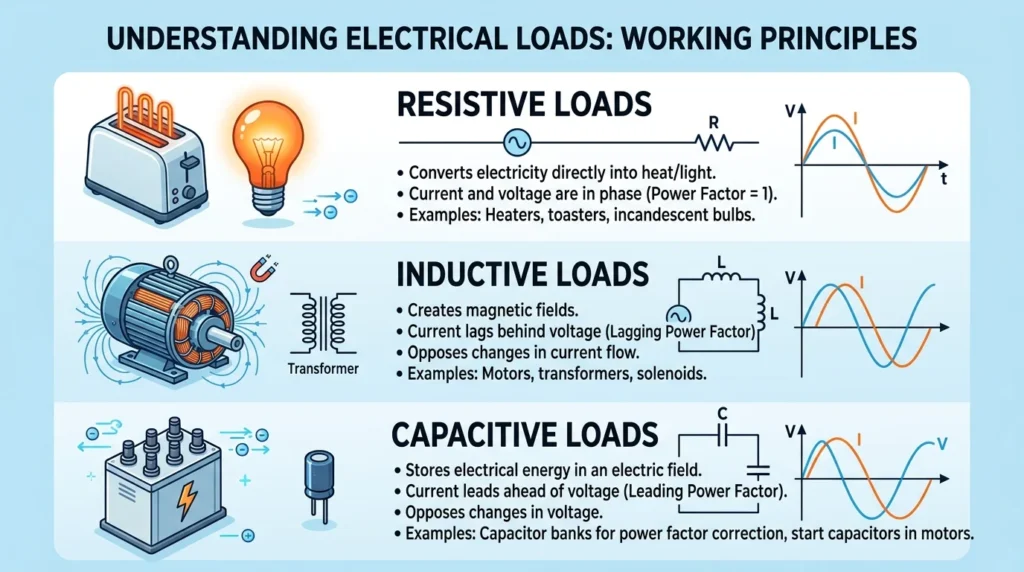
The types of electrical loads working principle is based on how electrical devices consume voltage and current.
Step-by-Step Working Process
Electrical Supply Reaches the Load
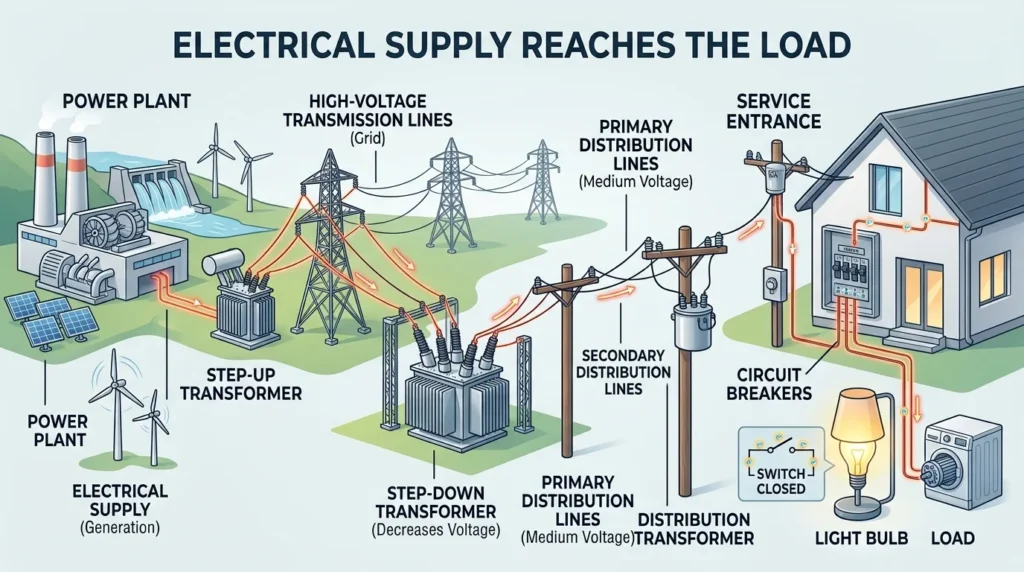
Electrical Supply Reaches the Load when electrical energy is delivered from the power source, such as the utility grid, inverter, generator, or battery system, to the connected electrical devices through wires and protective equipment. Once the circuit is complete, current flows to the load, allowing it to convert electrical energy into useful forms such as light, heat, motion, or sound. Depending on the type of load, this energy may power lights, operate electric motors, charge electronic devices, or run household and industrial equipment. Proper wiring, circuit protection, and voltage regulation ensure that the load receives a stable and safe electrical supply. This process is essential in homes, offices, industries, solar power systems, and backup power installations, ensuring the reliable and efficient operation of electrical appliances and equipment.
Voltage is supplied from the power source.
Current Flows Through the Load
The electrical load allows current flow according to its characteristics.
Energy Conversion Takes Place
The load converts electrical energy into another form.
Examples:
Heater → Heat energy
Motor → Mechanical energy
Bulb → Light energy
Circuit Behavior Changes
Different load types affect:
Power factor
Voltage
Current flow
Energy efficiency
Easy Analogy
Think of electrical loads like different water tools connected to a water supply:
A sprinkler sprays water
A turbine rotates
A heater warms water
Similarly, electrical loads use electrical energy differently.
Types / Classification
There are several types of electrical loads based on electrical behavior and energy consumption.
Resistive Load
A resistive load converts electrical energy mainly into heat.
Characteristics

Characteristics are the important features or properties that describe how a device, component, or system performs under different operating conditions. In electrical engineering, characteristics help engineers, technicians, and students understand the behavior, efficiency, reliability, and performance of electrical equipment. These may include voltage, current, power, efficiency, capacity, response time, durability, operating temperature, and safety features. By studying these characteristics, it becomes easier to compare different devices, select the right equipment for a specific application, and ensure safe and efficient operation. Understanding the characteristics of electrical components is essential for proper system design, maintenance, troubleshooting, and achieving reliable performance in residential, commercial, and industrial applications.
Voltage and current remain in phase
No reactive power
Simple operation
Examples
Electric heaters
Incandescent bulbs
Electric irons
Applications
Heating systems
Cooking appliances
Inductive Load
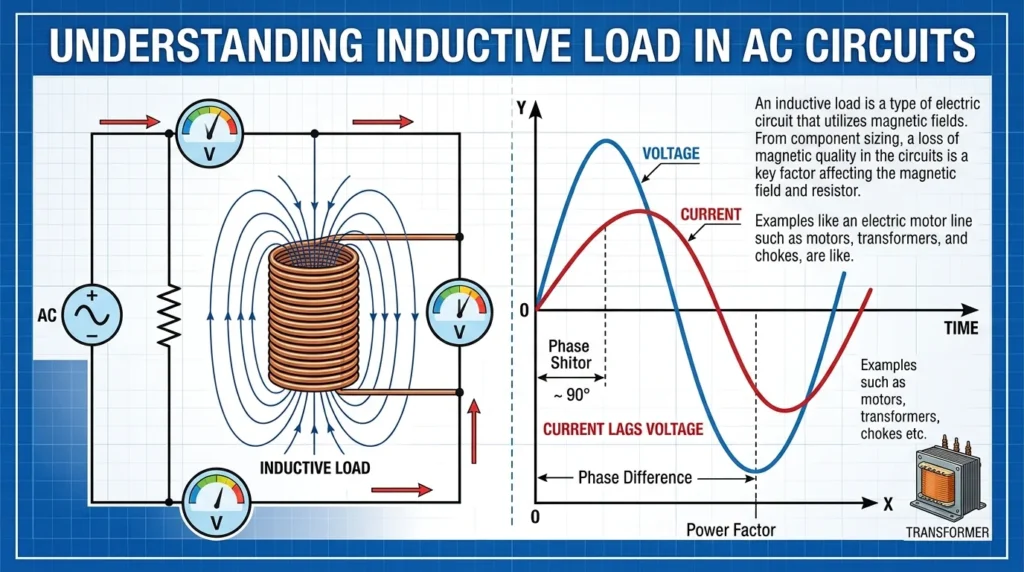
An Inductive Load is an electrical load that uses coils or windings to create a magnetic field when electric current flows through it. These loads require reactive power in addition to active power and typically cause the current to lag behind the voltage. Common examples of inductive loads include electric motors, transformers, fans, pumps, air conditioners, refrigerators, and industrial machinery. When switched on, inductive loads often draw a high starting current, known as inrush current, before settling to normal operating levels. They are widely used in residential, commercial, and industrial applications because they convert electrical energy into mechanical motion or magnetic energy. Proper sizing of power sources, inverters, and protection devices is important when operating inductive loads to ensure efficient performance, prevent voltage drops, and extend the lifespan of electrical equipment.
An inductive load uses magnetic fields for operation.
Characteristics
Current lags behind voltage
Consumes reactive power
Common in motors
Examples
Fans
Motors
Transformers
Applications
Industrial machinery
Air conditioning systems
Capacitive Load
A capacitive load stores electrical energy temporarily in an electric field.
Characteristics
Current leads voltage
Improves power factor
Stores energy briefly
Examples
Capacitor banks
Electronic circuits
Applications
Power factor correction
Electronic equipment
Linear Load
A linear load draws current in a smooth waveform.
Characteristics
Stable current pattern
Predictable operation
Examples
Heating elements
Simple motors
Non-Linear Load
A non-linear load draws irregular current waveforms.
Characteristics
Produces harmonics
Distorts electrical signals
Examples
Computers
LED drivers
UPS systems
Applications
Electronics
Digital systems
Static Load
A load without moving parts.
Examples
Lighting systems
Heating equipment
Dynamic Load
A load with continuously changing demand.
Examples
Elevators
Cranes
Industrial motors
Main Components
Different components influence electrical load behavior and operation.
Conductors
Carry electrical current to the load.
Power Source
Provides electrical energy.
Examples
Generator
Utility grid
Battery
Switches
Control electrical load operation.
Protective Devices
Protect loads from faults.
Examples
Fuse
Circuit breaker
Relay
Control Systems
Manage load operation automatically.
Load Devices
The equipment consuming electrical energy.
Advantages
Understanding types of electrical loads advantages and disadvantages helps improve electrical system design.
Advantages of Proper Load Classification
Improves system efficiency
Helps select correct equipment
Reduces power losses
Improves electrical safety
Supports proper cable sizing
Helps in power factor correction
Improves voltage stability
Enhances energy management
Reduces equipment damage
Improves industrial productivity
Disadvantages / Limitations
Improper load management can create several electrical problems.
Disadvantages of Electrical Loads
Excessive loads increase power consumption
Inductive loads reduce power factor
Non-linear loads create harmonics
Heavy loads may overload circuits
Voltage drops may occur
Increased heating in cables
Equipment damage risk increases
Poor load balance affects efficiency
Types of Electrical Loads Applications
Types of electrical loads applications are found in almost every electrical system.
Home Applications
Lighting systems
Fans
Refrigerators
Electric heaters
Commercial Applications
Office equipment
Air conditioning systems
Escalators
Industrial Applications
Motors
Welding machines
Compressors
Pumps
Modern Technology Applications
Data centers
Smart homes
Electric vehicles
Renewable energy systems
Comparison Section
Difference Between Resistive, Inductive, and Capacitive Loads
| Feature | Resistive Load | Inductive Load | Capacitive Load |
|—|—|—|
| Energy Conversion | Heat | Magnetic field | Electric field |
| Power Factor | Unity | Lagging | Leading |
| Current Behavior | In phase | Current lags voltage | Current leads voltage |
| Reactive Power | No | Yes | Yes |
| Common Devices | Heater | Motor | Capacitor bank |
| Harmonics | Low | Moderate | Low |
| Applications | Heating | Industrial machines | Power factor correction |
Selection Guide
Choosing the right electrical load type depends on application and power requirements.
Choose Resistive Loads When
Heating is required
Simple circuits are needed
Choose Inductive Loads When
Mechanical motion is needed
Motors are required
Choose Capacitive Loads When
Power factor correction is important
Voltage support is needed
Tips for Beginners
Calculate Total Load Properly
Avoid circuit overloading.
Understand Power Factor
Inductive loads may require correction.
Use Proper Protection Devices
Install suitable breakers and fuses.
Monitor Load Balance
Balanced loads improve efficiency.
Maintain Wiring Systems
Poor wiring increases losses and heating.
Common Problems & Solutions
Why Does the Circuit Overload?
Too many electrical loads may exceed circuit capacity.
Solution
Reduce connected devices
Upgrade wiring and breakers
Why Do Motors Overheat?
Low voltage or overload conditions may increase motor current.
Solution
Check voltage supply
Reduce mechanical load
Why Is the Power Factor Low?
Large inductive loads consume reactive power.
Solution
Install capacitor banks
Why Are Harmonics Produced?
Non-linear loads distort current waveforms.
Solution
Use harmonic filters
Improve system design
Why Does Voltage Drop Occur?
Long cables or heavy loads reduce voltage levels.
Solution
Use larger cable size
Reduce excessive loading
Future Trends
Modern electrical systems are improving load management technologies.
Smart Load Management
Modern systems automatically monitor and control loads.
Features
Energy monitoring
Automatic load balancing
Remote control
AI-Based Energy Systems
Artificial intelligence improves power optimization and load prediction.
IoT Integration
Internet-connected devices improve electrical load monitoring.
Renewable Energy Load Systems
Solar and battery systems require advanced load management.
Energy-Efficient Appliances
Modern appliances consume less electricity while improving performance.
Conclusion
Understanding the types of electrical loads is essential for electrical students, engineers, technicians, and beginners working with modern electrical systems. Electrical loads consume electrical energy and convert it into useful forms such as heat, light, motion, and electronic operation.
The types of electrical loads working principle explains how resistive, inductive, capacitive, linear, and non-linear loads behave differently in electrical circuits. Proper knowledge of load classification helps improve system efficiency, power factor, voltage stability, and equipment protection.
As electrical systems continue to evolve, smart load management, AI-based monitoring, renewable energy integration, and energy-efficient technologies are becoming increasingly important. Learning about electrical loads and their behavior builds strong practical knowledge for safe, efficient, and reliable electrical system design and operation.



Pingback: Demand vs Diversity vs Load Factor Explained