
Imagine a hot summer afternoon when electricity suddenly goes OFF, fans stop working, and the house becomes uncomfortable. At the same time, electricity bills continue increasing every month. Many homeowners now solve these problems by installing a solar system for home use. Solar energy allows homes to generate their own electricity directly from sunlight, reducing dependence on the utility grid and lowering electricity costs.
A solar system for home is becoming one of the most popular energy solutions because it is clean, reliable, and cost-effective. Modern solar systems can power lights, fans, refrigerators, air conditioners, computers, water pumps, and even electric vehicle chargers. With growing energy demand and rising fuel prices, understanding solar technology is very important for electrical students, engineers, technicians, and beginners.
The solar system for home working principle explains how solar panels convert sunlight into usable electrical energy. These systems are now widely used in homes, industries, schools, hospitals, and commercial buildings around the world.
In this article, you will learn everything about solar systems for homes, including working principles, types, components, advantages and disadvantages, applications, troubleshooting, selection guides, and future trends in simple and easy English.
What is Solar System for Home?
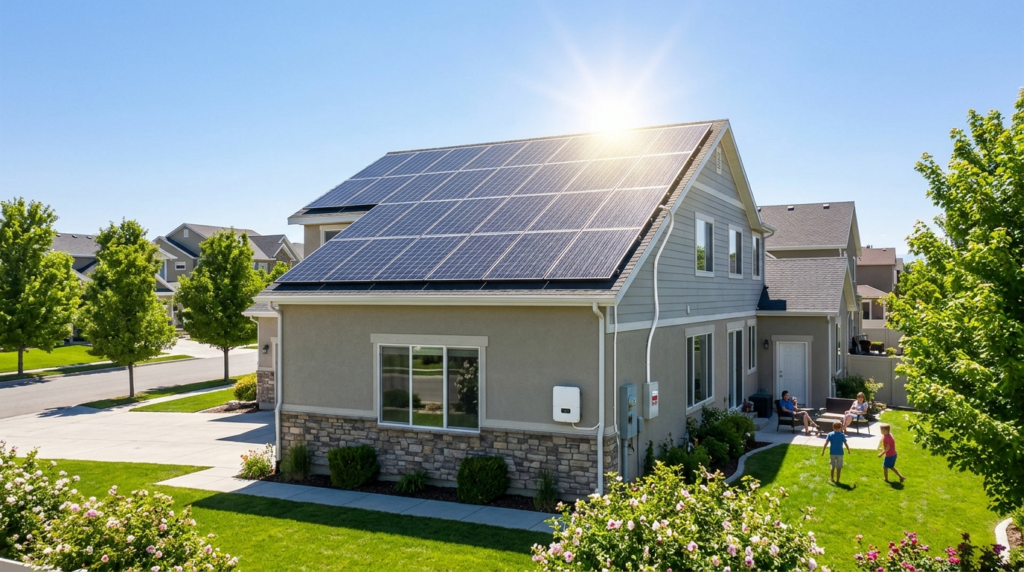
A solar system for home is an electrical energy system that converts sunlight into electricity using solar panels and supplies power to household appliances.
It allows homeowners to generate renewable electrical energy from sunlight instead of relying completely on utility power.
Simple Explanation
Solar panels capture sunlight and convert it into DC electricity.
An inverter then converts the DC power into AC power, which is used by home appliances such as:
Fans
Lights
Refrigerators
Televisions
Computers
Practical Example
A 5 kW home solar system installed on a rooftop can power:
LED lights
Ceiling fans
Refrigerator
Washing machine
Small air conditioner
during daytime using solar energy.
Solar System for Home Working Principle
The solar system for home working principle is based on photovoltaic energy conversion.
Solar panels absorb sunlight and generate electrical energy.
Step-by-Step Working Process
Sunlight Falls on Solar Panels
Solar panels absorb solar radiation from the sun.
Solar Cells Generate DC Power
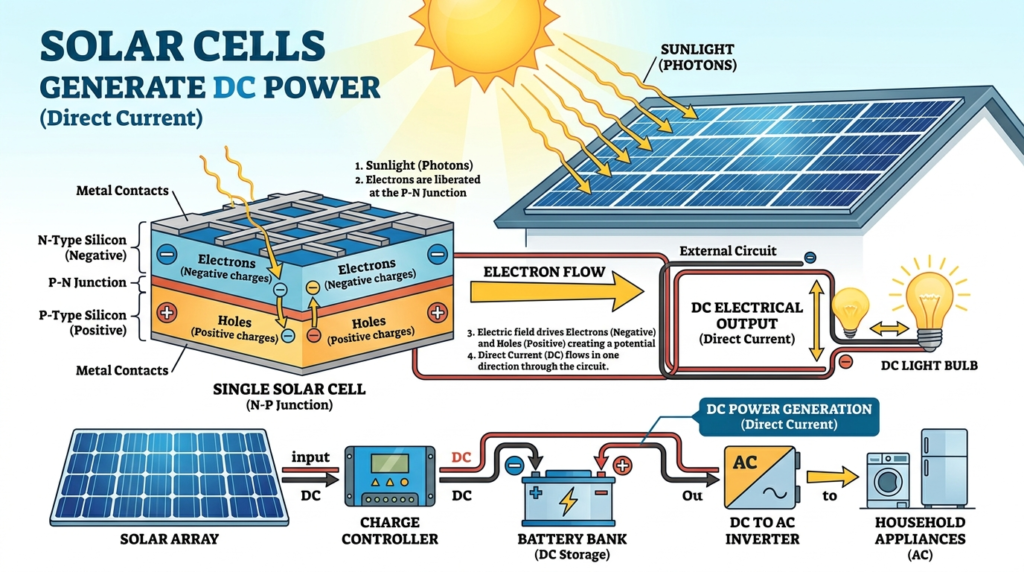
Solar cells generate DC (Direct Current) power by converting sunlight directly into electrical energy through the photovoltaic (PV) effect. When sunlight strikes the semiconductor material inside a solar cell, it excites electrons and creates an electric current. The electricity produced is in the form of DC power, which can be used to charge batteries or supplied to a solar inverter for conversion into AC (Alternating Current). Multiple solar cells are connected together to form a solar panel, increasing the amount of electricity generated. This DC power generation process is the foundation of solar energy systems used in homes, commercial buildings, industries, street lighting, and off-grid applications. Solar cells provide a clean, renewable, and environmentally friendly source of electricity, helping reduce dependence on fossil fuels and lowering energy costs.
Photovoltaic cells inside the panels convert sunlight into direct current (DC).
Inverter Converts DC into AC
The inverter changes DC power into alternating current (AC) for household use.
Electricity Powers Home Appliances
The AC power operates electrical loads such as lights and fans.
Excess Power is Stored or Exported
Depending on system type:
Batteries store extra energy
Grid systems send excess power to the utility network
Solar Power Formula
P = V \times I
Where:
P = Power
V = Voltage
I = Current
Easy Analogy
Think of solar panels like plant leaves.
Plants absorb sunlight to create food
Solar panels absorb sunlight to create electricity
Types / Classification
Different solar systems are available depending on backup and grid requirements.
On-Grid Solar System
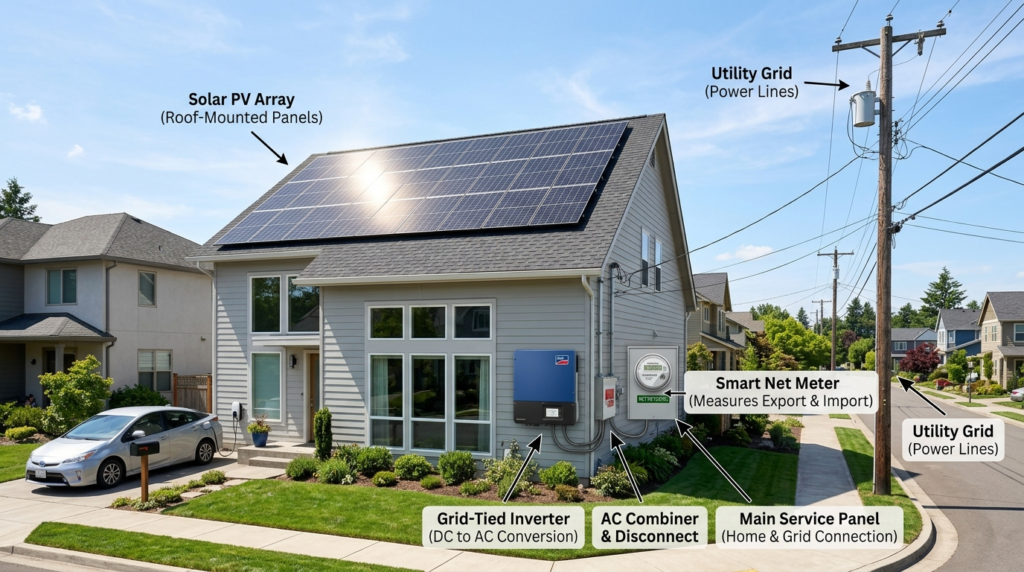
An On-Grid Solar System, also known as a grid-tied solar system, is a solar power system that is directly connected to the public electricity grid. It uses solar panels to generate DC (Direct Current) electricity, which is converted into AC (Alternating Current) by a solar inverter for use in homes, offices, and industries. During the day, the system supplies solar power to electrical loads, and any excess electricity is exported to the utility grid through net metering. When solar generation is insufficient, such as at night or during cloudy weather, electricity is automatically imported from the grid, ensuring a continuous power supply. On-grid solar systems are widely used because they reduce electricity bills, require no battery storage, have lower installation costs, and offer high efficiency, making them one of the most popular renewable energy solutions for residential and commercial applications.
Connected directly to the utility grid.
Features
No battery required
Lower installation cost
Excess power exported to grid
Applications
Urban homes
Commercial buildings
Off-Grid Solar System
Operates independently without utility supply.
Features
Battery storage required
Suitable for remote areas
Applications
Villages
Remote homes
Hybrid Solar System
Combines grid connection and battery storage.
Features
Backup during outages
Better energy management
Applications
Modern smart homes
Rooftop Solar System
Installed on rooftops for efficient space utilization.
Portable Solar System
Small movable systems used for temporary power needs.
Main Components
Several important components are required for a home solar system.
Solar Panels
Convert sunlight into electrical energy.
Common Types
Monocrystalline panels
Polycrystalline panels
Solar Inverter
Converts DC power into AC power.
Battery Bank
Stores electrical energy for backup operation.
Charge Controller
Controls battery charging and prevents overcharging.
Mounting Structure
Supports and secures solar panels.
Wiring and Connectors
Transfer electrical energy safely between components.
Protection Devices
Protect against faults and overloads.
Examples
Circuit breakers
Fuses
Surge protectors
Advantages
Understanding solar system for home advantages and disadvantages helps users make better decisions.
Advantages of Solar System for Home
Reduces electricity bills
Uses renewable energy
Environmentally friendly
Low operating cost
Reduces grid dependence
Provides backup power
Increases property value
Low maintenance requirements
Long system lifespan
Supports sustainable energy
Disadvantages / Limitations
Although highly beneficial, solar systems also have limitations.
Disadvantages of Solar System for Home
High initial installation cost
Performance depends on sunlight
Battery replacement cost
Large roof area may be required
Dust reduces efficiency
Nighttime generation is not possible without batteries
Solar System for Home Applications
Solar system for home applications are increasing rapidly worldwide.
Home Applications
Lighting systems
Fans
Refrigerators
Air conditioners
Water pumps
Commercial Applications
Offices
Shopping centers
Hotels
Industrial Applications
Factories
Warehouses
Industrial lighting
Agricultural Applications
Solar irrigation pumps
Farm lighting systems
Modern Technology Applications
Smart homes
Electric vehicle charging
IoT energy systems
Comparison Section
Difference Between On-Grid and Off-Grid Solar Systems
| Feature | On-Grid Solar System | Off-Grid Solar System |
| Grid Connection | Yes | No |
| Battery Requirement | Usually no | Yes |
| Backup During Outage | No | Yes |
| Installation Cost | Lower | Higher |
| Maintenance | Lower | Higher |
| Best Applications | Urban homes | Remote areas |
| Energy Storage | Limited | Full battery backup |
Selection Guide
Choosing the right solar system depends on energy usage and location.
Choose On-Grid Systems When
Stable utility power is available
Lower installation cost is preferred
Choose Off-Grid Systems When
Remote location has no utility supply
Complete energy independence is required
Choose Hybrid Systems When
Backup power is important
Smart energy management is needed
Tips for Beginners
Calculate Energy Consumption
Determine daily power usage before installation.
Select Quality Solar Panels
High-quality panels improve long-term performance.
Use Proper Inverter Size
The inverter should match load requirements.
Maintain Panel Cleanliness
Dust and dirt reduce energy production.
Install Proper Protection Devices
Electrical protection improves safety and reliability.
Common Problems & Solutions
Why Is Solar Output Low?
causes:
Dust on panels
Poor sunlight
Panel shading
Solution
Clean panels regularly
Remove shading objects
Why Is Battery Backup Weak?
causes:
Old battery
Improper charging
Solution
Replace battery
Check charge controller
Why Is the Inverter Shutting Down?
causes:
Overload
Overheating
Solution
Reduce load
Improve ventilation
Why Is Electricity Bill Still High?
Possible causes:
Incorrect system sizing
Excessive energy consumption
Solution
Increase solar capacity
Improve energy efficiency
Why Are Panels Overheating?
High temperatures reduce efficiency.
Solution
Improve airflow under panels
Future Trends
Modern solar technology continues improving rapidly.
Smart Solar Systems
Modern systems include:
Mobile monitoring
Remote control
Energy analytics
AI-Based Energy Management
Artificial intelligence improves energy optimization and fault detection.
High-Efficiency Solar Panels
New solar cells produce more electricity with less space.
Solar Battery Advancements
Lithium-ion batteries provide:
Longer lifespan
Faster charging
Better efficiency
Solar-Powered Smart Homes
Future homes will integrate:
Solar energy
Automation systems
Smart appliances
Vehicle-to-Home Integration
Electric vehicles may supply backup power to homes.
Conclusion
A solar system for home is one of the most effective and environmentally friendly energy solutions available today. It converts sunlight into usable electrical energy and helps reduce electricity bills, power outages, and dependence on traditional energy sources.
The solar system for home working principle uses photovoltaic technology, inverters, and battery systems to provide reliable electricity for homes and modern electrical applications. Understanding solar system for home applications, advantages and disadvantages, and component selection helps electrical students, engineers, technicians, and beginners build strong practical knowledge of renewable energy systems.
As solar technology continues advancing, smart solar systems, AI-based energy management, high-efficiency panels, and battery storage systems will make solar energy even more reliable and affordable for future homes worldwide.