
A single lightning strike can dump over 100 million volts onto a power line in a millionth of a second. Without protection, that surge would flash over insulators, puncture transformer windings, and black out entire districts. The quiet device standing between the lightning and your electricity supply is the lightning arrester — also called a surge arrester.
Every transformer yard, substation, and tall transmission tower carries these unassuming cylinders, waiting years for the few microseconds when they must act. This guide explains the lightning arrester working principle, the main types, how to read their ratings, and where they are installed.
What Is a Lightning Arrester?
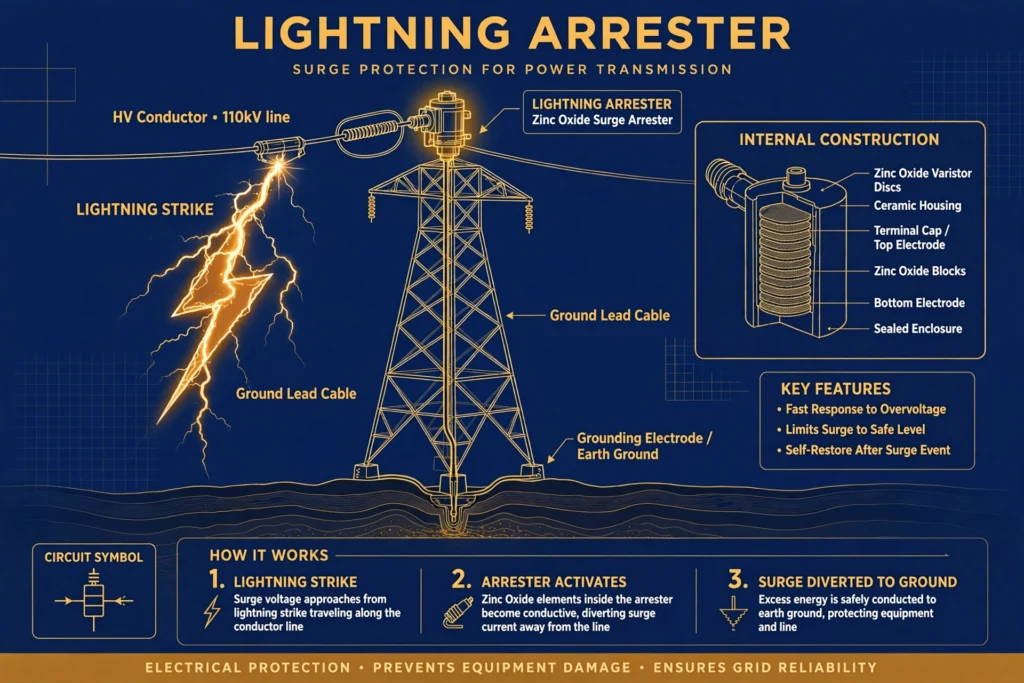
A lightning arrester is a protective device connected between a power conductor and earth. Under normal voltage it behaves like an open circuit — drawing essentially no current. But when a lightning surge (or switching surge) drives the voltage above a safe threshold, it instantly becomes conductive, diverting the massive surge current safely to earth. Once the surge passes and voltage returns to normal, it switches back to its insulating state.
Think of it as a pressure-relief valve for voltage: invisible in normal operation, lifesaving during a surge. It is a key member of the broader surge protection devices family, specialized for the extreme energies of lightning.
Lightning Arrester Working Principle
The lightning arrester working principle rests on a special material property: extreme non-linearity. The heart of a modern arrester is a stack of metal-oxide (zinc oxide, ZnO) discs called varistors. Their resistance changes enormously with voltage:
- At normal system voltage: the ZnO discs have extremely high resistance (megaohms). Only a tiny leakage current of about 1 mA flows — the arrester is effectively invisible to the system.
- When a surge arrives: as voltage climbs past the arrester’s threshold, the disc resistance collapses by many orders of magnitude within nanoseconds. The arrester becomes a low-resistance path, and the surge current — which can reach 10,000 to 100,000 amperes — is diverted straight to earth.
- After the surge: the moment voltage falls back to normal, resistance shoots back up. The arrester “reseals,” and normal operation resumes with no intervention needed.
Older designs (silicon-carbide valve arresters) used spark gaps in series with non-linear resistors: the gap sparked over on a surge, and the resistor limited the follow-on power-frequency current so the gap could extinguish. Modern gapless ZnO arresters do the same job with no gaps at all — faster, simpler, and more reliable.
The whole event lasts microseconds. The protected equipment — transformers, breakers, cables — never sees the dangerous voltage because the arrester clamps it to a safe level, typically 2–3 times the normal peak voltage.
Construction
A typical station-class lightning arrester consists of:
- ZnO varistor blocks: stacked cylindrical discs, the active surge-diverting element.
- Housing: traditionally porcelain, increasingly polymer/silicone-rubber for lighter weight, vandal resistance, and better pollution performance.
- Grading rings: metal rings at the top that even out the voltage distribution along tall arrester stacks.
- Pressure-relief diaphragm: vents safely if the arrester ever fails internally under extreme duty.
- Disconnector/counter: many installations add a surge counter (to log operations) and a disconnect device that isolates a failed arrester from the line.
- Earth lead: a short, direct connection to the substation earth grid — surge protection is only as good as its earthing system.
Types of Lightning Arresters
- Rod-gap arrester: The simplest and oldest — two metal rods with an air gap. Cheap but crude: it sparks over on surges but cannot limit follow current well. Rarely used today except on low-voltage lines.
- Horn-gap arrester: An improved gap design where the arc is driven upward and stretched until it extinguishes. Better than rod-gap, still largely obsolete.
- Silicon-carbide (valve) arrester: Spark gaps in series with SiC non-linear resistors. The workhorse of the mid-20th century; still found in older substations.
- Metal-oxide (ZnO) gapless arrester: The modern standard — no gaps, just ZnO blocks. Faster response, better protection levels, no follow current, compact. Used in all new installations.
- Line surge arrester: A lighter ZnO arrester mounted directly on transmission towers, connected between phase conductor and tower steel, to prevent lightning flashovers on the line itself.
Key Ratings (How to Read an Arrester Nameplate)
- Rated voltage (Ur): The maximum power-frequency voltage the arrester can withstand continuously — chosen slightly above the system’s maximum voltage.
- Nominal discharge current (In): The surge current the arrester is designed to handle repeatedly — typically 10 kA for station class, 5 kA for distribution class.
- Residual (discharge) voltage: The voltage appearing across the arrester while it carries the nominal discharge current — this is the actual protection level the equipment sees. Lower is better.
- Energy capability: How much surge energy (in kJ per kV of rating) the arrester can absorb without damage — critical for long-duration switching surges.
- Pressure-relief rating: The maximum fault current the housing can vent safely if the arrester fails short.
Where Lightning Arresters Are Installed
- Transformer terminals: The most critical location — as close as possible to the bushings, since transformers are the costliest and most surge-sensitive equipment.
- Substation busbars and line entrances: To intercept surges arriving along incoming lines.
- Transmission towers: Line surge arresters at selected towers in high-lightning areas.
- Cable terminations: Where overhead lines meet underground cables — cables are especially vulnerable to surges.
- Distribution poles: Smaller polymer arresters protect pole-mounted transformers in neighborhoods.
- Building entrances: Low-voltage surge protective devices guard sensitive electronics — the domestic cousins of station arresters.
Placement follows one rule: the arrester must be electrically close to what it protects, because every meter of lead wire adds inductance that raises the voltage the equipment actually sees.
Lightning Arrester vs Lightning Rod
A common confusion: a lightning rod (air terminal) sits on top of buildings and towers to attract a strike and carry it to earth along a preferred path. A lightning arrester sits on power conductors to clamp the voltage of surges that reach the electrical system. Substations use both: shield wires and masts intercept direct strikes, while arresters handle the surges that get through.
Maintenance and Failure Signs
ZnO arresters are largely maintenance-free, but utilities monitor them:
- Leakage current monitoring: a rising resistive leakage current indicates aging ZnO blocks.
- Infrared scanning: hot spots reveal internal damage.
- Surge counters: a sudden jump in operations after a storm season suggests the arrester absorbed heavy duty and deserves inspection.
- Visual checks: cracked housings, tracking marks, or a operated disconnector mean replacement time.
FAQs
How does a lightning arrester differ from a surge protector at home?
Same principle, different scale. A home surge protector (SPD) clamps surges of a few thousand volts to protect electronics. A station lightning arrester handles tens of kiloamperes from direct lightning to protect transformers and switchgear.
Why are most modern arresters “gapless”?
Zinc-oxide blocks are so non-linear that no spark gap is needed — they conduct on surges and insulate at normal voltage by themselves. Removing the gap eliminates gap-erosion, improves response time, and gives better protection levels.
Can a lightning arrester stop a direct lightning strike to a transformer?
It cannot stop the strike, but it doesn’t need to: it diverts the surge current to earth and clamps the voltage across the transformer to a safe level. Direct strikes to equipment are rare because shield wires and masts intercept them first.
What is the difference between a lightning arrester and a surge arrester?
Today the terms are used interchangeably. “Surge arrester” is the technically preferred name (per IEC) because the device also handles switching surges, not just lightning — but “lightning arrester” remains the common term.
How long does a lightning arrester last?
Typically 20–30 years. ZnO blocks age very slowly under normal voltage; heavy surge duty or sustained overvoltage shortens life. Leakage-current monitoring predicts end of life before failure.
Does a lightning arrester need a good earth connection?
Absolutely — it is the most important part of the installation. The surge current must flow to earth through the lowest possible impedance; a poor earth makes the arrester nearly useless, since the voltage will simply rise elsewhere. See our guide to earthing systems for what “good earth” means.
Conclusion
The lightning arrester is a masterpiece of materials science disguised as a boring gray cylinder: a device that is an insulator 99.999% of the time and a near-perfect conductor for the microseconds that matter. Its working principle — the violent non-linearity of zinc-oxide varistors — lets it swallow lightning-scale energies and clamp voltages to levels transformers can survive.
For the exam or the field, remember three things: arresters connect line to earth, they act on voltage threshold not current, and they are only as good as their earth connection and placement. Get those right, and the storm can do its worst. For the physics of the discharge itself, Wikipedia’s surge arrester article is a good next read.