
Imagine touching a metal body of a faulty washing machine and suddenly feeling an electric shock. This situation can be dangerous and even life-threatening. Now, think about how such risks are prevented in modern electrical systems. The answer lies in a simple but critical safety concept: earthing.
Earthing systems play a vital role in protecting people, equipment, and buildings from electrical faults. Whether it’s a home, factory, or power station, proper earthing ensures that fault currents safely flow into the ground instead of passing through a human body or damaging equipment.
Understanding the Types of Earthing Systems is essential for electrical students, engineers, technicians, and beginners. It helps in designing safe installations, troubleshooting faults, and maintaining system reliability.
In this article, you will learn what earthing systems are, how they work, their classifications, advantages and disadvantages, and their real-world applications. By the end, you will have a clear understanding of how to choose the right earthing system for different situations.
2. What is Earthing Systems?
Earthing (or grounding) is the process of connecting electrical equipment or systems to the earth (ground) to ensure safety.
Simple Definition
An earthing system provides a low-resistance path for fault current to flow into the ground.
Simple Explanation
- If a fault occurs (like insulation failure), current may flow through metal parts
- Earthing safely directs this current into the soil
- This prevents electric shock and equipment damage
Practical Example
In a house, the third pin of a plug (earth pin) connects appliances like refrigerators and washing machines to the ground. If a fault occurs, the current flows into the earth instead of passing through a person.
3. Working Principle
Earthing Systems Working Principle
The earthing systems working principle is based on providing a safe path for fault current.
Step-by-Step Explanation
- Electrical equipment is connected to an earthing conductor
- This conductor is connected to an electrode buried in the ground
- In case of a fault, current flows through this path
- The current reaches the earth safely
- Protective devices (like circuit breakers) detect the fault and disconnect supply
Easy Analogy
Think of earthing like a drainage system:
- Water (fault current) needs a safe path
- Drain (earthing system) carries it away safely
- Prevents flooding (electric shock or damage)
Key Points
- Earth has very low electrical resistance
- Fault current prefers the easiest path
- Earthing provides that path
4. Types / Classification
There are several Types of Earthing Systems, mainly classified based on how the neutral and earth connections are arranged.
TN System (Terra Neutral)
In this system, the neutral point is directly connected to earth, and the equipment is connected to this earth.
Types of TN System
TN-S System
- Separate neutral and earth conductors
- High safety and reliability
- Common in modern installations
TN-C System
- Neutral and earth combined into one conductor
- Economical but less safe
- Used in older systems
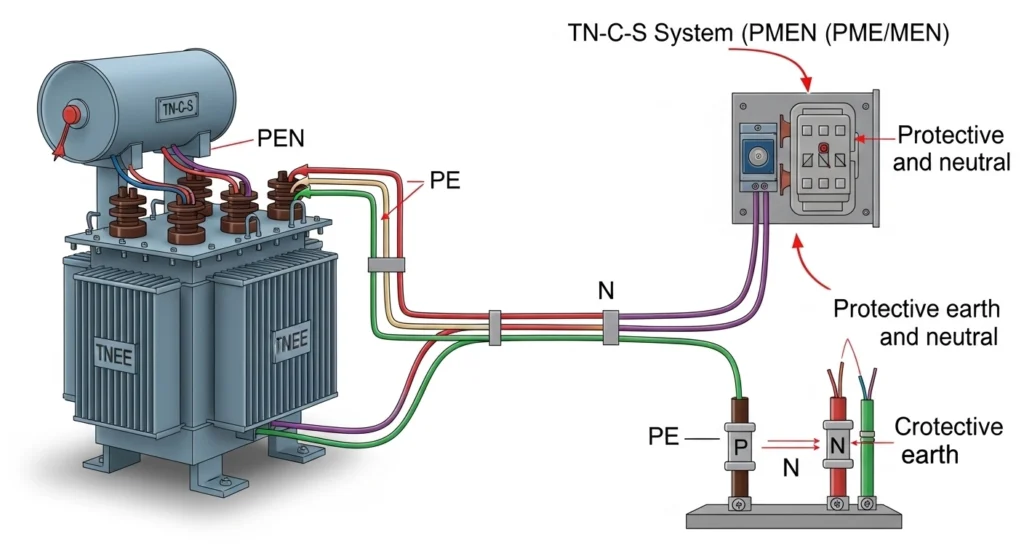
TN-C-S System
- Combination of TN-C and TN-S
- Used in many residential areas
- Provides a balance of cost and safety
TT System (Terra-Terra)
- Both neutral and equipment are connected to separate earth electrodes
- No direct connection between supply earth and installation earth
Features:
- Simple design
- Requires residual current devices (RCDs)
- Common in rural areas
IT System (Isolated Terra)
- No direct connection between system and earth
- Equipment is earthed, but supply is isolated
Features:
- High reliability
- Used in hospitals and critical systems
- Fault does not immediately disconnect supply
Plate Earthing
- Metal plate buried in the ground
- Surrounded by charcoal and salt
- Provides good conductivity
Pipe Earthing
- Most common method
- Uses a pipe driven into the ground
- Cost-effective and efficient
Rod Earthing
- Metal rod inserted deep into the soil
- Suitable for rocky areas
Strip/Wire Earthing
- Conductors buried horizontally in trenches
- Used in large installations
5. Main Components
Key Components of Earthing Systems
Earth Electrode
- Buried in soil
- Provides connection to earth
- Types: plate, rod, pipe
Earthing Conductor
- Connects equipment to electrode
- Carries fault current
Earth Pit
- Area where electrode is installed
- Filled with salt and charcoal
Protective Devices
- Circuit breakers and fuses
- Disconnect supply during faults
Earth Busbar
- Common connection point
- Used in panels and distribution boards
6. Advantages
Earthing Systems Advantages
- Protects humans from electric shock
- Prevents equipment damage
- Ensures safe fault current flow
- Improves system stability
- Helps in proper operation of protective devices
- Reduces fire hazards
7. Disadvantages / Limitations
Earthing Systems Disadvantages
- Requires proper installation and maintenance
- Soil conditions affect performance
- Corrosion of electrodes over time
- Initial installation cost
- Poor earthing can lead to serious hazards
8. Applications
Earthing Systems Applications
Home Applications
- Electrical appliances
- Wiring systems
- Distribution boards
Industrial Applications
- Heavy machinery
- Power plants
- Control panels
Modern Technology
- Data centers
- Communication systems
- Renewable energy systems
- Electric vehicle charging stations
9. Comparison Section
Difference Between Types of Earthing Systems
| System | Safety | Cost | Complexity | Usage |
| TN-S | High | Medium | Medium | Modern buildings |
| TN-C | Low | Low | Simple | Old systems |
| TN-C-S | Medium | Medium | Medium | Residential |
| TT | High | Medium | Simple | Rural areas |
| IT | Very High | High | Complex | Hospitals |
10. Selection Guide
How to Choose the Right Earthing System
Choosing the right system depends on safety, cost, and application.
Key Factors
- Type of installation (home, industry)
- Soil resistivity
- Safety requirements
- Budget
- Maintenance capability
Tips for Beginners
- Use TN-S for better safety
- Choose pipe earthing for cost-effective solutions
- Always follow local electrical standards
- Test earthing resistance regularly
11. Common Problems & Solutions
What causes poor earthing?
Dry soil, corrosion, or loose connections.
How to improve earthing resistance?
Add water, salt, or install additional electrodes.
Why is earthing important?
It protects against electric shock and equipment damage.
How often should earthing be checked?
At least once a year or as per regulations.
What happens if earthing fails?
High risk of shock, fire, and equipment failure.
12. Future Trends
Earthing systems are evolving with modern technology.
- Smart Earthing Systems: Real-time monitoring
- Chemical Earthing: Improved conductivity
- Maintenance-Free Electrodes: Longer life
- Integration with Smart Grids
- Advanced materials for corrosion resistance
These advancements improve safety, reliability, and efficiency.
13. Conclusion
Understanding the Types of Earthing Systems is essential for ensuring electrical safety and system reliability. Earthing provides a safe path for fault currents, protecting both people and equipment.
Different systems like TN, TT, and IT offer various levels of safety and complexity, while methods like pipe and plate earthing are widely used in practical installations. Choosing the right system depends on application, environment, and safety requirements.
As an electrical professional or learner, always prioritize proper earthing design and maintenance. It is one of the most important aspects of any electrical system and should never be ignored.