
Imagine you are using a home audio system. You connect a speaker to an amplifier, but the sound is either too weak or distorted. Even though everything is connected correctly, something is not right. The issue often comes down to impedance matching—a concept many beginners overlook.
Understanding what is electrical impedance is essential in electrical and electronics engineering. It plays a critical role in AC circuits, communication systems, power systems, and even everyday devices like speakers and chargers.
In simple terms, impedance tells us how much a circuit resists the flow of alternating current (AC). But unlike resistance, it also considers the effects of frequency and energy storage components like inductors and capacitors.
In this article, you will learn the definition of electrical impedance, its working principle, types, advantages and disadvantages, and real-world applications. We will also explore the difference between impedance and resistance, practical selection tips, and common troubleshooting problems. By the end, you will have a strong and practical understanding of this important concept.
2. What is Electrical Impedance?
Definition
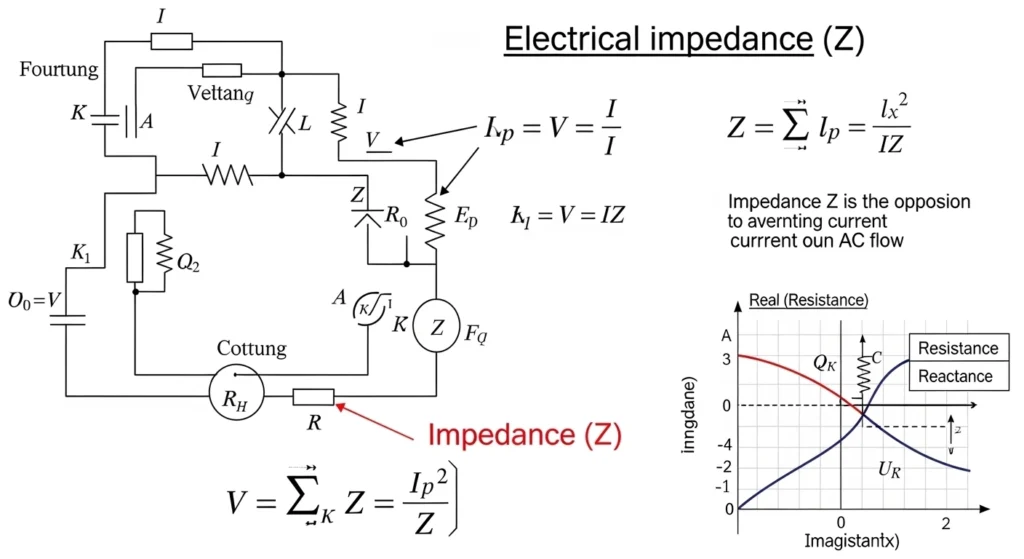
Electrical impedance is the total opposition that a circuit offers to the flow of alternating current (AC). It is represented by the symbol Z and measured in ohms (Ω).
Simple Explanation
Impedance is like resistance, but more advanced. It not only resists current but also reacts to changes in voltage and current over time.
- Resistance = opposes current flow
- Impedance = opposes and reacts to AC current
Practical Example
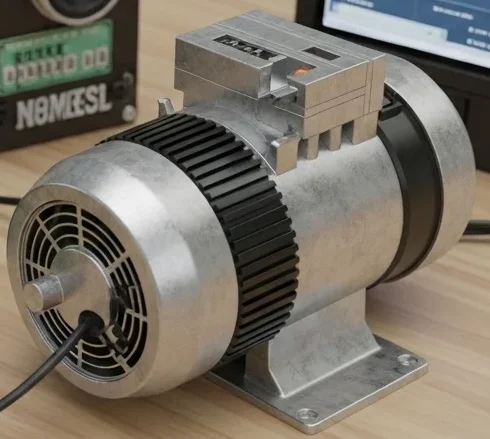
Consider a fan connected to AC supply:
- The wires offer resistance
- The motor coils create inductive effects
- The total opposition to current is impedance
Key Idea
Impedance combines:
- Resistance (R)
- Reactance (X)
3. Working Principle
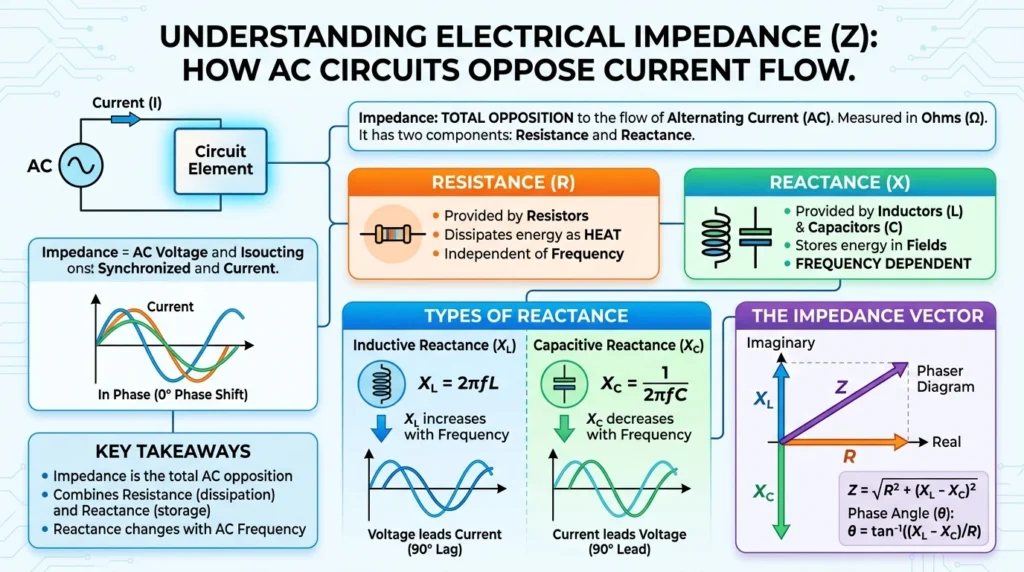
Electrical Impedance Working Principle explains how a circuit opposes the flow of alternating current (AC) due to the combined effect of resistance, inductance, and capacitance. When AC voltage is applied to a circuit, current does not flow freely because each element resists or reacts to the change in current. Resistance opposes both AC and DC, while inductance and capacitance create additional opposition based on frequency. Inductors oppose changes in current by generating a back EMF, whereas capacitors oppose changes in voltage by storing and releasing electrical energy. The combined effect of these factors is called impedance, which determines how much current will flow for a given AC voltage. Impedance also affects phase difference between voltage and current, making it a key concept in AC circuit analysis and electrical system design.
Understanding the electrical impedance working principle is key to mastering AC circuits.
Step-by-Step Explanation
- AC voltage is applied to a circuit
- Current starts flowing
- Circuit components oppose the current
- This opposition depends on frequency and component type
Components of Opposition
- Resistance (R): Constant opposition
- Inductive Reactance (XL): Opposition due to inductors
- Capacitive Reactance (XC): Opposition due to capacitors
Formula
Impedance is calculated as:
Z = \sqrt{R^2 + (X_L – X_C)^2}
Easy Analogy
Think of water flowing in a pipe:
- Resistance = narrow pipe
- Inductor = heavy wheel slowing changes
- Capacitor = flexible membrane storing energy
Impedance is the total effect of all these.
Key Points
- Depends on frequency
- Includes both resistance and reactance
- Affects voltage and current phase
4. Types / Classification
Types of Electrical Impedance
Resistive Impedance
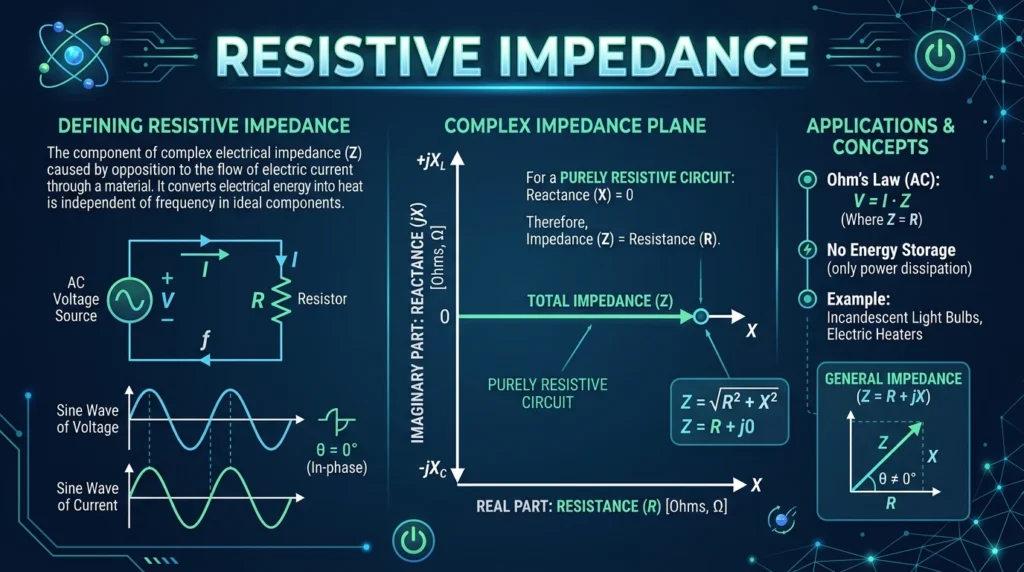
Resistive Impedance refers to the opposition offered by a circuit to the flow of alternating current (AC) when only resistance is present, with no inductive or capacitive effects involved. In a purely resistive circuit, impedance is equal to resistance and does not change with frequency. It means the voltage and current remain in phase with each other, and energy is dissipated only in the form of heat. Resistive impedance is commonly found in devices like heaters, incandescent lamps, and resistive loads where the main purpose is to convert electrical energy into heat or light. It plays an important role in AC circuit analysis, especially in understanding power consumption and phase relationships.
- Only resistance present
- No phase difference between voltage and current
- Example: Heater
Inductive Impedance
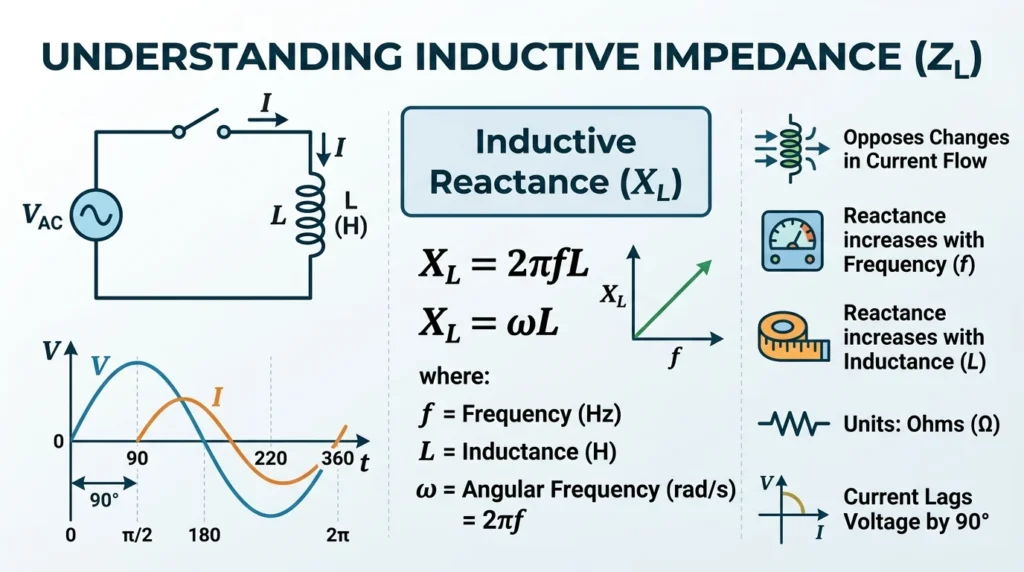
Resistive Impedance refers to the opposition offered by a circuit to the flow of alternating current (AC) when only resistance is present, with no inductive or capacitive effects involved. In a purely resistive circuit, impedance is equal to resistance and does not change with frequency. It means the voltage and current remain in phase with each other, and energy is dissipated only in the form of heat. Resistive impedance is commonly found in devices like heaters, incandescent lamps, and resistive loads where the main purpose is to convert electrical energy into heat or light. It plays an important role in AC circuit analysis, especially in understanding power consumption and phase relationships.
- Caused by inductors
- Current lags behind voltage
- Common in motors and transformers
Capacitive Impedance
- Caused by capacitors
- Current leads voltage
- Used in filters and electronic circuits
Complex Impedance
- Combination of resistance and reactance
- Most practical circuits fall into this category
5. Main Components
Electrical impedance is formed by three main components.
Resistance (R)
- Opposes current flow
- Independent of frequency
- Converts energy into heat
Inductance (L)
- Stores energy in magnetic field
- Opposes change in current
- Creates inductive reactance
Capacitance (C)
- Stores energy in electric field
- Opposes change in voltage
- Creates capacitive reactance
Supporting Components
- AC source
- Conductors
- Load devices
Function Summary
- Resistance blocks current
- Inductance delays current
- Capacitance shifts current
6. Advantages
Understanding electrical impedance advantages and disadvantages helps in practical design.
Advantages
- Helps analyze AC circuits accurately
- Enables proper circuit design
- Essential for impedance matching
- Improves signal transmission
- Reduces power loss in communication systems
- Supports efficient energy transfer
Real-World Benefits
- Better audio quality
- Stable power systems
- Efficient electronic devices
7. Disadvantages / Limitations
Limitations
- More complex than simple resistance
- Requires understanding of phase angles
- Frequency-dependent behavior
- Difficult calculations in complex circuits
Practical Issues
- Mismatch can cause signal loss
- Incorrect impedance leads to overheating
- Requires proper measurement tools
8. Applications
Understanding electrical impedance applications is crucial for real-world engineering.
Home Applications
- Audio systems (speakers and amplifiers)
- Household appliances
- Power adapters
Industrial Applications
- Motor control systems
- Power transmission
- Transformers
Electronics and Communication
- Signal transmission lines
- Antennas
- Filters and oscillators
Modern Technology
- Smartphones and laptops
- Renewable energy systems
- Electric vehicles
Key Insight
Impedance ensures efficient energy transfer and proper system performance.
9. Comparison Section
Difference Between Impedance and Resistance
| Feature | Impedance (Z) | Resistance (R) |
| Definition | Opposition to AC current | Opposition to DC current |
| Components | R + Reactance | Only resistance |
| Frequency Effect | Depends on frequency | Independent |
| Phase Difference | Present | Not present |
| Application | AC circuits | DC circuits |
10. Selection Guide
Choosing the right impedance is important for system performance.
When to Consider Impedance
- Designing AC circuits
- Working with communication systems
- Connecting audio equipment
Tips for Beginners
- Match impedance between source and load
- Check frequency requirements
- Use proper measuring instruments
- Avoid overloading components
Practical Advice
- Always read device ratings
- Use simulation tools for complex circuits
- Start with simple calculations
11. Common Problems & Solutions
What happens if impedance is too high?
Current flow reduces, and system performance drops.
What happens if impedance is too low?
Excess current flows, causing overheating or damage.
Why is impedance matching important?
It ensures maximum power transfer and prevents signal loss.
How to measure impedance?
Use an LCR meter or impedance analyzer.
Troubleshooting Tips
- Check component values
- Verify frequency
- Inspect connections
- Use proper instruments
12. Future Trends
Electrical impedance plays a key role in modern technology.
Emerging Trends
- Smart grids with advanced impedance control
- High-frequency communication systems
- Wireless power transfer
Industry Direction
- Better impedance matching techniques
- Advanced simulation tools
- Integration with IoT systems
New Technologies
- Electric vehicles
- Renewable energy systems
- 5G and beyond communication
13. Conclusion
Understanding what is electrical impedance is essential for anyone working with AC circuits. It combines resistance and reactance to describe how a circuit opposes current flow. Unlike resistance, impedance depends on frequency and affects both the magnitude and phase of current.
The difference between impedance and resistance highlights why impedance is more important in AC systems. From audio systems to power transmission, impedance plays a critical role in ensuring efficiency and performance.
By learning the electrical impedance working principle, applications, and practical considerations, you can design better circuits and troubleshoot problems effectively. Keep practicing and exploring real-world systems to strengthen your understanding.