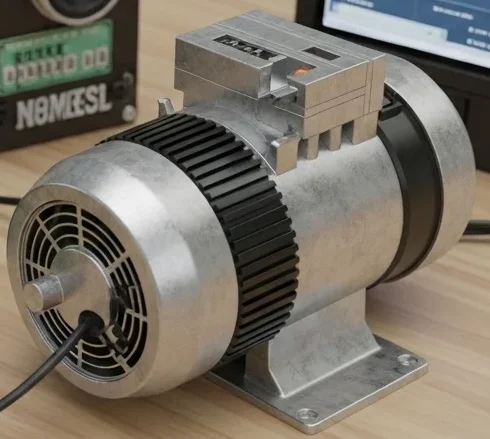

Imagine your ceiling fan suddenly stops working, or your air conditioner struggles to start. In many such cases, the problem is not the motor but a small component inside—the capacitor. A faulty capacitor can silently affect the performance of many electrical devices.
This is why understanding how to test capacitor is an essential skill for electrical students, engineers, technicians, and beginners. Capacitors are widely used in circuits for energy storage, filtering, and motor starting. When they fail, systems may behave unpredictably or stop working altogether.
In this guide, you will learn everything about how to test capacitor, including its basic concept, capacitor working principle, testing methods, and practical troubleshooting techniques. We will also explore capacitor applications, types, and the capacitor advantages and disadvantages. By the end, you will be able to confidently check whether a capacitor is working properly or needs replacement.
2. What is How to Test Capacitor?
How to test capacitor refers to the process of checking whether a capacitor is functioning correctly using electrical measurement tools.
Simple Explanation
Testing a capacitor means verifying:
- It can store electrical charge
- It releases energy properly
- It is not short-circuited or damaged
Practical Example
If a fan capacitor is rated at 5µF but measures only 1µF, it means the capacitor is weak and needs replacement. Testing helps identify this issue quickly.
3. Working Principle
Capacitor Working Principle
To understand testing, first learn the capacitor working principle.
A capacitor stores electrical energy in an electric field between two plates.
Step-by-step explanation:
- Two conductive plates are placed close together
- An insulating material (dielectric) is between them
- When voltage is applied, charge builds up on the plates
- Energy is stored and released when needed
Simple Analogy
Think of a capacitor like a water tank:
- Filling the tank = charging
- Storing water = energy storage
- Releasing water = discharging
How Testing Works
Testing checks whether this process is working correctly:
- Does it charge properly?
- Does it hold charge?
- Does it discharge correctly?
4. Types / Classification
Types of Capacitors
Electrolytic Capacitors
- Polarized (have positive and negative terminals)
- High capacitance values
- Used in power supplies
Ceramic Capacitors
- Non-polarized
- Small size
- Used in high-frequency circuits
Film Capacitors
- Stable and reliable
- Used in audio and industrial circuits
Tantalum Capacitors
- Compact and efficient
- Used in modern electronics
Supercapacitors
- Very high capacitance
- Used in energy storage systems
5. Main Components
Plates
- Conductive materials
- Store electric charge
Dielectric Material
- Insulating layer
- Determines capacitance value
Terminals
- Connect capacitor to circuit
- Allow current flow
Enclosure
- Protects internal parts
- Provides insulation
6. Advantages
Capacitor Advantages
- Stores and releases energy quickly
- Improves power factor
- Filters noise in circuits
- Supports motor starting
- Compact and cost-effective
Benefits of Testing
- Prevents equipment failure
- Improves system reliability
- Saves maintenance cost
- Ensures safety
7. Disadvantages / Limitations
Capacitor Disadvantages
- Limited energy storage compared to batteries
- Can fail due to heat or aging
- Sensitive to voltage spikes
- Electrolytic capacitors have polarity restrictions
Practical Limitations
- Testing requires proper tools
- Some faults are not visible
- Incorrect testing can damage components
8. Applications
Capacitor Applications
Capacitors are used in many areas:
Home Applications
- Ceiling fans
- Air conditioners
- Power supplies
Industrial Applications
- Motor starting systems
- Power factor correction
- Control circuits
Modern Technology
- Smartphones and laptops
- Electric vehicles
- Renewable energy systems
9. Comparison Section
Difference Between Capacitor and Battery
| Feature | Capacitor | Battery |
| Energy Storage | Short-term | Long-term |
| Charging Time | Very fast | Slow |
| Discharge Time | Quick | Gradual |
| Lifespan | Long cycles | Limited cycles |
| Applications | Circuits, motors | Power supply |
10. Selection Guide
How to Choose the Right Capacitor for Testing
For Beginners
- Use a digital multimeter
- Start with low-voltage capacitors
- Check capacitance rating
For Professionals
- Use LCR meter
- Perform ESR (Equivalent Series Resistance) test
- Analyze waveform behavior
Tips
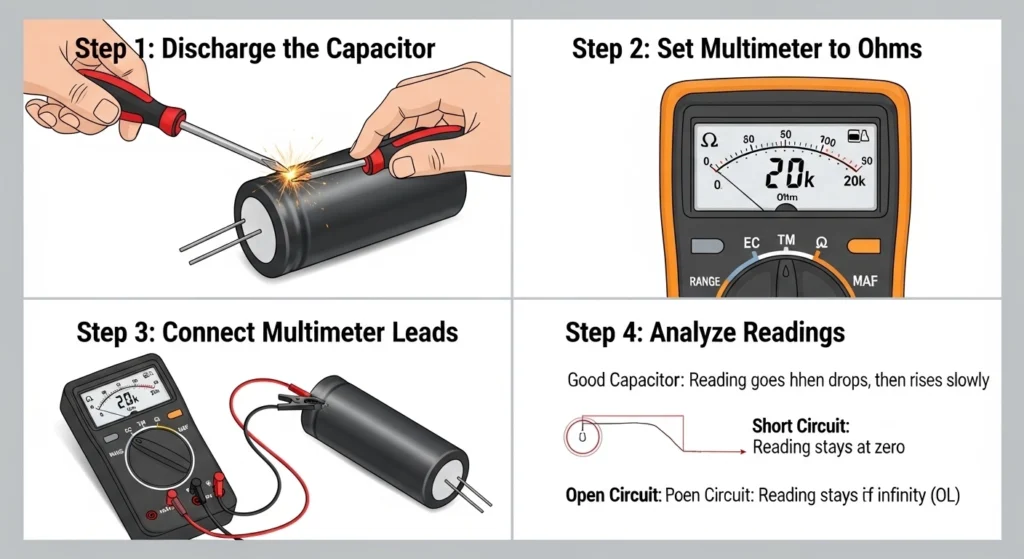
- Always discharge capacitor before testing
- Match voltage rating
- Check polarity for electrolytic capacitors
- Use proper safety tools
11. Common Problems & Solutions
Capacitor not chargingCauses:
- Internal damage
- Open circuit
Solution:
- Replace capacitor
- Check connections
Capacitor overheating
Causes:
- Overvoltage
- High temperature
Solution:
- Use correct rating
- Improve cooling
Low capacitance value
Causes:
- Aging
- Dielectric breakdown
Solution:
- Replace capacitor
Short circuit capacitor
Causes:
- Internal failure
Solution:
- Test with multimeter
- Replace immediately
12. Future Trends
Capacitor technology is advancing rapidly.
Modern Developments
- Supercapacitors with higher energy density
- Miniaturized capacitors for compact devices
- Smart monitoring systems
Industry Direction
- Integration with renewable energy
- Use in electric vehicles
- Improved materials for durability
13. Conclusion
Understanding how to test capacitor is a fundamental skill for anyone working with electrical and electronic systems. Capacitors play a critical role in energy storage, filtering, and circuit stability. Knowing the capacitor working principle helps you diagnose problems accurately and safely.
We discussed different types, testing methods, and real-world capacitor applications, along with the capacitor advantages and disadvantages. Regular testing ensures better performance, longer life, and improved safety of electrical systems.
As technology evolves, capacitors are becoming more efficient and compact. Continue practicing with proper tools and safety measures. With experience, you will be able to quickly identify faulty capacitors and maintain reliable systems in both simple and complex environments.