
Imagine a situation where a power transformer in a workshop suddenly stops working. Machines shut down, production halts, and troubleshooting begins. Often, the issue is not visible from the outside. This is where knowing how to test transformer becomes essential.
Transformers are critical components in electrical systems. They step voltage up or down and ensure safe and efficient power distribution. Whether in homes, industries, or power stations, their proper functioning is vital. A small fault inside a transformer can lead to serious failures if not detected early.
In this article, you will learn everything about how to test transformer, including basic concepts, testing methods, tools required, and practical troubleshooting. We will also cover the transformer working principle, types of tests, real-world transformer applications, and the transformer advantages and disadvantages. By the end, you will be able to confidently test a transformer in a safe and professional way.
2. What is How to Test Transformer?
How to test transformer refers to the process of checking a transformer’s condition, performance, and safety using different electrical tests.
Simple Explanation
Testing a transformer means verifying:
- It is working correctly
- There are no internal faults
- It delivers the expected voltage and current
Practical Example
Suppose a step-down transformer should convert 220V to 12V. If the output is incorrect, testing helps identify whether the issue is in windings, insulation, or connections.
3. Working Principle
Transformer Working Principle
Before testing, you must understand the transformer working principle.
A transformer works on electromagnetic induction.
Step-by-step explanation:
- AC voltage is applied to the primary winding
- It creates a changing magnetic field in the core
- This magnetic field induces voltage in the secondary winding
- Output voltage depends on the turns ratio
Simple Analogy
Think of two coils placed close together. When current flows in one coil, it influences the other through a magnetic link—like two gears working together without touching.
How Testing Works
Testing verifies this principle is functioning properly:
- Check input vs output voltage
- Measure resistance of windings
- Ensure insulation is intact
- Confirm no internal short circuits
4. Types / Classification
Types of Transformer Tests
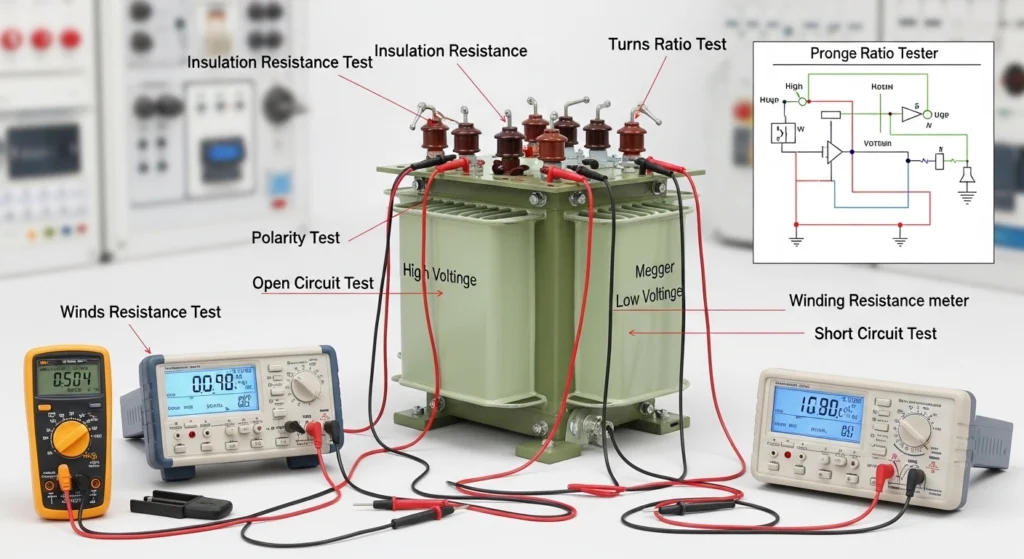
Open Circuit Test
- Performed with secondary winding open
- Measures core losses
- Helps determine efficiency
Short Circuit Test
- Secondary is shorted, low voltage applied
- Measures copper losses
- Useful for load performance
Insulation Resistance Test
- Checks insulation health
- Uses a megger
- Detects leakage current
Turns Ratio Test
- Compares primary and secondary turns ratio
- Ensures correct voltage transformation
Polarity Test
- Determines winding direction
- Important for parallel operation
Load Test
- Transformer is tested under actual load
- Verifies real performance
5. Main Components
Understanding components helps in effective testing.
Core
- Made of laminated steel
- Provides magnetic path
Windings
- Primary and secondary coils
- Carry electrical current
Insulation
- Prevents short circuits
- Maintains safety
Bushings
- Allow safe connection of wires
- Provide insulation
Tap Changer
- Adjusts output voltage
- Used in large transformers
6. Advantages
Transformer Advantages
- Ensures safe voltage levels
- Enables long-distance power transmission
- Improves energy efficiency
- Reliable and durable
- Low maintenance when properly tested
Benefits of Testing
- Early fault detection
- Prevents costly failures
- Improves lifespan
- Ensures safety
7. Disadvantages / Limitations
Transformer Disadvantages
- Testing requires proper equipment
- Some tests need system shutdown
- High-voltage testing can be risky
- Requires trained personnel
Practical Limitations
- Not all faults are visible externally
- Advanced tests may be expensive
- Time-consuming in large systems
8. Applications
Transformer Applications
Transformers are used everywhere:
Home Applications
- Power supply for appliances
- Chargers and adapters
Industrial Applications
- Heavy machinery
- Power distribution systems
Modern Technology
- Renewable energy systems
- Electric vehicles
- Data centers
9. Comparison Section
Difference Between Transformer Testing Methods
| Test Type | Purpose | Condition | Key Output |
| Open Circuit Test | Core loss measurement | No load | Efficiency |
| Short Circuit Test | Copper loss measurement | Shorted | Impedance |
| Insulation Test | Safety check | No load | Resistance |
| Load Test | Performance check | Full load | Output behavior |
10. Selection Guide
How to Choose the Right Test
Selecting the right method depends on your goal.
For Beginners
- Start with visual inspection
- Use a multimeter for basic checks
- Perform insulation test
For Engineers
- Use open and short circuit tests
- Perform ratio and polarity tests
- Analyze performance data
Tips
- Always disconnect power before testing
- Use proper safety gear
- Follow standard procedures
- Record results for comparison
11. Common Problems & Solutions
Transformer is not giving output
Causes:
- Open winding
- Loose connection
Solution:
- Check continuity
- Tighten connections
Transformer overheating
Causes:
- Overloading
- Poor ventilation
Solution:
- Reduce load
- Improve cooling
Low output voltage
Causes:
- Faulty winding
- Incorrect turns ratio
Solution:
- Perform turns ratio test
- Inspect windings
Insulation failure
Causes:
- Moisture
- Aging
Solution:
- Perform insulation resistance test
- Replace insulation if needed
12. Future Trends
Transformer technology is evolving rapidly.
Modern Developments
- Smart transformers with sensors
- Real-time monitoring systems
- Digital testing equipment
Industry Direction
- Integration with renewable energy
- Automation in testing
- AI-based fault detection
13. Conclusion
Understanding how to test transformer is an essential skill for anyone working in electrical systems. It ensures safety, reliability, and efficiency in power distribution. By learning the transformer working principle, different testing methods, and practical troubleshooting techniques, you can identify faults early and prevent major failures.
We explored various test types, components, and real-world transformer applications, along with their strengths and limitations. Knowing the transformer advantages and disadvantages helps in making better decisions during maintenance and design.
As technology advances, transformer testing is becoming smarter and more precise. Keep learning, practice regularly, and always follow safety guidelines. With the right approach, you can confidently handle transformer testing in both basic and advanced environments.