
Imagine a water pump at your home suddenly stops working. The power supply is fine, but the motor does not run. What do you do next? Replacing the motor immediately can be expensive—but what if the issue is minor and can be fixed easily? This is where knowing how to test motor becomes extremely useful.
Electric motors are used everywhere—fans, pumps, compressors, and industrial machines. When a motor fails, it can stop an entire system. Proper testing helps identify faults early and prevents costly breakdowns.
For electrical students, engineers, technicians, and beginners, understanding motor testing is a practical and essential skill. It helps in maintenance, troubleshooting, and ensuring system reliability.
In this article, you will learn the how to test motor working principle, different testing methods, tools required, step-by-step procedures, and common problems with solutions. By the end, you will be able to confidently test motors in real-world situations.
2. What is How to Test Motor?
How to test motor refers to the process of checking an electric motor to determine whether it is working properly or has faults.
Simple Explanation
It involves measuring electrical and mechanical parameters like resistance, insulation, and continuity to ensure the motor is healthy.
Practical Example
If a fan motor is not running:
- You test the winding resistance
- Check insulation condition
- Verify power supply
This helps you find whether the motor is faulty or not.
In simple terms, how to test motor means diagnosing the condition of a motor before repair or replacement.
3. Working Principle
The how to test motor working principle is based on checking electrical continuity, resistance, and insulation.
Key Concept
genui{“math_block_widget_always_prefetch_v2”: {“content”: “R = \frac{V}{I}”}}
Resistance helps determine the condition of motor windings.
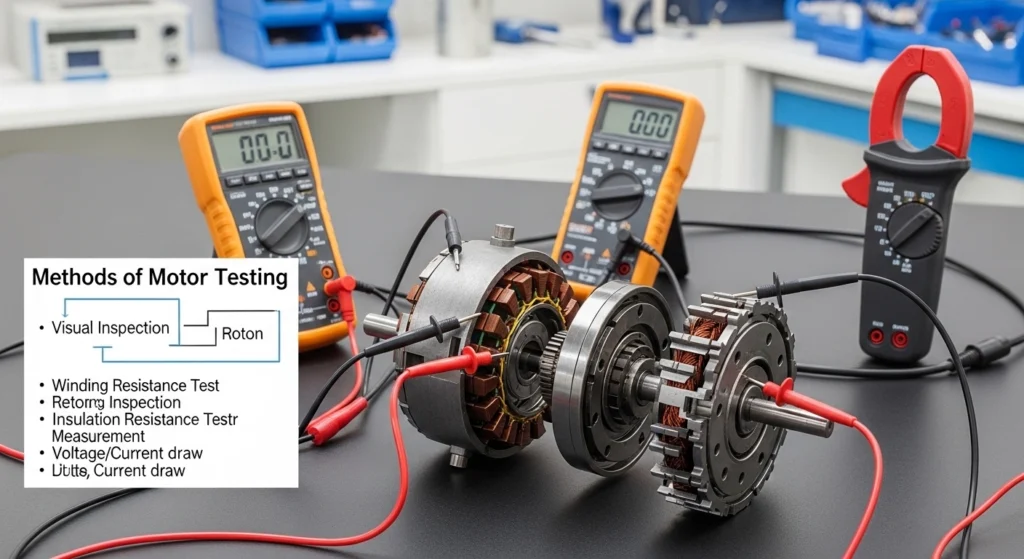
Step-by-Step Process
- Disconnect power supply
Ensure safety before testing - Visual inspection
Check for burns, damage, or loose connections - Continuity test
Verify winding connections - : Resistance measurement
Measure winding resistance - Insulation test
Check insulation using megger - Run test (if safe)
Observe motor operation
Easy Analogy
Think of a motor like a human body:
- Winding = Muscles
- Insulation = Skin
- Testing = Medical check-up
You check both internal and external conditions.
4. Types / Classification
Motor testing methods can be classified based on technique and purpose.
Electrical Testing
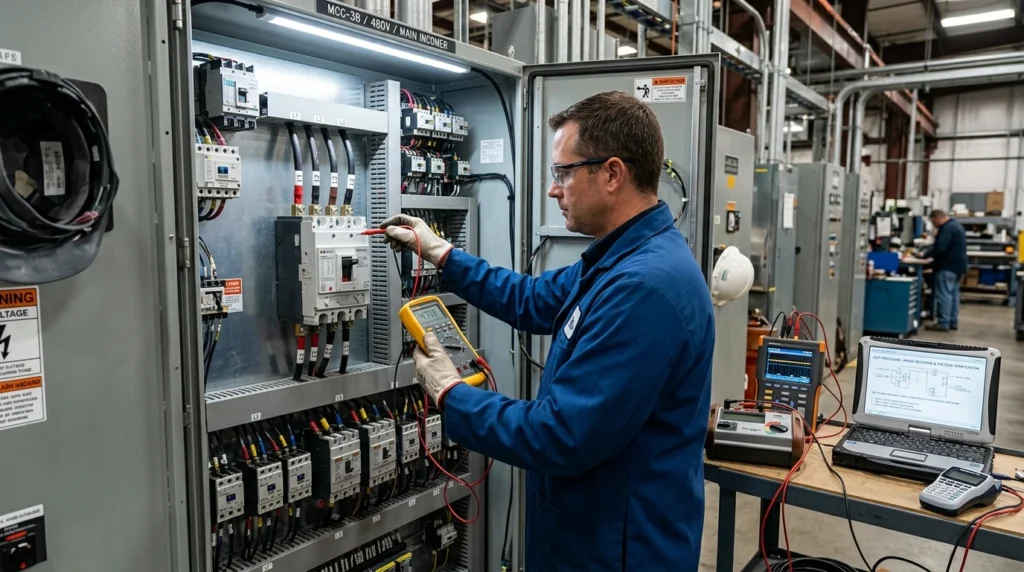
Electrical Testing is the process of inspecting and measuring electrical systems, equipment, and circuits to ensure they operate safely, efficiently, and according to design specifications. It involves using instruments such as multimeters, insulation testers, clamp meters, and continuity testers to check voltage, current, resistance, insulation condition, and circuit integrity. Electrical testing helps identify faults, damaged components, loose connections, and potential safety hazards before they cause equipment failure or accidents. It is widely performed in residential, commercial, and industrial installations during installation, maintenance, and troubleshooting to improve reliability, ensure compliance with safety standards, and maintain the proper performance of electrical systems.
- Measures voltage, current, and resistance
- Detects electrical faults
Mechanical Testing
- Checks shaft movement and bearings
- Identifies physical issues
Insulation Testing
- Uses megger
- Detects leakage or insulation failure
Performance Testing
- Tests motor under load
- Measures efficiency and output
Offline Testing
- Motor is disconnected
- Safe and detailed testing
Online Testing
- Motor runs during testing
- Used in industrial systems
5. Main Components
Motor Windings
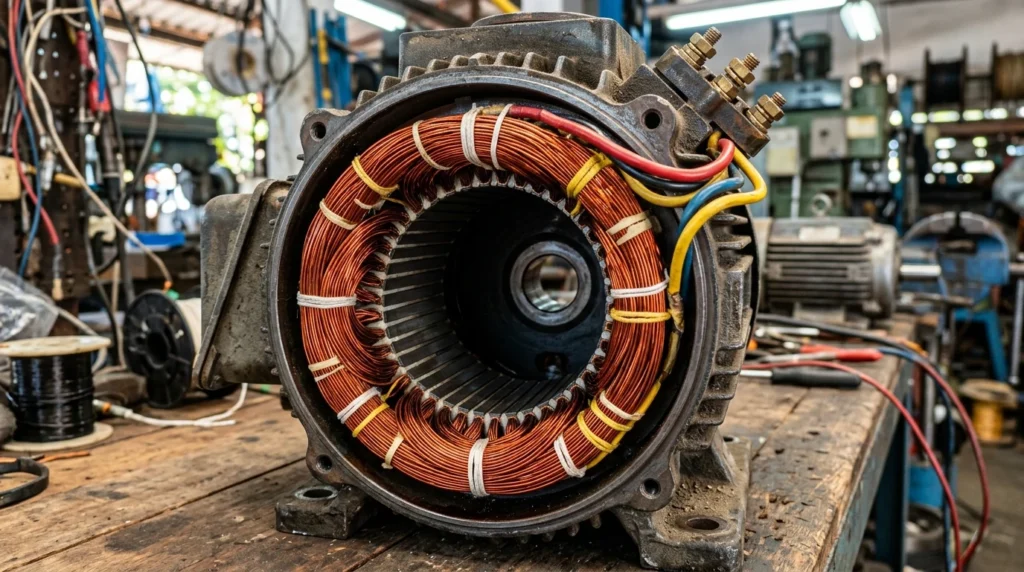
Motor Windings are coils of insulated copper or aluminum wire wound around the stator or rotor of an electric motor to produce the magnetic fields required for operation. When electric current flows through these windings, a magnetic field is generated that interacts with other magnetic fields inside the motor, creating the torque needed to rotate the shaft. The design, number of turns, and arrangement of the windings determine the motor’s voltage rating, speed, efficiency, and performance characteristics. Motor windings are a critical component in AC and DC motors, and their proper insulation and maintenance are essential for reliable operation, energy efficiency, and long service life.
- Copper coils inside motor
- Generate magnetic field
Insulation
- Protects windings
- Prevents short circuits
Rotor
- Rotating part
- Converts electrical energy into motion
Stator
- Stationary part
- Produces magnetic field
Bearings
- Support rotation
- Reduce friction
Testing Instruments
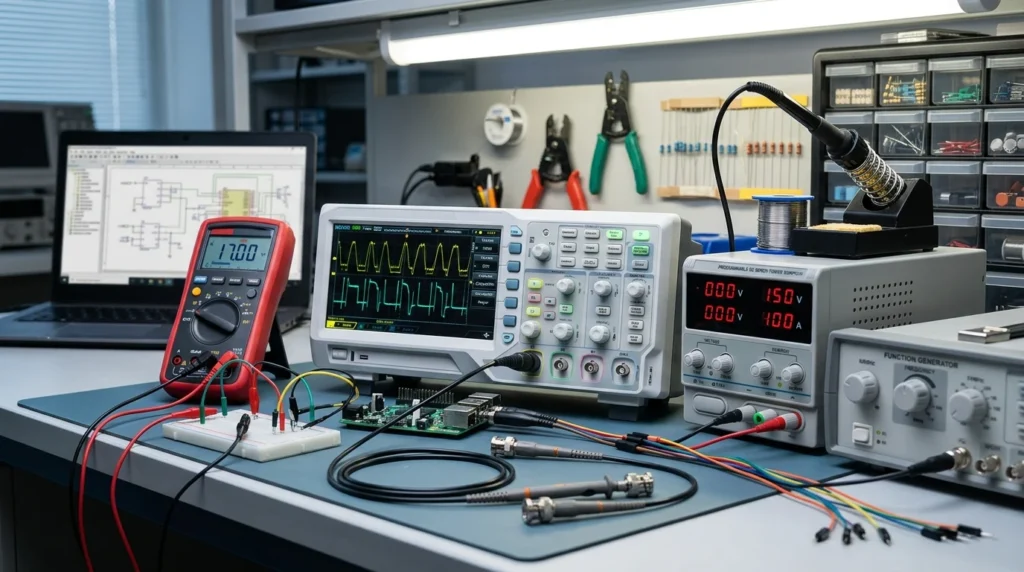
Testing Instruments are specialized devices used to measure, monitor, and evaluate electrical quantities in circuits and equipment. These instruments help electricians, technicians, and engineers verify the performance, safety, and condition of electrical systems. Common testing instruments include multimeters, clamp meters, insulation resistance testers, voltage testers, and oscilloscopes, which are used to measure parameters such as voltage, current, resistance, continuity, and frequency. By identifying faults, loose connections, overloads, and insulation problems, testing instruments play a vital role in installation, maintenance, and troubleshooting. Their accurate measurements help ensure reliable operation, improve safety, and maintain the efficiency of electrical systems in residential, commercial, and industrial applications.
- Multimeter
- Megger (insulation tester)
- Clamp meter
6. Advantages
How to Test Motor Advantages and Disadvantages (Advantages)
- Detects faults early
- Prevents major failures
- Saves repair costs
- Improves motor life
- Ensures safety
- Supports efficient maintenance
7. Disadvantages / Limitations
How to Test Motor Advantages and Disadvantages (Limitations)
- Requires proper tools
- Needs technical knowledge
- Some tests require motor shutdown
- Time-consuming for large motors
- Incorrect testing can give false results
8. Applications
How to Test Motor Applications
Home Applications
- Fan motors
- Water pumps
- Washing machines
Industrial Applications
- Heavy machinery
- Conveyor systems
- Compressors
Modern Technology
- Electric vehicles
- Robotics
- Automation systems
- Renewable energy systems
9. Comparison Section
Difference Between Offline and Online Motor Testing
| Feature | Offline Testing | Online Testing |
| Motor Condition | Stopped | Running |
| Safety | High | Moderate |
| Accuracy | Detailed | Real-time monitoring |
| Complexity | Simple | Complex |
| Usage | Maintenance | Continuous monitoring |
10. Selection Guide
Choosing the right testing method depends on your situation.
Use Offline Testing When:
- Motor is not running
- Detailed inspection is needed
- Safety is priority
Use Online Testing When:
- Continuous monitoring is required
- Industrial systems are running
Tips for Beginners
- Always disconnect power before testing
- Start with simple tests (continuity)
- Use proper instruments
- Follow safety procedures
- Record readings for comparison
11. Common Problems & SolutionsWhy is the motor not starting?
Check power supply, winding continuity, and capacitor (if present).
Why does the motor overheat?
Overloading or insulation failure.
What is the difference between good and bad winding?
Good winding has proper resistance; bad winding shows open or short circuit.
How to check insulation failure?
Use a megger to measure insulation resistance.
Why is noise coming from the motor?
Worn-out bearings or mechanical issues.
12. Future Trends
Motor testing is evolving with advanced technology.
- Smart sensors for real-time monitoring
- AI-based fault detection
- Wireless testing systems
- Predictive maintenance tools
- Integration with IoT systems
These innovations improve accuracy and reduce downtime.
13. Conclusion
Understanding how to test motor is a valuable skill for anyone in the electrical field. It helps identify faults, improve efficiency, and extend the life of motors.
The how to test motor working principle focuses on checking electrical and mechanical conditions. From simple continuity tests to advanced insulation testing, each method plays an important role.
While there are some challenges, proper tools and knowledge make the process easier. The how to test motor applications show how widely this skill is used in homes, industries, and modern technologies.
Keep practicing and learning—strong testing skills will make you a more confident and capable electrical professional.