
Think about an electric fan in your home. When you switch it on, it rotates and gives you cool air. But behind this simple action, two types of electrical power are at work. One type actually does the useful work (rotating the fan), while the other helps maintain the system but does not produce visible output. These are known as real power and reactive power.
Understanding Real Power vs Reactive Power is essential for anyone working with electrical systems. Whether you’re an engineering student, technician, or beginner, this concept is fundamental in power systems, energy efficiency, and equipment performance.
In this article, you will learn the difference between real power and reactive power, how they work, their applications, advantages and disadvantages, and how to manage them effectively. By the end, you will have a clear and practical understanding of how electrical power actually behaves in real-world systems.
2. What is Real Power vs Reactive Power?
Real Power (Active Power)
Real power is the actual power that performs useful work in an electrical circuit. It is the energy that runs appliances like fans, lights, heaters, and motors.
- Measured in Watts (W)
- Denoted by P
Example:
When a bulb glows or a motor runs, real power is being used.
Reactive Power
Reactive power is the power that does not perform useful work, but is necessary to maintain the electric and magnetic fields in devices like motors and transformers.
- Measured in Volt-Ampere Reactive (VAR)
- Denoted by Q
Example:
In a motor, reactive power helps create the magnetic field required for rotation.
Simple Explanation
- Real Power = Does actual work
- Reactive Power = Supports the system
3. Working Principle
Real Power vs Reactive Power Working Principle
To understand the real power vs reactive power working principle, we need to look at how voltage and current behave in AC circuits.
Step-by-Step Explanation
- In an ideal system, voltage and current move together
- When they are perfectly aligned, all power becomes real power
- In real systems, components like coils and capacitors cause a delay
- This delay creates reactive power
Key Concept: Phase Difference
- If voltage and current are in the same phase → Real power
- If they are out of phase → Reactive power appears
Easy Analogy
Imagine pushing a swing:
- When you push at the right time → Energy is used effectively (Real Power)
- If you push at the wrong time → Energy is wasted but still moving (Reactive Power)
Mathematical Insight (Simplified)
- Real Power = Useful energy
- Reactive Power = Stored and released energy
- Total Power = Combination of both
4. Types / Classification
Types of Power in AC Systems
Real Power (P)
- Performs useful work
- Consumed by resistive loads
- Example: Heaters, bulbs
Reactive Power (Q)
- Supports energy storage in fields
- Found in inductive and capacitive loads
- Example: Motors, transformers
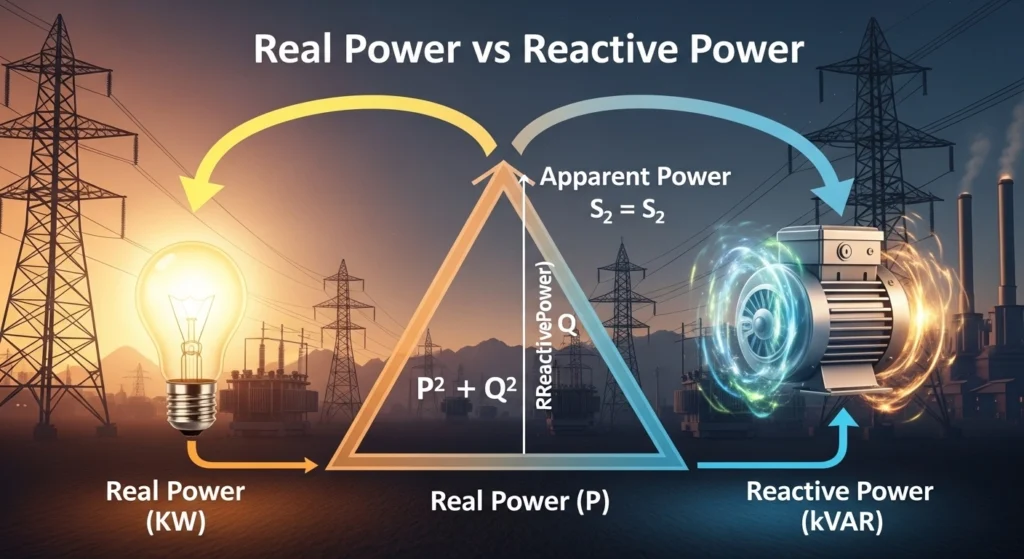
Apparent Power (S)
- Combination of real and reactive power
- Measured in Volt-Ampere (VA)
- Represents total power supplied
5. Main Components
Components Involved in Real and Reactive Power
Resistive Loads
- Examples: Heaters, incandescent bulbs
- Function: Consume real power only
Inductive Loads
- Examples: Motors, transformers
- Function: Create magnetic fields → produce reactive power
Capacitive Loads
- Examples: Capacitors, cables
- Function: Store electric energy → produce reactive power
Power Factor
- Ratio of real power to apparent power
- Indicates efficiency of the system
6. Advantages
Real Power Advantages
- Performs actual useful work
- Directly contributes to output (light, heat, motion)
- Easy to measure and understand
- Essential for all electrical systems
Reactive Power Advantages
- Maintains voltage levels in power systems
- Necessary for operation of motors and transformers
- Helps in energy transfer within AC systems
- Supports system stability
7. Disadvantages / Limitations
Real Power Disadvantages
- Cannot function alone in AC systems with inductive loads
- Requires proper system balance
Reactive Power Disadvantages
- Does not perform useful work
- Increases current in the system
- Causes power losses
- Reduces system efficiency (low power factor)
- Can lead to higher electricity bills in industries
8. Applications
Real Power Applications
- Household appliances (fans, lights, TVs)
- Heating systems
- Industrial machines
- Electric vehicles
Reactive Power Applications
- Power system voltage control
- Operation of motors and transformers
- Transmission systems
- Power factor correction systems
Real Power vs Reactive Power Applications in Modern Systems
- Smart grids use both efficiently
- Renewable energy systems manage reactive power carefully
- Industrial plants use capacitors to balance reactive power
9. Comparison Section
Difference Between Real Power and Reactive Power
| Feature | Real Power | Reactive Power |
| Definition | Performs useful work | Supports system |
| Unit | Watts (W) | VAR |
| Symbol | P | Q |
| Function | Produces output | Maintains fields |
| Consumption | Consumed | Not consumed |
| Efficiency Impact | Increases efficiency | Reduces efficiency if excessive |
| Devices | Heaters, bulbs | Motors, transformers |
10. Selection Guide
How to Manage Real and Reactive Power
You don’t choose one over the other—they work together. But you can optimize their balance.
Tips for Beginners
- Always aim for high power factor
- Use capacitors to reduce reactive power
- Avoid overloading inductive devices
- Monitor energy consumption regularly
When to Focus on Real Power
- Designing load systems
- Calculating energy usage
- Improving performance
When to Control Reactive Power
- In industrial setups
- In power transmission systems
- When facing low power factor issues
11. Common Problems & Solutions
What causes low power factor?
High reactive power due to inductive loads like motors.
How to improve power factor?
Use capacitor banks to balance reactive power.
Why is reactive power not useful?
It does not produce output but is necessary for system operation.
Can we eliminate reactive power completely?
No, because many devices require it to function properly.
Why do industries pay penalties for reactive power?
Because it increases system losses and reduces efficiency.
12. Future Trends
The importance of managing real and reactive power is increasing with modern technology.
- Smart Grids: Automatically balance power
- Renewable Energy: Solar and wind systems require reactive power control
- Advanced Power Electronics: Improve efficiency
- Energy Storage Systems: Help stabilize power flow
- AI-Based Monitoring: Predicts and corrects power issues
Reactive power management will become more critical as power systems grow complex.
13. Conclusion
Understanding Real Power vs Reactive Power is key to mastering electrical systems. Real power performs useful work, while reactive power supports system operation by maintaining electric and magnetic fields.
Both are essential, but their balance determines system efficiency. Too much reactive power can reduce performance and increase costs, while proper management improves reliability and energy savings.
As an electrical professional or student, focusing on power factor and system optimization will give you a strong advantage in real-world applications. Keep learning and applying these concepts to build efficient and reliable electrical systems.