

When you plug in an electric heater or measure voltage using a multimeter, the reading you see is not always the highest value the voltage reaches. In fact, the actual voltage in an AC system is constantly changing—rising to a maximum and falling back down repeatedly. This is where concepts like peak value and average value become very important.
Understanding the Peak vs Average Value in AC is essential for anyone working with electrical systems. Engineers use these values to design circuits, technicians rely on them for troubleshooting, and students must understand them to grasp AC fundamentals.
In this article, you will learn what peak and average values are, how they work, their differences, and their practical applications. We will also explore the difference between peak value and average value, their advantages and disadvantages, and how to choose the right measurement in real-world scenarios. By the end, you will have a clear and practical understanding of this key AC concept.
2. What is Peak vs Average Value in AC?
Peak Value in AC
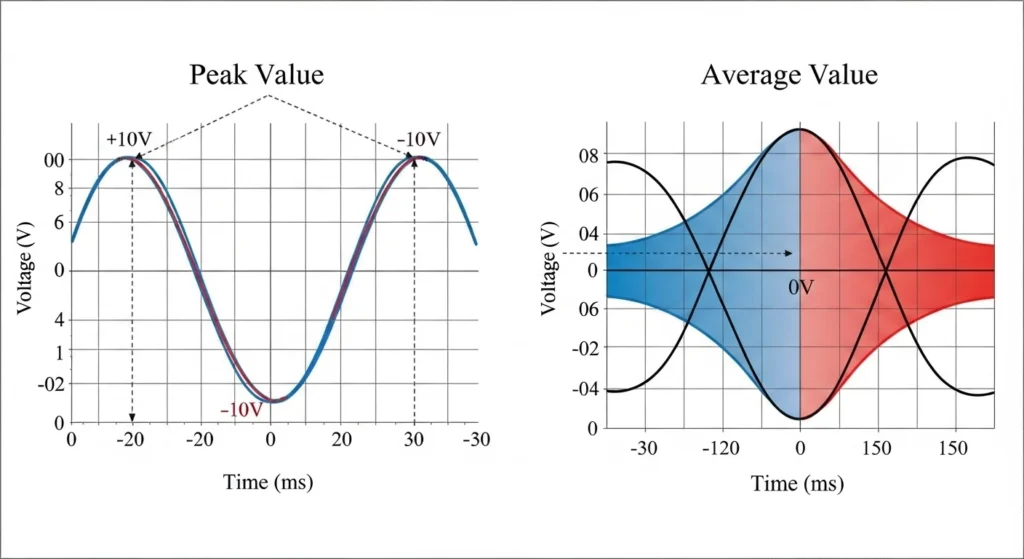
The peak value (also called maximum value) is the highest value reached by an AC waveform during one cycle.
For example, if an AC voltage rises up to 325V at its highest point, that is its peak value.
Average Value in AC
The average value is the average of all instantaneous values of the waveform over a half cycle.
For a sinusoidal AC waveform, the average value is approximately 0.637 times the peak value.
Simple Explanation
- Peak value = highest point of the wave
- Average value = overall “middle” value over time
Practical Example
- Peak value is important when selecting insulation and safety limits
- Average value is used in rectifier circuits and DC conversion
3. Working Principle
Understanding the Peak vs Average Value in AC working principle becomes easier when broken down step-by-step.
Step-by-Step Explanation
AC voltage changes continuously in a wave-like pattern
It rises from zero to a maximum (peak value)
Then it falls back to zero and reverses direction
This cycle repeats continuously
Peak Value Working
- It represents the extreme point of the waveform
- Occurs at the highest amplitude
- Important for determining maximum stress on components
Average Value Working
- Calculated over half a cycle (since full cycle average is zero)
- Represents the effective “mean” level
- Useful for converting AC to DC
Analogy
Think of ocean waves:
- Peak value = highest wave height
- Average value = average water level over time
Key Points
- Peak value shows extremes
- Average value shows general level
- Both are essential for AC analysis
4. Types / Classification
Types of Peak Values
Positive Peak Value
- Maximum positive amplitude
- Occurs in the positive half cycle
Negative Peak Value
- Maximum negative amplitude
- Occurs in the negative half cycle
Peak-to-Peak Value
- Total difference between positive and negative peaks
- Formula: Peak-to-peak = 2 × Peak value
Types of Average Values
Half-Cycle Average Value
- Calculated over one half cycle
- Used in most AC calculations
Full-Cycle Average Value
- For symmetrical AC waveforms, this is zero
- Not very useful for sinusoidal AC
5. Main Components
To understand peak and average values, we need to know the components involved in AC systems.
AC Source
- Generates alternating voltage
- Determines waveform shape
Waveform
- Usually sinusoidal
- Defines how values change over time
Measuring Instruments
- Oscilloscope
Displays peak value visually - Multimeter
Often shows RMS, not peak or average directly
Rectifiers
- Convert AC to DC
- Use average value for output calculations
Function Summary
- Source creates waveform
- Waveform defines values
- Instruments measure values
6. Advantages
Peak Value Advantages
- Helps in selecting insulation levels
- Useful for designing high-voltage systems
- Identifies maximum stress in components
- Important for surge and safety calculations
Average Value Advantages
- Useful in rectifier circuits
- Helps convert AC to DC
- Simple to calculate
- Useful in signal processing
Real-World Benefits
- Better circuit design
- Improved safety margins
- Accurate power calculations
7. Disadvantages / Limitations
Peak Value Limitations
- Does not represent usable power
- Not practical for energy calculations
- Can be misleading for beginners
Average Value Limitations
- Not useful for full AC cycle (becomes zero)
- Less accurate for power analysis
- Cannot represent peak stress
Practical Concerns
- Both values alone are not sufficient
- RMS value is often more useful in real applications
8. Applications
Understanding Peak vs Average Value in AC applications helps connect theory to real-world use.
Peak Value Applications
- Insulation design
- Surge protection systems
- High-voltage equipment
- Signal analysis
Average Value Applications
- Rectifier circuits
- DC power supplies
- Battery charging systems
- Analog signal processing
Home Applications
- Appliance voltage ratings
- Power adapter design
Industrial Applications
- Power electronics
- Motor control systems
Modern Technology
- Renewable energy systems
- Electronic converters
- Communication systems
9. Comparison Section
Here is a clear table showing the difference between peak value and average value:
| Feature | Peak Value | Average Value |
| Definition | Maximum value of waveform | Mean value over half cycle |
| Measurement | Instantaneous | Calculated |
| Importance | Safety and design limits | Conversion and analysis |
| Use Case | High voltage systems | Rectifiers and DC output |
| Representation | Maximum amplitude | Average level |
| Accuracy for Power | Low | Moderate |
10. Selection Guide
Choosing between peak and average value depends on your application.
Use Peak Value When
- Designing insulation systems
- Working with high voltage
- Analyzing maximum stress
Use Average Value When
- Designing rectifiers
- Converting AC to DC
- Analyzing signal behavior
Tips for Beginners
- Always understand waveform first
- Use RMS for power calculations
- Use peak for safety design
- Use average for DC conversion
11. Common Problems & Solutions
Why is average value zero for AC?
Because positive and negative halves cancel each other over a full cycle.
Why do we use half-cycle average?
To get a meaningful value instead of zero.
How to measure peak value?
Use an oscilloscope or peak detector circuit.
Why is peak value higher than RMS?
Because it represents the maximum point, not the effective value.
Q5: Common Troubleshooting Tips
- Check waveform shape
- Use correct measuring instrument
- Verify calibration
- Avoid confusion between RMS, peak, and average
12. Future Trends
The field of electrical engineering is evolving, and so is the use of AC measurements.
Key Trends
- Smart measurement devices
- Digital oscilloscopes with advanced analysis
- AI-based signal monitoring
- Improved power electronics
Industry Direction
- More accurate real-time measurements
- Integration with IoT systems
- Better waveform analysis tools
Emerging Technologies
- Renewable energy systems
- Electric vehicle charging systems
- Smart grids
13. Conclusion
Understanding the Peak vs Average Value in AC is essential for analyzing and designing electrical systems. Peak value tells us the maximum stress a system can handle, while average value helps in converting AC signals into usable DC forms. Both play important roles, but they serve different purposes.
The difference between peak value and average value becomes clear when you look at their applications—one focuses on extremes, while the other focuses on overall behavior. However, neither replaces RMS value in power calculations.
As a student or engineer, mastering these concepts will strengthen your understanding of AC systems and prepare you for more advanced topics. Keep practicing waveform analysis and real-world applications to build confidence.