
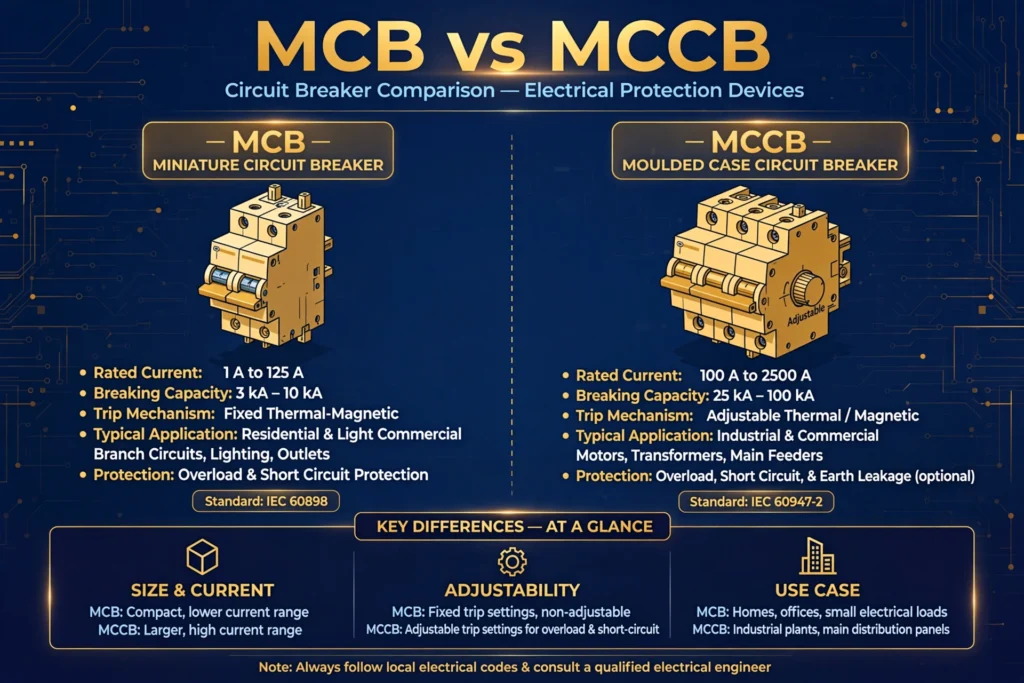

Walk into any electrical panel — from a home distribution board to a factory switchroom — and you will find circuit breakers guarding every circuit. Two names dominate: MCB (Miniature Circuit Breaker) and MCCB (Molded Case Circuit Breaker). They look similar and do the same basic job, yet they are built for very different worlds.
Choosing wrong costs money at best and safety at worst: an MCB in a heavy industrial feeder will fail dangerously, while an MCCB in a bedroom lighting circuit is expensive overkill. This guide lays out the difference between MCB and MCCB in a detailed side-by-side comparison, then gives you a practical selection guide so you always pick the right one.
This is a pure comparison article. If you need the fundamentals first, read our dedicated guides: what an MCCB is, and how an MCB differs from a fuse.
Quick Definitions
MCB (Miniature Circuit Breaker): A compact, fixed-rating breaker for low-current circuits — typically up to 125 A. It protects lighting, socket, and small-appliance circuits in homes and commercial buildings. Its trip characteristics are fixed at the factory and cannot be adjusted.
MCCB (Molded Case Circuit Breaker): A larger breaker housed in a molded insulating case, rated from about 16 A up to 2,500 A. It protects distribution feeders, motors, and industrial equipment, and — critically — its trip settings can be adjusted to suit the load. Both belong to the wider family of circuit breakers, but everything from their size to their intelligence differs.
MCB vs MCCB: Detailed Comparison Table
| Feature | MCB | MCCB |
|---|---|---|
| Full form | Miniature Circuit Breaker | Molded Case Circuit Breaker |
| Current rating | 0.5 A – 125 A | 16 A – 2,500 A |
| Breaking capacity | Up to ~10 kA (some 15 kA) | 25 kA – 200 kA |
| Voltage rating | Up to 440 V (low voltage only) | Up to 1,000 V AC (low voltage, heavy duty) |
| Trip unit | Fixed thermal-magnetic; not adjustable | Thermal-magnetic or electronic; adjustable trip settings |
| Tripping characteristics | Fixed curves: B, C, D, K, Z | Adjustable long-time, short-time, instantaneous + ground fault |
| Poles available | 1P, 2P, 3P, 4P (SPN) | 2P, 3P, 4P |
| Size | Compact, DIN-rail modular (1–4 modules) | Bulky molded case, much larger frame |
| Remote operation | Manual only (some add-on shunt trips) | Manual + shunt trip, undervoltage release, motor operator options |
| Typical applications | Homes, offices, shops — final circuits | Factories, commercial buildings — main & sub-main feeders, motor protection |
| Cost | Low | 5–20× the price of an equivalent MCB |
| Maintenance | Sealed; replace on failure | Inspectable; contacts and trip unit serviceable in larger frames |
10 Key Differences Explained
1. Current rating range
The most immediate difference. MCBs top out around 125 A — enough for any household or small commercial circuit. MCCBs start where MCBs end and run to 2,500 A, covering everything from a shop’s main incomer to a factory’s busbar feeder.
2. Breaking (interrupting) capacity
Breaking capacity is the maximum fault current a breaker can safely interrupt. Near a large transformer, fault currents can exceed 50 kA — an MCB rated 10 kA would explode trying to clear it. MCCBs are built for these violent faults, with ratings up to 200 kA.
3. Adjustable vs fixed trip settings
This is the MCCB’s superpower. An MCB trips at a fixed multiple of its rating, set at the factory. An MCCB’s trip unit lets you dial in the long-time pickup (for overloads), short-time delay (for selective coordination), and instantaneous trip (for short circuits) — essential for coordinated protection schemes in larger installations.
4. Trip curves and selectivity
MCBs come in fixed B, C, D, K, Z curves — you pick the curve, not the values. MCCBs with electronic trip units allow fine curve shaping, so upstream and downstream breakers can be coordinated: only the breaker nearest the fault trips, keeping the rest of the plant running.
5. Physical size and mounting
MCBs are slim DIN-rail modules that snap into a distribution board in seconds. MCCBs are heavy molded-case units bolted into panel compartments — a two-person lift at the larger frame sizes.
6. Auxiliary functions
MCCBs accept shunt-trip coils (remote tripping), undervoltage releases (trip on power loss), auxiliary contacts, and motor operators for remote open/close. MCBs offer only basic add-ons.
7. Application level in the system
Think in layers: MCCBs sit upstream (main incomers, sub-distribution boards, motor feeders), while MCBs sit downstream at the final circuits feeding lights, sockets, and small loads.
8. Cost
An MCB costs a few dollars; an MCCB of similar pole count can cost 5–20 times more. The price reflects the bigger frame, higher breaking capacity, and adjustable intelligence.
9. Maintenance philosophy
MCBs are disposable: when one fails, you replace it. Larger MCCBs are maintainable assets — contacts can be inspected, trip units tested and recalibrated.
10. Standards
MCBs follow IEC 60898 (household and similar installations); MCCBs follow IEC 60947-2 (industrial low-voltage switchgear). The different standards reflect their different worlds.
Selection Guide: When to Choose Which
Choose an MCB when:
- The load current is 125 A or less (lighting, sockets, small HVAC, office equipment).
- The prospective fault current at that point is within the MCB’s breaking capacity (typically under 10 kA — true for most final circuits).
- You need a fixed, tamper-proof characteristic — e.g., tenant or residential circuits.
- Budget and panel space are tight.
Choose an MCCB when:
- The load exceeds 125 A, or the fault level exceeds MCB breaking capacity.
- You need adjustable protection — motor starting coordination, generator protection, or selective tripping between boards.
- Remote tripping, interlocking, or status signaling is required.
- It is a main incomer or sub-main feeder where discrimination with downstream MCBs matters.
Golden rule: protect from the top down — MCCB at the incomer and sub-mains, MCBs at the final circuits — and verify that the upstream device’s breaking capacity exceeds the maximum fault current at its location. When in doubt, a short-circuit study of the installation settles the question.
Common Mistakes
- Using an MCB as a main incomer in a commercial building where fault levels exceed its breaking capacity — dangerous and non-compliant.
- Oversizing with MCCBs everywhere — wasting money on adjustable intelligence where a simple MCB would do.
- Ignoring selectivity: an upstream MCCB with instantaneous trip set too low will trip together with (or before) the downstream MCB, blacking out healthy circuits.
- Mixing standards: using a household-standard MCB in an industrial panel to save money — inspectors will flag it.
FAQs
Can an MCCB replace an MCB?
Technically yes — an MCCB can protect a small circuit — but it is bad practice: it costs far more, takes more panel space, and its minimum trip settings may be too coarse for small loads. Use each where it belongs.
Can an MCB replace an MCCB?
No, not safely. An MCB cannot handle the current ratings, fault levels, or adjustability an MCCB application demands. Substituting one risks catastrophic failure during a fault.
What do B, C, and D curves mean on an MCB?
They define the magnetic (instantaneous) trip range: B trips at 3–5× rated current (resistive loads, long cable runs), C at 5–10× (general mixed loads — the most common), D at 10–20× (motors and transformers with high inrush).
Do MCCBs provide earth-fault protection?
Many electronic-trip MCCBs include adjustable ground-fault protection as standard; thermal-magnetic MCCBs usually need an add-on earth-leakage module. MCBs provide no earth-fault protection — that is the job of an RCCB or RCBO paired with them.
How do I coordinate an MCCB with downstream MCBs?
Use the MCCB’s short-time delay setting to hold it closed while the downstream MCB clears the fault, and check the manufacturer’s selectivity tables. Proper discrimination studies are standard practice in commercial design.
Which is better for motor protection, MCB or MCCB?
MCCB — specifically a motor-protection MCCB with adjustable magnetic-only or electronic trip — because motor starting currents (5–7× rated) would nuisance-trip a standard MCB, while the MCCB can be set to ride through the start and still protect against faults. Dedicated motor protection techniques cover this in detail.
Conclusion
The difference between MCB and MCCB comes down to scale and intelligence: the MCB is a small, fixed, economical guardian for final circuits, while the MCCB is a large, adjustable, heavy-duty protector for feeders and industrial loads. Neither is “better” — they are different tools for different layers of the same protection hierarchy.
Remember the selection logic: match the current rating to the load, the breaking capacity to the fault level, and choose adjustability where coordination matters. Get those three right and your protection scheme will be safe, selective, and economical. For the deeper fundamentals behind either device, revisit our guides on MCCBs and MCBs vs fuses.