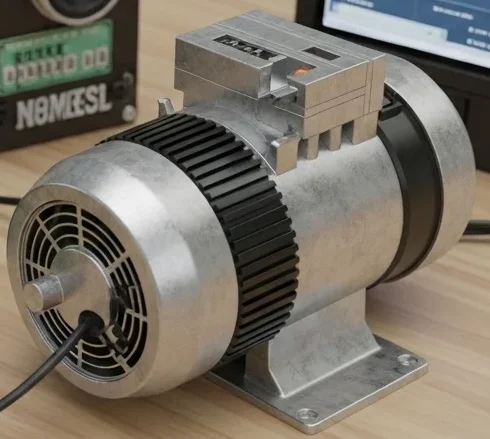

Imagine a ceiling fan running in your room. Even though it rotates smoothly, it never reaches the exact speed of the rotating magnetic field inside the motor. There is always a small difference in speed. This difference is called slip, and it is essential for the motor to work.
In induction motors, slip plays a critical role in torque production and overall performance. Without slip, the motor would not be able to generate torque and would stop functioning. That’s why understanding what is slip in induction motor is very important for anyone working with electrical machines.
For electrical students, engineers, technicians, and beginners, learning about slip helps in analyzing motor behavior, improving efficiency, and troubleshooting issues.
In this article, you will learn the complete slip in induction motor working principle, types, components, applications, advantages and disadvantages, and practical problem-solving methods. By the end, you will clearly understand how slip affects motor performance in real-world systems.
2. What Is Slip in an Induction Motor?
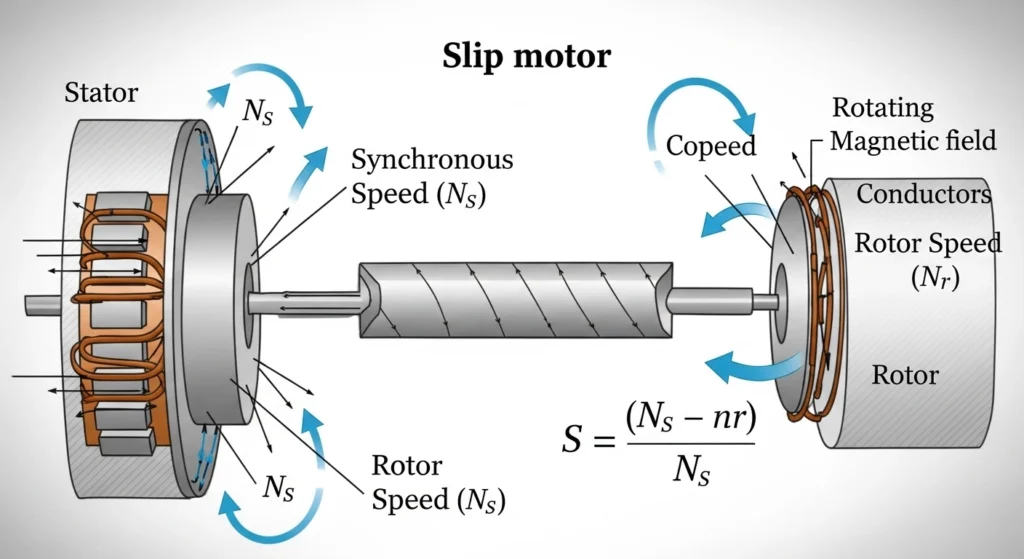
Slip in an induction motor is the difference between the synchronous speed of the rotating magnetic field and the actual speed of the rotor, expressed as a percentage of synchronous speed.
Slip is an essential characteristic of an induction motor because the rotor must rotate slightly slower than the rotating magnetic field for electromagnetic induction and torque production to occur.
Simple Definition of Slip
Slip indicates how much slower the rotor is rotating compared with the rotating magnetic field produced by the stator.
In a practical induction motor, the rotor speed is always slightly lower than synchronous speed when the motor is producing load torque.
Slip Formula for an Induction Motor
The standard formula for calculating slip is:
S = (Nₛ − Nᵣ) / Nₛ × 100
Where:
- S = Slip in percentage (%)
- Nₛ = Synchronous speed in RPM
- Nᵣ = Rotor speed in RPM
For example, if the synchronous speed is 1500 RPM and the rotor speed is 1450 RPM:
S = (1500 − 1450) / 1500 × 100
S = 3.33%
Therefore, the motor has a slip of approximately 3.33%.
Why Is Slip Necessary in an Induction Motor?
Slip is necessary because the relative speed between the rotating magnetic field and the rotor is required to induce EMF and current in the rotor.
If the rotor reached exactly synchronous speed, there would be no relative motion between the rotating magnetic field and the rotor. As a result, no rotor EMF would be induced, rotor current would fall to zero, and the motor would not produce electromagnetic torque.
3. Working Principle of Slip in an Induction Motor
The working principle of slip in an induction motor is based on electromagnetic induction and the relative motion between the stator’s rotating magnetic field and the rotor.
Step-by-Step Working Principle
The slip-producing process can be understood through the following steps:
- AC supply is applied to the stator of the induction motor.
- The stator winding produces a rotating magnetic field.
- The rotating magnetic field moves at synchronous speed.
- The rotating field cuts the rotor conductors because the rotor initially has a lower speed.
- This relative motion induces EMF and current in the rotor.
- The interaction between the rotor current and the rotating magnetic field produces electromagnetic torque.
- The rotor accelerates and approaches synchronous speed but cannot normally reach it while producing load torque.
- The remaining speed difference is known as slip.
Easy Analogy for Understanding Slip
Imagine that you are running behind a moving train. You try to match the speed of the train, but there is always a small difference between your speed and the train’s speed.
Similarly, the rotor tries to follow the rotating magnetic field but normally remains slightly slower. This speed difference is called slip.
Key Points About Induction Motor Slip
- Slip is the difference between synchronous speed and rotor speed.
- Slip is usually expressed as a percentage.
- Slip is necessary for rotor EMF and rotor current to be induced.
- Slip is necessary for electromagnetic torque production.
- At zero slip, no rotor EMF is induced and no induction-motor torque is produced.
- Under normal operation, the rotor speed is slightly lower than synchronous speed.
- Slip generally increases when the motor is subjected to a higher mechanical load.
4. Types / Classification
Normal Slip
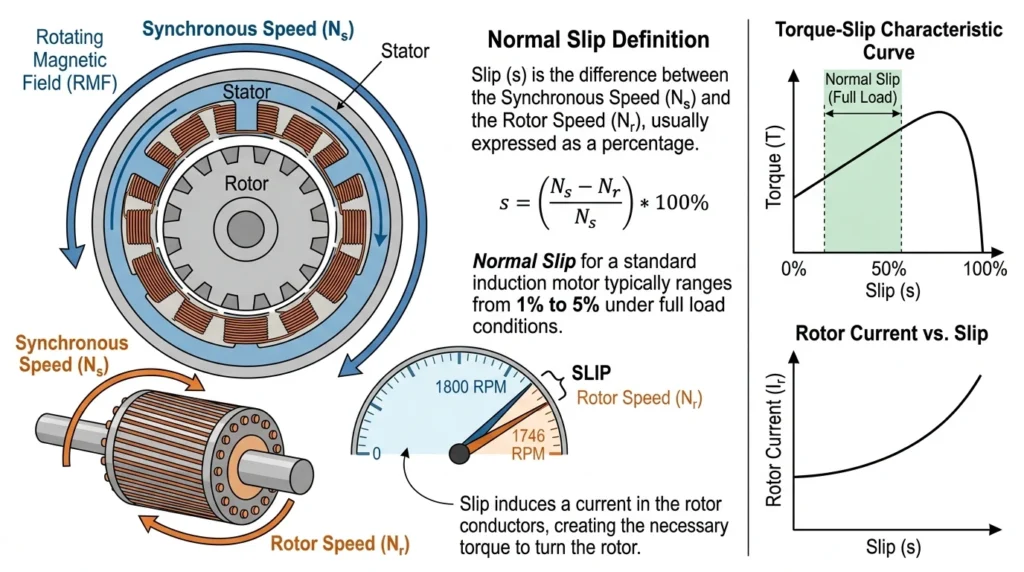
Normal Slip in an Induction Motor refers to the small difference between the synchronous speed of the rotating magnetic field and the actual speed of the rotor under normal operating conditions. In an induction motor, the rotor can never reach synchronous speed; it always rotates slightly slower to allow relative motion between the magnetic field and rotor conductors. This difference in speed is called slip, and in normal operating conditions it is typically a small percentage (about 2% to 6% for large motors and slightly higher for small motors). This slip is essential because it is the reason electromagnetic induction occurs in the rotor, producing torque and keeping the motor running smoothly under load.
- Occurs during normal operation
- Typically 1% to 5%
Starting Slip
- Slip = 100%
- Rotor is stationary
Full Load Slip
- Occurs at rated load
- Around 3% to 5%
High Slip
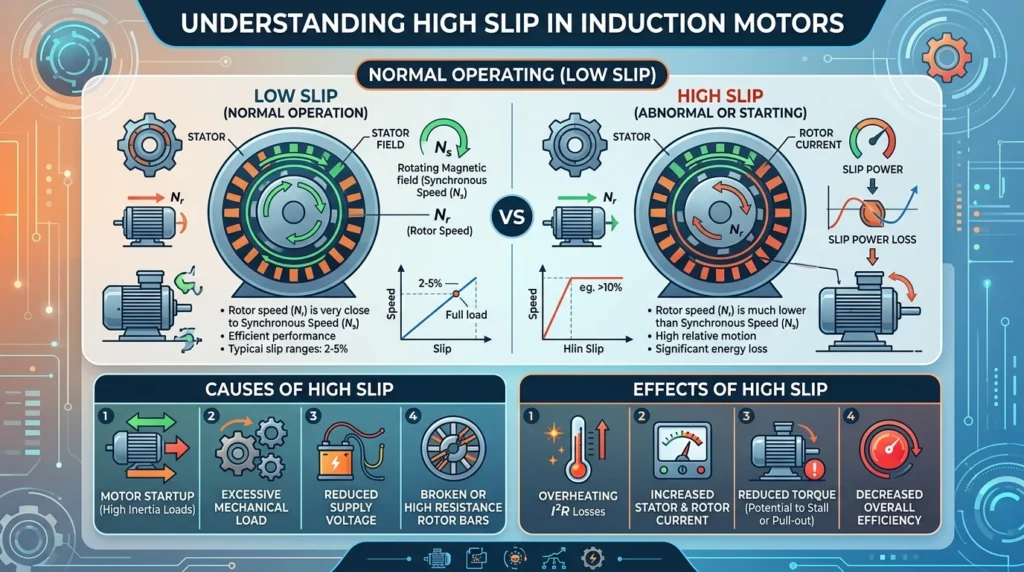
High Slip in an Induction Motor occurs when the difference between synchronous speed and rotor speed becomes large due to heavy load, mechanical fault, or insufficient supply voltage. In this condition, the rotor slows down significantly while the stator magnetic field continues to rotate at synchronous speed, resulting in increased slip percentage. High slip causes the motor to draw more current, generate more heat, and operate less efficiently. It may lead to reduced torque stability, overheating of windings, and possible damage if the condition persists for a long time. Although a small amount of slip is necessary for torque production, excessively high slip is considered undesirable in normal motor operation.
- Occurs during overload
- Causes heating
5. Main Components
Stator
- Produces the rotating magnetic field.
- Contains the windings connected to the AC supply.
Rotor
- Rotates due to electromagnetic induction.
- Current is induced in the rotor.
- The rotor rotates slightly slower than the rotating magnetic field, creating slip.
Air Gap
- The space between the stator and rotor.
- Allows the rotor to rotate freely.
- Affects the strength and efficiency of the magnetic field.
Supply System
- Provides AC power to the stator windings.
- Determines the frequency and voltage supplied to the motor.
- Supply frequency can be used to control motor speed.
Load
- Determines how much mechanical power the motor must produce.
- An increase in load causes the rotor speed to decrease slightly.
- Changes in load cause changes in the slip value.
6. Advantages
Slip in Induction Motor Advantages
- Enables torque production
- Allows smooth motor operation
- Helps in load adjustment
- Provides stable performance
- Useful in speed control methods
7. Disadvantages / Limitations
Slip in Induction Motor Disadvantages
- Causes energy loss
- Generates heat
- Reduces efficiency
- Increases with load
- Cannot be zero during operation
8. Applications of Slip in Induction Motors
Slip in Induction Motor Applications
Slip is an essential part of induction motor operation because it allows electromagnetic induction to take place between the rotating magnetic field and the rotor. Without slip, the motor cannot develop the torque required to drive a mechanical load.
Home and Residential Applications
Induction motors are commonly used in household appliances where reliable and continuous motor operation is required.
Common examples include:
- Ceiling and exhaust fans
- Washing machines
- Water pumps
- Refrigeration equipment
- Air-conditioning systems
Industrial Applications
Induction motors are widely used in industrial equipment because of their simple construction, reliability, and ability to operate continuously under varying loads.
Common applications include:
- Conveyor belt systems
- Water and industrial pumps
- Air compressors
- Fans and blowers
- Industrial machinery
- Material-handling equipment
Modern Electrical Drive Applications
Induction motors are also an important part of modern electrical drive and automation systems. Variable frequency drives (VFDs) can control motor speed and torque by adjusting the supply frequency and voltage, while the motor continues to operate with the required amount of slip.
Modern applications include:
- Electric drive systems
- Industrial automation
- Robotics and automated machinery
- HVAC systems
- Speed-controlled motor applications
Therefore, slip is fundamental to the operation of every induction motor, because the relative speed between the rotating magnetic field and rotor is required to induce rotor current and produce electromagnetic torque.
9. Comparison Section
Difference Between Synchronous Speed and Rotor Speed
| Feature | Synchronous Speed | Rotor Speed |
| Definition | Speed of magnetic field | Actual rotor speed |
| Value | Constant | Variable |
| Dependence | Supply frequency | Load |
| Relation | Always higher | Always lower |
| Role | Reference speed | Output speed |
10. Induction Motor Slip Selection and Operating Guide
Understanding slip is important when selecting and operating an induction motor because slip changes with load and affects motor speed, torque, and losses.
Tips for Beginners
- Select a motor with an appropriate slip characteristic for the required application.
- Low slip is generally desirable for better speed regulation and reduced rotor losses.
- Motors designed for higher slip can provide useful starting and load-handling characteristics in certain applications.
- Always consider the motor’s rated speed, torque, efficiency, and load requirements rather than selecting a motor based on slip alone.
Key Factors to Consider
- Load Type: Determine whether the load requires constant torque, variable torque, or high starting torque.
- Speed Requirement: Check the required operating speed and acceptable speed variation.
- Motor Efficiency: Consider efficiency and energy losses during continuous operation.
- Starting Torque: Make sure the motor can provide sufficient torque to start the connected load.
- Operating Conditions: Consider temperature, duty cycle, environment, and available power supply.
- Motor Rating: Select a motor with suitable power and torque ratings for the application.
Practical Operating Advice
- Avoid continuously operating the motor under excessive load.
- Monitor motor current, temperature, speed, and operating condition.
- Keep the cooling system clean and functional to prevent overheating.
- Maintain the motor regularly to reduce mechanical and electrical losses.
- Remember that some slip is necessary for an induction motor to produce torque.
11. Common Induction Motor Slip Problems and Solutions
Changes in slip are normally a response to changes in motor load. However, unusually high slip can indicate overloading, supply problems, mechanical issues, or motor faults.
Why Does Induction Motor Speed Decrease Under Load?
When the mechanical load increases, the rotor slows down slightly. This increases the difference between synchronous speed and rotor speed, resulting in higher slip.
Solution:
- Check whether the motor is overloaded.
- Reduce the mechanical load if necessary.
- Verify that the motor is correctly rated for the application.
Why Does High Slip Cause Motor Overheating?
Higher slip generally increases rotor frequency and rotor losses. If the motor operates with excessive slip for a long period, additional heat can be produced.
Solution:
- Check the mechanical load.
- Inspect the cooling fan and ventilation.
- Check the motor current and supply voltage.
- Ensure the motor is correctly sized for the load.
Why Is the Induction Motor Not Starting?
A motor may fail to start because of an incorrect or missing power supply, loose connections, protection-device operation, mechanical problems, or other electrical faults.
Solution:
- Check the incoming power supply.
- Inspect motor terminals and connections.
- Check fuses, circuit breakers, and overload protection.
- Inspect the motor and driven equipment for mechanical blockage.
Why Is Motor Efficiency Low?
Low efficiency can result from excessive loading, poor power quality, electrical losses, mechanical losses, or operation outside the motor’s intended conditions. High slip can also contribute to increased rotor losses.
Solution:
- Check the motor loading.
- Ensure the motor is correctly sized.
- Inspect bearings and mechanical components.
- Maintain proper cooling and ventilation.
- Check the quality of the electrical supply.
Can the Slip of an Induction Motor Be Zero?
In normal motor operation, slip cannot be zero. If the rotor reached synchronous speed, there would be no relative motion between the rotating magnetic field and rotor, so no rotor EMF or rotor current would be induced. As a result, the motor could not continue producing electromagnetic torque.
12. Future Trends in Induction Motor Slip Control and Efficiency
Modern induction motor technology is focusing on better speed control, energy efficiency, condition monitoring, and intelligent operation. Advanced control systems can manage motor speed and operating conditions more precisely while reducing unnecessary energy losses.
Key Trends in Induction Motor Technology
- Variable Frequency Drives (VFDs): Provide precise control of motor speed and operating conditions by adjusting supply frequency and voltage.
- Smart Motor Monitoring: Sensors can monitor temperature, vibration, current, speed, and other operating parameters.
- AI-Based Performance Optimization: Artificial intelligence can analyze motor operating data to identify abnormal conditions and improve performance.
- Energy-Efficient Motor Designs: Modern motors are designed to reduce electrical and mechanical losses and improve overall efficiency.
- IoT-Based Monitoring and Control: Connected motors can transmit operating data to monitoring systems for remote supervision and maintenance.
- Predictive Maintenance: Advanced monitoring systems can help identify developing faults before they result in unexpected motor failure.
Future of Slip Management
The future of induction motor operation will focus on better speed regulation, reduced energy losses, improved monitoring, and more reliable motor control. VFDs, smart sensors, IoT systems, and advanced control technologies will play an important role in improving induction motor performance.
13. Conclusion
Understanding what is slip in induction motor is essential for analyzing motor performance and efficiency. Slip is the difference between synchronous speed and rotor speed, and it plays a key role in torque production.
By learning the slip in induction motor working principle, types, and applications, you can better understand how motors operate under different conditions. While slip is necessary, excessive slip can reduce efficiency and cause losses.
For electrical students and professionals, mastering slip concepts is important for designing efficient and reliable systems. Focus on practical understanding to build strong expertise.