
Imagine electricity traveling from a power plant to your home. Along the way, transformers step up and step down voltage levels to ensure safe and efficient power delivery. But not all the electrical energy reaches your home—some of it is lost as heat inside the transformer. This is where transformer efficiency calculation becomes important.
Transformer efficiency tells us how effectively a transformer converts input electrical power into output power. Even a small improvement in efficiency can save a huge amount of energy, especially in large power systems.
For electrical students, engineers, technicians, and beginners, understanding Transformer Efficiency Calculation is essential. It helps in selecting the right transformer, improving system performance, and reducing energy losses.
In this article, you will learn the complete transformer efficiency calculation working principle, types, components, applications, advantages and disadvantages, and practical troubleshooting techniques. By the end, you will clearly understand how to calculate and improve transformer efficiency in real-world systems.
What is Transformer Efficiency Calculation?
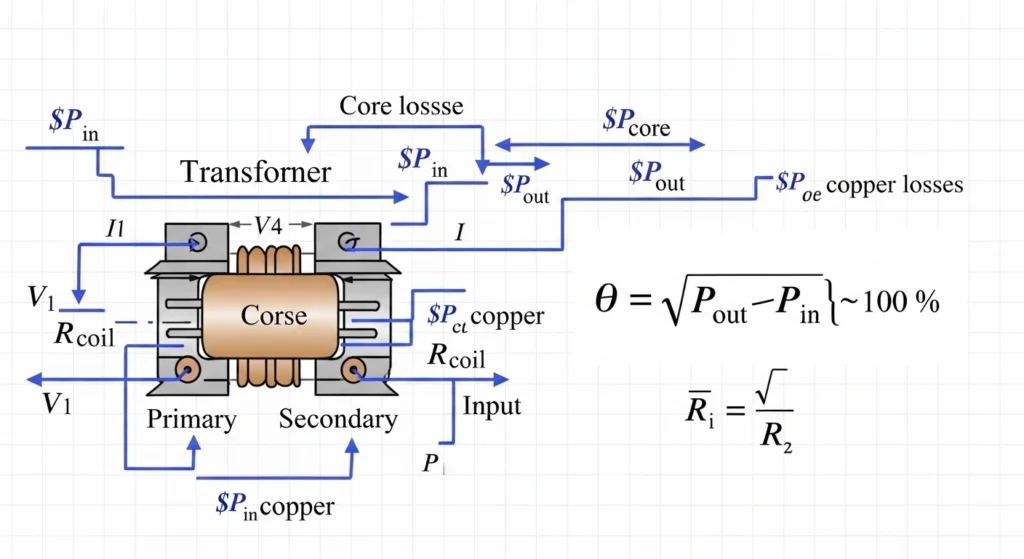
Transformer efficiency calculation is the process of determining how effectively a transformer converts the input electrical power into useful output power. It is defined as the ratio of output power delivered to the load to the input power supplied to the transformer. Since some energy is lost in the form of iron losses (core losses) and copper losses (winding losses), the output power is always slightly less than the input power. Transformer efficiency is usually expressed as a percentage and is calculated using the formula:
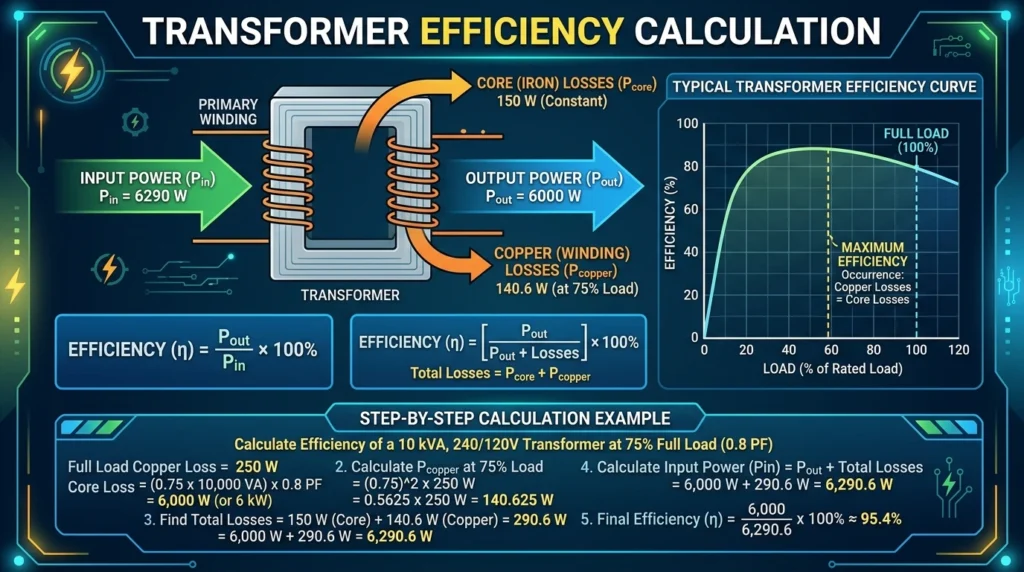
η=Input PowerOutput Power×100%
A high-efficiency transformer has lower losses and delivers more of the input power to the load. Modern power transformers typically achieve efficiencies between 95% and 99%. Calculating transformer efficiency is important for evaluating performance, reducing energy losses, improving system reliability, and selecting the most suitable transformer for electrical power applications.
Simple Definition
Efficiency is the ratio of output power to input power.
Efficiency Formula
\eta = \frac{Output\ Power}{Input\ Power} \times 100
Practical Example
- Input Power = 1000W
- Output Power = 950W
- Efficiency = 95%
This means 5% power is lost inside the transformer.
Working Principle
The transformer efficiency calculation working principle is based on energy conversion and losses.
Step-by-Step Explanation
- Electrical power is supplied to primary winding
- Magnetic flux is created in the core
- Flux induces voltage in secondary winding
- Output power is delivered to load
- Some power is lost due to:
- Core losses
- Copper losses
- Efficiency is calculated using input and output power
Loss-Based Efficiency Formula
\eta = \frac{Output}{Output + Losses} \times 100
Easy Analogy
Think of a water pipe:
- Water enters → input
- Water exits → output
- Leakage → losses
Key Points
- Efficiency depends on losses
- Lower losses → higher efficiency
- Transformers are highly efficient devices
Types / Classification
Based on Load Condition
Full Load Efficiency
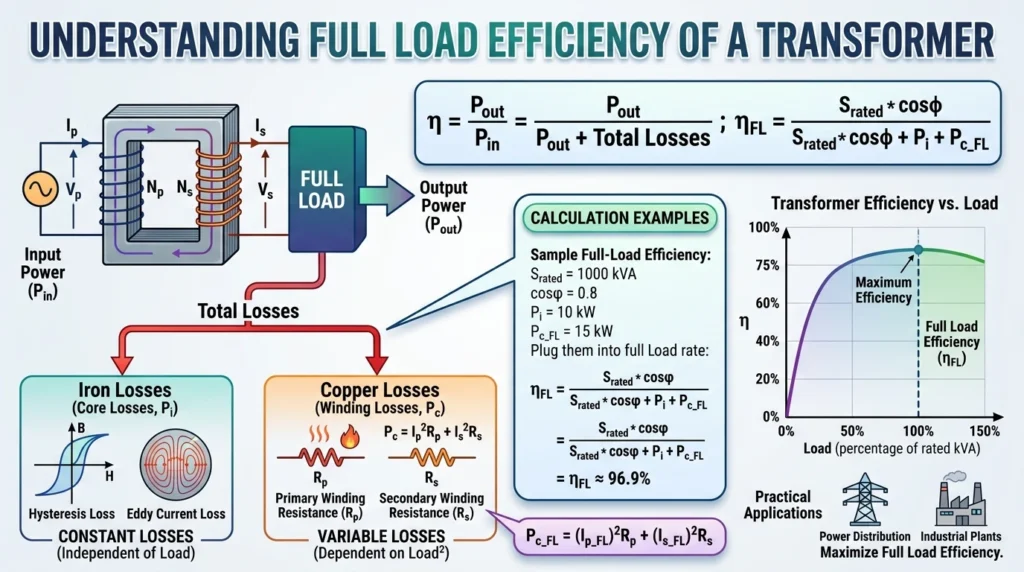
Full load efficiency is the ratio of the output power delivered to the load to the input power supplied to the transformer when it is operating at its rated full load capacity. It indicates how effectively the transformer converts electrical power from the primary winding to the secondary winding with minimum losses. At full load, the transformer experiences both core (iron) losses and copper losses, and the efficiency is calculated by comparing the useful output power with the total input power. Since transformers are highly efficient devices, their full load efficiency typically ranges from 95% to 99% depending on their size and design. High full load efficiency reduces energy losses, lowers operating costs, and improves the overall performance of power distribution systems, making it an important parameter in transformer selection and operation.
- Efficiency at rated load
- Usually maximum
Half Load Efficiency
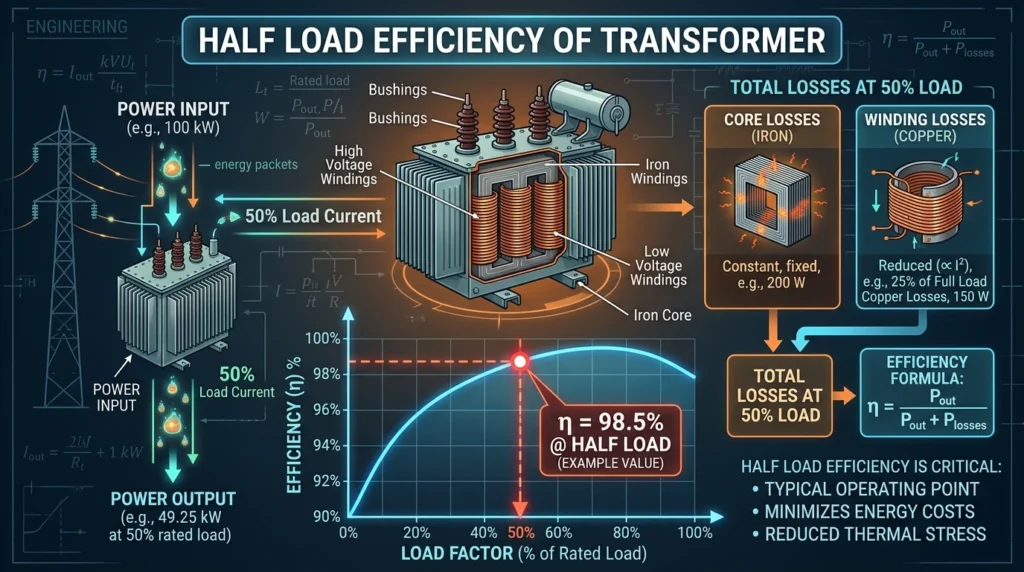
Half load efficiency is the efficiency of the transformer when it operates at 50% of its rated load capacity. It is defined as the ratio of output power delivered to the load to the input power supplied to the transformer at half load conditions. At this operating point, the transformer still experiences constant core (iron) losses, while the copper losses are reduced because they depend on the square of the load current. The half load efficiency helps evaluate transformer performance under normal operating conditions, as many transformers do not continuously operate at full load. A transformer with good half load efficiency ensures lower energy losses, improved voltage regulation, and economical operation, making it an important factor in power system design and energy management.
- Efficiency at 50% load
- Important for real operation
Based on Loss Consideration
Iron Loss Efficiency
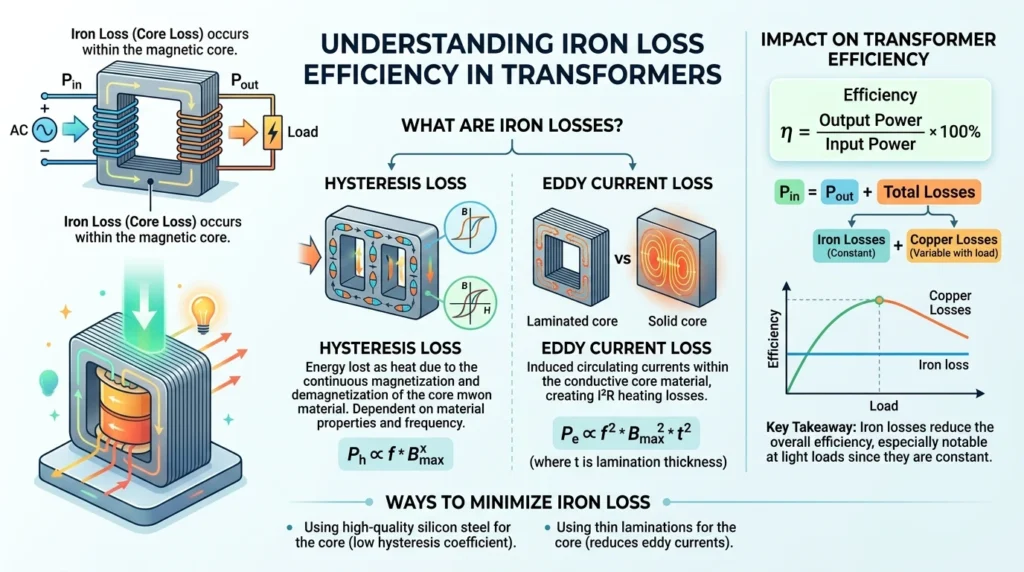
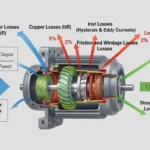
Iron loss is the power loss that occurs in the transformer core due to the alternating magnetic flux produced by the AC supply. These losses are present whenever the transformer is energized, regardless of whether it is carrying load current or not. Iron loss consists of two main components: hysteresis loss, caused by the continuous magnetization and demagnetization of the core, and eddy current loss, caused by circulating currents induced within the core material. Since iron losses depend mainly on the supply voltage and frequency, they remain nearly constant during transformer operation. To minimize these losses, transformer cores are made from high-quality silicon steel laminations. Reducing iron loss improves transformer efficiency, lowers energy wastage, and enhances the overall performance and reliability of power systems.
- Considers core losses
- Constant loss
Copper Loss Efficiency
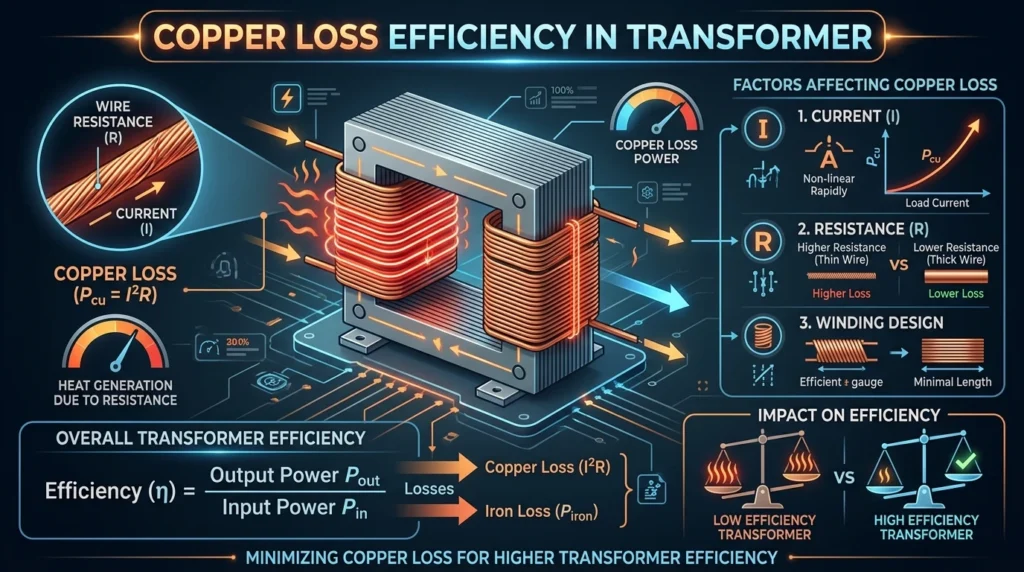
Copper loss is the power loss that occurs in the primary and secondary windings due to their electrical resistance when current flows through them. According to Joule’s law, this loss is proportional to the square of the load current and is commonly expressed as I²R loss. Unlike iron loss, copper loss varies with the load; it increases as the load current increases and decreases when the load is reduced. At no-load conditions, copper loss is very small, while at full load it reaches its maximum value. Copper losses produce heat in the windings, which can affect transformer efficiency and performance if not properly managed. To reduce copper losses, transformers use conductors with low resistance and adequate cross-sectional area. Minimizing copper loss improves transformer efficiency, reduces energy wastage, and enhances the lifespan of the transformer.
- Depends on load current
- Variable loss
All-Day Efficiency
- Used for distribution transformers
- Considers energy over 24 hours
Main Components
Core
- Magnetic path
- Causes iron losses
Windings
- Conduct current
- Cause copper losses
Insulation
- Prevents leakage
- Ensures safety
Cooling System
- Removes heat
- Improves efficiency
Tank and Oil
- Provides cooling and insulation
- Reduces losses
Advantages
Transformer Efficiency Calculation Advantages
- Helps in energy saving
- Improves system performance
- Reduces operating cost
- Helps in proper transformer selection
- Enhances reliability
- Useful for design optimization
7. Disadvantages / Limitations
Transformer Efficiency Calculation Disadvantages
- Requires accurate measurement
- Complex in large systems
- Efficiency varies with load
- Loss estimation may be difficult
- Needs proper instruments
Applications
Transformer Efficiency Calculation Applications
Home Applications
- Voltage regulation
- Energy-efficient appliances
Industrial Applications
- Power distribution systems
- Heavy electrical equipment
Modern Technology
- Smart grids
- Renewable energy systems
- Electric substations
Efficiency calculation is essential for power management.
Comparison Section
Difference Between Efficiency and Losses
| Feature | Efficiency | Losses |
| Definition | Useful output ratio | Wasted energy |
| Unit | Percentage (%) | Watts (W) |
| Impact | Improves performance | Reduces performance |
| Goal | Maximize | Minimize |
| Measurement | Ratio | Direct value |
Selection Guide
Choosing the right transformer depends on efficiency.
Tips for Beginners
- Always check efficiency rating
- Use high-efficiency transformers
- Consider load conditions
Key Factors to Consider
- Load type
- Operating hours
- Losses
- Cooling system
- Cost
Practical Advice
- Use transformers near rated load
- Avoid overloading
- Maintain proper cooling
Common Problems & Solutions
Why transformer efficiency is low?
High losses.
Reduce load and improve cooling.
Why transformer overheats?
Energy loss as heat.
Check load and ventilation.
Why efficiency changes with load?
Copper losses vary with current.
Operate near rated load.
How to improve efficiency?
- Reduce losses
- Use better materials
- Maintain properly
What is maximum efficiency condition?
When copper loss equals iron loss.
Future Trends
Transformer technology is improving rapidly.
Key Trends
- High-Efficiency Transformers
- Smart Monitoring Systems
- Low-Loss Core Materials
- AI-Based Efficiency Optimization
- Eco-Friendly Designs
Future transformers will focus on maximum efficiency and minimum losses.
Conclusion
Understanding Transformer Efficiency Calculation is essential for designing and operating efficient electrical systems. Efficiency shows how well a transformer converts input power into useful output power.
By learning the transformer efficiency calculation working principle, types, and applications, you can improve system performance and reduce energy losses. Proper calculation helps in selecting the right transformer and ensuring reliable operation.
As technology advances, transformers are becoming more efficient and intelligent. Focus on practical knowledge and energy-saving techniques to build strong expertise in this field.