
Imagine running a water pump for irrigation. You pay for electricity, but not all of that energy is converted into useful work. Some of it is lost as heat, noise, and friction. This difference between input energy and useful output is what we call motor efficiency.
In real-world systems, motors are everywhere—from fans and refrigerators at home to heavy machines in industries. If a motor is inefficient, it wastes energy, increases electricity bills, and reduces system performance. That’s why understanding Motor Efficiency Explained is very important.
For electrical students, engineers, technicians, and beginners, knowing motor efficiency helps in selecting the right motor, improving performance, and saving energy.
In this article, you will learn the complete motor efficiency working principle, types, components, applications, advantages and disadvantages, and practical troubleshooting techniques. By the end, you will clearly understand how efficiency affects motor performance and how to improve it in real systems.
2. What is Motor Efficiency Explained?
Motor efficiency is the ratio of useful mechanical output power to the electrical input power supplied to the motor.
Simple Explanation
It tells us how much input energy is converted into useful work.
Efficiency Formula
\eta = \frac{Output\ Power}{Input\ Power} \times 100
Practical Example
- If a motor takes 1000W input and gives 900W output
- Efficiency = 90%
- Remaining 10% is lost
3. Working Principle
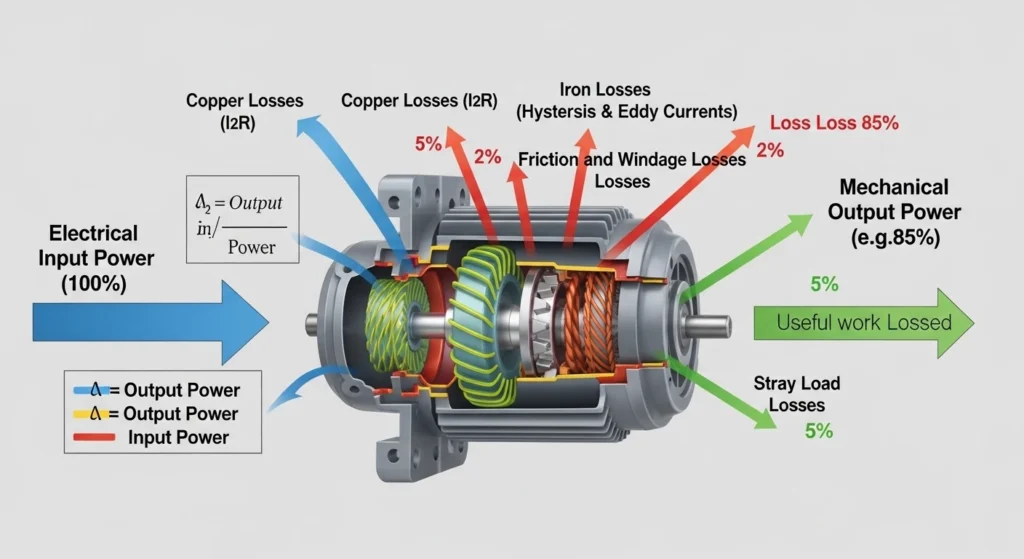
The motor efficiency working principle is based on energy conversion and losses.
Step-by-Step Explanation
- Electrical energy is supplied to motor
- Motor converts electrical energy into mechanical energy
- Some energy is lost due to:
- Heat
- Friction
- Magnetic losses
- Remaining energy becomes useful output
Easy Analogy
Think of a car engine:
- Fuel is input
- Movement is output
- Heat and noise are losses
Key Points
- Efficiency depends on losses
- Lower losses → higher efficiency
- No motor is 100% efficient
4. Types / Classification
Based on Motor Type
AC Motor Efficiency
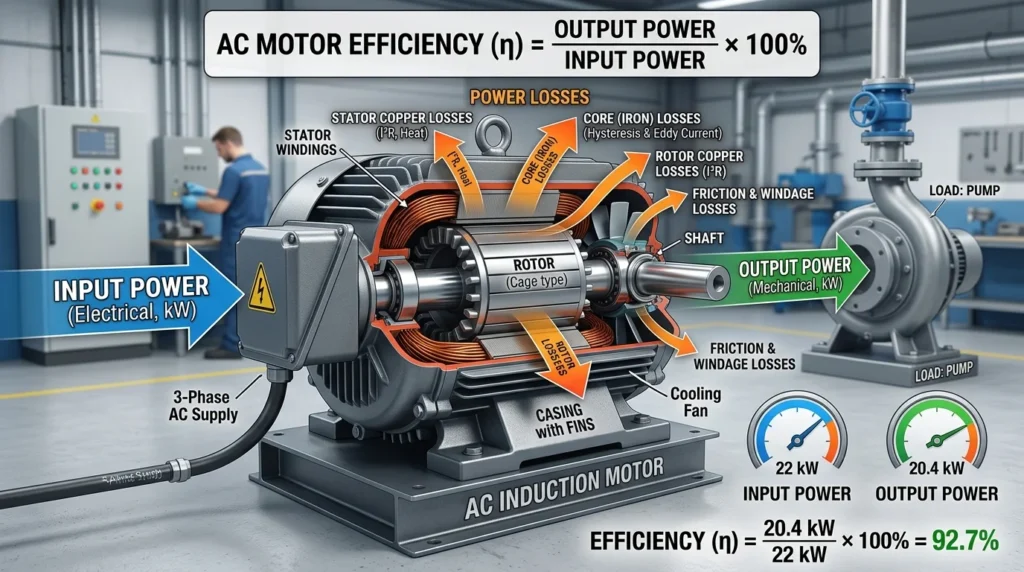
AC motor efficiency is the measure of how effectively an AC motor converts electrical energy into useful mechanical energy. It is expressed as the percentage of output power compared to the input power. A highly efficient motor converts most of the electrical energy into mechanical work while minimizing losses caused by heat, friction, windage, and electrical resistance. Motor efficiency depends on factors such as motor design, load conditions, power quality, and regular maintenance. Using a high-efficiency AC motor helps reduce electricity consumption, lowers operating costs, improves performance, and extends the motor’s service life. Therefore, selecting an efficient AC motor is essential for achieving reliable operation and energy savings in residential, commercial, and industrial applications.
- Used in industries
- High efficiency
DC Motor Efficiency
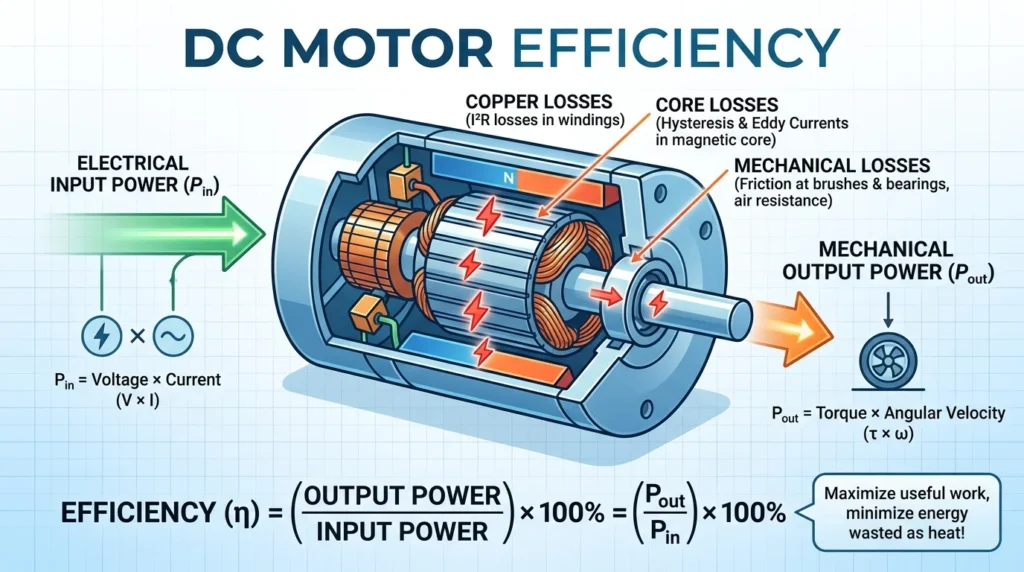
DC motor efficiency is the measure of how effectively a DC motor converts electrical energy into useful mechanical energy. It is expressed as the ratio of the motor’s mechanical output power to its electrical input power, usually as a percentage. A high-efficiency DC motor delivers more useful work while minimizing energy losses caused by armature resistance, friction, windage, iron losses, and brush contact losses. The efficiency of a DC motor depends on factors such as load conditions, motor design, proper maintenance, and operating voltage. Choosing a high-efficiency DC motor reduces power consumption, lowers operating costs, improves performance, and increases the motor’s lifespan. For this reason, DC motor efficiency is an important consideration in industrial machinery, electric vehicles, robotics, and battery-powered applications.
- Used in variable speed applications
- Moderate efficiency
Based on Efficiency Class
Standard Efficiency Motors
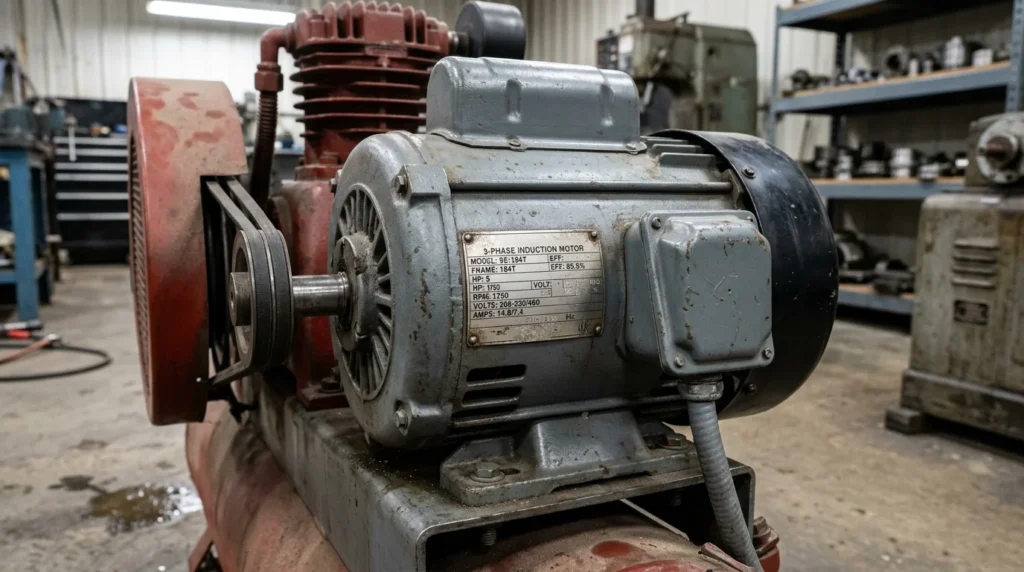
Standard efficiency motors are electric motors designed to provide reliable performance while meeting basic energy efficiency requirements. They convert electrical energy into mechanical energy with acceptable efficiency but generally consume more electricity than high-efficiency or premium-efficiency motors. These motors are commonly used in applications where operating hours are limited or energy savings are not the primary concern. Standard efficiency motors have a lower initial purchase cost, making them an economical choice for many residential, commercial, and light industrial applications. However, due to their higher energy losses, they may result in greater operating costs over time, especially in systems that run continuously.
- Basic performance
- Lower cost
High-Efficiency Motors
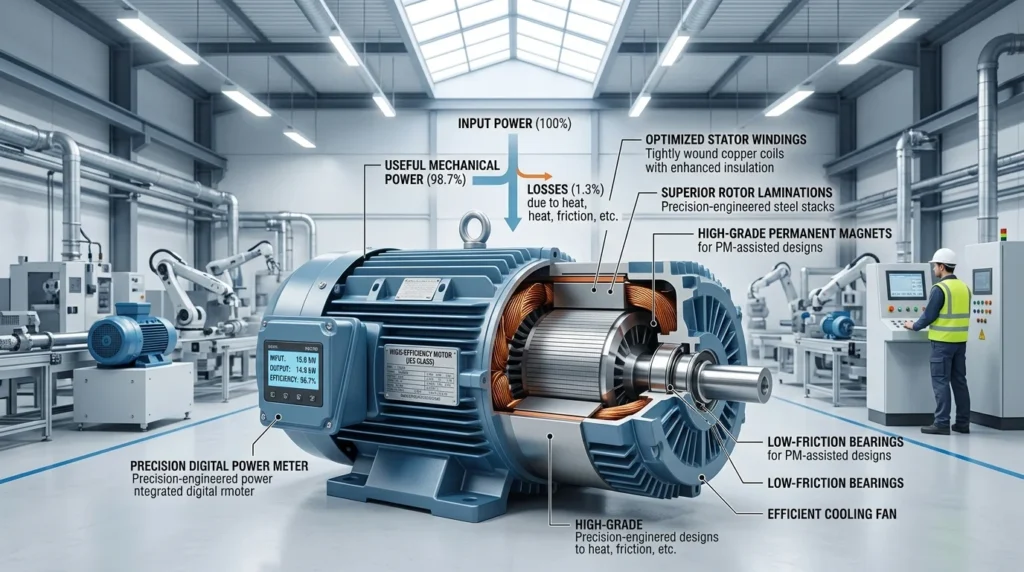
High-efficiency motors are electric motors designed to convert electrical energy into mechanical energy with minimal power losses. They use improved materials, advanced winding designs, and high-quality magnetic cores to achieve greater efficiency than standard motors. As a result, these motors consume less electricity while delivering the same output power, making them an energy-efficient and cost-effective choice for long-term operation. High-efficiency motors also generate less heat, provide better reliability, require less maintenance, and have a longer service life. They are widely used in industrial machinery, HVAC systems, pumps, compressors, conveyors, and other applications where motors operate for long hours and energy savings are important.
- Reduced losses
- Energy-saving
Premium Efficiency Motors
- Maximum efficiency
- Used in critical applications
Based on Load Conditions
Full Load Efficiency
- Maximum efficiency point
Partial Load Efficiency
- Lower efficiency
- Common in real systems
5. Main Components
Stator
- Stationary part
- Produces magnetic field
Rotor
- Rotating part
- Converts energy into motion
Windings
- Conduct current
- Cause copper losses
Core
- Magnetic material
- Causes core losses
Bearings
- Support rotation
- Cause friction losses
Cooling System
- Removes heat
- Improves efficiency
6. Advantages
Motor Efficiency Explained Advantages
- Reduces energy consumption
- Lowers electricity cost
- Improves performance
- Extends motor life
- Reduces heat generation
- Environment-friendly
7. Disadvantages / Limitations
Motor Efficiency Explained Disadvantages
- High-efficiency motors are expensive
- Efficiency drops at low load
- Requires proper maintenance
- Complex design in advanced motors
- Not constant under all conditions
8. Applications
Motor Efficiency Explained Applications
Home Applications
- Fans
- Refrigerators
- Washing machines
Industrial Applications
- Pumps
- Compressors
- Conveyor systems
Modern Technology
- Electric vehicles
- Robotics
- Automation systems
- Renewable energy systems
Efficiency is critical in energy-saving systems.
9. Comparison Section
Difference Between High Efficiency and Standard Motors
| Feature | Standard Motor | High Efficiency Motor |
| Efficiency | Lower | Higher |
| Cost | Low | High |
| Energy Loss | High | Low |
| Performance | Moderate | Better |
| Lifespan | Shorter | Longer |
10. Selection Guide
Choosing the right motor based on efficiency is important.
Tips for Beginners
- Always check efficiency rating
- Choose high-efficiency motors for continuous use
- Avoid oversized motors
Key Factors to Consider
- Load requirement
- Operating hours
- Cost vs savings
- Environment
- Maintenance
Practical Advice
- Use premium efficiency motors for industries
- Match motor size with load
- Maintain proper cooling
11. Common Problems & Solutions
Why motor efficiency is low?
Reduce load and improve maintenance.
Why motor overheats?
Energy loss as heat.
Improve ventilation and reduce load.
Why energy consumption is high?
Low efficiency motor.
Use high-efficiency motor.
Why efficiency drops at low load?
Fixed losses remain constant.
Operate near rated load.
How to improve efficiency?
- Use proper motor size
- Maintain regularly
- Reduce losses
12. Future Trends
Motor efficiency is improving with new technologies.
Key Trends
- Energy-Efficient Motors (IE3, IE4 Standards)
- Smart Motor Monitoring Systems
- AI-Based Efficiency Optimization
- Advanced Materials for Low Losses
- Integration with IoT Systems
Future motors will focus on maximum efficiency and energy savings.
13. Conclusion
Understanding Motor Efficiency Explained is essential for improving performance and saving energy in electrical systems. Efficiency shows how effectively a motor converts electrical energy into useful mechanical work.
By learning the motor efficiency working principle, types, and applications, you can select better motors and reduce energy losses. While high-efficiency motors may cost more initially, they provide long-term savings and better performance.
As technology advances, efficiency is becoming a key factor in motor design and selection. Focus on practical understanding and energy-efficient solutions to build strong expertise in this field.