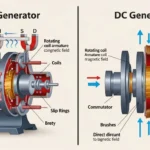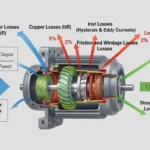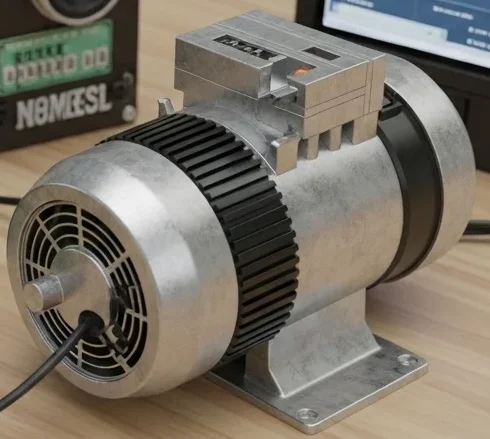
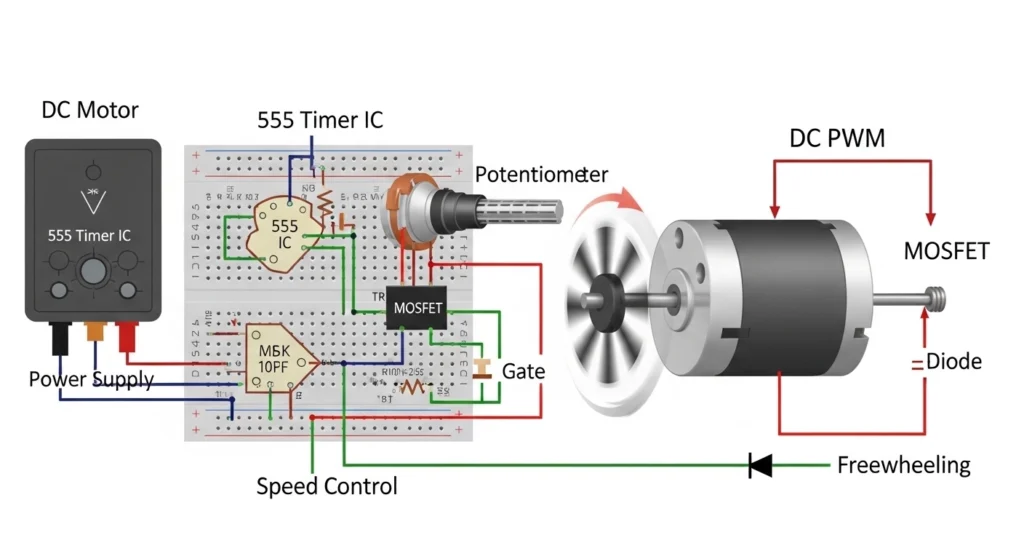

Imagine operating a conveyor belt in a factory. Sometimes you need it to run slowly for careful inspection, and other times faster for high production. Or think about an electric drill—you press lightly for slow speed and harder for fast rotation. This ability to control speed is essential in many applications, and it is made possible by speed control of DC motor.
DC motors are widely used because their speed can be easily controlled over a wide range. This makes them ideal for applications where precision, flexibility, and performance are important.
Understanding Speed Control of DC Motor is crucial for electrical students, engineers, technicians, and beginners. It helps in designing efficient systems, improving performance, and reducing energy consumption.
In this article, you will learn the complete speed control of DC motor working principle, methods, components, applications, advantages and disadvantages, and practical troubleshooting techniques. By the end, you will clearly understand how to control DC motor speed effectively in real-world systems.
2. What is Speed Control of DC Motor?
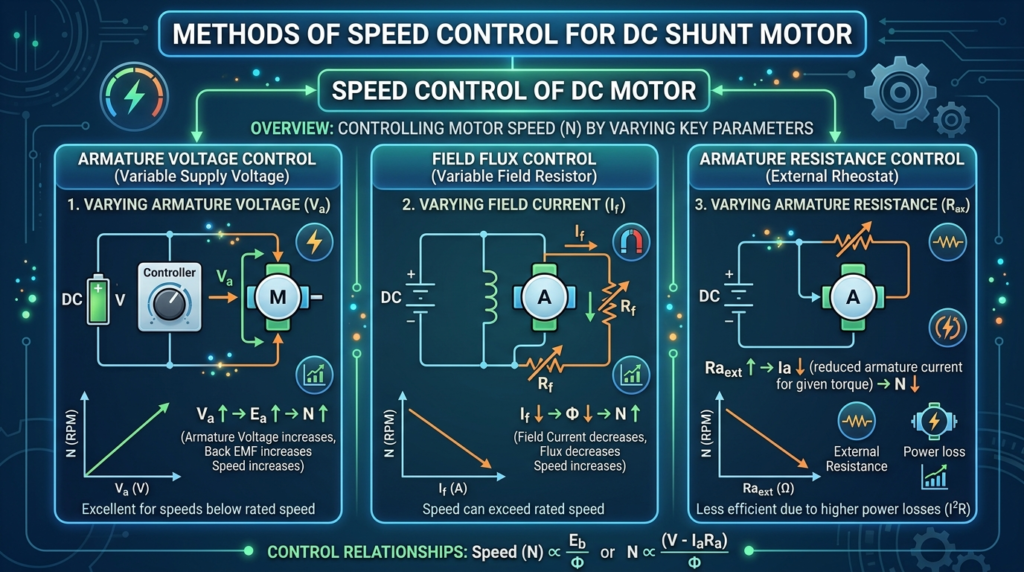
Speed Control of a DC Motor is the process of regulating the rotational speed of a DC motor to meet the requirements of a specific application. It is achieved by adjusting the armature voltage, field current, or armature circuit resistance, allowing the motor to operate at different speeds while maintaining efficient performance. The speed of a DC motor depends mainly on the applied voltage and the strength of the magnetic field. By controlling these factors, the motor can run slower or faster as needed without affecting its reliability. Modern DC motor control systems use electronic controllers, such as Pulse Width Modulation (PWM) drives and DC motor drives, to provide smooth, accurate, and energy-efficient speed regulation. Speed control is essential in applications where variable motor speed is required, including electric vehicles, cranes, elevators, conveyor belts, machine tools, rolling mills, and industrial automation systems. Proper speed control improves operational efficiency, reduces energy consumption, enhances equipment performance, and extends the motor’s service life.
Speed control of DC motor refers to the method of adjusting the speed of a DC motor according to the required application.
Simple Explanation
It means increasing or decreasing the motor speed by controlling electrical parameters.
Practical Example
- Electric trains adjust speed during acceleration and braking
- Fans and drills change speed based on user input
3. Working Principle
The speed control of DC motor working principle is based on the relationship between voltage, current, magnetic field, and speed.
Basic Speed Equation
N \propto \frac{V – I R}{\Phi}
Where:
- N = Speed
- V = Supply voltage
- I = Armature current
- R = Resistance
- Φ = Magnetic flux
Step-by-Step Explanation
- Supply voltage is applied to motor
- Current flows in armature
- Magnetic field is produced
- Motor starts rotating
- Speed depends on:
- Voltage
- Flux
- Resistance
Easy Analogy
Think of a car:
- Press accelerator → speed increases
- Apply brake → speed decreases
In motors:
- Increase voltage → speed increases
- Increase resistance → speed decreases
Key Points
- Speed is directly proportional to voltage
- Speed is inversely proportional to flux
- Speed can be controlled by electrical methods
4. Types / Classification
Armature Voltage Control Method
- Speed controlled by changing supply voltage
- Most efficient method
Features:
- Smooth control
- Used in modern systems
Field Control Method
- Speed controlled by changing magnetic flux
Features:
- Increasing flux → decreases speed
- Used for high-speed operation
Armature Resistance Control Method
- Resistance added in series with armature
Features:
- Simple method
- Causes power loss
Ward-Leonard Method
- Uses motor-generator set
- Provides smooth speed control
Features:
- High precision
- Expensive system
5. Main Components
DC Motor
- Main device
- Converts electrical energy to mechanical
Power Supply
- Provides DC voltage
- Controls speed level
Controller
- Adjusts voltage or current
- Used in modern systems
Rheostat (Variable Resistor)
- Controls resistance
- Used in simple methods
Field Windings
- Produce magnetic flux
- Affect speed
Sensors (Optional)
- Monitor speed
- Used in advanced systems
6. Advantages
Speed Control of DC Motor Advantages
- Easy and wide speed control
- High starting torque
- Smooth operation
- Suitable for variable load
- High efficiency (in modern methods)
- Precise speed regulation
7. Disadvantages / Limitations
Speed Control of DC Motor Disadvantages
- Some methods cause power loss
- Requires control equipment
- Maintenance needed for brushes
- Cost can be high in advanced systems
- Limited efficiency in resistance method
8. Applications
Speed Control of DC Motor Applications
Home Applications
- Fans
- Electric tools
Industrial Applications
- Conveyor belts
- Cranes and hoists
- Rolling mills
Modern Technology
- Electric vehicles
- Robotics
- Automation systems
- CNC machines
DC motor speed control is essential in variable-speed applications.
9. Comparison Section
Difference Between Armature Control and Field Control
| Feature | Armature Control | Field Control |
| Method | Vary voltage | Vary flux |
| Speed Range | Below base speed | Above base speed |
| Efficiency | High | Moderate |
| Application | Precise control | High-speed operation |
| Complexity | Medium | Simple |
10. Selection Guide
Choosing the right speed control method is important.
Tips for Beginners
- For efficiency → Use voltage control
- For simple setup → Use resistance method
- For precision → Use electronic controllers
Key Factors to Consider
- Speed range
- Load type
- Efficiency requirement
- Cost
- Maintenance
Practical Advice
- Avoid resistance control for large systems
- Use modern electronic drives
- Always match control method with application
11. Common Problems & Solutions
Why motor speed is unstable?
Voltage fluctuation.
Use stable power supply.
Why motor overheats?
Excess resistance or overload.
Reduce load and improve cooling.
Why speed is too low?
High flux or low voltage.
Adjust supply.
Why control is not smooth?
Poor controller.
Use better control system.
How to improve efficiency?
Use modern electronic drives.
12. Future Trends
Speed control technology is advancing rapidly.
Key Trends
- DC Drives (Electronic Control Systems)
- AI-Based Speed Control
- Smart Motor Controllers
- Energy-Efficient Designs
- Integration with IoT Systems
Future systems will focus on precision, automation, and efficiency.
13. Conclusion
Understanding Speed Control of DC Motor is essential for modern electrical systems. It allows motors to operate efficiently under different conditions and improves performance in real-world applications.
By learning the speed control of DC motor working principle, types, and applications, you can design better systems and solve practical problems. Each method has its own advantages and limitations, so choosing the right one is important.
As technology evolves, DC motor control is becoming more advanced and efficient. Focus on practical understanding and modern techniques to build strong expertise in this field.