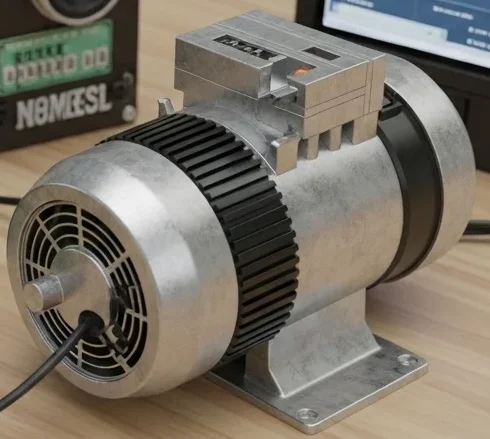

Imagine a large factory running conveyor belts, compressors, pumps, cranes, and heavy machinery continuously for hours without stopping. Behind most of these industrial operations is one highly reliable electrical machine — the three phase induction motor. It is one of the most widely used motors in the world because of its efficiency, durability, and simple design.
Three phase induction motors are considered the backbone of modern industries. They are used in manufacturing plants, water treatment systems, HVAC systems, electric transportation, and automation equipment. Their ability to operate smoothly under heavy loads makes them ideal for industrial applications.
Understanding three phase induction motor working is extremely important for electrical students, engineers, technicians, and beginners. It helps in understanding motor control, industrial automation, energy efficiency, troubleshooting, and electrical machine fundamentals. Once you learn how these motors work, many industrial electrical systems become much easier to understand.
In this article, you will learn the three phase induction motor working principle, types, components, applications, advantages and disadvantages, troubleshooting methods, comparison tables, and future industry trends. The explanations are simple, practical, and written like a senior engineer guiding a junior technician.
What is a Three Phase Induction Motor?
A three phase induction motor is an AC motor that converts electrical energy into mechanical energy using electromagnetic induction and operates with a three-phase power supply.
The rotor receives energy through induction from the stator instead of direct electrical connection.
Simple Explanation
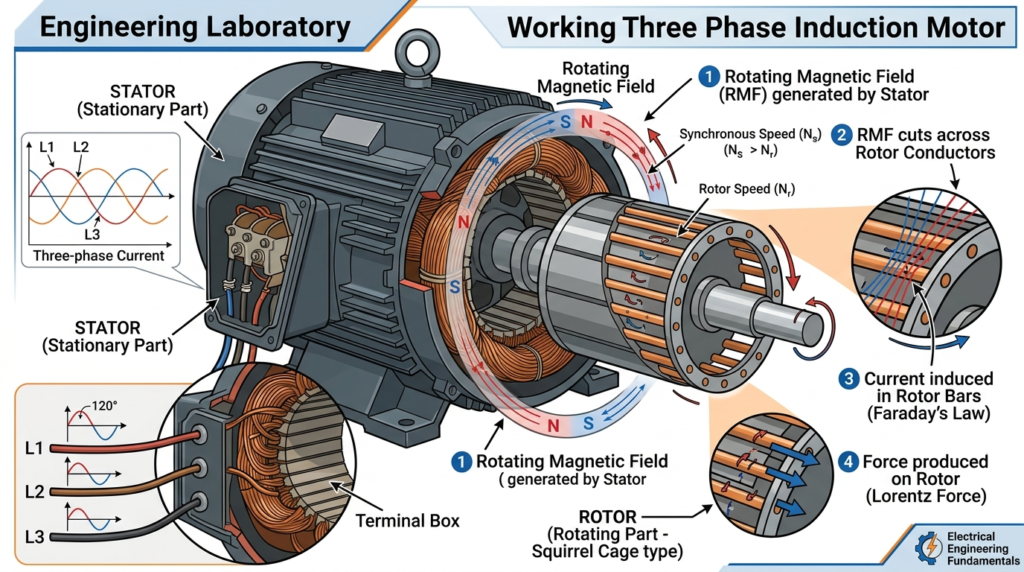
When three-phase AC supply is applied to the stator winding, it creates a rotating magnetic field. This rotating field induces current in the rotor, producing torque and causing the rotor to rotate.
Practical Example
Three phase induction motors are commonly used in:
- Industrial pumps
- Compressors
- Conveyor systems
- Elevators
- HVAC equipment
- Manufacturing machinery
These motors are preferred because they are self-starting and highly efficient.
Three Phase Induction Motor Working Principle
The three phase induction motor working principle is based on Faraday’s Law of Electromagnetic Induction.
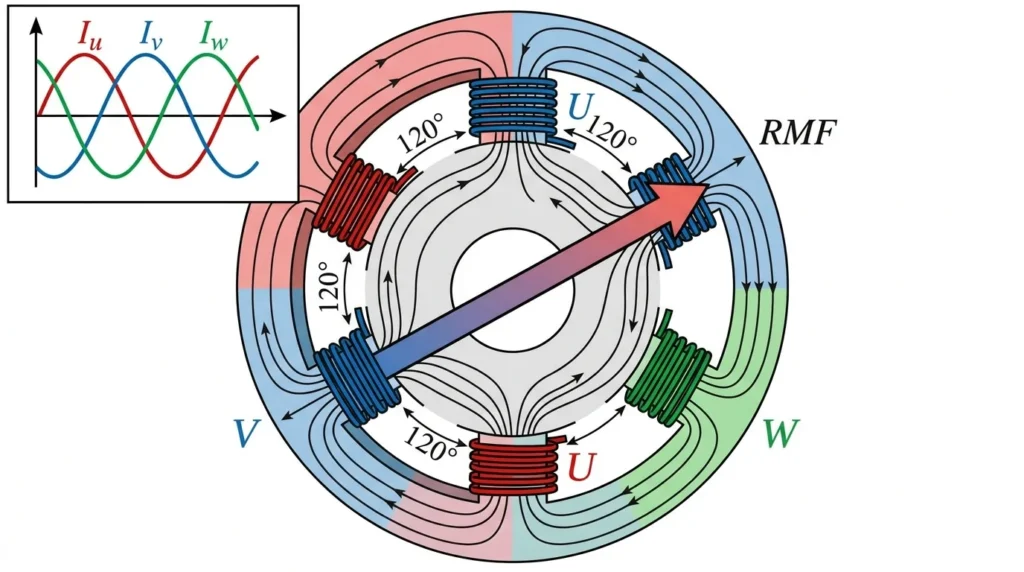
When three-phase current flows through stator windings, a rotating magnetic field is produced. This field cuts the rotor conductors and induces current. The interaction between magnetic fields creates torque that rotates the rotor.The three phase induction motor working principle is based on the concept of electromagnetic induction. When a three-phase AC supply is connected to the stator windings, it produces a rotating magnetic field around the stator. This rotating magnetic field continuously cuts the rotor conductors and induces an electromotive force (EMF) and current in the rotor according to Faraday’s law of electromagnetic induction. The induced rotor current creates its own magnetic field, which interacts with the stator’s rotating magnetic field. This interaction produces an electromagnetic torque that causes the rotor to rotate in the same direction as the rotating magnetic field. Since the rotor must lag slightly behind the magnetic field to maintain induction, it never reaches synchronous speed, and this difference in speed is known as slip. In simple words, a three-phase induction motor converts electrical energy into mechanical energy through the interaction of magnetic fields without requiring a direct electrical connection to the rotor. Because of its simple construction, high reliability, and low maintenance requirements, it is widely used in pumps, fans, compressors, conveyors, and various industrial machines.
Synchronous Speed Formula
The synchronous speed of the rotating magnetic field is:
N_s=\frac{120f}{P}
Where:
- Ns = Synchronous speed
- f = Supply frequency
- P = Number of poles
Step-by-Step Working Process
Three-Phase Supply is Applied
Three-phase AC voltage is supplied to stator windings.
The windings are placed 120 degrees apart.
Rotating Magnetic Field is Created
The three-phase current produces a rotating magnetic field.
This field rotates continuously at synchronous speed.
Rotor Conductors are Cut by Magnetic Flux
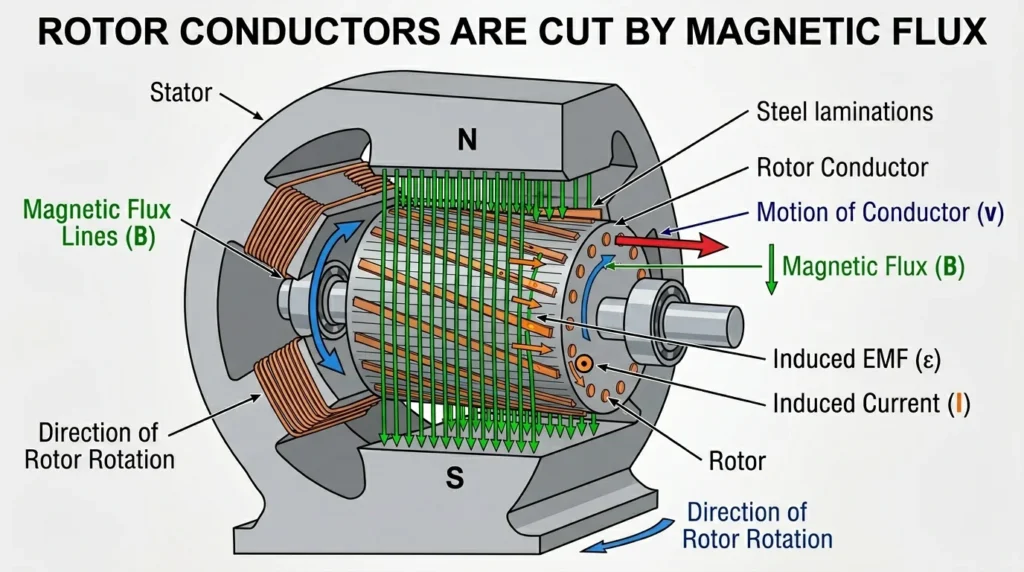
When a three-phase induction motor is supplied with electrical power, the stator produces a rotating magnetic field that moves around the rotor. As this magnetic field rotates, it continuously passes across the rotor conductors, a process known as the rotor conductors being cut by magnetic flux. According to the principle of electromagnetic induction, whenever a conductor cuts magnetic flux, an electromotive force (EMF) is induced in it. This induced EMF causes current to flow through the rotor conductors, creating their own magnetic field. The interaction between the stator’s rotating magnetic field and the magnetic field produced by the rotor currents generates torque, causing the rotor to rotate in the same direction as the rotating magnetic field. In simple words, the cutting of rotor conductors by magnetic flux is the key process that induces current and produces the mechanical motion required for motor operation. This principle forms the foundation of how induction motors convert electrical energy into mechanical energy.
The rotating magnetic field passes through rotor conductors.
According to electromagnetic induction:
- Voltage is induced
- Rotor current starts flowing
Rotor Magnetic Field is Produced
The induced current generates rotor magnetic flux.
Torque is Produced
Interaction between:
- Stator magnetic field
- Rotor magnetic field
creates electromagnetic torque.
Rotor Begins Rotating
The rotor rotates in the same direction as the magnetic field.
The motor converts electrical energy into mechanical motion.
Slip in Induction Motor
The rotor speed is always slightly lower than synchronous speed.
This speed difference is called slip.
Slip Formula
s=\frac{N_s-N_r}{N_s}\times100
Where:
- s = Slip
- Ns = Synchronous speed
- Nr = Rotor speed
Slip is necessary for induction to occur.
Easy Analogy
Imagine running behind a moving bus while trying to catch it.
You must remain slightly slower than the bus to continue moving toward it.
Similarly, the rotor must rotate slightly slower than the rotating magnetic field for continuous induction.
Types / Classification
Squirrel Cage Induction Motor
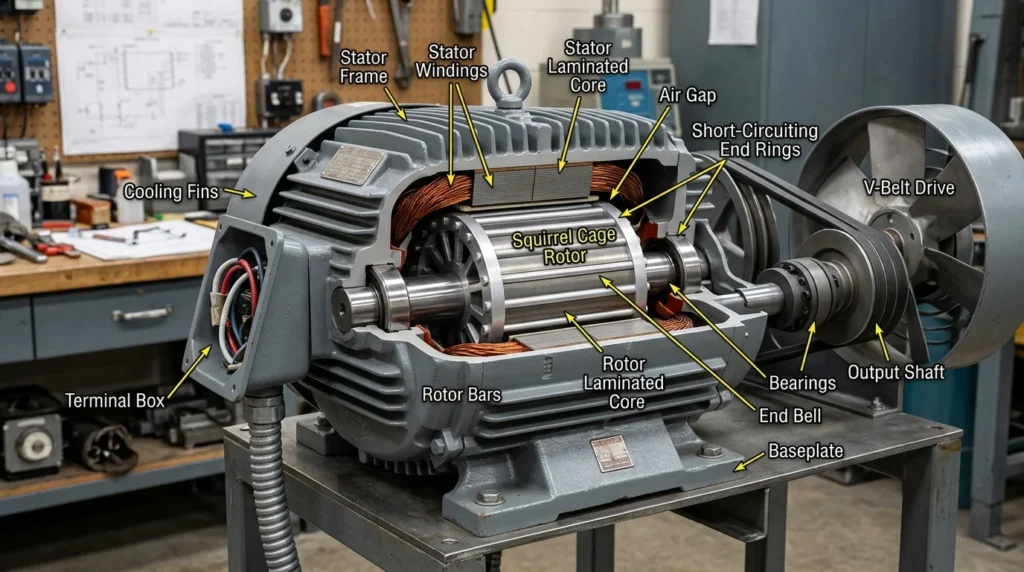
A squirrel cage induction motor is the most commonly used type of AC induction motor, known for its simple construction, durability, and reliable performance. It consists of a stator containing windings and a rotor made of conductive bars connected by end rings, forming a structure that resembles a squirrel cage. When three-phase AC power is supplied to the stator, a rotating magnetic field is produced. This magnetic field induces current in the rotor bars, creating torque that causes the rotor to rotate. In simple words, the motor operates without any direct electrical connection to the rotor, making it robust and low maintenance. Squirrel cage induction motors are widely used in pumps, fans, compressors, conveyor systems, machine tools, and industrial machinery due to their high efficiency, reliable operation, and cost-effectiveness. Understanding squirrel cage induction motors is important for electrical students and technicians because they are among the most widely used motors in residential, commercial, and industrial applications.
This is the most common type of induction motor.
The rotor consists of bars connected at both ends.
Features
- Simple construction
- Rugged design
- Low maintenance
Applications
- Pumps
- Fans
- Compressors
- Conveyors
Slip Ring Induction Motor
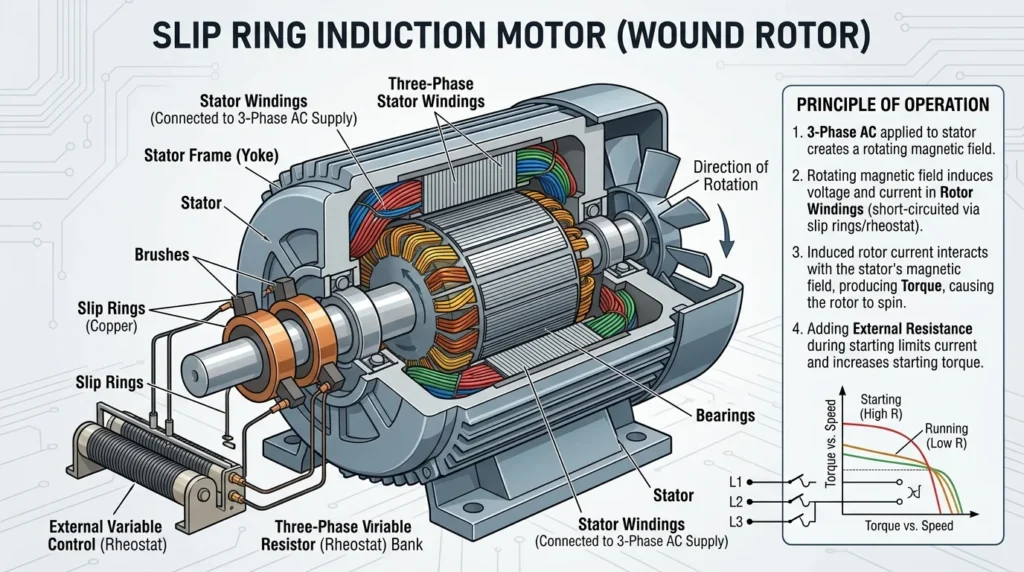
A slip ring induction motor, also known as a wound rotor induction motor, is a type of three-phase induction motor that uses slip rings and external resistors connected to the rotor winding. Unlike a squirrel cage motor, the rotor of a slip ring induction motor contains insulated windings connected to slip rings mounted on the shaft. Through these slip rings, external resistance can be added to the rotor circuit during startup. This increases the starting torque and reduces the starting current, making the motor suitable for heavy-load applications. In simple words, a slip ring induction motor provides better starting performance and speed control than a squirrel cage induction motor. These motors are commonly used in cranes, elevators, hoists, conveyors, crushers, and other industrial machines that require high starting torque. Understanding slip ring induction motors is important for electrical students and technicians because they are widely used in applications where smooth starting and load handling capabilities are critical.
Also called wound rotor induction motor.
The rotor winding connects through slip rings.
Features
- High starting torque
- Speed control capability
Applications
- Cranes
- Elevators
- Heavy industrial loads
Based on Rotor Construction
Deep Bar Rotor Motor
Designed for better starting performance.
Double Cage Rotor Motor
Provides:
- High starting torque
- Better efficiency
Main Components
Stator
The stationary outer part containing three-phase windings.
Function
Creates rotating magnetic field.
Rotor
The rotating internal part.
Function
Produces mechanical rotation through induced current.
Air Gap
The space between stator and rotor.
Function
Allows magnetic interaction.
Shaft
Connected to rotor.
Function
Transfers mechanical power to load.
Bearings
Support rotor movement.
Function
Reduce friction and vibration.
Cooling Fan
Mounted on motor shaft.
Function
Prevents overheating by cooling the motor.
Terminal Box
Contains electrical connections.
Function
Provides safe connection point for power supply.
Advantages
Advantages of Three Phase Induction Motor
Self-Starting
No external starting mechanism is needed.
High Efficiency
Suitable for continuous industrial operation.
Low Maintenance
No brushes or commutators are required.
Rugged Construction
Can operate in harsh industrial environments.
Reliable Operation
Provides long service life.
Good Speed Regulation
Maintains relatively constant speed under varying loads.
Cost Effective
Lower maintenance and operating costs.
Disadvantages / Limitations
Disadvantages of Three Phase Induction Motor
High Starting Current
Initial current may be several times rated current.
Speed Control Requires Additional Equipment
Variable speed operation often requires VFDs.
Slip Causes Minor Power Losses
Rotor slip slightly reduces efficiency.
Poor Power Factor at Light Loads
Efficiency decreases under low-load conditions.
Complex Repairs
Rotor winding repairs can be difficult in some designs.
Three Phase Induction Motor Applications
Industrial Applications
These motors dominate industrial operations.
- Conveyor belts
- Crushers
- Pumps
- Compressors
- Milling machines
Commercial Applications
- HVAC systems
- Elevators
- Escalators
- Air handling units
Agricultural Applications
Commonly used for:
- Irrigation pumps
- Grain processing
- Water supply systems
Modern Technology Applications
Electric Vehicles
Advanced induction motors are used in EV systems.
Automation and Robotics
Industrial automation depends heavily on induction motors.
Renewable Energy Systems
Wind energy systems may use induction generators and motors.
Comparison Section
Difference Between Three Phase and Single Phase Induction Motor
| Feature | Three Phase Motor | Single Phase Motor |
| Power Supply | Three-phase AC | Single-phase AC |
| Starting | Self-starting | Not self-starting |
| Efficiency | Higher | Lower |
| Starting Torque | High | Moderate |
| Applications | Industrial | Domestic |
| Maintenance | Low | Low |
| Cost | Higher | Lower |
| Performance | Smooth operation | More vibration |
Selection Guide
How to Choose the Right Three Phase Induction Motor
Selecting the proper motor depends on load, environment, and operating conditions.
Choose Squirrel Cage Motor When
Applications
- Pumps
- Fans
- Compressors
Advantages
- Simple
- Economical
- Durable
Choose Slip Ring Motor When
Applications
- Cranes
- Elevators
- Heavy starting loads
Advantages
- High starting torque
- Speed control capability
Tips for Beginners
Check Power Rating
Motor power must match load requirement.
Understand Starting Torque Needs
Heavy loads require motors with high starting torque.
Consider Operating Environment
Dusty or wet locations require protected motor enclosures.
Focus on Efficiency
Efficient motors reduce electricity costs.
Common Problems & Solutions
Why Does the Motor Overheat?
Overload or poor cooling.
- Reduce load
- Clean cooling fan
- Improve ventilation
Why Does the Motor Fail to Start?
- Voltage imbalance
- Damaged winding
- Bearing seizure
- Check supply voltage
- Inspect winding resistance
- Lubricate bearings
Why Does Excessive Vibration Occur?
Mechanical imbalance or misalignment.
- Align shaft properly
- Tighten mounting bolts
- Replace damaged bearings
Why Does the Circuit Breaker Trip?
Short circuit or excessive current draw.
- Check insulation
- Measure motor current
- Inspect wiring connections
Why Does Motor Speed Reduce Under Load?
Excessive load increases slip.
- Reduce load
- Use higher-rated motor
Future Trends
Smart Induction Motors
Modern motors now include:
- Sensors
- Remote monitoring
- Predictive maintenance
Energy-Efficient Motors
Industries are shifting toward premium efficiency motors.
Variable Frequency Drives (VFDs)
VFDs improve:
- Speed control
- Energy savings
- Process automation
Electric Transportation
Induction motors continue evolving for electric vehicles and rail systems.
Industrial Automation Growth
Future factories will depend heavily on intelligent motor control systems.
Conclusion
Understanding three phase induction motor working is essential for electrical students, engineers, technicians, and beginners. These motors operate using electromagnetic induction, where a rotating magnetic field created by the stator induces current in the rotor and produces torque.
Three phase induction motors are widely used because they are self-starting, efficient, reliable, rugged, and economical. Their simple construction and excellent industrial performance make them the backbone of modern manufacturing and automation systems.
By learning the working principle, types, applications, advantages and disadvantages, and troubleshooting methods of three phase induction motors, beginners can build a strong foundation in electrical engineering and industrial motor technology. As industries continue moving toward automation and energy efficiency, the importance of induction motors will continue growin