
Imagine a robotic arm in a car manufacturing factory placing heavy parts with perfect accuracy every second. Or think about a drone maintaining stable flight even in windy conditions. Behind these precise movements, one important device is working continuously — the servo motor.
Servo motors are widely used in automation, robotics, CNC machines, cameras, medical equipment, and modern industrial systems. They are designed to provide accurate position control, speed control, and smooth movement. Unlike ordinary motors that simply rotate, servo motors can stop at exact positions and maintain high precision.
Understanding the servo motor working principle is essential for electrical students, engineers, technicians, and beginners because servo systems are becoming more important in modern technology and smart manufacturing. Industries today demand better control, automation, and energy efficiency, and servo motors play a major role in achieving these goals.
In this article, you will learn what a servo motor is, how it works, its types, components, advantages and disadvantages, applications, troubleshooting methods, and future trends. By the end, you will clearly understand why servo motors are one of the most important motion control devices in electrical and electronic engineering.
What is a Servo Motor (2026)
A servo motor is a special type of motor designed for precise control of position, speed, and rotation angle. It works together with a feedback system to achieve accurate movement.
Unlike normal electric motors, a servo motor does not simply rotate continuously. Instead, it can rotate to a specific angle or maintain a fixed position with high accuracy.
Simple Explanation
A servo motor is like a smart motor that can “understand” where it should move and stop.
It continuously checks its position and corrects itself automatically if there is any error.
Practical Example
A common practical example is the steering control system in remote-controlled cars. When you turn the steering wheel on the remote, the servo motor moves the wheels to the exact required angle.
Other examples include:
- Robotic arms
- CNC machines
- Automatic doors
- Camera focus systems
- Industrial automation systems
Servo Motor Working Principle (2026)
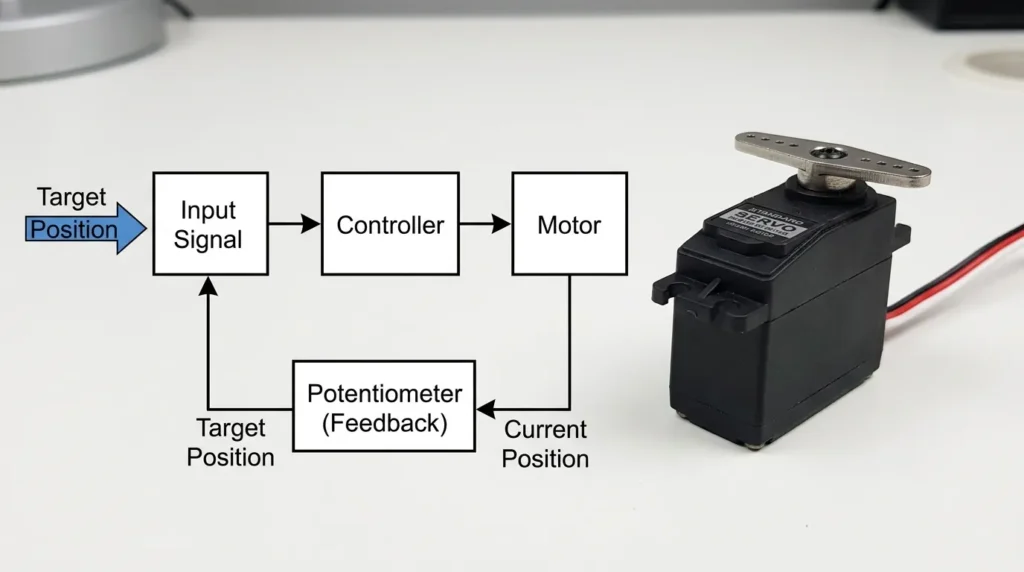
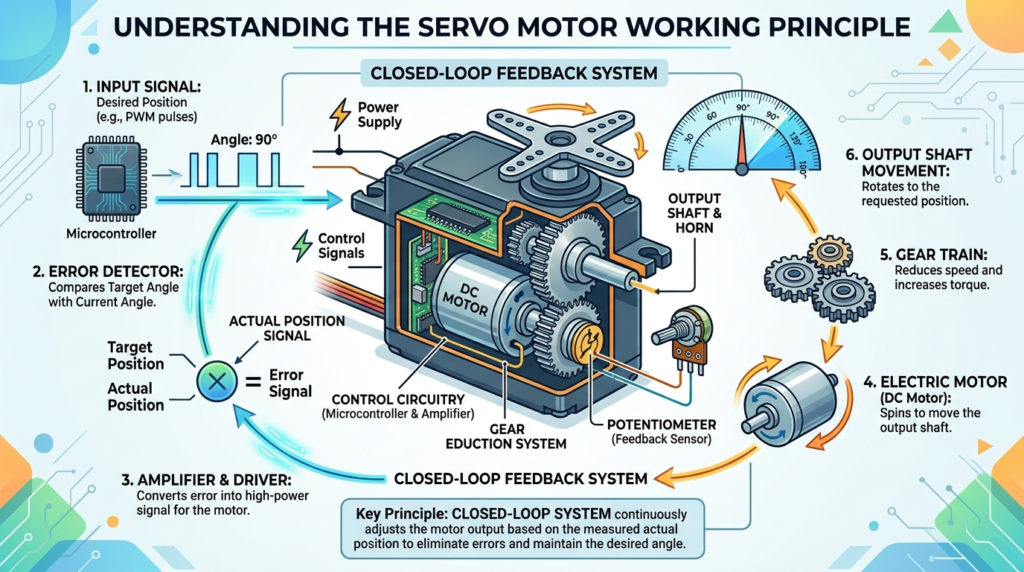
A servo motor works on the principle of closed-loop feedback control. It consists of a motor, a control circuit, a gearbox, and a feedback device such as an encoder or potentiometer. When a control signal is sent to the servo motor, the controller compares the desired position with the actual position provided by the feedback device. If there is any difference (error), the controller supplies power to the motor to rotate the shaft until the required position is reached. Once the desired position is achieved, the motor stops and continuously maintains that position. Servo motors provide precise control of position, speed, and torque, making them ideal for robotics, CNC machines, industrial automation, and other precision control applications.
The servo motor working principle is based on a closed-loop control system. This means the motor continuously receives feedback about its position and adjusts itself accordingly.
Step-by-Step Working Process
Input Signal is Given
A control signal is sent to the servo motor from a controller or microcontroller.
This signal tells the motor:
- Desired position
- Speed
- Direction of rotation
Controller Processes the Signal
The servo controller compares the desired position with the actual position of the motor.
If there is a difference, the controller creates an error signal.
Motor Starts Rotating
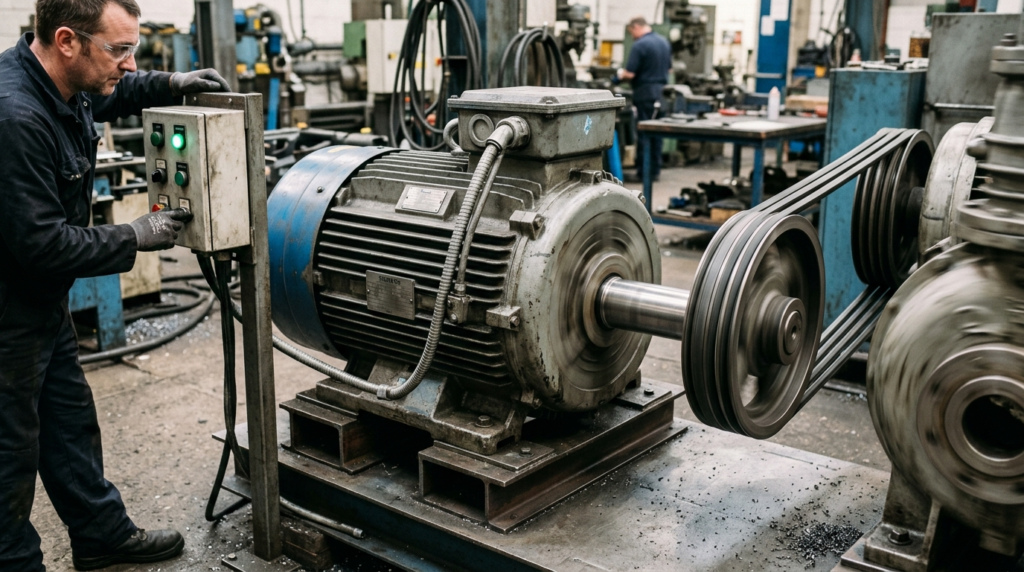
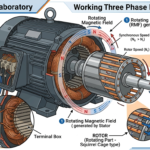
Motor starts rotating when electrical energy is converted into mechanical energy inside the motor. When power is supplied to the motor windings, a magnetic field is produced. This magnetic field interacts with the magnetic field of the rotor, creating an electromagnetic force that generates torque. As soon as the generated torque becomes greater than the load resistance and friction, the rotor begins to rotate. In simple words, the motor starts moving because magnetic forces inside the motor push and pull the rotating parts. The direction and speed of rotation depend on the motor type, power supply, and load conditions. This rotating motion is then used to drive machines, pumps, fans, conveyors, compressors, and many other industrial and household devices. Understanding how a motor starts rotating is essential for electrical students and technicians because it forms the basic operating principle of electric motors.
The motor rotates in the required direction to reduce the error.
It keeps moving until the correct position is achieved.
Feedback System Monitors Position
An encoder or potentiometer continuously measures the motor position.
This information is sent back to the controller.
Error Correction Happens Automatically
If the motor position changes due to load or disturbance, the system corrects itself immediately.
This makes servo motors highly accurate.
Easy Analogy
Imagine a driver parking a car carefully into a parking space.
The driver continuously checks:
- Car position
- Distance from obstacles
- Steering direction
If the car moves too far, the driver corrects it immediately.
A servo motor works in the same way using automatic feedback control.
Servo Motor Control Equation
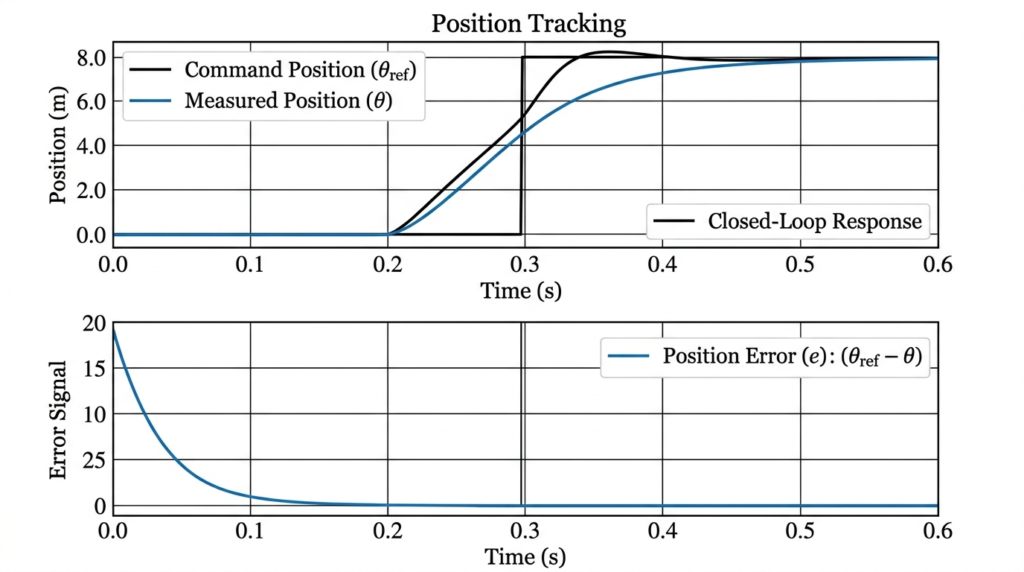
The Servo Motor Control Equation describes the mathematical relationship between the input control signal and the resulting position, speed, or torque of a servo motor. In a servo control system, the motor continuously compares the desired position (reference signal) with the actual position (feedback signal). The difference between these two values, known as the error signal, is used to control the motor’s movement. A basic servo motor control equation can be expressed as the motor output being proportional to the error signal, meaning the motor moves until the error becomes zero. In simple words, the servo motor automatically adjusts its position based on the command it receives and stops when the required position is reached. This precise control mechanism allows servo motors to achieve high accuracy and fast response in applications such as robotics, CNC machines, automated manufacturing systems, camera positioning systems, and industrial automation. Understanding the servo motor control equation helps electrical students and engineers analyze how servo systems maintain accurate and reliable motion control.
The relationship between position and control signal can be represented as:
e(t)=r(t)-c(t)
Where:
- ( e(t) ) = Error signal
- ( r(t) ) = Desired position
- ( c(t) ) = Actual position
The controller continuously minimizes this error.
Types / Classification (2026)
Servo motors are classified based on power supply and operating mechanism.
AC Servo Motor
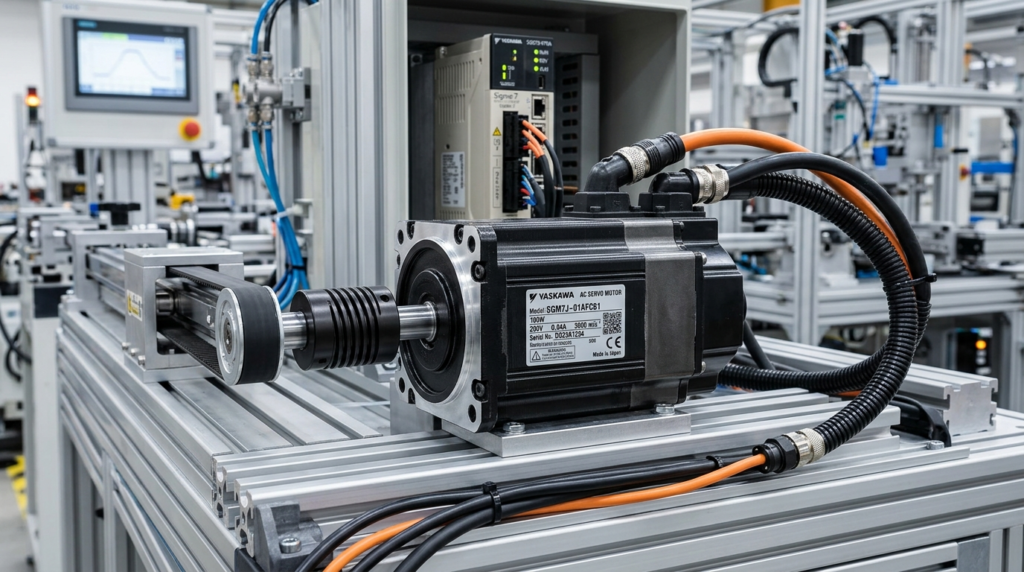
An AC servo motor is a special type of electric motor designed to provide precise control of position, speed, and torque using an alternating current (AC) power supply. It operates as part of a closed-loop control system, where feedback devices such as encoders or resolvers continuously monitor the motor’s position and send information to the controller. The controller compares the actual position with the desired position and adjusts the motor operation accordingly. In simple words, an AC servo motor can move to an exact position and maintain accurate speed control with high efficiency and reliability. These motors offer fast response, smooth operation, and excellent accuracy, making them ideal for applications such as robotics, CNC machines, conveyor systems, packaging equipment, automated manufacturing lines, and industrial automation systems. Understanding AC servo motors is important for electrical students and engineers because they are widely used in modern motion control applications that require precise and reliable performance.AC servo motors operate using alternating current.
Features
- High efficiency
- Suitable for industrial automation
- Smooth operation
- High-speed performance
Applications
- CNC machines
- Robotics
- Industrial conveyors
DC Servo Motor
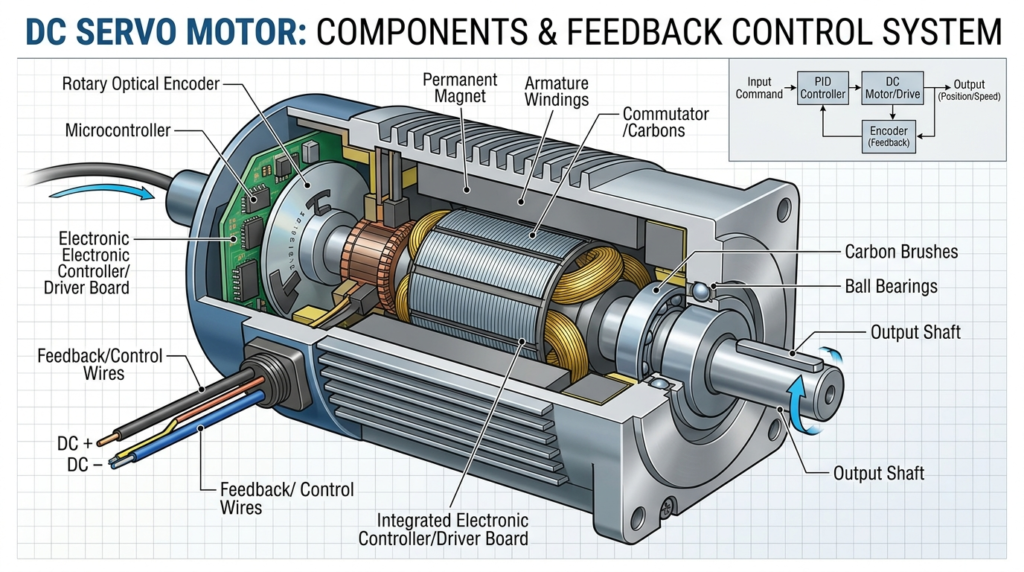
A DC servo motor is a precision-controlled electric motor that operates on direct current (DC) and is used for accurate control of position, speed, and torque. It works as part of a closed-loop control system, where a feedback device continuously monitors the motor’s movement and sends information to the controller. The controller compares the actual output with the desired command and adjusts the motor operation to minimize any error. In simple words, a DC servo motor moves to a specific position or speed and continuously corrects itself to maintain accurate performance. These motors are known for their fast response, high starting torque, and excellent speed control characteristics. DC servo motors are widely used in robotics, CNC machines, antenna positioning systems, automatic doors, printing machines, and industrial automation equipment. Understanding DC servo motors is important for electrical students and technicians because they play a vital role in applications that require precise and reliable motion control.
DC servo motors operate using direct current.
Features
- Simple control system
- Fast response
- High starting torque
Applications
- Small robots
- Portable equipment
- Electronic devices
Positional Rotation Servo Motor
This type rotates to a specific angle only.
Features
- Limited rotation range
- Accurate positioning
- Most common servo type
Applications
- RC cars
- Robotic joints
- Automatic gates
Continuous Rotation Servo Motor
This servo rotates continuously like a normal motor.
Features
- Speed-controlled operation
- Direction control possible
Applications
- Conveyor systems
- Mobile robots
Linear Servo Motor
Linear servo motors create straight-line motion instead of rotational motion.
Applications
- CNC cutting machines
- Precision industrial systems
Servo Motor Advantages, Limitations, and Applications (2026)
Servo motors offer several benefits in modern electrical, automation, and industrial systems.
High Positioning Precision
Servo motors can move and stop at precise positions, making them suitable for applications that require accurate motion control.
Fast Response Time
Servo motors respond quickly to control signals, allowing rapid and precise movement.
Excellent Speed Control
They provide smooth and accurate speed adjustment across different operating conditions.
High Energy Efficiency
Servo motor systems can operate efficiently by delivering power according to the required load and motion.
Compact Design
Servo motors can provide high performance and precise motion control within relatively compact dimensions.
Automatic Error Correction
Feedback systems continuously monitor motor operation and allow the controller to correct position or speed errors.
Practical Benefits of Servo Motors
- Improved industrial automation
- Higher manufacturing accuracy
- Faster robotic operations
- Reduced production errors
Servo Motor Disadvantages and Limitations (2026)
Although servo motors provide excellent performance, they also have several limitations.
Higher Initial Cost
Servo motor systems are generally more expensive than conventional motor systems because they require additional control and feedback components.
Complex System Design
The combination of a motor, controller, feedback device, and control software increases system complexity.
Maintenance Requirements
Encoders, controllers, wiring, and other components require proper inspection and maintenance.
Sensitivity to Electrical Noise
Electrical interference can affect feedback signals and may reduce system performance if proper shielding and grounding are not provided.
Requires Skilled Setup and Tuning
Correct installation, programming, parameter configuration, and tuning are necessary for reliable servo motor operation.
Servo Motor Applications Across Different Industries (2026)
Servo motor applications continue to expand across industrial automation, residential technology, automotive systems, medical equipment, and aerospace applications.
Industrial Servo Motor Applications
Computer Numerical Control (CNC) Machines
Servo motors provide precise tool positioning and controlled movement in CNC machinery.
Robotic Arms
They enable accurate positioning and coordinated movement in industrial robotic systems.
Packaging Machines
Servo motors provide fast and precise movement for filling, sealing, labeling, and packaging operations.
Conveyor Systems
They provide accurate control of conveyor speed, position, and direction.
Residential and Home Applications (2026)
Automatic Doors
Servo motors can control precise opening and closing movements in automated door systems.
Smart Home Devices
They are used in automated mechanisms that require controlled movement and positioning.
Camera Stabilizers
Servo-based systems can provide smooth and controlled camera movement for stabilization and positioning.
Automotive Servo Motor Applications (2026)
Electric Vehicles
Servo motor technology can be used in various vehicle control and actuation systems.
Cruise Control Systems
Motorized control mechanisms can help maintain accurate vehicle speed in automated control systems.
Medical Servo Motor Applications (2026)
Surgical Robotic Systems
Servo motors provide precise and controlled movements in robotic surgical equipment.
Medical Imaging Systems
They are used for accurate positioning and movement in imaging and scanning equipment.
Aerospace Servo Motor Applications (2026)
Aircraft Control Systems
Servo systems assist in controlling aircraft mechanisms and flight-control surfaces.
Unmanned Aerial Vehicles (UAVs) and Drones
Servo motors are commonly used for controlled movement of flight-control mechanisms and other adjustable components..
Difference Between Servo Motor and Stepper Motor (2026)
Understanding the difference between servo motor and stepper motor is important for selecting the correct system.
| Feature | Servo Motor | Stepper Motor |
| Control System | Closed-loop | Open-loop |
| Accuracy | Very high | Moderate |
| Speed | High | Lower |
| Torque at High Speed | Excellent | Reduced |
| Feedback System | Required | Usually not required |
| Cost | Higher | Lower |
| Efficiency | High | Moderate |
| Applications | Robotics, CNC | Printers, small automation |
Selection Guide (2026)
Choosing the correct servo motor depends on several electrical, mechanical, environmental, and performance requirements.
Determine the Load Requirements
Calculate the required:
- Torque
- Operating speed
- Positioning accuracy
Select the Appropriate Supply Voltage
Choose an Alternating Current (AC) servo motor or Direct Current (DC) servo motor according to the available power source and system requirements.
Consider the Operating Environment
Check the conditions in which the servo motor will operate, including:
- Dust exposure
- Moisture and humidity
- Ambient temperature
Evaluate Feedback Requirements
High-precision applications require advanced feedback devices, such as high-resolution encoders, to provide accurate position and speed information.
Consider the Total System Cost
Servo motor systems generally provide higher precision and performance but may have a higher initial cost than simpler motor systems.
Servo Motor Selection Tips for Beginners (2026)
Start with Small Servo Motors
Begin with small servo motors to understand basic control concepts before moving to complex industrial servo systems.
Understand Servo Feedback Systems
Feedback is a fundamental feature of servo motors because it allows the controller to monitor and correct motor position, speed, and movement.
Learn Servo Motor Programming
Modern servo systems often require software integration, programming, parameter configuration, and digital control.
Common Servo Motor Problems, Causes, and Solutions (2026)
Why Is the Servo Motor Vibrating?
Common Causes
- Incorrect motor tuning
- Loose electrical or mechanical connections
- Mechanical imbalance
Recommended Solutions
- Adjust the servo controller settings
- Tighten loose components and connections
- Check load alignment and mechanical balance
Why Is the Servo Motor Overheating?
Common Causes
- Excessive mechanical load
- Poor ventilation or cooling
- Incorrect supply voltage
Recommended Solutions
- Reduce the motor load
- Improve ventilation and cooling
- Check the electrical supply voltage
Why Is the Servo Motor Not Holding Position?
Common Causes
- Encoder failure
- Weak or unstable feedback signal
- Servo controller problem
Recommended Solutions
- Inspect or replace the faulty encoder
- Check encoder and feedback wiring
- Reset or reconfigure the servo controller
Why Is the Servo Motor Producing Excessive Noise?
Common Causes
- Worn gears
- Damaged bearings
- Incorrect motor tuning
Recommended Solutions
- Lubricate or replace worn gears as required
- Inspect and replace damaged bearings
- Adjust the servo motor control parameters
Future Trends (2026)
Servo motor technology is evolving rapidly with the growth of automation, robotics, artificial intelligence, and smart manufacturing.
Artificial Intelligence (AI)-Based Motion Control
Artificial Intelligence (AI) is improving motion accuracy, adaptive control, fault detection, and predictive maintenance in modern servo systems.
Smart Servo Motor Systems
Modern servo motor systems increasingly include:
- Self-monitoring capabilities
- Automatic diagnostics
- Remote monitoring and control
- Real-time performance tracking
Energy-Efficient Servo Motor Designs
New servo motor designs focus on reducing electrical power consumption while maintaining high performance, precision, and reliability.
Integration with Industry 4.0 Technologies
Servo systems are becoming an important part of Industry 4.0, smart factories, industrial automation, and Industrial Internet of Things (IIoT) systems.
Servo Motor Miniaturization
Smaller and more compact servo motors are being developed for applications such as portable devices, medical equipment, robotics, and precision machinery.
Growing Demand in Robotics
The continued development of advanced robotics and automated systems is expected to increase demand for high-precision servo motors in manufacturing and other industries.
Conclusion
Understanding the servo motor working principle is essential for anyone studying electrical engineering, electronics, robotics, or industrial automation. Servo motors provide accurate position control, fast response, and reliable operation, making them ideal for modern motion control systems.
Compared to ordinary motors, servo motors offer higher precision and better efficiency, although they require more complex control systems and higher investment costs. Their applications in robotics, CNC machines, electric vehicles, medical devices, and automation systems continue growing rapidly.
As industries move toward smart manufacturing and advanced automation, servo motors will become even more important. Learning their working principles, applications, advantages and disadvantages, and troubleshooting methods provides a strong technical foundation for future engineers and technicians.