
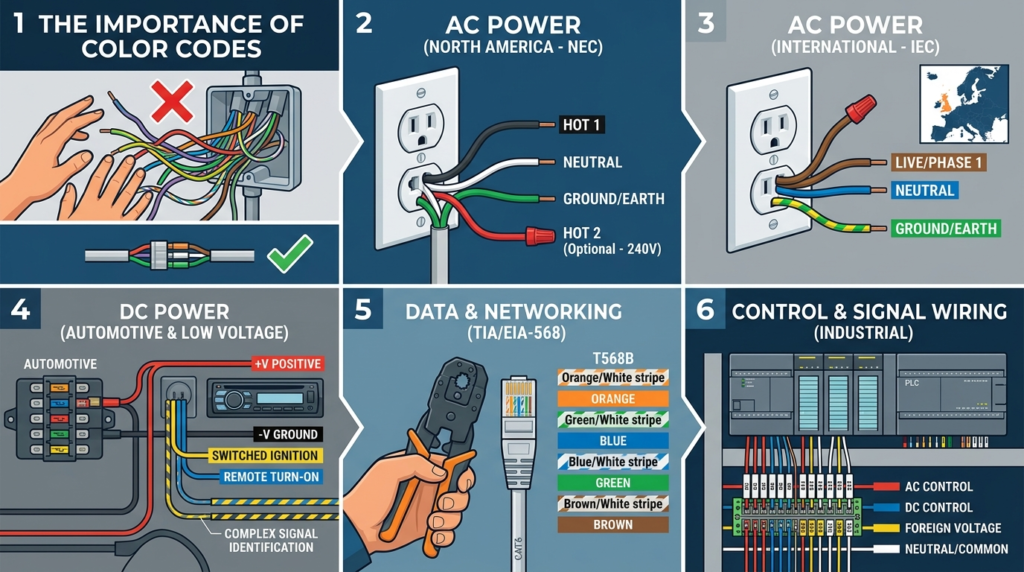

Imagine an electrician opening an electrical panel filled with dozens of wires. Some wires are red, some are black, blue, green, or yellow. Without proper color coding, identifying the correct wire would become dangerous and confusing. A single wiring mistake could damage equipment, cause electrical shock, or even start a fire.
This is why wiring color codes are extremely important in every electrical system. Whether in homes, factories, vehicles, or industrial machines, color-coded wires help electricians and engineers identify the purpose of each conductor quickly and safely.
Understanding wiring color codes explained is essential for electrical students, technicians, engineers, and beginners because correct wire identification improves safety, troubleshooting, maintenance, and installation quality. Different countries and standards may use different color codes, but the main goal is always the same — safe and organized electrical wiring.
In this article, you will learn wiring color codes meaning, working principles, classifications, components, advantages and disadvantages, applications, safety tips, troubleshooting methods, and future trends. By the end, you will clearly understand how wire color systems work and why they are critical in modern electrical engineering.
What are Wiring Color Codes?
Wiring color codes are standardized colors used to identify the function of electrical wires in a circuit. Each color represents a specific purpose such as live wire, neutral wire, or grounding wire.
These color standards help technicians and electricians work safely and reduce wiring mistakes.
Simple Explanation
Think of traffic lights on roads.
- Red means stop
- Green means go
- Yellow means caution
Similarly, electrical wire colors tell electricians what each wire does.
Practical Example
In many residential electrical systems:
- Black wire = Live or phase wire
- White wire = Neutral wire
- Green wire = Ground or earth wire
An electrician can quickly identify the circuit function just by checking wire colors.
Wiring Color Codes Working Principle
The wiring color codes working principle is based on standard identification and electrical safety.
Different wire colors are assigned to different electrical functions so technicians can recognize circuits easily.
Step-by-Step Working Process
Electrical Standards Define Colors
International and national electrical standards assign specific colors for:
- Phase wires
- Neutral wires
- Ground wires
Wires Are Manufactured in Standard Colors
Cable manufacturers produce wires with colored insulation.
This makes wire identification simple during installation.
Electricians Follow Color Standards
During wiring installation, electricians connect wires according to color coding rules.
This ensures safe operation.
Maintenance Becomes Easier
Technicians can identify faults and circuits quickly because wire functions are already marked by colors.
Easy Analogy
Imagine colored water pipes:
- Blue pipe for cold water
- Red pipe for hot water
You immediately understand the purpose of each pipe.
Electrical wire colors work in the same way.
Why Color Codes Matter
Without proper color coding:
- Electric shock risks increase
- Wiring mistakes become common
- Troubleshooting becomes difficult
- Equipment damage may occur
Types / Classification
Different electrical systems use different wiring color codes depending on voltage level, country, and application.
AC Wiring Color Codes
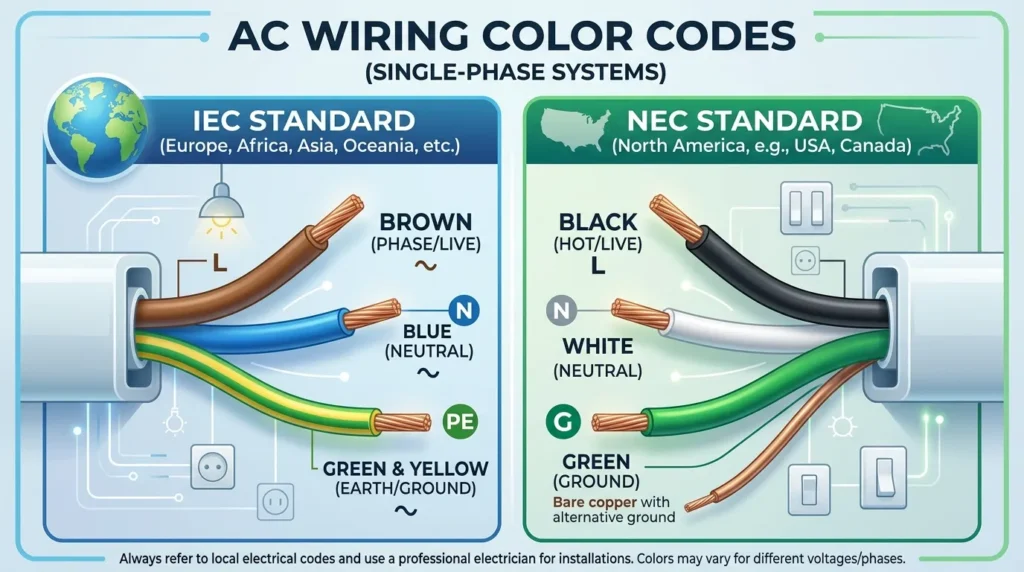
AC wiring colour codes are standardized colours used to identify different electrical conductors in alternating current (AC) systems. These colour codes help electricians, technicians, and engineers correctly identify the live (phase), neutral, and earth (ground) wires, reducing the risk of wiring errors, electric shock, and equipment damage. Although the exact colours may vary by country and electrical standard, the purpose remains the same—to ensure safe installation, maintenance, and troubleshooting of electrical systems. For example, under the IEC standard, brown is used for the live wire, blue for the neutral wire, and green/yellow for the earth wire. Following the correct AC wiring colour codes improves electrical safety, simplifies maintenance, and ensures compliance with national and international electrical regulations.
AC systems commonly use standardized color identification.
Single-Phase AC Wiring
In many systems:
| Wire Type | Common Color |
| Live/Phase | Brown or Black |
| Neutral | Blue or White |
| Earth/Ground | Green or Green-Yellow |
Applications
- Homes
- Offices
- Small commercial buildings
Three-Phase AC Wiring Colour Codes
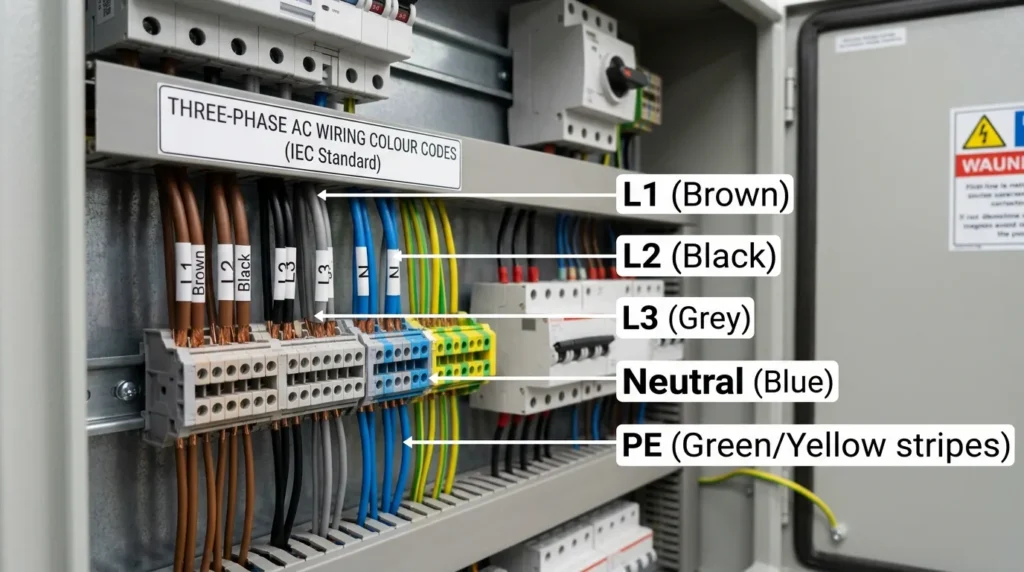
Three-phase AC wiring colour codes are standardized colours used to identify the three live (phase) conductors, the neutral conductor, and the protective earth (ground) conductor in a three-phase electrical system. These colour codes help electricians and engineers correctly connect, maintain, and troubleshoot electrical installations while reducing the risk of wiring mistakes, electric shock, and equipment damage. Under the IEC (International Electrotechnical Commission) standard, the three phase conductors are Brown (L1), Black (L2), and Grey (L3), the Neutral (N) conductor is Blue, and the Protective Earth (PE) conductor is Green/Yellow. Using the correct three-phase wiring colour codes ensures safe operation, proper phase identification, compliance with electrical standards, and reliable performance in residential, commercial, and industrial power systems.
Three-phase systems use separate colors for each phase.
Common Color Standards
| Phase | Color |
| Phase 1 | Brown |
| Phase 2 | Black |
| Phase 3 | Grey |
| Neutral | Blue |
| Earth | Green/Yellow |
Applications
- Industrial machinery
- Motors
- Power distribution systems
DC Wiring Colour Codes
DC wiring colour codes are standardized colours used to identify the positive, negative, and protective earth conductors in direct current (DC) electrical systems. These colour codes help electricians, technicians, and engineers make correct connections, simplify maintenance, and reduce the risk of reverse polarity, electric shock, and equipment damage. According to the IEC standard, the positive (+) conductor is typically Brown, the negative (−) conductor is Grey, and the protective earth (PE) conductor is Green/Yellow. In some industries and countries, different colour codes such as Red for positive and Black for negative may also be used. Following the correct DC wiring colour codes improves electrical safety, ensures reliable system performance, and helps comply with applicable electrical standards in solar power systems, battery banks, telecommunications, and other DC installations.
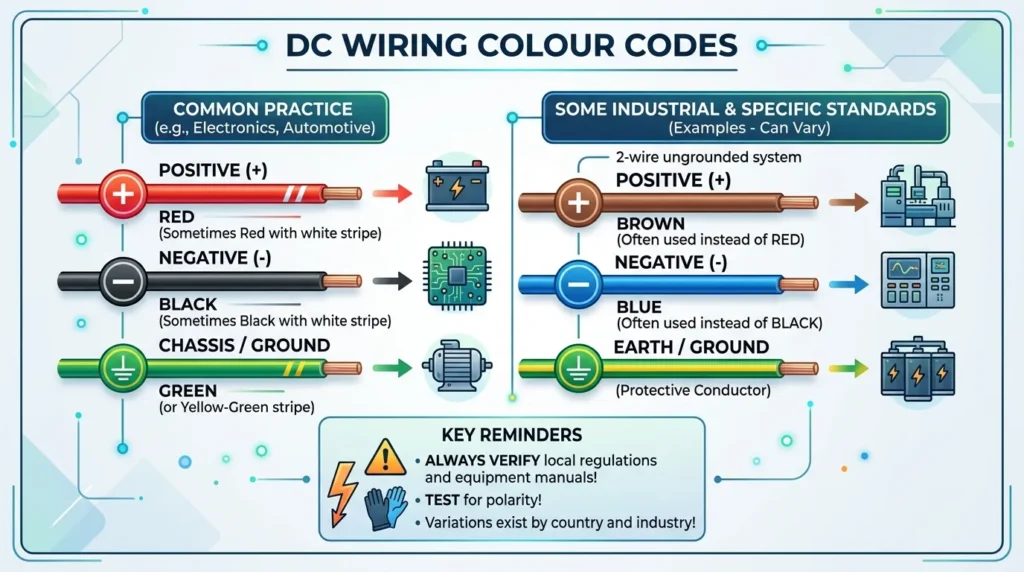
DC systems use different colours for positive and negative conductors.
Common DC Colors
| Wire Type | Color |
| Positive | Red |
| Negative | Black |
| Ground | Green |
Applications
- Batteries
- Solar systems
- Automotive wiring
Automotive Wiring Color Codes
Vehicles use specialized wiring standards.
Features
- Multiple signal wires
- Sensor identification
- Lighting control circuits
Applications
- Cars
- Trucks
- Motorcycles
International Wiring Standards
Different countries may follow different standards.
IEC Standard
Common in Europe and many Asian countries.
NEC Standard
Widely used in the United States.
Understanding international standards is important for engineers working globally.
Main Components
Several important components are involved in wiring color code systems.
Conductors
Conductors carry electrical current.
Copper and aluminum are commonly used.
Insulation
Colored insulation identifies wire function and protects users from electric shock.
Ground Wire
Provides safety by carrying fault current safely to earth.
Neutral Wire
Returns current back to the power source.
Phase or Live Wire
Carries voltage from the supply source to the load.
Cable Markings
Some cables also include printed labels and numbering for additional identification.
Advantages of Wiring Colour Codes
Wiring color codes provide many practical and safety benefits.
Improved Electrical Safety
Color identification reduces accidental contact with live wires.
Faster Installation
Electricians can identify wires quickly.
Easier Troubleshooting
Fault detection becomes faster during maintenance.
Reduced Wiring Errors
Correct wire connection prevents equipment damage.
Better Organization
Panels and circuits remain neat and understandable.
International Standardization
Standardized systems improve compatibility worldwide.
Real-World Benefits
- Safer homes
- Reliable industrial systems
- Faster repair work
- Reduced downtime
Disadvantages / Limitations
Although wiring color codes are highly useful, they also have some limitations.
Different Standards Between Countries
Color codes vary internationally.
This can create confusion for beginners.
Fading of Wire Colors
Old wires may lose color clarity over time.
Human Error
Incorrect installation may still happen if electricians ignore standards.
Modified Systems
Old buildings may contain mixed or outdated wiring standards.
Color Blindness Challenges
Some technicians may have difficulty distinguishing certain colors.
Wiring Color Codes Applications
Wiring color codes applications are found everywhere electrical systems exist.
Residential Applications
Home Wiring
Used in:
- Lighting circuits
- Switchboards
- Power outlets
Industrial Applications
Factory Machines
Color coding helps identify:
- Motor circuits
- Control panels
- Automation systems
Commercial Applications
Office Buildings
Used for organized electrical distribution systems.
Renewable Energy Applications
Solar Systems
DC color coding is important for battery and inverter connections.
Automotive Applications
Vehicle Wiring Harnesses
Different wire colors control:
- Headlights
- Sensors
- Ignition systems
Telecommunication Systems
Used for organized signal wiring and networking systems.
Difference Between AC and DC Wiring Colour Codes
Understanding the difference between AC and DC wiring color codes is important for safe installations.
| Feature | AC Wiring Colors | DC Wiring Colors |
| Main Purpose | Power distribution | Battery and electronics |
| Positive Wire | Phase colors | Red |
| Neutral Wire | Blue or White | Usually not used |
| Ground Wire | Green/Yellow | Green |
| Voltage Type | Alternating Current | Direct Current |
| Common Use | Homes and industries | Solar and vehicles |
Selection Guide
Choosing the correct wire color system is very important for safety and compliance.
Follow Local Electrical Standards
Always use the wiring standards approved in your country.
Check Voltage Type
Determine whether the system is:
- AC system
- DC system
Understand Application Requirements
Different systems require different color codes.
Examples:
- Industrial systems
- Solar systems
- Automotive wiring
Use Proper Labels
In complex systems, labels improve identification further.
Tips for Beginners
Never Assume Wire Function
Always test wires before handling them.
Learn Standard Color Meanings
Understanding basic colors improves safety.
Use Safety Equipment
Wear insulated gloves and use testing tools.
Study Wiring Diagrams
Diagrams help understand circuit structure clearly.
Common Problems & Solutions
Why Are Wire Colors Different in Old Buildings?
Reason
Older systems may follow outdated standards.
Solution
Use a multimeter to verify wire functions before working.
What Happens If Wires Are Connected Incorrectly?
Problems
- Electric shock
- Equipment failure
- Short circuits
Solution
Reconnect wires according to correct standards.
Why Is the Ground Wire Important?
The ground wire provides a safe path for fault current and protects people from electric shock.
Can Wire Colors Be Reused for Different Functions?
No. Using incorrect colors creates safety hazards and confusion.
What Should Be Done If Wire Colors Fade?
- Replace damaged wires
- Add labels
- Use proper identification sleeves
Future Trends
Electrical wiring technology is improving continuously with smart systems and modern safety standards.
Smart Cable Identification
Future cables may include digital identification systems.
Improved Safety Standards
Global electrical standards are becoming more unified.
Color and Label Combination Systems
Modern installations combine:
- Color coding
- QR labels
- Smart tracking systems
Growth of Renewable Energy Wiring
Solar and battery systems are increasing the demand for specialized DC wiring standards.
Smart Buildings
Automated buildings require better-organized wiring systems for sensors and communication networks.
Fire-Resistant Cable Technology
Advanced insulation materials improve safety and durability.
Conclusion
Understanding wiring color codes explained is essential for safe and professional electrical work. Wiring color systems help electricians, engineers, and technicians identify conductors quickly, reduce installation mistakes, and improve electrical safety.
Although wiring standards may vary between countries and applications, the purpose remains the same — creating safer and more organized electrical systems. From residential wiring to industrial automation and renewable energy systems, color-coded wiring plays a major role in modern electrical engineering.
Beginners should always learn local electrical standards, follow safety procedures, and verify wire functions before handling circuits. As technology continues evolving, wiring systems will become smarter, safer, and more efficient, making proper understanding of wiring color codes even more important for future electrical professionals.