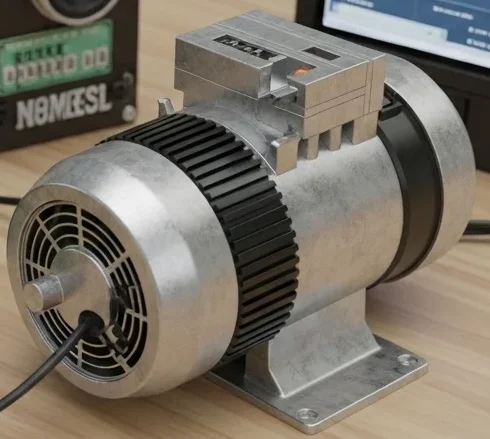

Imagine a large industrial factory where heavy machines must run at an exact constant speed throughout the day. Even a small speed variation can affect production quality, efficiency, and safety. In such situations, engineers often use a synchronous motor because it operates at a fixed speed regardless of load changes.
Synchronous motors are widely used in industries, power systems, manufacturing plants, and modern automation systems. These motors are known for their high efficiency, precise speed control, and ability to improve power factor in electrical systems. Understanding how a synchronous motor works is important for electrical students, technicians, engineers, and beginners who want to build a strong foundation in electrical machines.
In this article, you will learn the synchronous motor working principle, types, components, applications, advantages and disadvantages, comparison with induction motors, troubleshooting methods, and future trends. The explanations are simple, practical, and written like a senior electrical engineer guiding a junior learner.
What is a Synchronous Motor?
A synchronous motor is an AC motor that rotates at a constant speed equal to the speed of the rotating magnetic field produced by the stator.
In simple words, the motor shaft rotates in synchronization with the supply frequency. This means the motor speed remains fixed and does not change with load under normal operating conditions.
Simple Explanation
In a synchronous motor, the rotor locks with the rotating magnetic field created by the stator. Both rotate together at the same speed.
Unlike induction motors, there is no slip between the rotor speed and the magnetic field speed.
Practical Example
Large compressors, industrial pumps, conveyor systems, and power plants commonly use synchronous motors because these machines require constant speed operation.
Synchronous Motor Working Principle
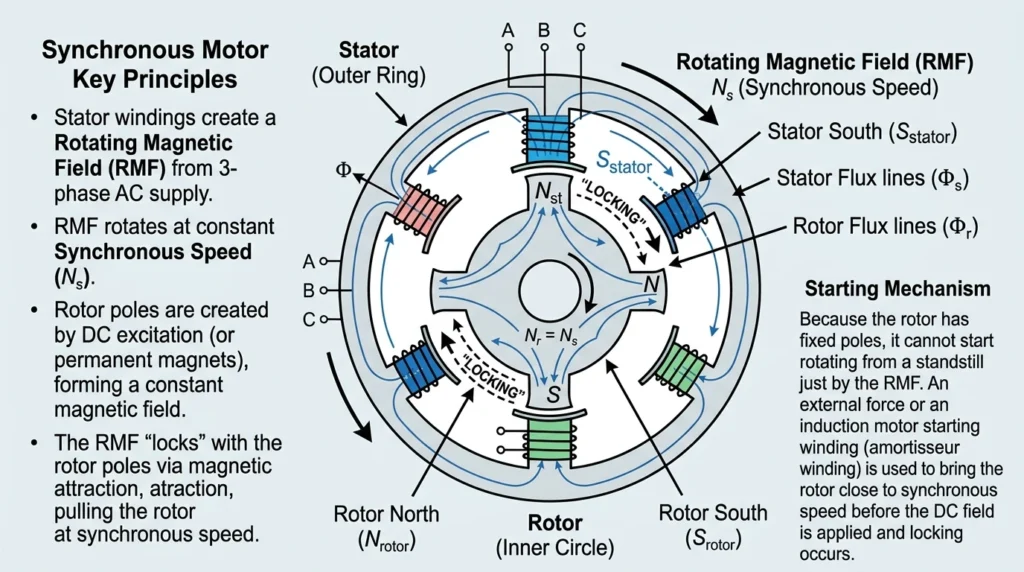
The synchronous motor working principle is based on the interaction between the rotating magnetic field produced by the stator and the magnetic field created by the rotor. When a three-phase AC supply is applied to the stator winding, it generates a rotating magnetic field that rotates at synchronous speed. The rotor, which is excited either by a DC supply or permanent magnets, produces its own magnetic field. As the motor starts and reaches near synchronous speed, the rotor magnetic field locks with the rotating stator field, causing the rotor to rotate at exactly the same speed as the stator field. Since both magnetic fields rotate together, there is no slip between them, which is why the motor is called a synchronous motor. This constant-speed operation makes synchronous motors highly efficient and suitable for applications requiring precise speed control. They are commonly used in industrial drives, power plants, compressors, pumps, and other systems where stable speed and power factor improvement are important.The synchronous motor working principle is based on the interaction between rotating magnetic fields.
Step-by-Step Working Principle
AC Supply to Stator
When three-phase AC supply is given to the stator winding, it creates a rotating magnetic field.
Rotor Excitation
The rotor receives DC supply through slip rings or an excitation system. This creates a strong magnetic field around the rotor.
Magnetic Locking
The rotor magnetic field tries to align with the rotating stator magnetic field.
Synchronized Rotation
The rotor starts rotating at exactly the same speed as the stator magnetic field.
Simple Analogy
Imagine two gears perfectly connected together. When one gear rotates, the other rotates at exactly the same speed. This is similar to how the rotor follows the stator magnetic field.
Synchronous Speed Formula
The synchronous speed depends on frequency and number of poles.
N_s = \frac{120f}{P}
Where:
- (N_s) = Synchronous speed
- (f) = Supply frequency
- (P) = Number of poles
Important Point
A synchronous motor is not self-starting. It requires an external starting method.
Types / Classification
Types of Synchronous Motors
Non-Excited Synchronous Motor
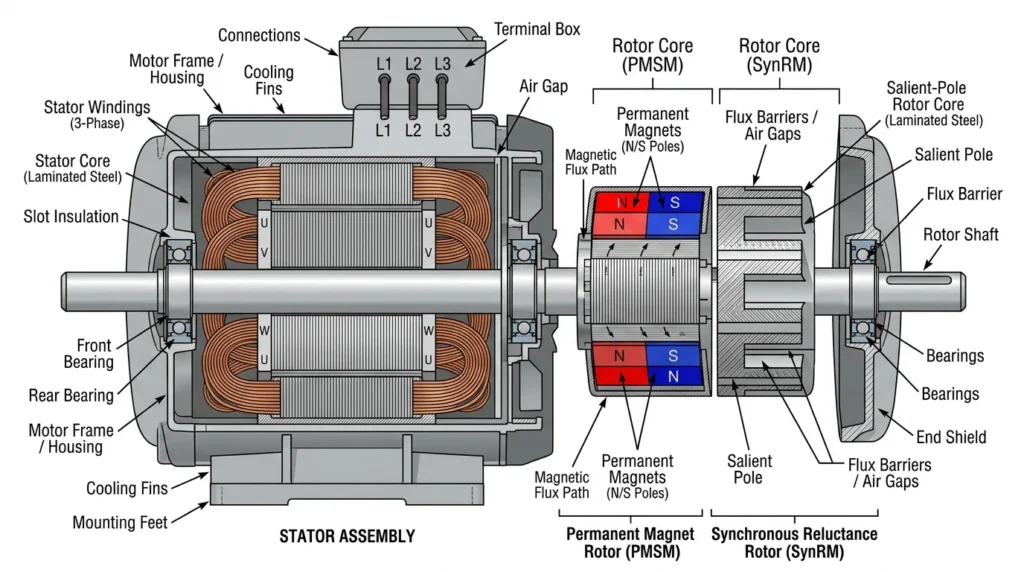
A non-excited synchronous motor is a type of synchronous motor that operates without an external DC excitation system. Instead of using a separately energized rotor winding, it produces the required magnetic field through permanent magnets or the reluctance effect of the rotor. In simple words, the rotor locks onto the rotating magnetic field created by the stator and rotates at exactly the same speed as the supply frequency, known as synchronous speed. Because there is no slip between the stator field and the rotor, the motor maintains a constant speed regardless of normal load variations. Non-excited synchronous motors are generally simpler in construction, require less maintenance, and offer high efficiency compared to motors that use external excitation. Common examples include permanent magnet synchronous motors (PMSMs) and synchronous reluctance motors. These motors are widely used in industrial automation, electric vehicles, robotics, pumps, compressors, and energy-efficient drive systems where precise speed control and reliable performance are important.
Features
- Simple design
- Lower maintenance
- Used in small applications
Examples
- Reluctance motors
- Hysteresis motors
DC Excited Synchronous Motor
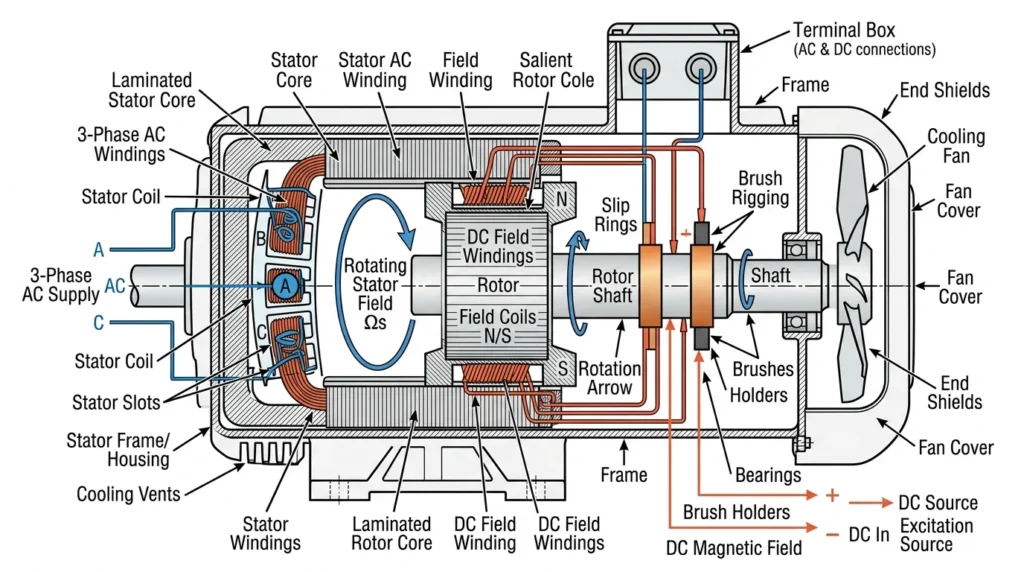
A DC excited synchronous motor is a type of synchronous motor in which the rotor magnetic field is produced by supplying direct current (DC) to the rotor winding through slip rings and brushes or a brushless excitation system. When a three-phase AC supply is applied to the stator, it creates a rotating magnetic field, while the DC supply energizes the rotor to produce a constant magnetic field. The rotor then locks with the rotating stator field and rotates at the same speed, known as synchronous speed. Since there is no slip between the rotor and stator magnetic fields, the motor maintains a constant speed even under varying load conditions. DC excited synchronous motors are known for their high efficiency, excellent power factor control, and precise speed regulation. They are widely used in power plants, industrial drives, compressors, pumps, rolling mills, and other heavy-duty applications where constant speed and improved power factor are required.This motor uses external DC supply for rotor excitation.
Features
- High efficiency
- Better power factor correction
- Used in industries
Applications
- Compressors
- Industrial drives
Permanent Magnet Synchronous Motor (PMSM)
Permanent magnets are mounted on the rotor instead of field windings.
Features
- Compact size
- High efficiency
- Low maintenance
Applications
- Electric vehicles
- Robotics
- CNC machines
Hysteresis Synchronous Motor
This motor works on hysteresis loss principles.
Features
- Smooth operation
- Silent running
- Constant speed
Applications
- Electric clocks
- Audio equipment
Reluctance Synchronous Motor
The rotor aligns itself with the minimum reluctance path.
Features
- Simple construction
- Economical
- Moderate efficiency
Applications
- Timing devices
- Small machinery
Main Components
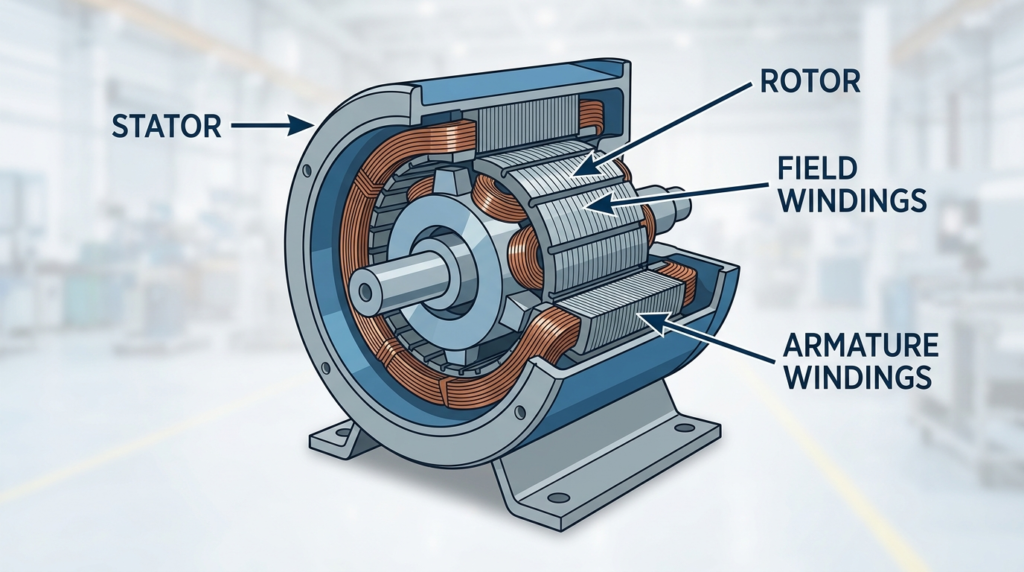
Stator
The stator is the stationary part of the motor.
Function
- Produces rotating magnetic field
- Contains three-phase winding
Rotor
The rotor is the rotating part connected to the shaft.
Function
- Produces rotor magnetic field
- Rotates synchronously with stator field
Slip Rings and Brushes
Used in DC excited synchronous motors.
Function
- Supply DC current to rotor winding
Exciter
The exciter provides DC power to the rotor.
Function
- Maintains rotor magnetic field
Shaft
The shaft transfers mechanical power to the load.
Function
- Connects motor to machine
Bearings
Bearings support smooth rotation.
Function
- Reduce friction
- Maintain alignment
Cooling System
Cooling fans or ventilation systems remove heat.
Function
- Prevent overheating
- Improve efficiency
Advantages of Synchronous Motor
Synchronous Motor Advantages
- Operates at constant speed
- High efficiency under heavy load
- Improves power factor
- Suitable for large industrial applications
- Better performance in stable-speed systems
- Can operate at leading power factor
- Lower energy losses
- Excellent for precision machinery
Real-World Benefits
Industries use synchronous motors to reduce electricity bills by improving power factor and maintaining stable operation.
Disadvantages / Limitations
Synchronous Motor Disadvantages
- Not self-starting
- More expensive than induction motors
- Requires DC excitation system
- Complex construction
- Maintenance is higher
- Synchronization process is difficult
- Not ideal for varying speed applications
Practical Limitation
If synchronization is lost, the motor may stop suddenly or operate improperly.
Synchronous Motor Applications
Synchronous motor applications are found in many industrial and modern electrical systems.
Industrial Applications
Compressors
Used where constant speed is necessary.
Pumps
Operate large industrial water systems.
Conveyors
Provide precise speed control.
Crushers and Mills
Used in mining and cement industries.
Power System Applications
Power Factor Correction
Synchronous motors improve power factor in electrical networks.
Reactive Power Compensation
Used to stabilize industrial power systems.
Modern Technology Applications
Electric Vehicles
Permanent magnet synchronous motors are common in EV systems.
Robotics
Used for accurate speed and motion control.
CNC Machines
Provide precise positioning and stable operation.
Commercial Applications
- Air compressors
- Refrigeration plants
- Textile industries
- Paper mills
Difference Between Synchronous Motor and Induction Motor
The difference between synchronous motor and induction motor is important for understanding motor selection.
| Feature | Synchronous Motor | Induction Motor |
| Speed | Constant | Varies with load |
| Starting | Not self-starting | Self-starting |
| Slip | Zero | Present |
| Efficiency | Higher | Moderate |
| Cost | Higher | Lower |
| Power Factor | Can improve power factor | Usually lagging |
| Construction | More complex | Simpler |
| Maintenance | Higher | Lower |
| Applications | Constant speed systems | General-purpose drives |
Selection Guide
Choosing the right motor depends on application requirements.
Choose Synchronous Motor When
- Constant speed is required
- High efficiency is important
- Power factor improvement is needed
- Heavy industrial load exists
- Precision control is necessary
Choose Induction Motor When
- Low cost is important
- Simple operation is needed
- Variable load conditions exist
- Minimal maintenance is preferred
Tips for Beginners
- Check load requirements before motor selection
- Understand starting methods carefully
- Consider maintenance costs
- Verify power factor requirements
- Select proper cooling systems for heavy-duty operation
Common Problems & Solutions
Why Does a Synchronous Motor Fail to Start?
Causes
- Improper starting system
- Low voltage supply
- Rotor excitation problem
Solution
- Check starter circuit
- Verify excitation supply
- Inspect electrical connections
Why Does the Motor Lose Synchronization?
Causes
- Sudden overload
- Supply voltage fluctuation
- Excitation failure
Solution
- Reduce load
- Stabilize voltage
- Inspect excitation system
Why Does the Motor Overheat?
Causes
- Poor ventilation
- Excessive load
- Bearing friction
Solution
- Clean cooling system
- Check load conditions
- Lubricate bearings
Excessive Vibration Problem
Causes
- Misalignment
- Damaged bearings
- Rotor imbalance
Solution
- Align shaft properly
- Replace faulty bearings
- Balance rotor assembly
Noise During Operation
Causes
- Loose mounting
- Electrical imbalance
- Mechanical wear
Solution
- Tighten mounting bolts
- Check phase balance
- Inspect moving parts
Future Trends
The future of synchronous motors is strongly connected with energy efficiency and smart automation.
Permanent Magnet Technology
Permanent magnet synchronous motors are becoming more popular because of their high efficiency and compact size.
Electric Vehicles
Modern EV manufacturers increasingly use synchronous motors for better torque and efficiency.
Smart Industrial Automation
Industries are integrating synchronous motors with:
- Smart sensors
- Variable frequency drives
- IoT monitoring systems
- Automated control systems
Renewable Energy Systems
Synchronous machines play an important role in wind turbines and renewable energy power generation.
High-Efficiency Motor Standards
Governments and industries are promoting energy-efficient motors to reduce electricity consumption and carbon emissions.
Conclusion
A synchronous motor is one of the most important electrical machines used in industries and modern technology. Its ability to run at constant speed, improve power factor, and provide high efficiency makes it ideal for heavy industrial applications and precision systems. Although synchronous motors are more complex and expensive than induction motors, their performance advantages make them valuable in power systems, automation, renewable energy, and electric vehicles.
Understanding the synchronous motor working principle, types, applications, and limitations helps students and engineers choose the right motor for specific tasks. As industries continue moving toward smart automation and energy-efficient systems, synchronous motors will remain a key technology in modern electrical engineering.



Pingback: Synchronous vs Induction Motor: 12 Key Differences