
Imagine watching television during a sudden voltage fluctuation at home. The screen flickers, lights dim, and electronic devices may suddenly shut down. In many areas, unstable voltage is a common problem that can damage expensive appliances such as refrigerators, air conditioners, computers, and medical equipment. This is where a voltage stabilizer becomes extremely important.
A stabilizer protects electrical and electronic devices from high voltage and low voltage conditions by maintaining a steady output voltage. It automatically adjusts the incoming voltage to keep connected equipment safe and operating properly. Understanding the stabilizer working principle is essential for electrical students, engineers, technicians, and beginners because stabilizers are widely used in homes, industries, hospitals, and commercial systems.
In this article, you will learn what a stabilizer is, the stabilizer working principle, different types of stabilizers, main components, advantages and disadvantages, applications, troubleshooting methods, and future trends. The explanations are simple, practical, and written like a senior electrical engineer teaching junior learners.
What is a Stabilizer?
A stabilizer is an electrical device that maintains a constant output voltage even when the input voltage changes.
In simple words, a stabilizer protects electrical equipment from voltage fluctuations by increasing or decreasing voltage automatically.
Simple Explanation
When voltage becomes too low or too high, the stabilizer corrects it and provides safe voltage to connected appliances.
Practical Example
If the supply voltage drops from 220V to 170V, the stabilizer increases the voltage to a safer level for appliances like refrigerators and televisions.
Stabilizer Working Principle
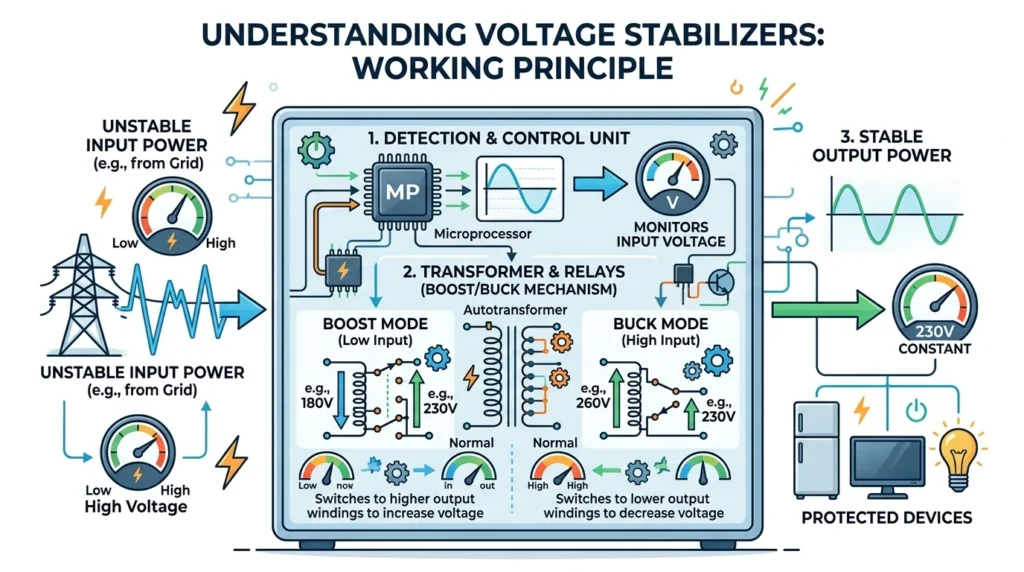
The working principle of a voltage stabilizer is based on automatically detecting fluctuations in the input voltage and maintaining a constant, safe output voltage for connected electrical equipment. When the input voltage rises above or falls below the desired level, the stabilizer senses the change through its control circuit. It then adjusts the voltage using components such as a buck-boost transformer, voltage regulator, relay, or servo motor, depending on the type of stabilizer. If the input voltage is too low, the stabilizer boosts it to the required level. If the input voltage is too high, it reduces the voltage before supplying it to the load. This automatic correction protects appliances and electrical equipment from damage caused by overvoltage and undervoltage, ensuring stable performance, improved efficiency, and a longer operating life.
The stabilizer working principle is based on voltage sensing and automatic voltage correction.
The stabilizer continuously monitors incoming voltage and adjusts it to maintain a stable output.
Step-by-Step Stabilizer Working Principle
Input Voltage Detection
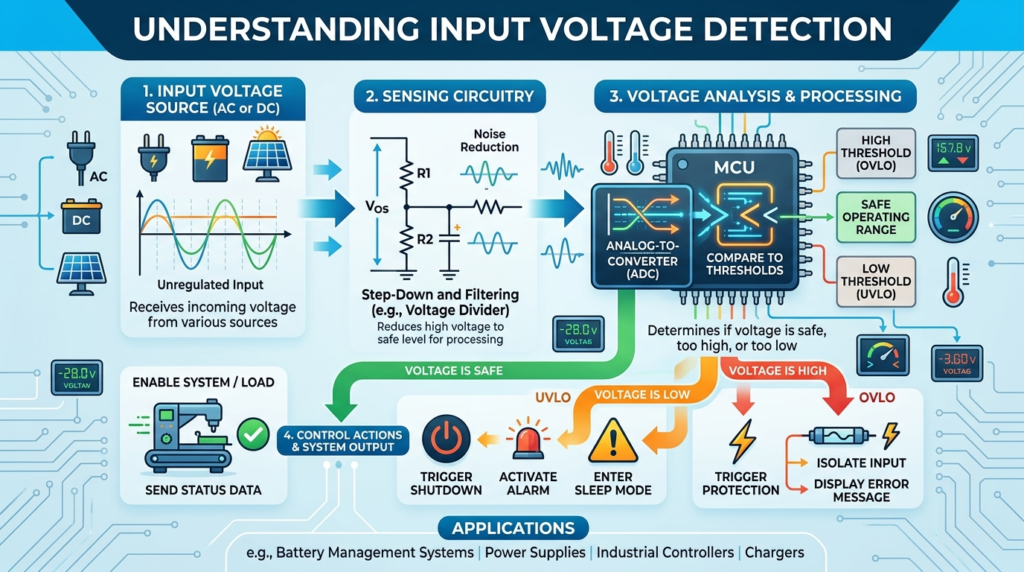
Input voltage detection is the process of monitoring and measuring the voltage supplied to an electrical or electronic system before it is processed or distributed to various components. It is an important function in power supplies, control circuits, protection systems, and automation equipment because it ensures that the incoming voltage is within the required operating range. When the input voltage is detected, sensors or monitoring circuits analyze its value and provide feedback to the control system. If the voltage is too high, too low, or completely absent, protective actions can be taken to prevent equipment damage or system failure. In simple words, input voltage detection acts like a safety checkpoint that verifies the quality and availability of electrical power before the system begins operating. This feature is widely used in UPS systems, voltage stabilizers, motor controllers, industrial automation equipment, and electronic devices to improve reliability, efficiency, and protection against abnormal power conditions.The stabilizer detects incoming voltage from the power supply.
Voltage Comparison
The internal control circuit compares input voltage with the required output voltage.
Voltage Correction
If voltage is too low or too high, the stabilizer activates correction circuits.
Transformer Adjustment
The transformer increases or decreases voltage using different winding taps.
Stable Output Supply
The corrected voltage is supplied safely to the connected equipment.
Simple Analogy
Think of a water pressure regulator that maintains constant water flow even when supply pressure changes. A stabilizer works similarly for electrical voltage.
Voltage Regulation Formula
The stabilizer maintains output voltage close to rated value.
V_o \approx V_r
Where:
- (V_o) = Output voltage
- (V_r) = Rated voltage
Types / Classification
Types of Stabilizers
Relay Type Stabilizer
A relay type stabilizer is a voltage regulation device that maintains a stable output voltage by automatically switching different transformer taps using electromagnetic relays. It continuously monitors the incoming supply voltage and compares it with the desired output level. When the input voltage becomes too high or too low, the control circuit activates the appropriate relay, which changes the transformer winding connection to correct the output voltage. In simple words, a relay type stabilizer adjusts the voltage in steps to keep electrical appliances operating safely and efficiently. These stabilizers are widely used for televisions, refrigerators, air conditioners, computers, and other household or commercial equipment that require protection from voltage fluctuations. Relay type stabilizers are popular because they are affordable, reliable, easy to maintain, and provide good voltage correction for everyday applications. Understanding relay type stabilizers is important for electrical students and technicians because they are among the most commonly used voltage stabilization devices in electrical systems.
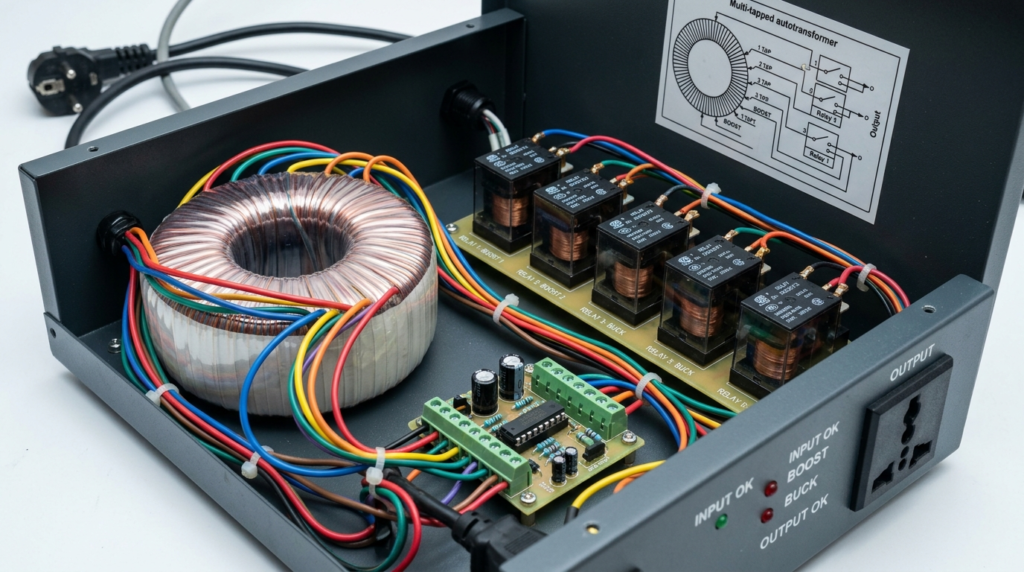
This stabilizer uses relays to switch transformer taps.
Features
- Simple design
- Affordable cost
- Common household use
Applications
- TVs
- Refrigerators
- Small appliances
Servo Voltage Stabilizer
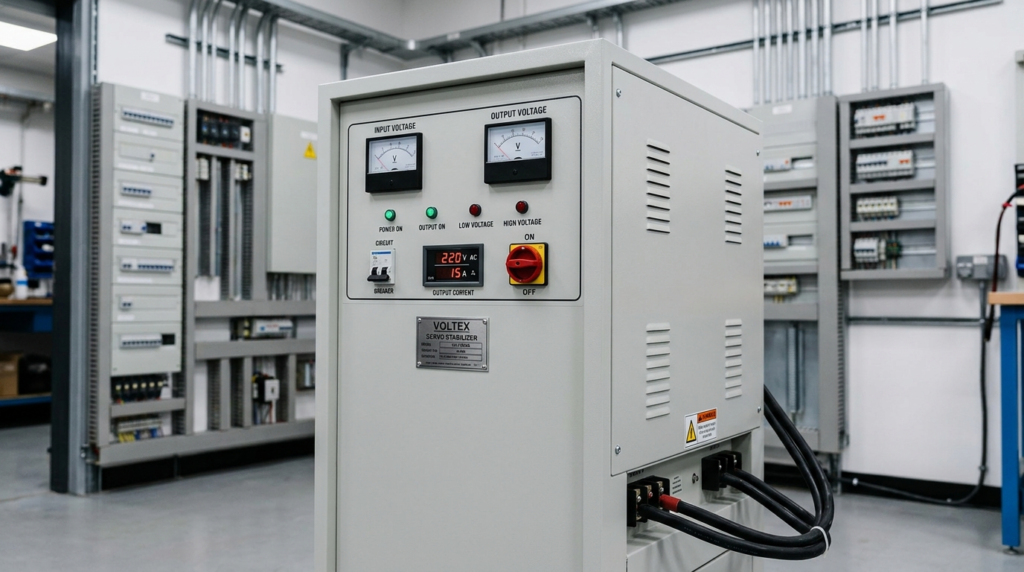
A servo voltage stabilizer is an advanced voltage regulation device that maintains a constant output voltage by automatically correcting fluctuations in the input supply voltage. It uses a servo motor, control circuit, and variable transformer to continuously monitor and adjust the voltage with high accuracy. When the input voltage rises or falls, the control circuit detects the change and drives the servo motor to reposition the transformer contact, thereby increasing or decreasing the output voltage as required. In simple words, a servo voltage stabilizer provides smooth and precise voltage correction to protect electrical equipment from overvoltage and undervoltage conditions. These stabilizers are widely used in industries, hospitals, laboratories, data centers, CNC machines, printing equipment, and other sensitive electrical systems where stable voltage is essential for reliable operation. Understanding servo voltage stabilizers is important for electrical students and technicians because they offer superior voltage regulation, improved equipment protection, and higher efficiency compared to conventional stabilizers.Servo stabilizers use a servo motor for precise voltage control.
Features
- High accuracy
- Smooth voltage correction
- Better efficiency
Applications
- Industrial machines
- Medical equipment
- CNC systems
Static Stabilizer
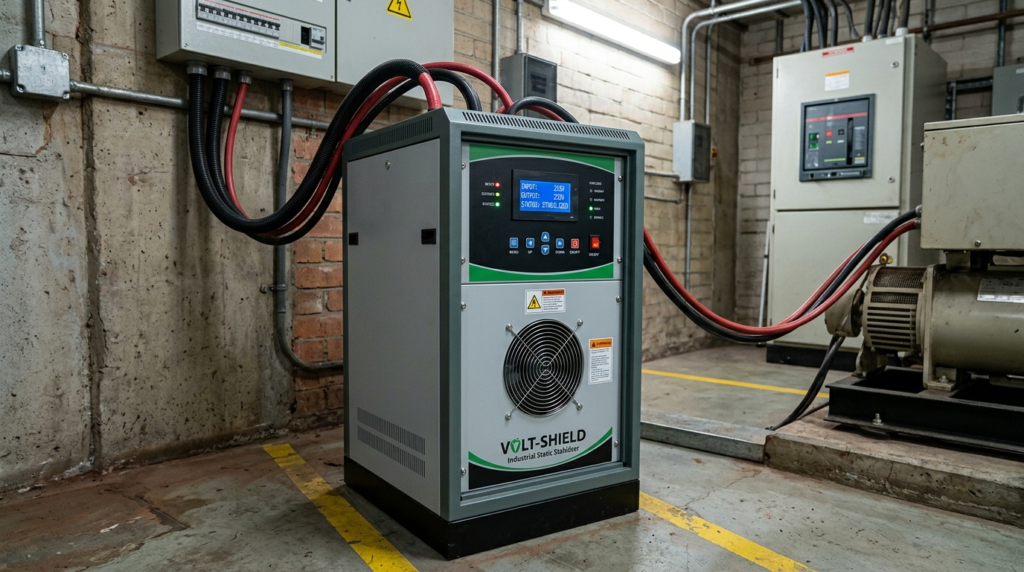
A static stabilizer is an electronic voltage stabilization device that maintains a constant output voltage without using moving parts such as relays or servo motors. It operates using power electronic components, control circuits, and transformers to continuously monitor and correct voltage fluctuations in real time. When the input voltage rises or falls, the control system instantly detects the change and adjusts the output voltage electronically, providing fast and precise regulation. In simple words, a static stabilizer keeps the voltage stable by using electronic switching instead of mechanical movement. Because of its high speed, accuracy, and reliability, it is widely used in hospitals, data centers, telecommunication systems, industrial automation equipment, laboratories, and other applications that require uninterrupted and stable power. Static stabilizers also require less maintenance and have a longer operational life due to the absence of mechanical wear. Understanding static stabilizers is important for electrical students and engineers because they represent a modern and efficient solution for voltage regulation in advanced electrical systems.
Static stabilizers use electronic circuits instead of moving parts.
Features
- Fast response
- Low maintenance
- High reliability
Applications
- Data centers
- Communication systems
- Sensitive electronics
Manual Stabilizer
Manual stabilizers require user adjustment.
Features
- Simple operation
- Lower cost
Applications
- Small workshops
- Basic electrical systems
Automatic Stabilizer
Automatic stabilizers adjust voltage without human operation.
Features
- Fully automatic
- Better protection
- Commonly used today
Applications
- Homes
- Offices
- Industrial systems
Main Components
Transformer
The transformer is the main voltage correction component.
Function
- Increases or decreases voltage
Relay
Relays switch transformer taps automatically.
Function
- Control voltage correction process
Servo Motor
Used in servo stabilizers.
Function
- Adjust transformer output precisely
Control Circuit
The control circuit monitors voltage conditions.
Function
- Detect voltage fluctuations
- Activate correction system
Voltage Sensor
Measures incoming voltage continuously.
Function
- Provide voltage data to control circuit
Circuit Breaker
Protects stabilizer from overload and short circuits.
Function
- Disconnect faulty supply conditions
Cooling System
Cooling fans or vents remove heat.
Function
- Prevent overheating
Advantages of Stabilizer
Stabilizer Advantages
- Protects appliances from voltage fluctuations
- Extends equipment lifespan
- Prevents overheating and damage
- Improves system reliability
- Automatic voltage correction
- Reduces maintenance costs
- Suitable for homes and industries
- Improves electrical safety
Real-World Benefits
A stabilizer prevents expensive equipment failure caused by unstable power supply conditions.
Disadvantages / Limitations
Stabilizer Disadvantages
- Additional installation cost
- Requires maintenance
- Large stabilizers occupy more space
- Some models respond slowly
- Heat generation occurs
- Not effective during complete power failure
Practical Limitation
Low-quality stabilizers may fail to protect sensitive electronic equipment accurately.
Stabilizer Applications
Stabilizer applications are common in homes, industries, and modern technology systems.
Home Applications
Refrigerators
Protect compressors from voltage fluctuations.
Air Conditioners
Maintain proper voltage for motors.
Televisions
Prevent screen damage.
Computers
Protect sensitive electronic circuits.
Industrial Applications
CNC Machines
Require stable voltage for precision operation.
Manufacturing Equipment
Protect motors and control systems.
Welding Machines
Improve stable machine performance.
Commercial Applications
Hospitals
Protect medical equipment.
Offices
Maintain stable power for computers and servers.
Shopping Malls
Protect lighting and HVAC systems.
Modern Technology Applications
Data Centers
Prevent server damage.
Telecommunication Systems
Maintain uninterrupted communication systems.
Renewable Energy Systems
Used with solar and inverter systems.
Difference Between Stabilizer and UPS
The difference between stabilizer and UPS is important for equipment protection.
| Feature | Stabilizer | UPS |
| Main Function | Voltage correction | Backup power supply |
| Battery | Usually not included | Included |
| Power During Failure | No output | Continues supply |
| Cost | Lower | Higher |
| Applications | Voltage protection | Backup systems |
| Response Time | Moderate | Very fast |
Selection Guide
Choosing the right stabilizer depends on equipment type and power requirements.
Choose Relay Stabilizer When
- Budget is limited
- Household appliances are used
- Moderate voltage correction is needed
Choose Servo Stabilizer When
- High accuracy is required
- Industrial equipment is used
- Heavy loads exist
Choose Static Stabilizer When
- Fast response is important
- Sensitive electronics are used
- Low maintenance is preferred
Tips for Beginners
- Check appliance power rating carefully
- Select proper voltage range
- Consider overload protection
- Use branded stabilizers for safety
- Ensure proper ventilation during installation
Common Problems & Solutions
Why is the Stabilizer Not Turning ON?
Causes
- No power supply
- Fuse failure
- Loose wiring
Solution
- Check input power
- Replace fuse
- Tighten electrical connections
Why is the Stabilizer Overheating?
Causes
- Overload condition
- Poor ventilation
- Continuous operation
Solution
- Reduce connected load
- Improve airflow
- Allow cooling time
Why is Output Voltage Unstable?
Causes
- Faulty relay
- Damaged transformer
- Sensor problem
Solution
- Replace relay
- Inspect transformer winding
- Test control circuit
Why is the Stabilizer Producing Noise?
Causes
- Loose components
- Relay switching sound
- Cooling fan issues
Solution
- Tighten internal parts
- Check relays
- Replace faulty fan
Why Does the Stabilizer Trip Frequently?
Causes
- Short circuit
- Overload
- Faulty appliance
Solution
- Disconnect damaged equipment
- Check load capacity
- Inspect wiring system
Future Trends
The future of stabilizer technology is becoming smarter and more energy efficient.
Smart Stabilizers
Modern stabilizers now include:
- Digital displays
- Smart monitoring systems
- Mobile app connectivity
- Automatic diagnostics
IoT-Based Voltage Monitoring
Advanced systems can monitor voltage remotely using internet-connected devices.
Energy-Efficient Stabilizers
Manufacturers are developing stabilizers with:
- Lower power loss
- Improved efficiency
- Better cooling systems
Renewable Energy Integration
Modern stabilizers are increasingly used with:
- Solar systems
- Inverters
- Battery storage systems
Industrial Automation
Smart factories now use advanced stabilizers for:
- CNC systems
- Robotics
- Automated production lines
Conclusion
Understanding the stabilizer working principle is essential for students, technicians, and engineers dealing with electrical systems. A stabilizer protects equipment from dangerous voltage fluctuations by automatically correcting high and low voltage conditions. It plays an important role in improving appliance safety, reliability, and lifespan.
Different stabilizer types such as relay, servo, and static stabilizers are designed for various applications ranging from household appliances to industrial machinery. Although stabilizers have some limitations such as installation cost and maintenance requirements, their advantages make them highly valuable in modern electrical systems.
By learning the stabilizer working principle, applications, advantages and disadvantages, and troubleshooting methods, beginners can better understand how voltage protection systems maintain safe and efficient electrical operation.