
Imagine you connect a small LED directly to a 12V battery without adding any resistor. Within seconds, the LED burns out. Why did this happen? Because too much current flowed through it. There was nothing to limit or control that current.
This simple example shows the importance of understanding What is Resistance? Resistance plays a critical role in controlling current in electrical circuits. Without proper resistance, electrical devices can overheat, fail, or even cause fire hazards.
For electrical students, engineers, and technicians, resistance is one of the most important basic concepts. It directly affects voltage, current, power loss, and circuit safety. Whether you are designing a small electronic circuit or installing industrial wiring, resistance must always be considered.
In this complete guide, you will learn:
- What is Resistance in simple language
- Resistance working principle
- Types of resistance
- Main components related to resistance
- Resistance applications
- Resistance advantages and disadvantages
- Difference between resistance and reactance
- Practical troubleshooting and selection tips
Let’s build your understanding step by step like a senior engineer guiding you in the field.
What Is Electrical Resistance (2026)
Electrical resistance is one of the fundamental concepts of electrical and electronic engineering. Every electrical circuit contains some amount of resistance because no conducting material allows electric current to flow without opposition. Understanding resistance is essential for designing safe circuits, selecting electrical components, troubleshooting faults, and improving energy efficiency. As electrical technology continues to evolve 2026, the study of resistance remains a core topic in modern electrical systems, renewable energy, automation, and smart electronics.
Definition of Electrical Resistance
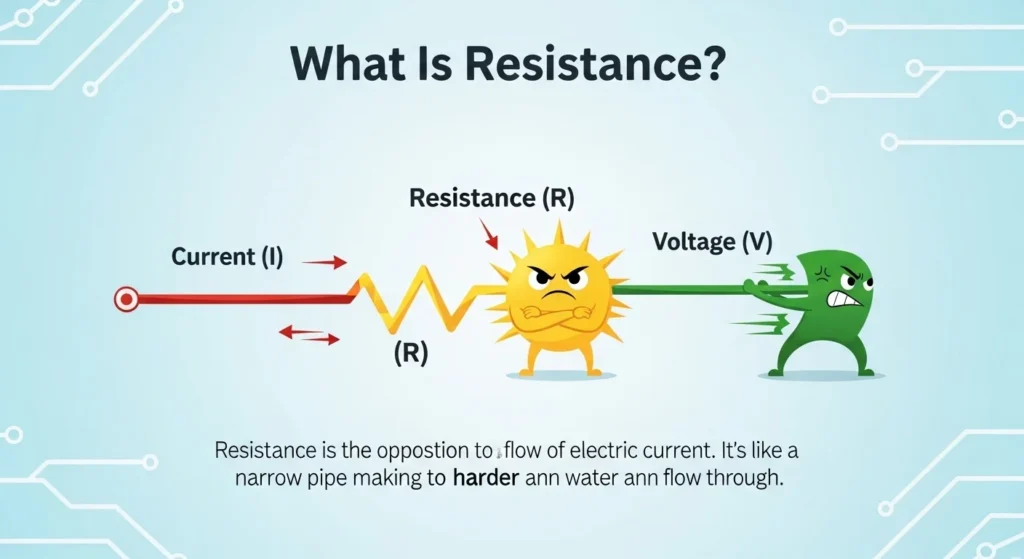
Electrical resistance is the opposition offered by a material or conductor to the flow of electric current. It limits the movement of electrons through a circuit and helps regulate the amount of current flowing from the power source to the electrical load.
The SI unit of electrical resistance is the ohm (Ω), named after the German physicist Georg Simon Ohm, who established the relationship between voltage, current, and resistance through Ohm’s Law.
The amount of resistance in a conductor depends on several factors, including the type of material, the length of the conductor, its cross-sectional area, and its operating temperature.
Simple Explanation
To understand resistance more easily, imagine electricity flowing through a wire. Inside the conductor, electrons move from one point to another under the influence of voltage. However, they cannot move completely freely because they continuously collide with atoms and impurities inside the material.
These collisions slow the movement of electrons and create opposition to the flow of electric current. This opposition is called electrical resistance.
In simple words:
Resistance controls how much electric current can flow through a circuit.
A conductor with low resistance allows more current to pass, while a conductor with high resistance restricts current flow. This property is essential for controlling electrical energy safely and efficiently.
Practical Example
A common example of electrical resistance is found in an electric heater.
When electrical current passes through the heating element, the element offers resistance to the flow of electrons. Because of this resistance, part of the electrical energy is converted into heat energy. This heating effect is intentionally used in appliances such as:
- Electric heaters
- Electric irons
- Water heaters
- Toasters
- Electric kettles
- Hair dryers
In these devices, resistance performs a useful function by generating controlled heat for everyday applications.
Another example is an LED circuit, where a resistor limits the current flowing to the LED. Without the resistor, excessive current could damage or permanently destroy the LED.
Why Resistance Is Important
Electrical resistance is necessary for the safe and reliable operation of electrical systems. It helps engineers control current, protect electronic components, regulate voltage levels, and improve overall circuit stability.
Without resistance:
- Electric current would flow uncontrollably.
- Electrical components could overheat and fail.
- Short circuits would become more dangerous.
- Wires could be damaged by excessive current.
- The risk of electrical fires and equipment failure would increase significantly.
Proper resistance management ensures that electrical devices operate safely, efficiently, and within their designed electrical limits.
Key Facts About Electrical Resistance
Materials such as copper have low resistance, while insulating materials such as rubber and plastic have extremely high resistance.
Resistance opposes the flow of electric current.
It is measured in ohms (Ω).
Resistance controls and limits current within a circuit.
Electron collisions inside a conductor produce resistance.
Electrical resistance converts some electrical energy into heat.
The resistance of a conductor depends on its material, length, cross-sectional area, and temperature.
Electrical Resistance Working Principle (2026)
Understanding the working principle of electrical resistance is essential for anyone studying electrical or electronic engineering. Resistance determines how easily electric current can flow through a conductor and directly affects the performance, efficiency, and safety of electrical systems. Every conductor offers some opposition to the movement of electrons, and this opposition is known as electrical resistance. As electrical technologies continue to advance between 2026, understanding how resistance works remains fundamental for designing modern electrical equipment, renewable energy systems, smart electronics, and electric vehicles.
Understanding Resistance with a Simple Example
A useful way to understand electrical resistance is by comparing it to water flowing through a pipe.
- Wide Pipe → Water flows easily → Low Resistance
- Narrow Pipe → Water flows slowly → High Resistance
In the same way, electricity behaves inside a conductor. If the conductor offers very little opposition, electrons move freely and a larger current flows. However, if the conductor offers greater opposition, the movement of electrons becomes more difficult, reducing the amount of current flowing through the circuit.
Although water and electricity are different, this comparison helps explain why resistance affects the flow of electric current.
Step-by-Step Working Principle
Voltage Creates Electron Movement
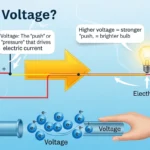
An electrical circuit begins with a voltage source, such as a battery or power supply. The voltage provides the electrical force that pushes electrons through the conductor, creating an electric current.
Electrons Travel Through the Conductor
As electrons move through the conducting material, they encounter atoms that make up the conductor. Even in highly conductive materials, the path is not completely free of obstacles.
Electron Collisions Produce Resistance
During their movement, electrons collide with atoms, impurities, and imperfections within the material. These collisions oppose the motion of electrons and create electrical resistance. The greater the number of collisions, the higher the resistance.
Current Flow Is Reduced
Because resistance opposes electron movement, the amount of current flowing through the circuit decreases. According to Ohm’s Law, increasing resistance results in lower current when the voltage remains constant.
Electrical Energy Converts into Heat
The energy lost during electron collisions is converted into heat. This phenomenon is known as the heating effect of electric current or Joule heating. In some applications, such as electric heaters and irons, this heat is useful. In other systems, excessive heat is undesirable and must be controlled through proper circuit design and cooling.
Factors That Affect Electrical Resistance
The amount of resistance in a conductor depends on several important factors:
- Material Type: Conductive materials such as copper and silver have low resistance, while materials such as rubber and plastic have extremely high resistance.
- Length of the Conductor: Longer conductors have greater resistance because electrons travel a longer distance and experience more collisions.
- Cross-Sectional Area: Thicker conductors have lower resistance because they provide more space for electrons to flow.
- Temperature: In most metallic conductors, resistance increases as temperature rises because atoms vibrate more, causing additional electron collisions.
Understanding these factors helps engineers select the most suitable materials and conductor sizes for electrical installations.
Important Points to Remember
- Higher resistance results in lower current flow.
- Lower resistance allows higher current flow.
- Resistance depends on the conductor’s material, length, cross-sectional area, and operating temperature.
- Electrical resistance converts part of the electrical energy into heat.
- Proper resistance control improves efficiency, safety, and equipment performance.
- Accurate resistance calculations are essential for reliable circuit design.
Why Copper Is Commonly Used for Electrical Wiring
Copper is the preferred material for electrical wiring because it has very low electrical resistance and excellent electrical conductivity. This allows electric current to flow efficiently with minimal energy loss. Copper is also strong, corrosion-resistant, and highly durable, making it suitable for residential, commercial, industrial, and renewable energy installations. Its combination of efficiency, reliability, and long service life has made it the standard conductor material in modern electrical systems.
Types / Classification(2026)
Resistance can be classified in different ways.
🔹 Fixed Resistance
The resistance value remains constant.
Examples:
- Carbon resistors
- Metal film resistors
Used in:
- Electronic circuits
- LED circuits
🔹 Variable Resistance
Resistance can be adjusted.
Examples:
- Potentiometer
- Rheostat
Used in:
- Volume control
- Speed control
🔹 Linear Resistance
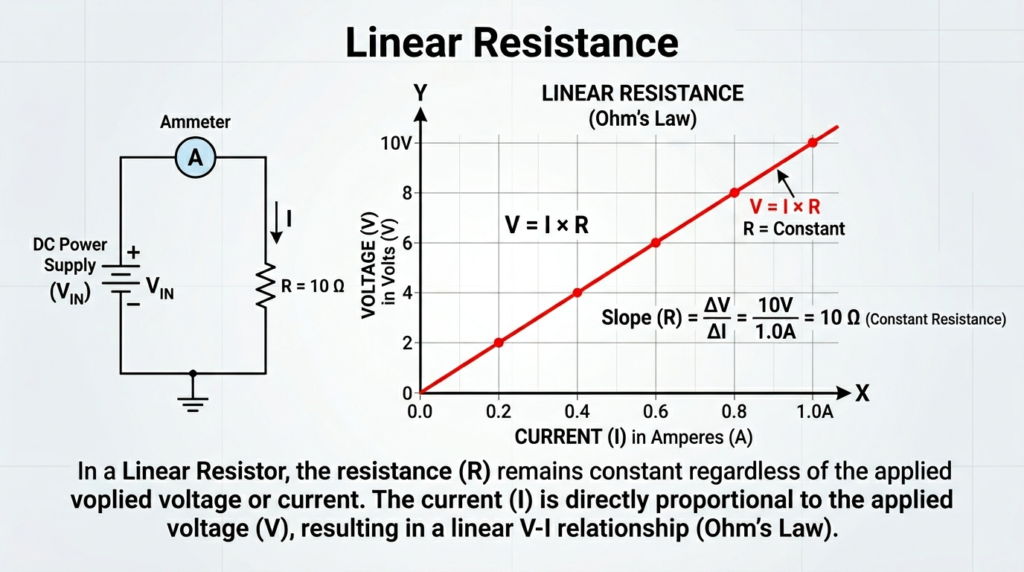
Linear resistance is a type of electrical resistance in which the current flowing through a conductor changes proportionally with the applied voltage. In other words, the resistance value remains constant even when voltage or current changes, as long as temperature remains stable. Linear resistances follow Ohm’s Law, which states that voltage is directly proportional to current. Common examples of linear resistance include metallic resistors made from materials such as copper, aluminum, and carbon. These resistors are widely used in electrical and electronic circuits for current limiting, voltage control, and circuit protection. Linear resistance is important because it provides stable and predictable electrical behavior, making circuit design and analysis easier for engineers and technicians.
Follows Ohm’s Law directly.
Current changes proportionally with voltage.
🔹 Non-Linear Resistance
Does not follow Ohm’s Law strictly.
Examples:
- Diodes
- Thermistors
Understanding different types helps in selecting the correct component for resistance applications.
Main Components Related to Electrical Resistance (2026)
Electrical resistance is influenced by several important components that work together to ensure the safe and efficient operation of electrical and electronic circuits. Each component has a specific purpose, whether it is controlling current, carrying electrical energy, preventing unwanted current flow, or measuring resistance accurately. Understanding these components helps students, technicians, and engineers design reliable circuits, troubleshoot faults, and improve overall system performance. As electrical technology advances 2026, these components continue to play a vital role in modern power systems, automation, consumer electronics, and renewable energy applications.
Resistor
A resistor is a passive electrical component specifically designed to provide a predetermined resistance value within a circuit. It is one of the most commonly used components in electrical and electronic systems because it controls the flow of current and regulates voltage levels.
Functions of a Resistor
- Limits electrical current to protect sensitive components.
- Divides voltage into required levels for different circuit sections.
- Controls signal strength in electronic circuits.
- Generates controlled heat in heating applications.
- Improves circuit stability and reliability.
- Protects LEDs, integrated circuits (ICs), sensors, and microcontrollers from excessive current.
Resistors are available in many forms, including carbon film, metal film, wire-wound, surface-mount (SMD), and variable resistors (potentiometers). The correct resistor type depends on the circuit’s power, precision, and environmental requirements.
Conductor Material
A conductor is a material that allows electric current to flow with minimal resistance. The choice of conductor material directly affects electrical efficiency, voltage drop, and heat generation within a system.
Common Conductor Materials
Copper (Cu)
- Very low electrical resistance.
- Excellent electrical conductivity.
- High durability and corrosion resistance.
- Widely used in household wiring, motors, transformers, and electronic equipment.
Aluminium (Al)
- Moderate electrical resistance compared with copper.
- Lightweight and cost-effective.
- Commonly used in overhead transmission lines and large power distribution systems because of its lower weight.
Functions of Conductors
- Carry electrical current efficiently.
- Reduce energy losses during transmission.
- Minimise voltage drop across electrical installations.
- Improve overall system performance and reliability.
Selecting the appropriate conductor size and material is essential for ensuring safe operation and reducing unnecessary power losses.
Insulator
An insulator is a material with extremely high electrical resistance that prevents the flow of electric current. Insulators protect people and equipment by separating live conductors from surrounding objects and reducing the risk of electric shock or short circuits.
Common Examples of Insulators
- Plastic
- Rubber
- Glass
- Ceramic
- PVC (Polyvinyl Chloride)
- Porcelain
Functions of Insulators
- Prevent unwanted current flow.
- Protect electrical cables and equipment.
- Reduce the risk of electrical shock.
- Prevent short circuits and electrical leakage.
- Increase the safety and durability of electrical installations.
Modern electrical systems rely heavily on high-quality insulation materials to maintain safety standards in residential, commercial, and industrial environments.
Measuring Instruments
Accurate resistance measurement is essential for testing electrical components, diagnosing faults, and verifying circuit performance. Measuring instruments help technicians determine whether components are operating within their specified resistance values.
Common Measuring Instruments
Ohmmeter
A dedicated instrument designed specifically to measure electrical resistance.
Digital Multimeter (DMM)
A versatile instrument capable of measuring resistance, voltage, current, continuity, and several other electrical parameters. It is widely used by electricians, technicians, engineers, and students.
Functions of Measuring Instruments
- Measure resistance accurately.
- Test resistor values before installation.
- Check continuity in electrical circuits.
- Detect open circuits and faulty connections.
- Assist in preventive maintenance and troubleshooting.
- Improve the accuracy and reliability of electrical testing.
Regular testing with calibrated measuring instruments helps prevent equipment failures and ensures that electrical systems continue to operate safely.
Importance of These Components
Each component related to electrical resistance performs a unique and essential function within an electrical system. Resistors regulate current and voltage, conductors transport electrical energy efficiently, insulators provide protection against unwanted current flow, and measuring instruments verify the correct operation of electrical circuits. Together, these components form the foundation of safe, efficient, and reliable electrical engineering practices.
As technology continues to develop throughout 2026, improvements in resistor design, advanced conductor materials, high-performance insulation, and smart digital measuring instruments will further enhance electrical safety, energy efficiency, and system reliability across industries ranging from consumer electronics to renewable energy and electric vehicles.
Advantages, Limitations, and Applications of Electrical Resistance (2026)
Electrical resistance is one of the most important concepts in electrical and electronic engineering. It controls the flow of electric current, protects sensitive components, and ensures that electrical systems operate safely and efficiently. Understanding the advantages, limitations, and practical applications of resistance enables engineers, technicians, and students to design reliable circuits, improve energy efficiency, and reduce equipment failures. As electrical technology continues to evolve between 2026, resistance remains a fundamental element in modern electrical systems.
Advantages of Electrical Resistance
Electrical resistance offers several important benefits that make it an essential part of almost every electrical and electronic circuit. When used correctly, resistors improve circuit performance, enhance safety, and protect valuable equipment from electrical damage.
Controls Current Safely
Resistance limits the amount of current flowing through a circuit, preventing excessive current that could damage wires, electronic components, or electrical equipment. This current control is essential for maintaining safe operating conditions.
Protects Electronic Devices
Resistors protect sensitive components such as LEDs, integrated circuits (ICs), sensors, and microcontrollers by limiting current to safe levels. Without proper resistance, these components could fail due to excessive electrical stress.
Helps in Voltage Division
Resistors are widely used in voltage divider circuits to produce specific voltage levels from a single power source. This technique is commonly used in sensors, measurement circuits, and electronic control systems.
Produces Useful Heat
In many applications, electrical resistance intentionally converts electrical energy into heat. This principle is used in electric heaters, water heaters, electric irons, toasters, and industrial heating equipment where controlled heat generation is required.
Improves Circuit Stability
Properly selected resistors stabilise voltage and current within a circuit, reducing unwanted fluctuations and improving the overall performance and reliability of electrical and electronic systems.
Essential for Circuit Design
Every electrical and electronic circuit requires carefully selected resistance values to achieve the desired operating conditions. Resistors are used for current limiting, signal conditioning, biasing transistors, filtering circuits, and timing applications.
Helps Prevent Short Circuits
Although resistors cannot eliminate short circuits completely, they help limit fault current in many applications, reducing the risk of severe component damage and improving overall electrical safety.
Conclusion on Advantages
Electrical resistance is indispensable for safe and efficient electrical systems. It provides current control, equipment protection, voltage regulation, and reliable circuit operation, making it one of the most widely used principles in electrical engineering.
Limitations and Challenges of Electrical Resistance (2026)
While electrical resistance provides many benefits, it also introduces certain limitations that engineers must carefully manage. Excessive or unwanted resistance can reduce efficiency, increase operating costs, and negatively affect system performance.
Causes Energy Loss as Heat
Whenever current flows through a resistor, part of the electrical energy is converted into heat. This energy loss reduces the overall efficiency of electrical systems, particularly in high-power applications.
Reduces System Efficiency
High resistance in conductors and components causes unnecessary power losses. Engineers continuously work to minimise unwanted resistance by using better conductor materials and optimised circuit designs.
Causes Voltage Drop
Long electrical cables and undersized conductors have higher resistance, resulting in voltage drops between the power source and the load. Excessive voltage drop can reduce equipment performance and affect system reliability.
Risk of Overheating
Excessive resistance at loose connections, damaged wires, or overloaded resistors generates heat that may damage insulation, reduce equipment lifespan, or create fire hazards if left uncorrected.
Increases Power Consumption
Higher resistance often requires additional electrical power to deliver the same output, increasing energy consumption and operating costs in industrial and commercial systems.
Engineering Considerations
Engineers minimise unwanted resistance by selecting appropriate conductor sizes, using high-quality materials, ensuring secure electrical connections, and performing regular maintenance. Proper resistance management improves both safety and energy efficiency.
Practical Applications of Electrical Resistance (2026)
Electrical resistance is used in nearly every modern electrical and electronic system. From household appliances to renewable energy systems and electric vehicles, resistance plays a vital role in controlling current, protecting equipment, and ensuring reliable operation.
Home Applications
Electrical resistance is commonly used in household appliances that convert electrical energy into heat or regulate electrical current.
- Electric heaters for space heating
- Electric irons for fabric pressing
- Water heaters for domestic hot water
- Electric kettles and toasters
- Hair dryers and cooking appliances
- Household lighting and protection circuits
Industrial Applications
Industrial systems rely on resistance for process control, equipment protection, and power management.
- Motor speed control circuits
- Industrial load banks for testing generators and UPS systems
- Electrical control panels
- Protective relay circuits
- Industrial automation and PLC systems
- Heating elements used in manufacturing processes
Electronics Applications
Electronic circuits depend heavily on resistors for precise electrical control and stable operation.
- LED current-limiting circuits
- Voltage divider networks
- Signal conditioning circuits
- Amplifier biasing circuits
- Sensor interface circuits
- Timing circuits using resistors and capacitors
- Microcontroller and embedded system designs
Modern Technology Applications
Emerging technologies continue to rely on advanced resistance management for higher efficiency and improved reliability.
Internet of Things (IoT) devices and smart electronics
Electric vehicles (EVs)
Solar inverters and photovoltaic systems
Battery Management Systems (BMS)
Smart grids and intelligent power distribution
Renewable energy storage systems
Robotics and industrial automation
Resistance vs Reactance Comparison and Resistor Selection Guide (2026)
A clear understanding of the difference between resistance and reactance is essential for students, technicians, and electrical engineers. Although both oppose the flow of electrical current and are measured in ohms (Ω), they behave differently in electrical circuits. Resistance is present in both DC and AC circuits, while reactance mainly affects AC systems because of inductance and capacitance. As electrical technologies continue to advance between 2026 knowledge of these concepts is becoming increasingly important for designing efficient and reliable power systems.
Difference Between Resistance and Reactance
| Feature | Resistance | Reactance |
|---|---|---|
| Definition | Opposition to the flow of electric current caused by the physical properties of a material. | Opposition to alternating current caused by inductance or capacitance in a circuit. |
| Energy Behaviour | Converts electrical energy into heat, resulting in power loss. | Temporarily stores energy in magnetic or electric fields and returns it to the circuit without continuous power loss. |
| Present In | Found in both DC and AC circuits. | Exists only in AC circuits because it depends on changing current or voltage. |
| Unit | Ohm (Ω) | Ohm (Ω) |
| Primary Cause | Material composition, conductor length, cross-sectional area, and temperature. | Magnetic fields produced by inductors or electric fields produced by capacitors. |
| Effect on Current | Reduces current flow regardless of frequency. | Changes with AC frequency and influences the phase relationship between voltage and current. |
| Common Applications | Current limiting, voltage division, heating elements, and electronic circuits. | Motors, transformers, filters, power-factor correction, and AC transmission systems. |
Understanding the distinction between resistance and reactance helps engineers analyse AC circuits more accurately, improve power quality, reduce energy losses, and design safer electrical installations.
Practical Resistor Selection Guide (2026)
Choosing the correct resistor is essential for ensuring circuit safety, stability, and long-term reliability. An incorrectly selected resistor can overheat, fail prematurely, or cause poor circuit performance. Modern electronic systems require careful consideration of electrical specifications, environmental conditions, and application requirements before selecting a resistor.
Check Circuit Requirements
Begin by analysing the circuit and determining the required resistance value using Ohm’s Law (V = I × R). Calculate the voltage, current, and resistance needed to achieve the desired circuit operation. Always verify that the selected resistor matches the electrical design specifications.
Consider the Power Rating
A resistor must be capable of safely dissipating the heat generated during operation. Select a resistor with a suitable wattage rating, preferably with a safety margin above the calculated power dissipation. Using a resistor with an insufficient power rating can result in overheating, reduced performance, or permanent failure.
Check the Tolerance Value
Tolerance indicates how closely a resistor’s actual resistance matches its rated value. Choose an appropriate tolerance based on the application’s accuracy requirements. Precision electronic circuits often require tighter tolerances, while general-purpose circuits can operate with standard tolerance values.
Evaluate Operating Conditions
Consider environmental factors such as temperature, humidity, vibration, and continuous operating load. Selecting a resistor designed for the intended environment improves durability and ensures consistent electrical performance over time.
Tips for Beginners
Replace damaged or discoloured resistors immediately to prevent further circuit faults.
Never use a resistor with a power rating lower than the circuit requires.
Measure the resistor value with a multimeter before installation whenever possible.
Consider temperature effects, as resistance may change under high operating temperatures.
Ensure all electrical connections are tight and free from corrosion to minimise unwanted resistance.
Use proper insulation and follow electrical safety standards during installation.
Double-check resistor colour codes or printed values before connecting components.
Common Electrical Resistance Problems & Practical Solutions (2026)
Understanding common resistance-related problems is essential for electricians, engineers, and technicians. Electrical resistance can affect the performance, efficiency, and safety of a circuit if it is not properly managed. Identifying the root cause of these issues and applying the correct solution helps prevent equipment damage, reduce maintenance costs, and improve system reliability. The following are some of the most common resistance-related problems and their practical solutions.
Why Is a Resistor Burning?
Cause:
A resistor usually burns when excessive current flows through it or when its power rating is too low for the application. Overloading causes the resistor to generate more heat than it can safely dissipate, leading to overheating, discoloration, or complete failure. Incorrect circuit design, short circuits, or voltage spikes can also contribute to this problem.
Solution:
Select a resistor with a higher wattage rating and ensure its resistance value is suitable for the circuit. Verify that the current remains within the component’s specified limits and inspect the circuit for short circuits or excessive voltage. Proper ventilation and heat management can also improve resistor lifespan.
Why Is Voltage Dropping?
Cause:
Voltage drop commonly occurs because of high cable resistance, long cable runs, undersized conductors, or poor-quality wiring. Excessive resistance reduces the voltage available at the load, resulting in lower equipment performance and increased energy losses.
Solution:
Use thicker cables with a larger cross-sectional area to reduce resistance. Keep cable lengths as short as practical and use high-quality conductors such as copper where appropriate. Regularly inspect wiring for corrosion or damage that may increase resistance.
Why Is Electrical Equipment Heating Up?
Cause:
Electrical equipment often overheats because of high resistance at loose, corroded, or damaged connections. These poor connections create additional resistance, producing excessive heat that can damage insulation, reduce efficiency, and increase the risk of electrical fires.
Solution:
Inspect all terminals and connectors regularly, tighten loose connections, and replace damaged or corroded components. Ensure all electrical joints are clean and secure to minimise contact resistance. Routine preventive maintenance helps maintain safe operating temperatures.
Why Is the Circuit Not Working?
Cause:
A circuit may stop working due to an open resistance path, a broken conductor, damaged wiring, or a failed component. When electrical continuity is interrupted, current cannot flow, causing the circuit to become inoperative.
Solution:
Use a multimeter to check continuity, measure resistance, and identify open circuits or faulty components. Repair or replace damaged wires, connectors, or electrical devices as needed. After repairs, perform a complete functional test to confirm the circuit operates correctly.
Importance of Practical Troubleshooting
Professional troubleshooting skills are essential for diagnosing and solving electrical resistance problems quickly and safely. By understanding the causes of resistor failure, voltage drop, overheating, and open circuits, technicians can improve system performance, reduce downtime, and increase the reliability of electrical installations. As electrical technology continues to advance 2026, effective troubleshooting techniques and preventive maintenance will remain critical for ensuring safe, efficient, and long-lasting electrical systems.
Future Trends (2026)
As electrical and electronic systems continue to evolve, resistance technology is becoming more efficient, intelligent, and sustainable. Engineers and researchers are developing innovative materials and smart control systems to reduce energy losses, improve performance, and support modern infrastructure. The following trends are expected to shape the future of resistance technology 2026.
Advanced Low-Loss Materials
New generations of conductive materials, including advanced metal alloys, graphene-based composites, and high-performance polymers, are being developed to minimize electrical resistance. These materials reduce heat generation, improve conductivity, and extend the lifespan of electrical components. They are expected to play a significant role in next-generation electronics, aerospace systems, and industrial equipment.
Smart Electronics and AI-Based Resistance Control
Modern electronic devices are increasingly equipped with intelligent sensors and AI-powered control systems that automatically monitor and adjust electrical resistance. These smart technologies improve energy efficiency, prevent overheating, and enhance system reliability in power grids, manufacturing plants, and consumer electronics.
Electric Vehicles (EVs)
The rapid growth of electric vehicles has increased the demand for precise resistance management. Low-resistance wiring, efficient battery connections, and advanced power electronics help reduce energy losses, improve battery performance, and extend driving range. Future EVs will continue to benefit from innovations that optimise current flow and thermal management.
Renewable Energy Systems
Renewable energy technologies such as solar farms and wind power installations require highly efficient electrical transmission. Optimised cable designs, improved conductor materials, and reduced resistance losses enable more electricity to reach consumers with minimal energy waste. These improvements contribute to more reliable and cost-effective renewable energy systems.
Smart Power Grids and Energy Distribution
Future smart grids will use real-time monitoring and automated resistance management to balance electrical loads and minimise transmission losses. Intelligent distribution networks will improve power quality, reduce operational costs, and support the integration of renewable energy sources into national electricity grids.
Sustainable Engineering and Energy Efficiency
Modern engineering is focused on minimising unwanted electrical resistance while maximising efficiency. By combining advanced materials, intelligent electronics, and innovative system designs, future electrical technologies will consume less energy, generate less heat, and deliver higher performance. These advancements will support global sustainability goals and create more reliable, eco-friendly electrical systems for industries and everyday applications.
Conclusion
Understanding What is Resistance? is essential for every electrical professional. Resistance controls current flow and ensures safe operation of circuits. We explored the resistance working principle, types, applications, resistance advantages and disadvantages, and the difference between resistance and reactance.
For students and technicians, mastering resistance improves circuit design, troubleshooting ability, and safety awareness. Without proper resistance control, electrical systems become unsafe and inefficient.
Strong fundamentals in resistance help you understand advanced electrical concepts with confidence. Keep practicing calculations and always prioritize safety in real-world installations.