

A thermistor is a small, inexpensive resistor whose resistance changes a lot with temperature. That one property makes it one of the most useful temperature sensors in electronics: it can measure temperature, limit inrush current, protect circuits from overheating, and even sense the level of a liquid. You will find thermistors in phone chargers, 3D printers, car engines, air conditioners, and battery packs.
There are two kinds, and they behave in opposite ways. An NTC thermistor’s resistance falls as it gets hotter, while a PTC thermistor’s resistance rises sharply once it passes a certain temperature. Knowing which type you have, and why, is the key to using them correctly. This guide explains how both types work, how they differ, and where each one belongs.
What Is a Thermistor?
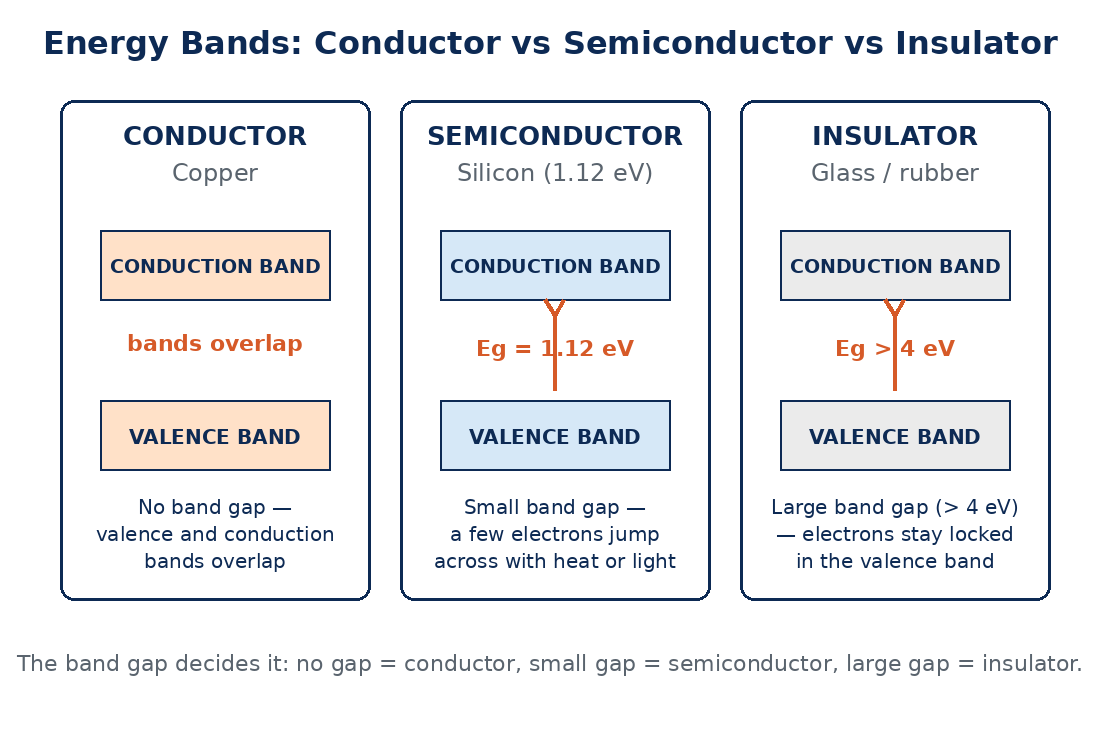
The word thermistor comes from “thermal resistor.” It is a two-terminal device made from a semiconductor material, usually a metal oxide such as manganese, nickel, or cobalt oxide pressed into a bead, disc, or chip and sealed in glass or epoxy. Because the material is a semiconductor, its resistance depends strongly on temperature, far more than an ordinary fixed resistor.
That sensitivity is the whole point. A small change in temperature produces a large, predictable change in resistance, so a simple voltage divider can turn a thermistor into a temperature reading. To see why resistance behaves this way, it helps to recall what resistance is: the opposition a material offers to the flow of current. In a thermistor, heat frees more charge carriers in the semiconductor, and the resistance changes as a result.

How an NTC Thermistor Works
NTC stands for Negative Temperature Coefficient. As the temperature rises, the resistance of an NTC thermistor falls. Heat gives the semiconductor’s electrons more energy, freeing more charge carriers, so current flows more easily. At room temperature a typical NTC might measure 10,000 ohms; heat it to 100 degrees Celsius and it may drop to a few hundred ohms.
The relationship follows the Steinhart-Hart equation, or a simpler exponential (beta) model that most datasheets give. A thermistor’s beta value, usually between 3,000 and 5,000 K, tells you how steeply its resistance falls. Because the curve is steep, an NTC thermistor can resolve temperature changes of a fraction of a degree, far finer than most other low-cost sensors.
How a PTC Thermistor Works
PTC stands for Positive Temperature Coefficient. Below its switching temperature, a PTC thermistor behaves like an ordinary low-value resistor. But once it reaches a threshold temperature, its resistance climbs sharply, by several orders of magnitude over a few degrees. That sudden jump makes it a self-resetting fuse: when a fault current heats the device, its resistance soars, choking the current to a safe trickle.
When the fault clears and the device cools, the resistance falls back and the circuit works again. No replacement is needed. This is why PTC thermistors guard USB ports, motors, and battery packs against overcurrent and overheating.
NTC vs PTC: Key Differences
| Property | NTC thermistor | PTC thermistor |
|---|---|---|
| Resistance vs temperature | Falls as temperature rises | Rises sharply above a threshold |
| Main use | Temperature sensing | Overcurrent and overtemperature protection |
| Typical resistance | 1 k ohms to 100 k ohms at 25 degrees Celsius | 0.1 ohms to a few k ohms below threshold |
| Behavior after a fault | Reading changes smoothly | Trips and self-resets |
| Common examples | 3D printer hot end, battery pack | Motor starter, USB port protection |
The two types are not interchangeable. An NTC is a measurement device, while a PTC is a protection device. Choosing the wrong one is the most common thermistor mistake in a new design.
Measuring Temperature with a Thermistor
The usual circuit is a voltage divider: the thermistor in series with a fixed resistor, fed by a known voltage. The voltage at the junction changes with the thermistor’s resistance, and a microcontroller converts that voltage to a temperature using the beta equation or a lookup table. A 10 k ohm NTC with a 10 k ohm series resistor is the most common pairing, because it centers the measurement range near room temperature.
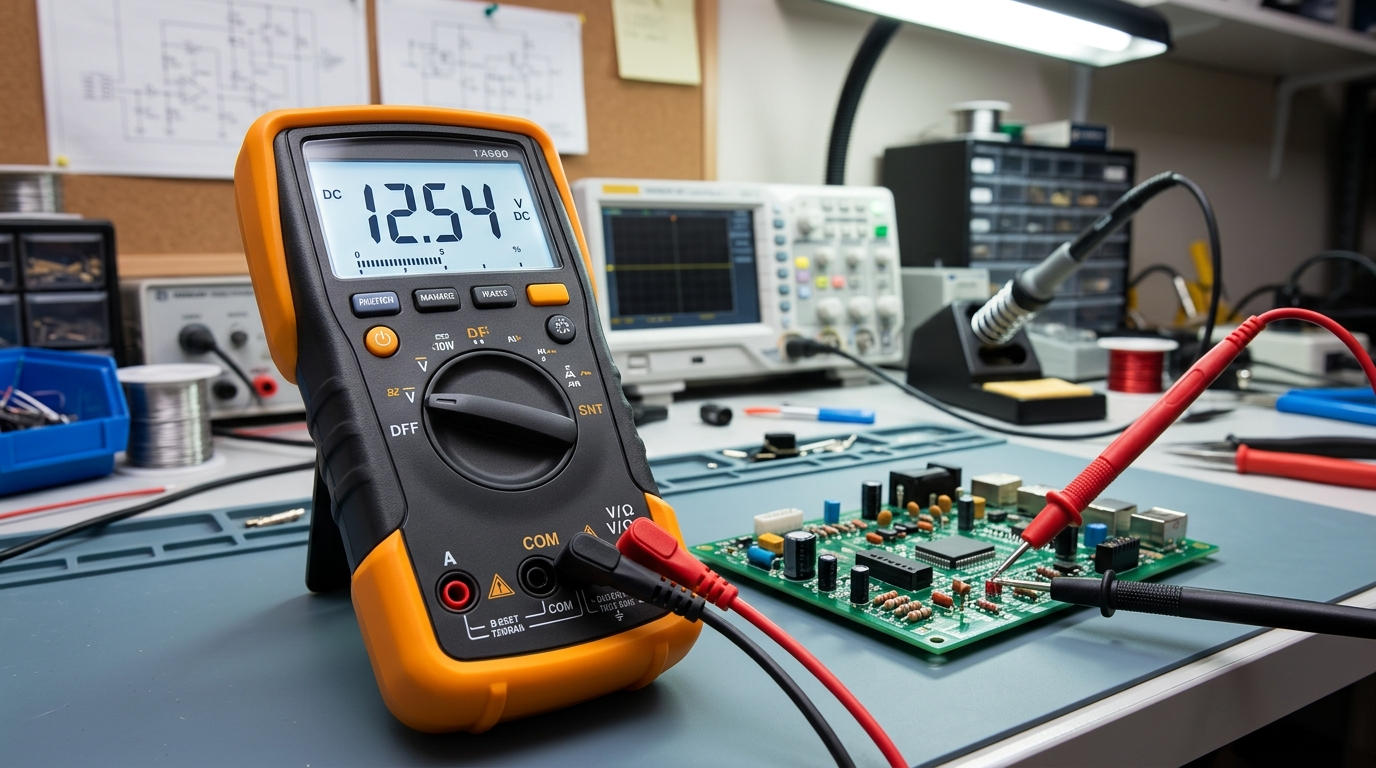
You can check a thermistor with a digital multimeter on the resistance range. At room temperature the reading should be close to its rated value, for example 10 k ohms, and warming the bead gently with your fingers should make the reading fall (NTC) or rise (PTC). If the reading is open-circuit or stuck, the device is damaged.
Common Applications
Thermistors show up wherever a cheap, accurate temperature reading or a self-resetting protection is needed. A few of the most common uses are listed below.
- Temperature sensing in 3D printers, coffee machines, and HVAC systems
- Battery temperature monitoring in phones, laptops, and electric vehicles
- Inrush current limiting in power supplies, where a cold NTC starts with high resistance and then drops as it warms
- Motor and transformer overtemperature protection with PTC devices
- Liquid level sensing, using the cooling effect of a liquid on a heated thermistor
In power supplies, the NTC inrush limiter is a neat trick. At switch-on the thermistor is cold, so its high resistance limits the surge that charges the bulk capacitors. Within seconds it heats up, its resistance falls, and it stops wasting power. It is a passive component doing a job that would otherwise need extra circuitry.
How to Choose a Thermistor
Start with the job: sensing or protection. For sensing, pick an NTC with a resistance value that suits your circuit (10 k ohms is the standard), a beta value matched to your temperature range, and a tolerance that fits your accuracy budget. For protection, pick a PTC with a trip temperature above the normal operating range and a hold current above the normal load.
Also check the package and the response time. A glass-bead thermistor responds in seconds and suits air temperature; a disc or chip device mounted on a surface responds faster. And remember that a thermistor heats itself when current flows through it, so keep the measuring current small so self-heating does not spoil the reading. If you need to compare resistive and reactive behavior in the surrounding circuit, our guide to the difference between resistance and reactance is a useful refresher.
Frequently Asked Questions
What is the difference between a thermistor and a thermocouple?
A thermistor is a resistor whose resistance changes with temperature, while a thermocouple generates a small voltage from the junction of two metals. Thermistors are cheaper and more sensitive over a narrow range, while thermocouples handle much higher temperatures and longer distances.
Why does an NTC thermistor’s resistance fall when it gets hot?
Heat frees more charge carriers inside the semiconductor material, so current flows more easily. The effect is strong in semiconductors, which is the opposite of what happens in metals, where resistance rises with temperature.
Can a thermistor measure high temperatures?
Most NTC thermistors work from about minus 50 degrees Celsius to 150 degrees Celsius, and some glass-sealed types reach 300 degrees Celsius. Above that range, thermocouples and RTDs are the better choice, because the thermistor’s resistance becomes too low to measure accurately.
How do I test a thermistor with a multimeter?
Set the meter to resistance, connect the probes to the thermistor’s leads, and note the reading at room temperature. Then warm the device gently with your fingers or a hair dryer: an NTC reading should fall, and a PTC reading should rise once it passes its threshold. An open circuit means the thermistor is broken.
What causes a PTC thermistor to trip?
Excess current heats the device past its switching temperature, and its resistance jumps sharply, limiting the current to a safe level. It trips on heat, so a hot environment can trip it too. The trip temperature must sit above the normal operating temperature.
Conclusion
A thermistor turns temperature into resistance, and that simple idea covers an enormous range of jobs: precise temperature sensing with NTC devices, and self-resetting protection with PTC devices. Pick the type for the job, match its resistance and temperature ratings, and keep self-heating in check, and a component that costs cents will do work that once needed a whole circuit.
For the underlying theory and more worked curves, the Electronics Tutorials guide to thermistors explains NTC and PTC behavior with examples.