

Look at the outlet in your bathroom or kitchen and you will see two small buttons between the sockets: TEST and RESET. That is a GFCI outlet — a ground fault circuit interrupter — and it is one of the most important safety devices in your home. It watches every milliamp of electricity flowing through it, and if even a tiny amount starts flowing through you instead of through the wires, it cuts the power in about a fortieth of a second.
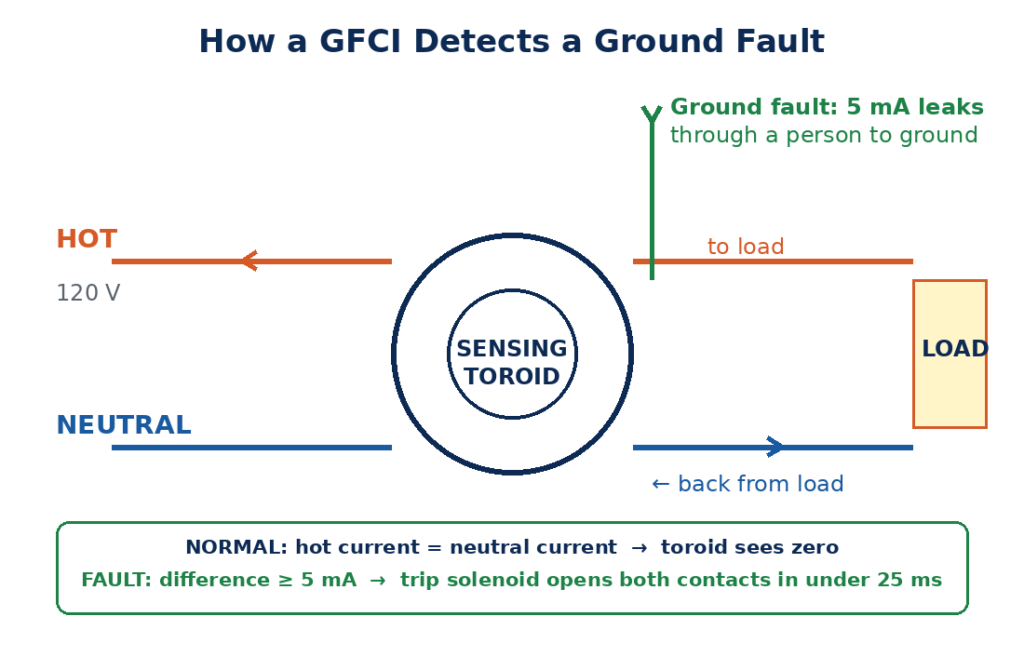
A GFCI does not protect wires the way a circuit breaker does. It protects people. A standard breaker trips at 15 or 20 amps to stop wires from overheating, but as little as 0.1 amps through the chest can throw the heart out of rhythm. The GFCI fills that gap: it trips at about 5 milliamps, roughly 3,000 times more sensitive than a breaker. This article explains what a GFCI outlet is, how it works, the types available, where the NEC requires them, and how to test yours.
GFCI Outlet Definition
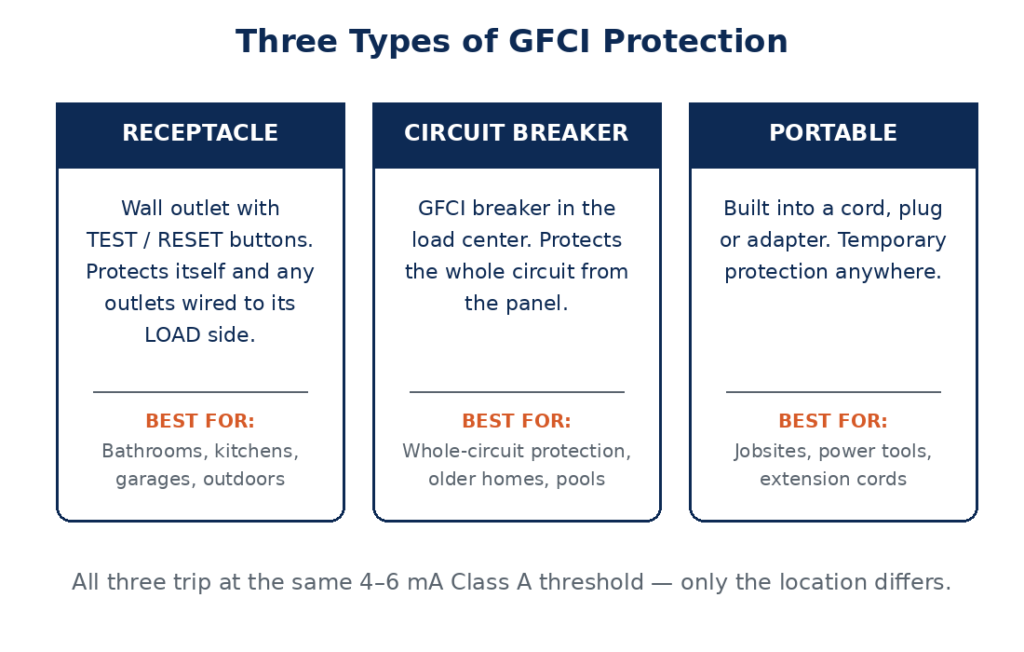
A GFCI (ground fault circuit interrupter) is a safety device that continuously compares the current leaving on the hot conductor with the current returning on the neutral conductor. In a healthy circuit, those two currents are equal — every electron that goes out comes back. If some current takes an unintended path to ground, for example through a person’s body, the two currents no longer match. The GFCI detects the difference and opens the circuit.
The device was invented around 1961 by Charles Dalziel, a professor at the University of California, Berkeley, who researched the effects of electric shock on the human body. The US National Electrical Code began requiring GFCIs in the 1970s — first outdoors and in bathrooms, then in kitchens, garages, and other wet locations. The US Consumer Product Safety Commission credits GFCIs with a large fall in home electrocutions since their introduction.
Class A GFCIs — the type used for personnel protection in homes — are built to the UL 943 standard. They must trip when the imbalance reaches 4 to 6 milliamps, and they must trip fast: within about 25 milliseconds (1/40 of a second) at the fault currents a real shock produces. That speed is what makes the difference between a frightening tingle and a fatal shock.
How a GFCI Works
Inside every GFCI is a differential current transformer — a small iron ring (toroid) with both the hot and neutral conductors passing through it, plus a sensing coil wound around the ring. Under normal conditions, the hot and neutral currents are equal and opposite, so their magnetic fields cancel out and the sensing coil sees nothing. The device stays quiet.
When a ground fault happens — say a damaged hair dryer drops into a sink, or a person touches a faulty appliance while standing on a wet floor — some current leaks to ground instead of returning through the neutral. Now the hot and neutral currents no longer balance, the toroid sees a net magnetic field, and the sensing coil produces a small voltage. The GFCI’s electronics amplify that signal and fire a solenoid that mechanically opens the contacts on both the hot and neutral wires, cutting power to the outlet.
The TEST button on the face of the outlet simulates a ground fault internally by deliberately creating a small imbalance. Pressing it should trip the device immediately. The RESET button restores operation once the fault is gone. If TEST does not trip the device, or RESET does not restore power, the GFCI has failed and must be replaced — it is providing no protection.
GFCI vs Circuit Breaker: Different Jobs
Homeowners often assume a breaker protects them from shock. It does not. A breaker and a GFCI protect against different hazards, and one cannot replace the other.
| Feature | GFCI | Circuit breaker |
|---|---|---|
| Protects | People from electric shock | Wires from overload and short circuit |
| Trip level | 4–6 mA of leakage current | 15–20 A (residential branch circuits) |
| Trip speed | Under 25 ms at fault current | Seconds at moderate overload, fast at short circuit |
| Detects | Current leaking to ground | Too much current in the wires |
| Standard | UL 943 (Class A) | UL 489 |
The numbers make the point: 5 milliamps versus 15 amps is a factor of 3,000. A breaker will happily let a lethal 100 mA flow through a person for seconds, because 100 mA is nothing to a 15-amp breaker. The GFCI is the only device in the circuit that cares about the tiny currents that kill people. That is also why a GFCI does not replace a breaker — a GFCI will not trip on overload or short circuit, so the circuit still needs overcurrent protection. Combination AFCI/GFCI devices exist that provide both protections in one unit, and our comparison of MCB vs MCCB explains the breaker side of the picture.
Types of GFCI Protection
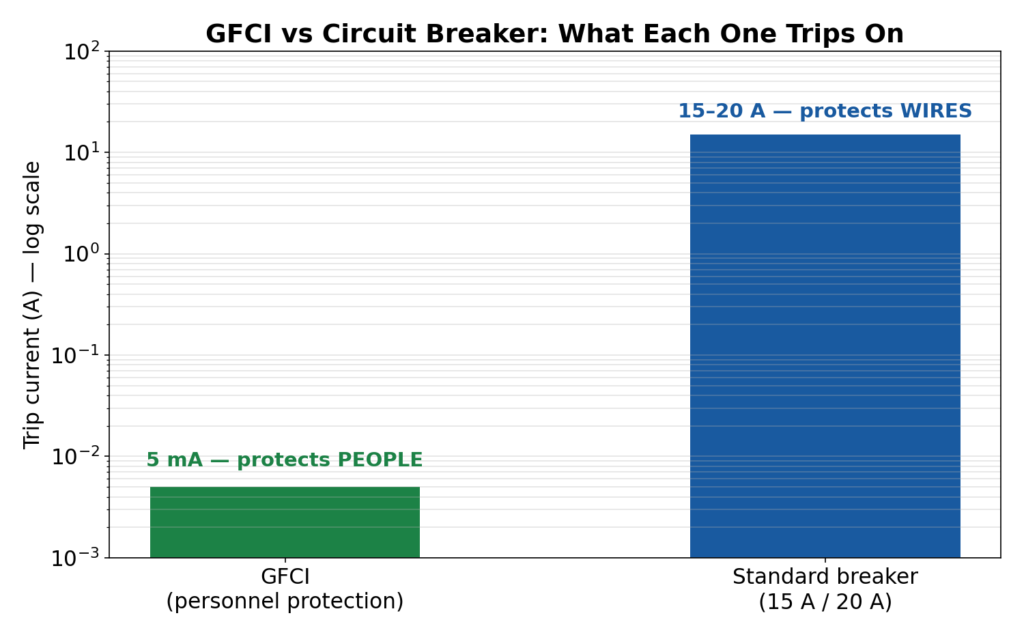
GFCI protection comes in three main forms. All three trip at the same 4–6 mA Class A threshold and to the same UL 943 standard — the difference is only where the protection sits.
- GFCI receptacle: the familiar wall outlet with TEST and RESET buttons on its face. It protects itself and any ordinary outlets wired to its LOAD terminals downstream — so one GFCI in a bathroom can protect every outlet after it on the same circuit. This is the most common type in homes.
- GFCI circuit breaker: a breaker in the electrical panel (load center) with built-in ground-fault sensing. It protects the entire circuit from the panel outward, which is useful for older homes, pool equipment, and circuits where a receptacle-type device is impractical.
- Portable GFCI: built into a cord, plug, or adapter for temporary use. Jobsites, power tools, and extension cords used outdoors rely on portable GFCIs, and OSHA requires them on construction sites where permanent GFCI protection is not available.
Dual-function AFCI/GFCI breakers combine both protections in one device and are now common in new residential panels. They cost more than a standard breaker, but they satisfy both the arc-fault and ground-fault requirements of the NEC in a single slot.
Where the NEC Requires GFCI Protection
The National Electrical Code (NEC) has expanded GFCI requirements with almost every edition. Under the 2023 NEC, GFCI protection is required for 125 V, 15- and 20-amp receptacles in dwelling units in: bathrooms, garages and accessory buildings, outdoors, crawl spaces, basements, kitchens (including receptacles serving countertops), sinks (within 6 feet of the edge), laundry areas, bathtubs and shower stalls, and boathouses. The list keeps growing because the data keeps showing the same thing: water and electricity together kill people, and GFCIs stop it.
Outside homes, the NEC requires GFCI protection in commercial kitchens, rooftops (for servicing HVAC equipment), pool and spa areas, marinas, and many other wet or outdoor locations. The general rule is simple to remember: if water is likely to be present, or the receptacle is outdoors, GFCI protection is probably required. Always check the edition your local jurisdiction enforces, because the exact list changes between editions.
One common question is whether a GFCI protects against every kind of shock. It does not. A GFCI cannot detect a shock where current flows from hot to neutral through a person with no leakage to ground — for example, touching both prongs of a plug at once. It also does not protect against arc flash, which is a different hazard covered in our article on arc flash. A GFCI is a powerful layer of protection, not a substitute for safe practice: dry hands, intact cords, and de-energized work are still essential.
How to Test a GFCI Outlet
Manufacturers and the US Consumer Product Safety Commission recommend testing every GFCI at least once a month, and also after installation, after a power failure, and after any trip. The test takes less than a minute and needs no tools:
- Step 1: Plug a small device, such as a lamp or nightlight, into the GFCI outlet and switch it on to confirm the outlet has power.
- Step 2: Press the TEST button firmly. You should hear a click, the lamp should go out, and the RESET button should pop out. That proves the sensing and tripping mechanism works.
- Step 3: Press the RESET button firmly until it latches. The lamp should come back on, confirming power is restored.
- Step 4: If the lamp stays on when you press TEST, or stays off when you press RESET, the GFCI has failed. Replace it immediately — a failed GFCI looks normal but protects no one.
Some newer GFCIs are self-testing: they run an internal test automatically every few minutes and trip or signal if they detect a fault in themselves. Even so, a manual monthly test is still the recommended habit. Also test the outlets protected downstream of a GFCI: plug the lamp into each one, press TEST on the GFCI, and confirm they all lose power. That confirms the wiring is correct and the downstream outlets really are protected.
Why a GFCI Keeps Tripping
A GFCI that trips repeatedly is usually doing its job, and the cause is usually one of a few things. The most common is a genuine ground fault: a damaged appliance, a wet outlet box, or moisture in an outdoor receptacle. Unplug everything on the circuit and reset the GFCI; then plug appliances back one at a time until the trip repeats, and you have found the faulty one.
Other causes include a worn-out GFCI (they typically last 10–15 years), moisture or insects inside an outdoor box, a shared neutral between two circuits, or a faulty appliance with internal leakage — old refrigerators, freezers, and motors are frequent offenders. Nuisance tripping from a healthy appliance is rare with modern GFCIs; if a GFCI trips often, treat it as a warning, not an annoyance, and find the cause before bypassing or replacing it. Never replace a GFCI with an ordinary outlet to stop the tripping — that removes the protection entirely.
Frequently Asked Questions
What is a GFCI outlet?
A GFCI outlet is a receptacle with built-in ground-fault protection. It compares the current going out on the hot wire with the current returning on the neutral, and trips in under 25 milliseconds if the difference reaches 4–6 mA — the sign that current is leaking, possibly through a person.
What is the difference between GFCI and GFI?
There is no technical difference. GFI (ground fault interrupter) is the older, shorter name for the same device. GFCI (ground fault circuit interrupter) is the current industry and code term.
How often should I test my GFCI outlets?
At least once a month, using the TEST and RESET buttons, plus after installation and after any power failure. If TEST does not cut power, or RESET does not restore it, replace the outlet.
Can one GFCI protect multiple outlets?
Yes. A GFCI receptacle protects all ordinary outlets wired to its LOAD terminals downstream on the same circuit. A GFCI breaker protects the entire circuit. That is why a single bathroom GFCI often covers every outlet in the bathroom.
Does a GFCI replace a circuit breaker?
No. A GFCI trips at 5 mA to protect people; a breaker trips at 15–20 A to protect wires from overload and short circuit. A circuit needs both. Dual-function AFCI/GFCI breakers combine both protections in one device.
How long does a GFCI outlet last?
Typically 10–15 years. Outdoor GFCIs exposed to weather may fail sooner. Monthly testing is the only reliable way to know a GFCI still works — a failed one looks exactly like a working one from the outside.
Conclusion
A GFCI outlet is a small, cheap device that does one job extremely well: it notices when current leaks out of a circuit and cuts the power before that leak can kill someone. It trips at just 5 milliamps in under 25 milliseconds — about 3,000 times more sensitive than the breaker in your panel — and the NEC requires it everywhere water and electricity are likely to meet: bathrooms, kitchens, garages, and outdoors. Testing takes less than a minute a month: press TEST, confirm the power cuts off, press RESET, confirm it comes back. If either step fails, replace the outlet. A GFCI cannot protect against every shock, and it is no substitute for a breaker or for safe working habits, but in the rooms where the risk is highest, it is the device standing between an accident and a tragedy. If yours has not been tested this month, test it today.
For a step-by-step walkthrough of the test procedure with photos, see EngineerFix’s guide on how to trip and test a GFCI outlet.



Pingback: 3-Way Switch Wiring Diagram: Complete Step-by-Step Guide