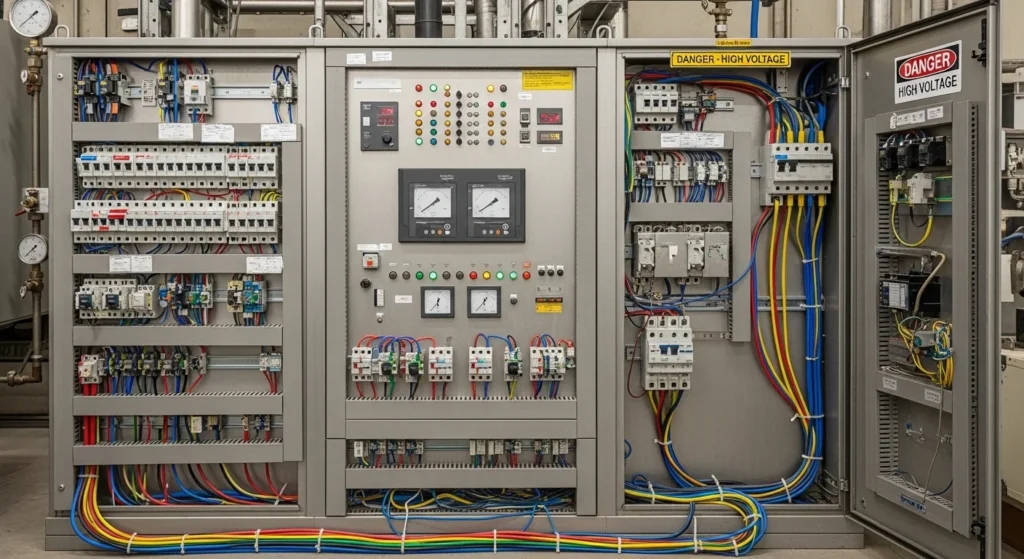

Imagine you walk into a factory where hundreds of motors, pumps, lights, and machines are operating smoothly. You see one large cabinet mounted against the wall with switches, breakers, meters, and indicator lights. That cabinet is the heart of the electrical system. If it is designed properly, everything works safely. If it is poorly designed, the entire system becomes dangerous.
This is why Electrical Panel Design is one of the most important skills for electrical engineers and technicians.
A well-designed panel ensures safety, proper load distribution, easy maintenance, and reliable operation. Whether you are working on a small house distribution board or a large industrial control panel, the design principles remain very important.
In this article, you will learn the Electrical Panel Design working principle, types, components, applications, advantages and disadvantages, comparison with similar systems, selection guide, troubleshooting tips, and future trends. I will explain everything in simple and practical language, just like a senior engineer guiding a junior on-site.
What Is Electrical Panel Design?
Electrical panel design is the process of planning, selecting, arranging, and connecting electrical components inside an electrical panel to safely distribute, control, protect, and monitor electrical power.
An electrical panel acts as the control center of an electrical system. It receives electrical power from the main supply and distributes it to different circuits and loads such as lights, sockets, motors, machines, HVAC systems, and industrial equipment.
A proper electrical distribution panel design must consider electrical safety, load requirements, circuit protection, cable size, voltage, current, earthing, panel space, and future expansion.
Simple Explanation of Electrical Panel Design
Think of an electrical panel as a traffic control center.
Electricity enters through the main supply. The panel then sends power to different outgoing circuits. Circuit breakers and other protection devices stop or disconnect the supply when a dangerous condition occurs.
For example, a residential electrical panel may contain:
- Main circuit breaker
- MCBs
- RCCB or RCD
- Busbars
- Neutral bar
- Earth bar
- Incoming and outgoing terminals
An industrial electrical control panel may also include:
- Contactors
- Overload relays
- Control transformers
- Timers
- Push buttons
- Selector switches
- PLCs
- Control relays
- Meters
- Motor protection devices
Practical Examples of Electrical Panel Design
In a house, a distribution board (DB) distributes electrical power to lighting, sockets, air conditioners, and other circuits.
In a commercial building, an electrical distribution panel may supply several floors, lighting systems, HVAC equipment, and other electrical loads.
In a factory, a motor control panel may control several motors using contactors, overload relays, circuit breakers, and control devices.
Although these panels have different designs, the main purpose remains the same: safe electrical power distribution, protection, and control.
Main Goals of Electrical Panel Design
A good electrical panel design should provide:
- Safe power distribution
- Short circuit protection
- Overload protection
- Proper cable and breaker selection
- Reliable equipment control
- Easy maintenance
- Clear circuit identification
- Proper earthing
- Good heat management
- Enough space for wiring
- Future expansion capacity
Electrical Panel Design Working Principle
The electrical panel design working principle is based on controlled power distribution, circuit protection, equipment control, and electrical safety.
Electrical power enters the panel through an incoming supply. The main protection device controls the overall supply and provides protection against faults. Power is then distributed through busbars or suitable distribution components to individual outgoing circuits.
Each circuit is protected according to its load and electrical requirements.
Step-by-Step Electrical Panel Working
Incoming Power Supply
Electrical power first enters the panel from the utility supply, generator, transformer, or another power source.
The incoming supply may contain:
- Phase conductors
- Neutral conductor
- Protective earth conductor
The incoming rating must match the expected electrical load and panel requirements.
Main Circuit Breaker
The incoming power normally passes through a main circuit breaker or suitable isolating and protective device.
The main breaker allows the entire panel to be switched off and provides protection against certain overcurrent conditions.
Depending on the system, the main protection may use an MCB, MCCB, ACB, fuse, or another suitable protective device.
Busbar Power Distribution
After the main protection device, electrical power is distributed through busbars.
Busbars provide a convenient and reliable method of distributing electrical power to outgoing circuits.
A panel may contain:
- Phase busbars
- Neutral bar
- Earth bar
The busbar rating must be suitable for the expected current and fault conditions.
Branch Circuit Protection
Power is then supplied to individual outgoing circuits.
Each circuit normally has an appropriate protective device, such as:
- MCB
- MCCB
- Fuse
- RCBO
- RCD/RCCB
The protective device should be selected according to the circuit load, cable rating, voltage, fault level, and applicable electrical requirements.
Control Devices
Industrial electrical control panels often contain devices that control motors and machines.
Common control components include:
- Contactors
- Overload relays
- Control relays
- Timers
- Push buttons
- Selector switches
- PLCs
For example, a contactor can switch power to a motor while an overload relay helps protect the motor from excessive current.
Electrical Monitoring
Meters and monitoring devices can be installed to check system conditions.
Depending on the panel, these may measure:
- Voltage
- Current
- Power
- Energy
- Frequency
- Power factor
Digital meters can make fault finding and system monitoring easier.
Earthing and Grounding
A proper electrical panel grounding and earthing system is essential for safety.
The earth bar provides a connection for protective conductors and helps provide a safe path for fault current.
Proper earthing can help reduce the risk of electric shock and equipment damage during faults.
Cable Entry and Wiring
Incoming and outgoing cables enter the panel through suitable cable glands, openings, or cable management systems.
Good electrical panel wiring should be:
- Neat
- Properly identified
- Correctly terminated
- Protected from mechanical damage
- Separated where required
- Easy to inspect and maintain
Proper wire routing also makes future troubleshooting easier.
Main Components of an Electrical Panel
Main Circuit Breaker
The main circuit breaker controls and protects the incoming electrical supply.
It allows the complete panel to be disconnected when maintenance or emergency isolation is required.
MCB
An MCB (Miniature Circuit Breaker) protects individual circuits from overcurrent and short circuit conditions.
MCBs are commonly used in residential and commercial distribution panels.
MCCB
An MCCB (Molded Case Circuit Breaker) is commonly used for higher-current applications.
It can provide protection and switching for larger electrical loads.
RCCB or RCD
An RCCB/RCD is designed to detect leakage or residual current and disconnect the circuit when the leakage reaches a dangerous level.
It is an important part of electrical shock protection systems.
Busbar
A busbar is a conductive component used to distribute electrical power inside the panel.
It must have a suitable current rating and adequate insulation or clearance based on the panel design.
Contactor
A contactor is an electrically controlled switching device commonly used to control motors, heaters, lighting systems, and other loads.
Overload Relay
An overload relay protects motors from prolonged excessive current.
It is commonly used with a contactor in motor control panels.
Neutral Bar
The neutral bar provides connection points for neutral conductors where the panel and electrical system require them.
Earth Bar
The earth bar provides connection points for protective earthing conductors.
Electrical Meter
Meters allow operators and technicians to monitor electrical parameters such as voltage and current.
Electrical Panel Design Considerations
Load Calculation
Before selecting panel components, the expected electrical load should be calculated.
The design may consider:
- Connected load
- Maximum demand
- Diversity
- Motor starting current
- Continuous loads
- Future loads
Correct load calculation helps prevent undersized equipment and unnecessary oversizing.
Circuit Breaker Selection
Circuit breakers should be selected according to the circuit requirements.
Important factors include:
- Rated current
- Operating voltage
- Number of poles
- Breaking capacity
- Load characteristics
- Cable rating
Cable Size Selection
The cable must be suitable for the expected current and installation conditions.
Cable selection may consider:
- Current-carrying capacity
- Voltage drop
- Installation method
- Ambient temperature
- Cable length
- Short circuit withstand capability
Panel Size and Space
The enclosure should have enough space for all components, wiring, terminals, and cable entry.
Extra space can also be useful for future expansion and maintenance.
Heat and Ventilation
Electrical components generate heat during operation.
A panel design should consider:
- Component heat generation
- Ambient temperature
- Ventilation
- Cooling fans
- Filters
- Enclosure type
Good thermal management can improve equipment reliability.
Safety and Protection
Electrical panel design should include suitable protection against:
- Short circuits
- Overloads
- Earth faults
- Electrical leakage
- Overheating
- Accidental contact
The final design should follow the electrical codes, standards, and local requirements applicable to the installation.
Electrical Panel Design vs Electrical Control Panel
| Feature | Electrical Distribution Panel | Electrical Control Panel |
|---|---|---|
| Main purpose | Power distribution | Equipment control |
| Common use | Buildings and facilities | Industrial machines |
| Main components | MCB, MCCB, RCCB, busbar | Contactors, relays, overloads, PLC |
| Main function | Distributes power | Controls equipment |
| Typical loads | Lights, sockets, HVAC | Motors and machines |
| Control wiring | Limited | More extensive |
| Monitoring | Basic to advanced | Often advanced |
Benefits of Proper Electrical Panel Design
A properly designed panel provides several benefits.
Improved Electrical Safety
Correct circuit protection helps reduce the risk of electrical faults, overheating, and equipment damage.
Reliable Power Distribution
A well-designed panel distributes electrical power efficiently to different circuits.
Easy Maintenance
Clear labels, organized wiring, and accessible components make inspection and repair easier.
Better Equipment Protection
Correct breakers, overload protection, and other protective devices help protect electrical equipment.
Future Expansion
A panel designed with spare space and capacity can make future upgrades easier.
Common Electrical Panel Design Problems
Overloaded Circuit
An overloaded circuit can cause excessive current and heating.
Solution: Check the load, cable rating, and protective device. Reduce the load or redesign the circuit when required.
Incorrect Breaker Size
An incorrectly selected breaker may provide poor protection.
Solution: Match the protective device with the cable, load, and system requirements.
Loose Connections
Loose terminals can cause heating, voltage drop, and equipment failure.
Solution: Inspect and properly tighten connections according to the equipment manufacturer’s requirements.
Poor Panel Wiring
Messy or unidentified wiring makes troubleshooting difficult.
Solution: Use proper wire routing, ferrules, terminal blocks, labels, and cable management.
Poor Earthing
Poor earthing can create serious electrical safety risks.
Solution: Verify the protective earthing system and connections according to applicable electrical requirements.
Electrical Panel Design Applications
Electrical panels are used in many locations, including:
- Residential buildings
- Commercial buildings
- Factories
- Warehouses
- Hospitals
- Shopping centers
- Data centers
- Water treatment plants
- HVAC systems
- Solar power systems
- Manufacturing plants
- Motor control systems
Industrial electrical panels are especially important where several machines and motors must be controlled and protected.
Frequently Asked Questions About Electrical Panel Design
What is electrical panel design?
Electrical panel design is the process of selecting and arranging electrical components to safely distribute, control, protect, and monitor electrical power.
What are the main components of an electrical panel?
Common components include circuit breakers, busbars, contactors, overload relays, terminal blocks, neutral bars, earth bars, meters, and control devices.
What is the purpose of an electrical distribution panel?
An electrical distribution panel receives electrical power and distributes it safely to multiple outgoing circuits.
What is the difference between a distribution panel and a control panel?
A distribution panel mainly distributes electrical power, while a control panel is designed to control equipment such as motors and industrial machines.
Why is load calculation important in panel design?
Load calculation helps determine suitable breaker ratings, cable sizes, panel capacity, and other components.
Why is earthing important in an electrical panel?
Earthing provides a protective path for fault current and helps reduce the risk of electric shock and equipment damage.
What should be considered when designing an electrical panel?
Important factors include load calculation, voltage, current, breaker selection, cable size, fault level, enclosure size, heat management, earthing, wiring, maintenance, and applicable electrical standards.
Types / Classification of Electrical Panels(2026 Edition)
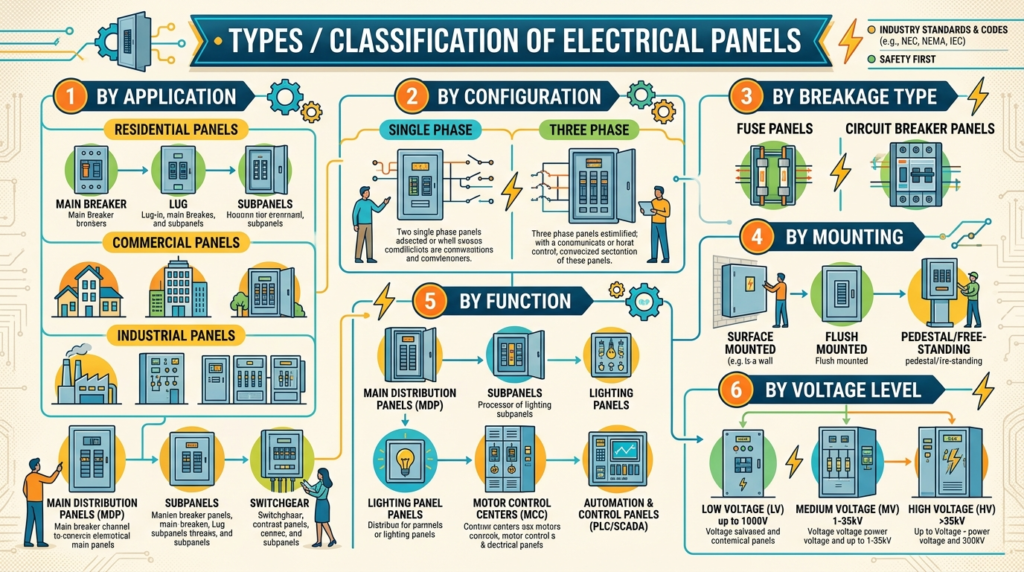
Electrical panels are classified into different types based on their function, voltage level, and application in electrical distribution systems. The most common types include main distribution panels (MDP), subpanels, motor control centers (MCC), power control centers (PCC), and lighting control panels. A main distribution panel receives electrical power from the utility supply or transformer and distributes it to various circuits within a building or industrial facility. Subpanels are smaller panels connected to the main panel to supply electricity to specific areas or equipment. Motor control centers are designed to control and protect electric motors using starters, breakers, and relays, while power control centers handle high-power industrial loads and heavy machinery. Lighting control panels manage lighting circuits in homes, offices, and commercial buildings. Electrical panels may also be classified as low-voltage, medium-voltage, or high-voltage panels depending on operating voltage levels. Understanding the types and classification of electrical panels is important for electrical students, engineers, and technicians because proper panel selection improves electrical safety, load management, system reliability, and efficient power distribution.
Complete Guide to Electrical Panels: MDP, SDP, MCC, PCC & Control Panels
Electrical panels are the backbone of any building, factory, or industrial system. They control, distribute, and protect electrical power safely and efficiently. Each type of panel has a specific role in power management and automation.
Below is a complete and updated guide to the main types of electrical panels.
Main Distribution Panel (MDP) – The Heart of Power Distribution
The Main Distribution Panel (MDP) is the primary panel that receives electrical power from the transformer or main power source.1. Main Distribution Panel (MDP) – The Heart of Power Distribution (Detailed Guide)
The Main Distribution Panel (MDP) is one of the most important components in any electrical power distribution system. It is often called the “heart of electrical distribution” because it controls and distributes electricity from the main power source to different parts of a building, commercial complex, or industrial plant. Without the MDP, safe and organized power distribution would not be possible.
The MDP receives high-voltage or main electrical supply directly from the transformer, generator, or utility grid. This incoming power is then carefully controlled, monitored, and divided into multiple outgoing circuits. These circuits supply electricity to sub-distribution panels (SDPs), motor control centers (MCCs), lighting systems, machinery, and other electrical loads. In this way, the MDP acts as a central hub that ensures every area receives the correct amount of power.
One of the most important functions of the MDP is protection. It contains various protective devices such as air circuit breakers (ACB), molded case circuit breakers (MCCB), fuses, and protective relays. These components automatically disconnect the power supply in case of overload, short circuit, or electrical fault. This helps prevent damage to equipment, reduces fire risks, and ensures the safety of both electrical systems and personnel.
The MDP also plays a key role in load management and power control. Electrical loads are carefully balanced and distributed to avoid overloading any single circuit. This improves system efficiency and stability. In large industrial setups, the MDP may also include metering devices, power monitoring systems, and smart control units that help engineers track voltage, current, and power consumption in real time.
From a design perspective, the MDP is built inside a strong metal enclosure to ensure safety and durability. It is usually installed in a dedicated electrical room for easy maintenance and accessibility. Proper cable management, labeling, and insulation are also important features of a well-designed MDP.
In modern electrical systems, the MDP is not just a distribution box—it is a complete power management system. It ensures that electricity is distributed efficiently, safely, and reliably across all connected systems. Whether in a residential building, commercial tower, or industrial plant, the MDP remains the central point that keeps the entire electrical network running smoothly and safely.
Key Functions:
- Receives main incoming electrical supply
- Distributes power to sub-distribution panels (SDPs)
- Protects the entire electrical system using circuit breakers
Where It Is Used:
- Large buildings
- Commercial complexes
- Industrial plants
Importance:
The MDP acts as the central control point for electricity distribution, ensuring safe and organized power flow throughout the system.
Sub Distribution Panel (SDP) – Area-Based Power Distribution System
The Sub Distribution Panel (SDP) is an important part of an electrical distribution system that works after the Main Distribution Panel (MDP). It receives electrical power from the MDP and then further distributes it to specific zones, floors, or departments within a building. This helps in organizing the electrical system in a structured and safe way.
Key Functions of Sub Distribution Panel (SDP):
- Receives power supply from the Main Distribution Panel (MDP)
- Distributes electricity to specific areas, floors, or sections
- Helps in balancing electrical load across different zones
- Improves safety by isolating faults in specific areas only
- Supports efficient power management in large installations
Where Sub Distribution Panels Are Used:
- Multi-story commercial buildings
- Residential apartments and housing societies
- Hospitals and healthcare facilities
- Office buildings and shopping malls
- Educational institutions
Importance of SDP in Electrical Systems:
The Sub Distribution Panel plays a major role in improving the efficiency and safety of electrical systems. By dividing the main electrical supply into smaller sections, it ensures that each area receives a controlled and stable power supply. In case of any fault, only the affected zone is disconnected, which helps reduce downtime and prevents disruption in the entire building.
SDPs also make maintenance easier because electricians can work on specific sections without shutting down the complete system. This makes the electrical network more reliable, organized, and easier to manage in both residential and industrial environments.
Motor Control Center (MCC) – Industrial Motor Management and Control System
The Motor Control Center (MCC) is an essential electrical system used in industrial environments to control, manage, and protect multiple electric motors from a single centralized location. It is widely used in factories and large industrial plants where many motors operate simultaneously for different machines and processes. The MCC ensures smooth operation, safety, and efficient control of all motor-driven equipment.
Key Components of Motor Control Center (MCC):
- Contactors for switching motor circuits ON and OFF
- Overload relays for motor protection against excess current
- Motor starters for safe starting of motors
- Circuit breakers for fault protection and safety isolation
Key Functions of MCC:
- Starts and stops multiple motors efficiently from a central system
- Protects motors from overload, short circuits, and electrical faults
- Provides centralized control for easy monitoring and operation
- Improves coordination between different industrial machines
- Enhances system safety and reduces manual intervention
Where Motor Control Centers Are Used:
- Manufacturing and production plants
- Heavy industrial factories
- Chemical and processing industries
- Oil and gas facilities
- Water treatment and pumping stations
Importance of MCC in Industrial Systems:
The Motor Control Center plays a vital role in modern industrial automation and power control. It improves overall motor performance by ensuring safe operation and reducing the risk of electrical failures. By centralizing motor control, MCC makes industrial systems more organized, efficient, and easier to maintain. It also reduces downtime and increases productivity, which is highly important in large-scale industrial operations.
Power Control Center (PCC) – High Power Management System
The Power Control Center (PCC) is used for controlling and distributing large electrical loads in heavy industries.
Key Functions:
- Controls high-capacity power distribution
- Manages heavy electrical loads
- Provides system protection and monitoring
Where It Is Used:
- Power plants
- Steel industries
- Oil & gas facilities
Importance:
PCC ensures stable and safe operation of high-power electrical systems.
Control Panel – Automation and System Intelligence
A Control Panel is used for automation and controlling machines or processes.
Key Components:
- PLC (Programmable Logic Controller)
- Relays
- Timers
- Sensors
- Switches and indicators
Key Functions:
- Automates industrial processes
- Monitors system performance
- Controls machines intelligently
Where It Is Used:
- Automated factories
- HVAC systems
- Production lines
Importance:
Control panels increase productivity, reduce manual work, and improve system accuracy.
Electrical panels such as MDP, SDP, MCC, PCC, and Control Panels play a vital role in modern electrical systems. Each panel is designed for a specific function—ranging from basic power distribution to advanced industrial automation.
Together, they ensure:
- Safe power distribution
- Efficient load management
- Reliable system operation
- Industrial automation and control
Understanding these panels is essential for electrical students, engineers, and technicians working in the power and industrial sector.
Main Components of Electrical Panel (2026 Edition)
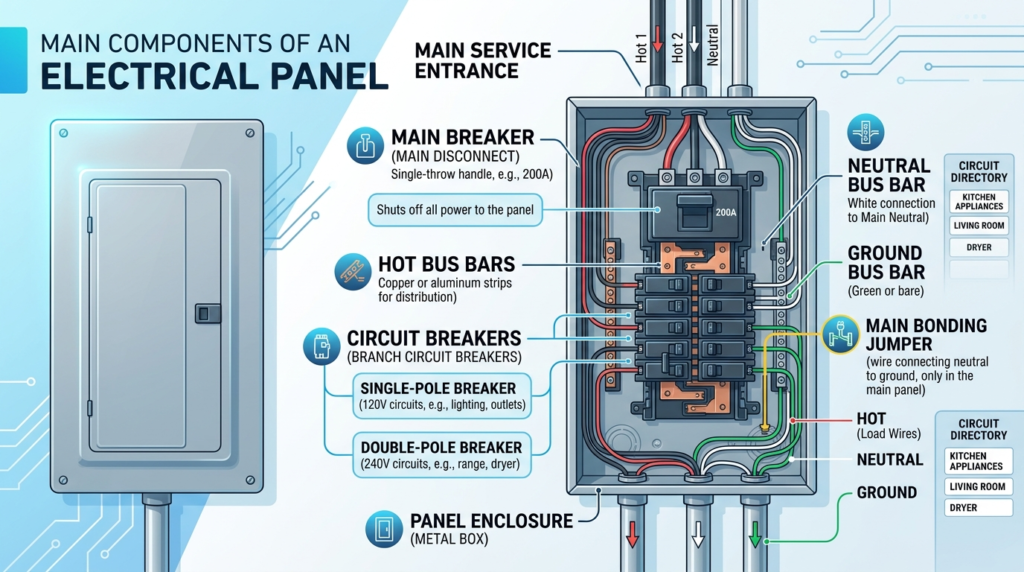
An electrical panel consists of several important components that work together to control, distribute, and protect electrical power within a system. The main component is the circuit breaker, which protects electrical circuits from overloads and short circuits by automatically disconnecting faulty circuits. Busbars are metallic strips that distribute electrical power to different breakers and circuits inside the panel. The main switch or isolator is used to manually disconnect the entire electrical supply for maintenance and safety purposes. Protective devices such as fuses, relays, and surge protectors help prevent equipment damage caused by faults, overcurrent, or voltage surges. Wiring and terminal blocks provide organized electrical connections between incoming and outgoing circuits. In industrial panels, contactors and motor starters are used to control motors and heavy electrical loads. Modern electrical panels may also include meters, indicator lights, and monitoring systems for voltage, current, and power measurement. Understanding the main components of an electrical panel is important for electrical students, engineers, and technicians because these components ensure safe operation, efficient power distribution, and reliable protection of electrical systems.
Understanding components is essential for proper design.
Circuit Breaker
A circuit breaker protects an electrical circuit from dangerous overload and short circuit conditions. It automatically disconnects the power when the current becomes too high. Common types include MCB, MCCB, and ACB. The correct breaker rating should be selected according to the load, cable size, voltage, and required protection.
Busbar
A busbar is a conductive metal bar used to distribute electrical power inside an electrical panel. It can carry high current and supply power to multiple outgoing circuits. Busbars are commonly made from copper or aluminum and must have a suitable current rating, insulation, spacing, and fault withstand capability.
Contactor
A contactor is an electrically operated switch used to control motors, heaters, lighting systems, and other heavy electrical loads. It allows a low-power control circuit to switch a higher-power circuit. Contactors are widely used in motor control panels and industrial electrical control systems.
Overload Relay
An overload relay protects an electric motor from prolonged excessive current. If a motor draws too much current for a certain period, the overload relay operates and signals the contactor to disconnect the motor. It helps reduce the risk of motor overheating and damage.
Relays
Relays are electrically operated switching devices used to control circuits and perform control or protection functions. A relay can use a small control signal to operate another circuit. Different types of relays are used for applications such as motor control, voltage monitoring, current protection, and automation systems.
Electrical Meters
Electrical meters are used to monitor important electrical parameters inside a panel. Depending on the panel design, meters can measure voltage, current, power, energy, frequency, and power factor. Digital meters make it easier for operators and technicians to monitor system performance and identify abnormal conditions.
Terminal Blocks
Terminal blocks provide organized connection points for incoming and outgoing electrical wires. They make panel wiring cleaner and easier to inspect, test, and maintain. Terminal blocks can also help separate power wiring, control wiring, neutral connections, and other circuits according to the panel design.
Earthing Bar
An earthing bar or grounding bar provides a common connection point for protective earth conductors inside an electrical panel. It helps provide a safe path for fault current and reduces the risk of electric shock. Proper earthing and bonding are essential parts of a safe electrical panel design.
Proper Electrical Panel Layout
A proper electrical panel layout should provide enough space for components, wiring, cable entry, ventilation, inspection, and maintenance. Components should be arranged logically, with clear labels and suitable separation between power and control circuits where required.
A well-organized layout makes electrical panel wiring easier to understand and helps technicians locate components quickly during troubleshooting or maintenance. It also improves safety, reliability, and future panel expansion.
Electrical Panel Design Advantages and Disadvantages(2026 Edition)
Advantages
- Safe power distribution
- Organized wiring
- Easy fault detection
- Better load management
- Protection against electrical hazards
- Supports automation
These Electrical Panel Design advantages and disadvantages must be evaluated before installation.
Disadvantages / Limitations
- High initial design cost
- Requires skilled engineering
- Space requirement
- Poor design can cause overheating
- Maintenance required regularly
Proper planning reduces these limitations.
Electrical Panel Design Applications (2026 Edition)
Electrical panel design is used in almost every building and industrial facility where electrical power needs to be distributed, controlled, and protected. A properly designed electrical panel improves safety, reliability, energy management, and maintenance.
Residential Buildings
In homes and apartments, electrical distribution panels supply power to lighting, sockets, air conditioners, water heaters, kitchen appliances, and other loads. The panel normally contains circuit breakers, busbars, neutral and earthing connections, and other protection devices.
A good residential electrical panel design helps protect household circuits from overloads, short circuits, and electrical faults.
Commercial Buildings
Offices, shopping malls, hotels, schools, and hospitals use electrical distribution panels to manage larger electrical loads. These panels may supply lighting systems, HVAC equipment, elevators, pumps, computers, and other building services.
Commercial electrical panel design must provide proper load distribution, circuit protection, cable management, and easy maintenance.
Industrial Plants
Industrial facilities use advanced electrical control and distribution panels for motors, pumps, compressors, conveyors, machines, and production equipment. Motor Control Centers (MCCs), PLC panels, and automation panels are common examples.
Industrial panel design focuses on motor protection, overload protection, control circuits, automation, safety, and reliable power distribution.
Renewable Energy Systems
Solar power systems also require specially designed electrical panels. Solar distribution panels, DC combiner panels, AC distribution panels, and inverter panels help safely manage power generated by solar panels.
These panels may include DC protection devices, circuit breakers, surge protection, isolators, busbars, and monitoring equipment.
Data Centers
Data centers need highly reliable electrical panel systems because servers and networking equipment must receive continuous and stable power. Electrical panels are used for power distribution, backup systems, UPS systems, cooling equipment, and emergency power.
Data center panel design focuses on reliability, redundancy, protection, monitoring, and continuous power availability.
Infrastructure and Utility Systems
Electrical panels are also used in water treatment plants, transportation facilities, telecommunications sites, warehouses, and utility installations. These panels control and distribute power to pumps, lighting, ventilation, communication equipment, and other essential systems.
Proper electrical panel design ensures that each load receives the correct power while maintaining electrical safety and system reliability.
In short, electrical panels are the backbone of modern electrical systems. A well-designed panel provides safe power distribution, effective protection, easier troubleshooting, and reliable operation in residential, commercial, industrial, and renewable energy applications.
Comparison Section
Difference Between PCC and MCC Panel
| Feature | PCC Panel | MCC Panel |
| Main Purpose | Power distribution | Motor control |
| Load Type | General loads | Motors |
| Components | Breakers, meters | Contactors, overloads |
| Application | Main plant supply | Production lines |
| Control Level | Limited control | Detailed motor control |
The difference between PCC and MCC panel is mainly in application and control level.
Electrical Panel Selection Guide (2026 Edition)
Choosing the right electrical panel design requires careful consideration of the electrical load, voltage, installation environment, protection requirements, and future expansion. A proper selection improves safety, reliability, performance, and maintenance.
Electrical Load Requirement
First, calculate the total electrical load that the panel will supply. The load may be measured in kW, kVA, or amperes, depending on the system.
Consider lighting, sockets, motors, HVAC equipment, heaters, and other connected loads. The main breaker, busbar, cables, and panel rating should be selected according to the calculated load.
Voltage and Phase Level
Determine whether the electrical system is single-phase or three-phase. The panel voltage must match the incoming electrical supply and connected equipment.
Three-phase panels are commonly used for commercial and industrial applications, while single-phase panels are widely used in residential installations.
Installation Environment
Consider where the electrical panel will be installed. Indoor panels normally have different requirements from outdoor panels.
For outdoor, dusty, humid, or harsh environments, the enclosure should provide suitable protection against water, dust, moisture, corrosion, and other environmental conditions.
Protection and IP Rating
Select the required IP (Ingress Protection) rating according to the installation environment. A higher IP rating provides better protection against dust and water.
The panel may also require circuit breakers, surge protection, overload protection, short-circuit protection, and other protective devices.
Panel Size and Future Expansion
Do not design a panel only for the present load. Leave sufficient space for future circuits, additional breakers, terminal blocks, and equipment.
Extra capacity makes future modifications easier and can reduce the cost and difficulty of upgrading the panel later.
Busbar and Circuit Breaker Rating
The busbar and circuit breakers must be selected according to the expected current and fault conditions. The breaker rating should also be coordinated with the cable size and connected load.
Proper breaker and busbar selection helps prevent overheating, equipment damage, and electrical faults.
Safety Standards and Electrical Codes
Electrical panel design should follow the applicable electrical codes, standards, and local regulations. Proper earthing, insulation, clearances, labeling, enclosure protection, and circuit protection should be considered during the design.
Single-Line Diagram
Beginners should prepare a single-line diagram (SLD) before starting the electrical panel design. It provides a simple visual representation of the power source, main breaker, busbars, outgoing circuits, protection devices, and loads.
A clear single-line diagram makes panel design, wiring, inspection, troubleshooting, and future modifications much easier.
Common Electrical Panel Problems and Solutions (2026 Edition)
Even a properly designed electrical panel can develop problems because of overloading, poor wiring, loose connections, inadequate ventilation, or incorrect component selection. Regular inspection and preventive maintenance help identify these issues before they become serious.
Why Does an Electrical Panel Overheat?
Reason: An electrical panel may overheat because of overloaded circuits, loose connections, undersized cables, poor ventilation, or components operating above their rated current.
Solution: Check the total electrical load, inspect terminals and connections, ensure proper ventilation, and verify that breakers, busbars, and cables have suitable ratings.
Why Does the Circuit Breaker Trip Frequently?
Reason: Frequent breaker tripping can occur because of an overloaded circuit, short circuit, faulty equipment, or an incorrectly selected circuit breaker.
Solution: Check the connected loads and wiring for faults. If the circuit is overloaded, redistribute the load or redesign the circuit. Do not simply replace the breaker with a higher-rated one without checking the cable and system capacity.
Why Is Electrical Panel Wiring Messy?
Reason: Messy wiring is usually caused by poor panel layout, insufficient planning, incorrect cable routing, or a lack of cable management.
Solution: Plan the panel layout before installation. Use suitable cable ducts, terminal blocks, wire markers, and clear labeling. Keep power and control wiring properly organized.
Why Is Voltage Drop High?
Reason: High voltage drop can result from undersized cables, long cable runs, excessive load current, or poor electrical connections.
Solution: Calculate the expected voltage drop and select the correct cable size for the load and installation distance. Check all terminals and connections for unwanted resistance.
Why Are Electrical Connections Loose?
Reason: Loose terminals can develop because of vibration, thermal expansion, poor installation, or inadequate tightening.
Solution: Inspect and tighten connections according to the component manufacturer’s requirements. Regular maintenance can help prevent overheating and electrical faults caused by loose connections.
Why Does the Panel Make Unusual Noise?
Reason: Humming, buzzing, or unusual sounds may indicate a faulty contactor, relay, transformer, loose connection, or overloaded component.
Solution: Switch off the system safely and inspect the suspected component. Qualified personnel should diagnose electrical faults before the panel is returned to service.
Regular inspection, proper load management, thermal checks, connection inspection, and preventive maintenance are essential for keeping an electrical panel safe and reliable.
Future Trends in Electrical Panel Design (2026 Edition)
Electrical panel design is moving toward smarter, more connected, compact, and energy-efficient systems. Modern panels are increasingly combining traditional electrical protection with digital monitoring and automation.
Smart Electrical Panels
Smart panels can monitor electrical loads and system conditions in real time. With connected monitoring systems, users can receive information about energy consumption, overload conditions, and certain electrical faults.
Digital Metering and Energy Monitoring
Modern electrical panels increasingly use digital meters to measure voltage, current, power, energy consumption, frequency, and power factor.
This information helps technicians and facility managers understand electrical usage, identify unusual loads, and improve energy management.
IoT-Based Remote Monitoring
Internet of Things (IoT) technology allows electrical panel information to be monitored remotely. Sensors and communication systems can send operating data to computers or mobile platforms.
Remote monitoring can help detect abnormal conditions earlier and reduce unnecessary inspection time.
Compact and Modular Panel Design
Modern electrical panels are becoming more compact and modular. Modular components make it easier to install, replace, and expand circuits while making better use of available space.
Compact panel designs are especially useful where installation space is limited.
Solar and Battery Integration
The growth of renewable energy is increasing the need for panels that can safely integrate solar inverters, battery storage systems, AC distribution, and DC protection.
Future electrical panel designs will increasingly support bidirectional power flow and better energy management between the grid, solar system, batteries, and electrical loads.
PLC and Intelligent Automation
Industrial electrical panels are increasingly using Programmable Logic Controllers (PLCs), sensors, communication systems, and intelligent control devices.
These systems can automate motors, pumps, production equipment, and other industrial processes while providing better monitoring and control.
Predictive Maintenance
Advanced monitoring systems can collect electrical and temperature data to identify abnormal operating conditions before a major failure occurs.
This approach can help maintenance teams move from reactive repairs toward predictive and condition-based maintenance.
The future of electrical panel design will focus on intelligent monitoring, automation, renewable energy integration, compact construction, improved protection, and better energy efficiency.
Conclusion
Electrical Panel Design is a critical skill for every electrical engineer and technician. A well-designed panel ensures safe power distribution, proper load management, and reliable system performance. It includes careful selection of components, correct wiring layout, proper protection devices, and adherence to safety standards.
Understanding the Electrical Panel Design working principle, types, applications, and the difference between PCC and MCC panel helps build strong technical knowledge. Although it requires planning and experience, mastering panel design will greatly improve your engineering career.
Always focus on safety, calculation accuracy, and proper documentation. Strong fundamentals in panel design create safe and efficient electrical systems.