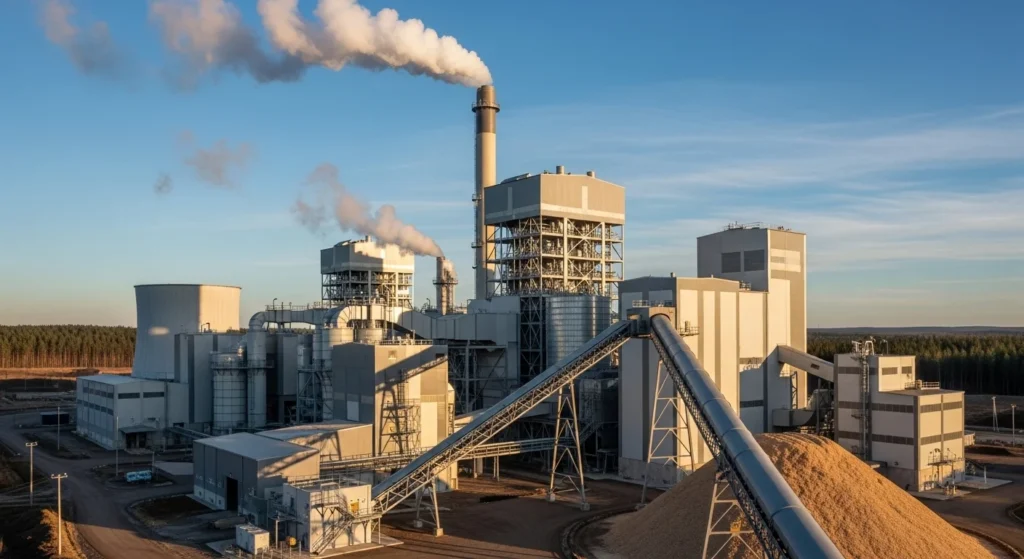

Imagine a small town surrounded by farms. After every harvest, large amounts of crop waste like rice husk and wheat straw are left behind. Instead of burning this waste and causing pollution, the town uses it to generate electricity. This is the real-world application of a Biomass Power Plant.
As electrical engineers, we must understand not only conventional power plants but also renewable energy systems. With increasing fuel prices and environmental concerns, biomass-based power generation is becoming more important worldwide.
In this article, you will learn the Biomass Power Plant working principle, its types, components, advantages and disadvantages, applications, and comparison with other power plants. I will explain everything in simple language, just like guiding a junior engineer in the field.
What is Biomass Power Plant (2026 Edition)
A Biomass Power Plant is a power generation system that produces electricity by burning organic materials such as agricultural waste, wood chips, animal waste, and other biodegradable materials.
In simple words, it converts plant and animal waste into electrical energy.
Simple Explanation
Plants store energy from the sun through photosynthesis. When we burn plant-based materials, this stored solar energy is released as heat. That heat is used to produce steam, which rotates a turbine connected to a generator. The generator produces electricity.
Practical Example
For example, rice husk collected from mills can be used as fuel in a biomass boiler. The boiler produces steam, which drives a steam turbine to generate power for local industries.
Biomass Power Plant Working Principle
Understanding the Biomass Power Plant working principle is very important for electrical students.
The working process is similar to a thermal power plant, but the fuel is organic waste instead of coal.
Step-by-Step Working Process
Fuel Collection
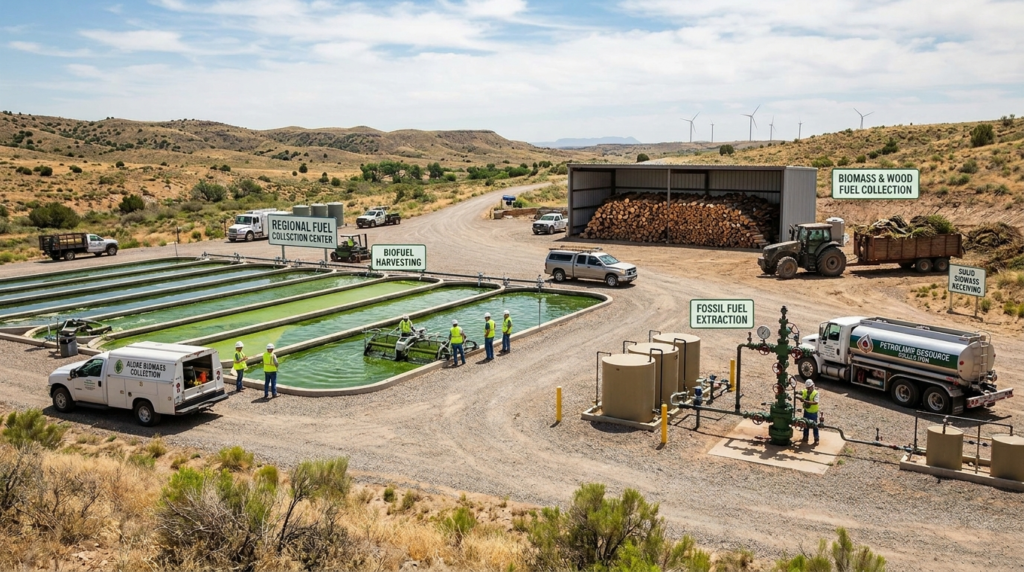
Fuel collection is the process of gathering, storing, and supplying fuel for use in engines, generators, power plants, industrial machines, and transportation systems. It is an important part of fuel management because proper fuel collection ensures continuous and reliable operation of equipment. The process may involve transporting fuel from storage tanks, pipelines, fuel stations, or delivery systems to the required machinery or power generation unit. Different types of fuels such as diesel, petrol, natural gas, coal, and biofuels are collected and handled according to their specific storage and safety requirements. Proper fuel collection systems include storage tanks, pumps, filters, pipelines, and monitoring equipment to maintain fuel quality and prevent contamination or leakage. Efficient fuel collection improves system performance, reduces operational interruptions, and supports safe energy production. In industries and power plants, fuel collection plays a major role in maintaining continuous power generation and smooth machine operation.
- Biomass such as wood chips, crop waste, or animal waste is collected.
Fuel Feeding System
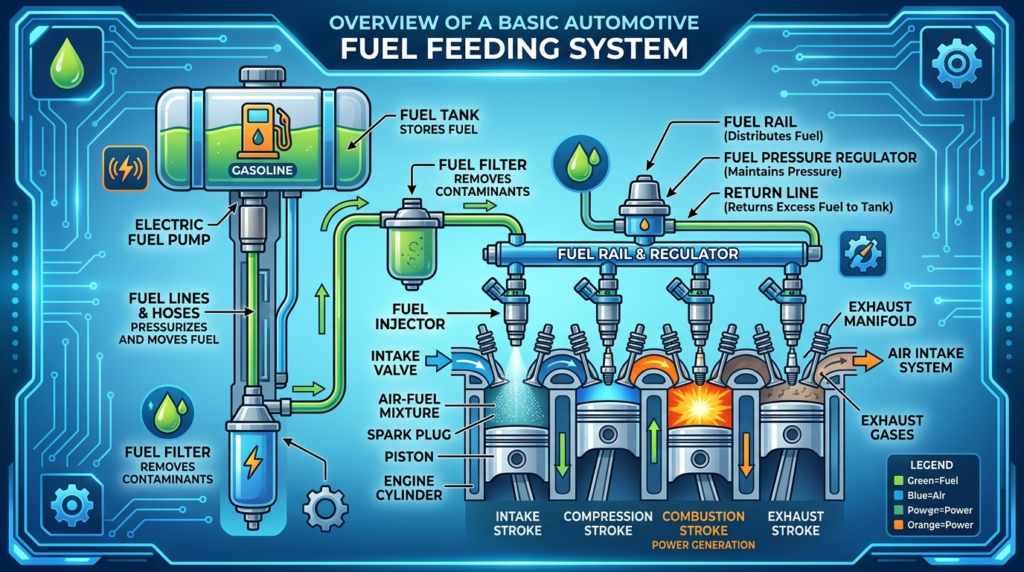
A fuel feeding system is a mechanical and electrical arrangement used to supply fuel from the storage tank to the engine, boiler, furnace, or power plant equipment in a controlled and continuous manner. Its main purpose is to deliver the correct amount of fuel at the required pressure and flow rate for efficient combustion and smooth operation. The system typically includes components such as fuel tanks, fuel pumps, filters, injectors, pipelines, and control valves. In diesel engines, the fuel feeding system sends clean diesel fuel to the injectors, which spray the fuel into the engine cylinder for combustion. In power plants and industrial systems, fuel feeding systems are used to supply coal, gas, oil, or other fuels to boilers and turbines. Proper fuel feeding improves fuel efficiency, engine performance, and energy production while reducing fuel wastage and operational problems. Due to its important role in combustion control and power generation, the fuel feeding system is an essential part of modern engines and industrial energy systems.
- The biomass fuel is supplied to a boiler or combustion chamber.
Combustion Process
- Biomass is burned to produce heat energy.
Steam Generation
- Heat converts water into high-pressure steam.
Turbine Rotation
- Steam rotates the steam turbine.
Electricity Generation
- The turbine drives an alternator or generator to produce electricity.
Exhaust and Ash Removal
- Flue gases are treated, and ash is removed safely.
Easy Analogy
Think of it like cooking food on a gas stove:
- Fuel burns → Heat is produced
- Heat boils water → Steam is formed
- Steam moves turbine → Electricity is generated
That is the core of the biomass system.
Types and Classification (2026 Edition)
Biomass power plants can be classified according to the type of biomass fuel, energy conversion method, plant configuration, and electricity-generation technology. Different systems are selected depending on the availability and characteristics of biomass, required power output, project location, investment budget, and desired efficiency. In 2026, the major biomass technologies include direct combustion, gasification, anaerobic digestion, and co-firing, while hybrid systems and combined heat and power (CHP) configurations are also becoming increasingly important.
Direct Combustion Biomass Power Plant
Direct combustion is one of the most established and widely used methods of biomass power generation. In this system, biomass is directly burned in a specially designed boiler to produce heat.
Working Process
- Biomass fuel is collected, processed, and fed into the boiler.
- The biomass is burned under controlled combustion conditions.
- Heat energy converts water into high-pressure steam.
- Steam flows through a steam turbine.
- The turbine rotates the generator.
- The generator converts mechanical energy into electrical energy.
- Exhaust steam is condensed and returned to the water cycle.
The basic energy conversion process is:
Biomass → Heat Energy → Steam Energy → Mechanical Energy → Electrical Energy
Common Biomass Fuels
- Wood chips.
- Agricultural residues.
- Sugarcane bagasse.
- Rice husks.
- Forestry waste.
- Crop residues.
Direct combustion is particularly suitable for medium- and large-scale biomass power generation where a consistent supply of suitable biomass fuel is available.
Gasification Biomass Power Plant
Biomass gasification converts solid biomass into a combustible gas instead of directly burning the material to generate steam.
During gasification, biomass reacts with a controlled amount of oxygen, air, or steam at elevated temperatures to produce a gas containing combustible components such as hydrogen and carbon monoxide.
Working Process
- Biomass is dried and prepared.
- Prepared biomass enters the gasifier.
- Controlled thermal conversion takes place.
- Producer gas or syngas is produced.
- The gas is cleaned and conditioned.
- The gas is supplied to a gas engine, turbine, or other energy-conversion equipment.
- Mechanical energy drives a generator.
- Electricity is produced.
Advantages
- Potentially high conversion efficiency for suitable applications.
- Suitable for certain dry biomass fuels.
- Can be used for decentralized electricity generation.
- Can support combined heat and power systems.
- Produces a combustible gas that can have multiple applications.
Gasification systems generally require more sophisticated fuel preparation, gas cleaning, and process control than conventional direct combustion systems.
Anaerobic Digestion Biomass Power Plant
Anaerobic digestion is a biological method of producing energy from organic materials. Instead of burning solid biomass directly, microorganisms break down organic matter in an oxygen-free environment.
Working Process
- Organic waste is collected and prepared.
- The material is placed inside an anaerobic digester.
- Microorganisms decompose the organic material without oxygen.
- Biogas containing mainly methane and carbon dioxide is produced.
- Biogas is cleaned and supplied to a gas engine or generator.
- Electricity and, in many systems, useful heat are produced.
Common Feedstocks
- Animal manure.
- Dairy farm waste.
- Food waste.
- Sewage sludge.
- Agricultural organic waste.
- Organic industrial waste.
Anaerobic digestion is particularly suitable for farms, wastewater facilities, food-processing industries, and rural energy systems.
An additional benefit is that the remaining digestate may be used as a soil amendment when it meets relevant quality and environmental requirements.
Co-Firing Biomass Power Plant
Co-firing involves using biomass together with another fuel, most commonly coal, in an existing or modified thermal power plant.
Working Process
- Biomass is processed into a suitable form.
- Biomass is mixed with coal or supplied through a separate fuel-feeding system.
- The combined fuel is burned in the boiler.
- Steam is produced.
- The steam turbine generates electricity.
Advantages
- Reduces the amount of coal required.
- Allows existing power-generation infrastructure to be utilized.
- Can reduce the fossil-fuel share of electricity generation.
- Provides a pathway for integrating biomass into conventional thermal plants.
- May reduce lifecycle emissions depending on biomass sourcing and plant operation.
The effectiveness of co-firing depends on biomass characteristics, boiler design, fuel-processing requirements, emission regulations, and the allowable biomass percentage.
Biomass Combined Heat and Power (CHP) Plant
A biomass CHP system produces both electricity and useful thermal energy from the same biomass fuel source.
Applications
- Industrial process heating.
- Sugar and food-processing facilities.
- Paper and pulp industries.
- District heating.
- Agricultural processing.
- Commercial facilities.
Instead of rejecting waste heat into the environment, CHP systems utilize it for useful purposes. This can significantly improve the overall energy utilization of the biomass fuel.
Hybrid Biomass Power Plant
Modern biomass plants can also be integrated with other renewable technologies.
Common Configurations
- Biomass + solar power.
- Biomass + wind power.
- Biomass + battery storage.
- Biomass + grid-connected systems.
- Biomass + microgrid systems.
Biomass can provide controllable generation while solar and wind generation varies according to weather conditions. This combination can improve overall renewable energy reliability.
Classification by Scale
Biomass power plants can also be classified according to their generating capacity and intended application.
Small-Scale Biomass Plants
Typically used for:
- Farms.
- Rural communities.
- Small industries.
- Local microgrids.
- Agricultural processing.
Medium-Scale Biomass Plants
Commonly used for:
- Industrial facilities.
- Commercial operations.
- Regional power generation.
- Combined heat and power applications.
Large-Scale Biomass Plants
Designed for:
- Utility-scale electricity generation.
- Grid-connected renewable power.
- Large industrial operations.
- Regional energy systems.
The appropriate scale depends on available biomass resources, electrical demand, grid infrastructure, and project economics.
Comparison of Major Biomass Technologies
| Feature | Direct Combustion | Gasification | Anaerobic Digestion | Co-Firing |
|---|---|---|---|---|
| Main Fuel | Solid biomass | Solid biomass | Organic waste | Biomass + coal |
| Conversion Method | Combustion | Thermochemical conversion | Biological digestion | Combined combustion |
| Main Output | Steam and electricity | Producer gas and electricity | Biogas and electricity | Steam and electricity |
| Typical Application | Medium/large plants | Small/medium systems | Farms and waste facilities | Existing thermal plants |
| Fuel Requirement | Suitable solid biomass | Generally prepared/dry biomass | Wet organic waste | Biomass suitable for boiler |
| System Complexity | Moderate | Higher | Moderate | Depends on existing plant |
| CHP Potential | High | High | High | Possible |
Main Components of a Biomass Power Plant (2026 Edition)
A biomass power plant consists of several interconnected mechanical, thermal, electrical, and fuel-handling systems that work together to convert biomass energy into useful electrical power. Each component has a specific function, and the performance of one system can directly affect the efficiency and reliability of the entire plant. In 2026, modern biomass power plants are increasingly equipped with automated fuel handling, advanced combustion controls, smart monitoring, improved emission-control equipment, and predictive maintenance systems.
Fuel Handling and Storage System
The fuel handling system is responsible for receiving, processing, storing, and transporting biomass fuel to the combustion or gasification unit.
Main Functions
- Collects and receives biomass from different sources.
- Stores biomass safely before use.
- Removes unwanted materials such as stones and metals.
- Controls biomass size and moisture where required.
- Transports fuel using conveyors, hoppers, or feeders.
- Provides a consistent fuel supply to the boiler or gasifier.
A reliable fuel handling system is essential because irregular fuel supply can cause unstable combustion and variations in power output.
Biomass Preparation System
Before biomass enters the combustion system, it may require processing to improve its quality and consistency.
Common Processes
- Drying.
- Chipping.
- Crushing.
- Screening.
- Size reduction.
- Removal of contaminants.
Proper fuel preparation improves combustion efficiency and helps prevent blockages in conveyors, feeders, and boilers.
Boiler or Combustion System
The boiler is one of the most important components of a conventional biomass power plant. It converts the chemical energy stored in biomass into thermal energy.
Main Functions
- Burns biomass under controlled conditions.
- Produces high-temperature heat.
- Transfers heat to water.
- Generates high-pressure steam.
- Maintains suitable combustion conditions.
Modern biomass boilers may include advanced combustion controls to regulate fuel and air supply, improve efficiency, and reduce emissions.
Steam Turbine
The steam turbine converts the energy contained in high-pressure steam into mechanical rotational energy.
Working Functions
- Receives high-pressure steam from the boiler.
- Steam expands through turbine stages.
- Expansion produces force on turbine blades.
- The rotor rotates at high speed.
- Mechanical power is transferred through the shaft to the generator.
The efficiency of the steam turbine has a significant effect on the overall electrical output of the biomass power plant.
Generator or Alternator
The generator converts mechanical energy from the turbine into electrical energy.
Main Functions
- Receives mechanical rotation from the turbine shaft.
- Uses electromagnetic induction to generate electricity.
- Produces electrical power at the required voltage.
- Supplies electricity to local loads or the electrical grid.
The generator must operate at the correct speed, voltage, frequency, and load conditions to maintain stable electrical output.
Condenser
The condenser converts exhaust steam from the turbine back into water.
Main Functions
- Condenses low-pressure steam.
- Recovers water for reuse.
- Maintains low turbine exhaust pressure.
- Improves the efficiency of the steam cycle.
- Reduces water consumption through recycling.
Maintaining an effective condenser vacuum is important for achieving good turbine performance.
Cooling System
The cooling system removes excess heat from the condenser and other plant equipment.
Common Cooling Equipment
- Cooling towers.
- Cooling water pumps.
- Heat exchangers.
- Cooling water pipelines.
- Fans and ventilation equipment.
An effective cooling system maintains suitable operating temperatures and prevents overheating of critical components.
Feedwater Pump
The feedwater pump returns condensed water to the boiler at the required pressure.
Functions
- Pumps water from the condenser or feedwater system.
- Increases water pressure.
- Supplies water back to the boiler.
- Supports continuous steam generation.
- Helps maintain the closed steam-water cycle.
Proper feedwater control is essential for stable boiler operation.
Ash Handling System
Biomass combustion produces ash that must be collected and removed safely.
Main Functions
- Collects bottom ash and fly ash.
- Transports ash away from the combustion area.
- Prevents ash accumulation.
- Supports safe disposal or reuse.
- Reduces blockages and equipment damage.
In some applications, biomass ash may be reused in agriculture, construction, or other industries, depending on its composition and applicable regulations.
Flue Gas and Emission Control System
The flue gas system handles exhaust gases produced during biomass combustion.
Important Functions
- Removes combustion gases from the boiler.
- Controls particulate emissions.
- Reduces harmful pollutants.
- Monitors exhaust-gas conditions.
- Directs treated gases safely through the stack.
Modern plants may use equipment such as cyclones, bag filters, electrostatic precipitators, and other emission-control technologies depending on the fuel and regulatory requirements.
Electrical Control and Protection System
The electrical control system manages power generation and protects equipment from abnormal operating conditions.
Key Functions
- Controls generator operation.
- Monitors voltage and frequency.
- Provides overload protection.
- Detects electrical faults.
- Controls synchronization with the grid.
- Monitors plant electrical parameters.
Digital control systems can also provide real-time data for operators and maintenance teams.
Smart Monitoring and Automation System
Modern biomass power plants increasingly use automation and digital monitoring to improve efficiency and reliability.
Modern Features
- Real-time temperature monitoring.
- Pressure and steam-flow measurement.
- Automated fuel feeding.
- Online emission monitoring.
- Remote equipment monitoring.
- Predictive maintenance alerts.
- Automatic fault detection.
- Performance and efficiency analysis.
These technologies help operators identify problems early and optimize plant performance.
Overall Energy Conversion Process
The major components work together through a continuous energy-conversion process:
Biomass Fuel → Combustion → Heat Energy → Steam → Steam Turbine → Mechanical Energy → Generator → Electrical Energy
The condenser, cooling system, feedwater pump, ash handling system, and control systems support this main process and ensure safe and continuous operation.
Advantages of Biomass Power Plants(2026 Edition)
Biomass power generation offers several benefits for electricity production, waste management, and rural development.
Renewable Energy Source
Biomass is considered a renewable energy resource when organic materials are produced and harvested sustainably. Agricultural residues, forestry waste, and other organic materials can be continuously replenished.
Uses Agricultural and Organic Waste
Biomass plants can convert materials that might otherwise be burned, dumped, or left unused into useful energy.
Common example
- Rice husks.
- Sugarcane bagasse.
- Wood residues.
- Crop stalks.
- Forestry waste.
- Animal waste.
- Food-processing residues.
This approach creates additional value from locally available resources.
Reduces Waste Disposal
Biomass power generation can support waste-management programs by converting suitable organic waste into electricity or heat.
This can:
- Reduce the amount of organic waste sent to landfills.
- Reduce uncontrolled waste burning.
- Recover useful energy from waste materials.
- Support circular-economy practices.
Lower Carbon Emissions Compared with Coal in Suitable Applications
Sustainably sourced biomass can have lower lifecycle greenhouse-gas emissions than conventional coal generation, although the actual environmental benefit depends on the biomass source, transportation, processing, and combustion technology.
Modern emission-control systems can further reduce pollutants from biomass combustion.
Supports Rural Economies
Biomass power plants can create economic opportunities in agricultural and rural areas.
Benefits.
- Additional income for farmers.
- Jobs in biomass collection and transportation.
- Development of local energy infrastructure.
- Better utilization of agricultural residues.
- Support for local industries.
Provides Controllable Renewable Power
Unlike solar and wind generation, biomass plants can generally be operated according to demand when fuel is available. This makes biomass useful for providing controllable renewable generation and supporting grid reliability.
Disadvantages and Limitations of Biomass Power Plants
Despite their benefits, biomass power plants have several technical and economic limitations that must be considered during project planning.
Large Fuel Storage Requirement
Biomass has a relatively low energy density compared with many conventional fuels. As a result, large quantities may need to be stored to maintain continuous plant operation.
Proper storage must protect biomass from:
- Rain and moisture.
- Fire hazards.
- Contamination.
- Biological degradation.
- Excessive humidity.
Lower Efficiency in Some Small-Scale Systems
The efficiency of biomass power generation depends strongly on plant size and technology. Small-scale systems may have lower electrical efficiency than large modern fossil-fuel or combined-cycle plants.
Advanced gasification, combustion, steam-cycle, and combined heat and power technologies can improve overall energy utilization.
Biomass Transportation Costs
Biomass materials are often bulky and have relatively low energy density. Transporting them over long distances can increase operating costs and environmental impact.
Locating a plant close to agricultural, forestry, or waste sources can significantly reduce transportation requirements.
Moisture Content Affects Combustion
High moisture content reduces the useful energy available from biomass because part of the combustion energy is consumed in evaporating water.
Excess moisture can result in:
- Lower combustion temperature.
- Reduced thermal efficiency.
- Increased fuel consumption.
- Unstable combustion.
- Higher operating costs.
Proper drying and fuel preparation can improve plant performance.
Regular Maintenance Requirements
Biomass fuel can contain ash, dust, soil, fibers, and other impurities that may increase wear and deposits in plant equipment.
Regular maintenance may be required for:
- Fuel conveyors.
- Feeders.
- Boilers.
- Gasifiers.
- Turbines.
- Ash-handling systems.
- Filters and emission-control equipment.
Proper maintenance improves reliability and extends equipment life.
Biomass Power Plant Applications(2026 Edition)
Biomass power plants have a wide range of applications in renewable energy, agriculture, industry, and waste management.
Rural Electrification
Small biomass power plants can provide electricity to rural communities where grid access is limited or unreliable.
Potential uses:
- Village electricity supply.
- Agricultural processing.
- Water pumping.
- Small businesses.
- Rural microgrids.
- Community facilities.
Local biomass resources can help reduce dependence on imported fuels.
Industrial Power Generation
Biomass is particularly useful in industries that produce large quantities of organic waste as part of their normal operations.
Examples.
- Sugar mills.
- Rice mills.
- Paper industries.
- Food-processing plants.
- Timber and wood-processing facilities.
- Agricultural processing industries.
These industries can use their own waste materials to generate electricity and heat.
Combined Heat and Power (CHP)
Biomass-based CHP systems produce both electricity and useful thermal energy.
The generated heat can be used for:
- Industrial process heating.
- Steam production.
- Drying agricultural products.
- Water heating.
- District heating.
Using both electricity and heat improves overall energy utilization.
Waste-to-Energy Projects
Suitable organic municipal and commercial waste can be processed to generate useful energy.
Applications.
- Organic waste treatment.
- Municipal waste processing.
- Food waste utilization.
- Landfill-related energy projects.
- Industrial waste recovery.
Waste-to-energy systems can reduce disposal requirements while recovering energy from organic materials.
Agricultural Sector
Agricultural communities can use locally available residues for electricity generation.
Examples.
- Rice husks.
- Sugarcane bagasse.
- Corn residues.
- Wheat straw.
- Fruit-processing waste.
- Animal manure.
This can reduce waste-disposal problems and provide a local source of renewable energy.
Comparison: Biomass Power Plant vs Coal Thermal Power Plant
Understanding the difference between biomass and coal-based thermal power generation helps engineers evaluate fuel, environmental, and operational factors.
| Feature | Biomass Power Plant | Coal Thermal Power Plant |
|---|---|---|
| Fuel Type | Organic biomass and waste materials | Coal |
| Fuel Source | Agricultural, forestry, and organic residues | Extracted fossil fuel |
| Renewability | Renewable when sustainably sourced | Non-renewable |
| Carbon Impact | Potentially lower lifecycle emissions | Generally higher greenhouse-gas emissions |
| Fuel Availability | Can be seasonal and location-dependent | Usually available through established fuel supply chains |
| Fuel Storage | Requires relatively large storage volume | Higher energy density and easier long-term storage |
| Moisture Effect | Strong effect on combustion efficiency | Generally less significant |
| Waste Output | Mainly ash and process residues | Significant fly ash, bottom ash, and other residues |
| Waste Management | Can utilize agricultural and organic waste | Requires coal ash management |
| Typical Applications | Renewable generation, CHP, waste-to-energy | Large-scale bulk electricity generation |
| Environmental Performance | Can be favorable with sustainable sourcing and emission controls | Higher environmental impact in conventional systems |
| Fuel Transportation | Can be expensive for bulky biomass | Established coal transportation infrastructure |
The main difference between a biomass power plant and a coal thermal power plant is the type and sustainability of the fuel source. Biomass can utilize renewable organic materials and waste streams, while coal relies on a finite fossil resource. However, the actual environmental performance of a biomass plant depends on sustainable fuel sourcing, transportation distance, plant efficiency, and emission-control technology.
Selection Guide (2026 Edition)
Choosing the right biomass power plant requires careful evaluation of fuel availability, required power capacity, plant location, technology, investment cost, operating conditions, and future expansion. Unlike conventional fossil fuels, biomass resources can vary considerably in moisture, size, energy content, and availability throughout the year. Therefore, proper planning is essential for achieving reliable electricity generation and maintaining good long-term efficiency. In 2026, engineers are also considering automation, renewable-energy integration, waste-to-energy opportunities, emissions control, and smart monitoring when selecting modern biomass power systems.
Fuel Availability
A reliable and continuous biomass supply is one of the most important factors when planning a biomass power plant.
Potential biomass sources include:
- Agricultural residues.
- Wood and forestry waste.
- Rice husks and crop residues.
- Animal waste.
- Food-processing waste.
- Organic municipal waste.
- Dedicated energy crops.
Before selecting the plant, engineers should evaluate the quantity, quality, moisture content, seasonal availability, storage requirements, and transportation distance of the biomass.
A stable local fuel supply reduces transportation costs and prevents interruptions in plant operation.
Plant Capacity
The plant capacity should be selected according to the expected electrical load and future demand.
Important factors include:
- Total connected load.
- Peak power demand.
- Average operating load.
- Required backup capacity.
- Expected future expansion.
- Daily and seasonal electricity demand.
Small biomass systems may be suitable for farms, rural communities, and small businesses, while larger systems can supply industrial facilities or feed electricity into the grid.
Proper capacity selection prevents both overloading and unnecessary investment in oversized equipment.
Plant Location
The location of a biomass power plant has a major effect on operating and transportation costs.
A suitable location should ideally be close to reliable biomass sources such as:
- Farms.
- Agricultural processing facilities.
- Forestry operations.
- Food-processing industries.
- Waste collection centers.
Locating the plant near biomass sources reduces fuel transportation distance, handling costs, and fuel degradation during storage and transportation.
Engineers should also consider access to roads, water, electricity infrastructure, land availability, environmental requirements, and proximity to the electrical grid.
Technology Type
Selecting the correct biomass conversion technology depends on the type of biomass, required capacity, fuel characteristics, budget, and desired efficiency.
Gasification Technology
Biomass gasification converts solid biomass into a combustible gas that can be used for heat and electricity generation.
Advantages
- Potentially higher conversion efficiency.
- Suitable for certain dry biomass fuels.
- Better utilization of selected agricultural and forestry residues.
- Suitable for small and medium-scale applications.
- Can be integrated with advanced energy systems.
Gasification generally requires more sophisticated fuel preparation and process control than simple combustion systems.
Direct Combustion Technology
Direct combustion burns biomass in a boiler or combustion chamber to produce heat and, in larger systems, steam for electricity generation.
Advantages
- Relatively straightforward operation.
- Suitable for a wide range of biomass fuels.
- Proven technology.
- Suitable for medium and large-scale power generation.
- Can be integrated with combined heat and power systems.
The choice between gasification and direct combustion should be based on technical feasibility, fuel properties, project size, and economic conditions.
Budget and Investment Cost
Budget planning is essential before selecting a biomass power plant.
Engineers and project owners should consider:
- Initial equipment cost.
- Land and construction expenses.
- Fuel handling and storage systems.
- Boiler or gasifier cost.
- Turbine and generator cost.
- Emission-control equipment.
- Installation and commissioning expenses.
- Maintenance costs.
- Fuel transportation costs.
- Expected operating expenses.
A plant with a lower initial cost may not always provide the lowest long-term operating cost. Lifecycle cost analysis should therefore be performed before making the final selection.
Fuel Storage Requirements
Biomass often requires proper storage to maintain its quality before use.
Storage planning should consider:
- Moisture protection.
- Fire prevention.
- Ventilation.
- Storage capacity.
- Fuel degradation.
- Pest and contamination control.
- Seasonal fuel availability.
Adequate storage ensures that the plant can continue operating when biomass supply temporarily decreases.
Environmental Considerations
Modern biomass projects must also evaluate environmental performance.
Important considerations include:
- Air emissions.
- Ash disposal.
- Noise levels.
- Waste management.
- Transportation emissions.
- Sustainable biomass sourcing.
- Local environmental regulations.
Selecting appropriate combustion and emission-control technologies can improve environmental performance and support regulatory compliance.
Grid Connection and Energy Use
The intended use of generated electricity should be considered during plant selection.
A biomass power plant may be designed for:
- On-site industrial power.
- Rural electrification.
- Farm-based electricity generation.
- Commercial facilities.
- Microgrids.
- Grid-connected electricity generation.
- Combined heat and power (CHP) applications.
The required generator voltage, protection system, synchronization equipment, and grid connection infrastructure should be evaluated during the design stage.
Automation and Smart Monitoring
Modern biomass power plants can benefit from advanced monitoring and automation technologies.
Useful systems include:
- Automatic fuel-feeding controls.
- Real-time temperature and pressure monitoring.
- Fuel moisture monitoring.
- Digital boiler controls.
- Remote plant monitoring.
- Predictive maintenance systems.
- Automatic fault detection.
- Energy-efficiency tracking.
These technologies improve operational stability and help operators identify faults before they cause major equipment failures.
Future Expansion
When selecting a biomass power plant in 2026, it is useful to consider future energy requirements.
Engineers should evaluate whether the system can accommodate:
- Increased electricity demand.
- Additional biomass resources.
- Battery energy storage.
- Solar PV integration.
- Wind energy integration.
- Additional generating units.
- Smart grid connectivity.
Planning for expansion can reduce future modification costs and make the plant more adaptable to changing energy requirements.
Practical Guide for Beginners
Beginners and students can start by understanding small-scale biomass systems before moving toward large industrial installations.
A simple selection process is:
Identify the available biomass source.
Estimate the available quantity throughout the year.
Calculate the required electrical load.
Determine the appropriate plant capacity.
Compare gasification and combustion technologies.
Estimate installation and operating costs.
Evaluate environmental requirements.Consider fuel storage and transportation.
Plan basic maintenance requirements.Evaluate future expansion possibilities.
Small-scale systems can provide valuable practical experience in fuel handling, combustion, gasification, generator operation, energy monitoring, and maintenance.
Common Problems FAQs (2026 Edition)
Biomass power plants can provide reliable renewable electricity, but their performance depends heavily on fuel quality, moisture content, combustion conditions, fuel feeding, boiler operation, and regular maintenance. Unlike conventional fuels, biomass can vary significantly in size, composition, moisture, and energy content. These variations may affect plant efficiency, power output, emissions, and equipment performance. In 2026, modern biomass plants increasingly use automated fuel handling, online monitoring, improved combustion control, and predictive maintenance systems to reduce these problems and maintain stable operation.
Why Is Biomass Power Plant Efficiency Low?
Low efficiency is one of the most common problems in biomass power generation.
Possible Reasons:
- High moisture content in biomass fuel.
- Poor-quality or low-energy fuel.
- Incomplete combustion.
- Improper air-to-fuel ratio.
- Heat losses through exhaust gases.
- Poor boiler insulation.
- Inefficient steam turbine operation.
- Irregular fuel feeding.
Recommended Solutions:
- Pre-dry biomass before combustion.
- Select fuel with suitable moisture and calorific value.
- Maintain the correct air-to-fuel ratio.
- Improve boiler combustion control.
- Inspect insulation and reduce unnecessary heat losses.
- Maintain turbines, boilers, and heat-exchange equipment regularly.
- Use automated fuel-feeding systems for consistent combustion.
Reducing fuel moisture is particularly important because excess water requires additional energy to evaporate, leaving less useful energy available for electricity generation.
Why Does Boiler Clogging Occur in Biomass Power Plants?
Boiler and fuel-handling systems can become clogged when biomass contains excessive impurities, fine particles, stones, soil, or unsuitable materials.
Possible Reasons:
- Poor-quality biomass fuel.
- Excessive ash content.
- Inconsistent fuel size.
- High moisture levels.
- Inadequate fuel screening.
- Improper combustion conditions.
- Accumulation of ash and deposits on boiler surfaces.
Recommended Solutions:
- Properly screen biomass before feeding it into the plant.
- Remove stones, metals, soil, and other unwanted materials.
- Maintain consistent fuel particle size.
- Control fuel moisture.
- Clean boiler surfaces regularly.
- Monitor ash accumulation.
- Use suitable fuel-handling and cleaning equipment.
Proper fuel preparation helps prevent blockages, improves combustion, and reduces unplanned shutdowns.
Why Is Biomass Power Output Unstable?
Unstable power output can occur when the amount or quality of biomass entering the combustion system changes continuously.
Possible Reasons:
- Irregular fuel feeding.
- Variable biomass moisture.
- Inconsistent fuel quality.
- Fluctuating calorific value.
- Poor combustion control.
- Unstable steam production.
- Changes in electrical load.
Recommended Solutions:
- Use an automated biomass feeding system.
- Maintain a consistent fuel supply.
- Monitor fuel moisture and quality.
- Use automatic combustion-control systems.
- Maintain stable boiler pressure and temperature.
- Monitor generator output continuously.
- Use energy storage or hybrid renewable systems where appropriate.
Automated feeding and monitoring systems help maintain a more stable fuel supply and improve power generation consistency.
What Causes Excessive Ash Formation?
Ash is a natural by-product of biomass combustion, but excessive ash can reduce efficiency and create operational problems.
Possible Causes:
- High-ash biomass fuel.
- Poor-quality agricultural residues.
- Incomplete combustion.
- Incorrect air supply.
- High levels of soil or mineral contamination.
- Improper fuel preparation.
Recommended Solutions:
- Select lower-ash biomass fuels where possible.
- Improve combustion control.
- Use properly dried and processed fuel.
- Screen biomass before combustion.
- Remove accumulated ash regularly.
- Monitor boiler operating conditions.
Effective ash management prevents blockage, reduces heat-transfer problems, and improves plant availability.
Why Does Biomass Fuel Feeding Become Difficult?
Fuel feeding problems can occur because biomass materials have different shapes, sizes, densities, and moisture levels.
Possible Reasons:
- Wet or sticky biomass.
- Oversized fuel particles.
- Poor storage conditions.
- Bridging inside fuel hoppers.
- Blocked conveyors.
- Inconsistent fuel density.
Recommended Solutions:
- Maintain suitable biomass moisture levels.
- Process oversized materials before feeding.
- Inspect conveyors and hoppers regularly.
- Use appropriate mechanical or automated feeding systems.
- Improve fuel storage conditions.
- Install sensors to detect blockages and irregular flow.
Reliable fuel feeding is essential for stable boiler operation and consistent electricity generation.
How Can Biomass Power Plant Performance Be Improved?
Plant performance can be improved through a combination of proper fuel management, efficient equipment operation, and preventive maintenance.
Recommended Practices:
- Use high-quality biomass fuel.
- Control fuel moisture.
- Maintain consistent fuel size.
- Optimize combustion conditions.
- Clean boiler and heat-transfer surfaces.
- Inspect turbines and generators regularly.
- Monitor temperature, pressure, and steam flow.
- Use automated fuel-feeding systems.
- Track energy efficiency and fuel consumption.
- Implement predictive maintenance technologies.
How Can Modern Technology Reduce Biomass Plant Problems?
In 2026, digital technologies are increasingly being used to improve biomass power plant reliability.
Modern systems can provide:
- Real-time fuel monitoring.
- Automated feeding control.
- Online boiler performance monitoring.
- Automatic ash monitoring.
- AI-based fault detection.
- Predictive maintenance alerts.
- Remote plant supervision.
- Continuous emission monitoring.
- Automated combustion optimization.
These technologies help operators detect developing problems early and reduce unexpected downtime.
Future Trends (2026)
Biomass power generation technology is developing rapidly as countries look for renewable, reliable, and lower-carbon alternatives to conventional fossil-fuel-based electricity generation. Modern biomass systems are becoming more efficient through improvements in gasification, combustion, hybrid energy integration, carbon management, digital monitoring, and automated control. 2026 biomass power plants are expected to focus increasingly on higher conversion efficiency, better fuel utilization, lower emissions, waste-to-energy applications, and integration with other renewable energy technologies.
Advanced Gasification Technology
Advanced gasification is one of the important areas of development in modern biomass power generation. Gasification converts biomass materials into a combustible gas that can be used to produce heat or electricity.
Key Developments
- Improved gasification efficiency.
- Better control of operating temperature and pressure.
- Cleaner producer gas with fewer impurities.
- Improved utilization of agricultural and forestry residues.
- Higher electricity output from the same quantity of biomass.
- Reduced formation of unwanted emissions.
Advanced gasification systems can help convert different types of biomass waste into useful energy while improving overall plant performance.
Hybrid Biomass Renewable Energy Systems
Future biomass plants will increasingly operate as part of hybrid renewable energy systems. Biomass can complement variable renewable sources such as solar and wind because it can provide controllable power when renewable generation is low.
Examples
- Biomass + solar power systems.
- Biomass + wind energy systems.
- Biomass + battery energy storage.
- Biomass-based microgrids.
- Biomass combined heat and power (CHP) systems.
Hybrid systems can improve energy reliability, reduce dependence on fossil fuels, and make better use of locally available renewable resources.
Carbon Capture and Emission Reduction
Carbon management is becoming an important area of research for future biomass power plants. Advanced emission-control technologies can reduce the environmental impact of biomass-based electricity generation.
Future Developments
- Carbon capture systems.
- Improved flue-gas treatment.
- Higher combustion efficiency.
- Reduced particulate emissions.
- Lower nitrogen oxide (NOx) emissions.
- Better monitoring of greenhouse-gas emissions.
When sustainably sourced biomass is combined with effective carbon management, biomass power can contribute to long-term low-carbon energy strategies.
Smart Automation and IoT Monitoring
Digital technologies are transforming biomass power plants into smarter and more automated facilities. IoT-based monitoring systems can continuously track plant performance and identify operational problems.
Smart System Features
- Real-time temperature and pressure monitoring.
- Automatic fuel-feed control.
- Continuous emission monitoring.
- Remote equipment supervision.
- Predictive maintenance alerts.
- Automated fault detection.
- Performance and efficiency analysis.
These technologies can reduce downtime, improve operational efficiency, and help operators maintain stable plant performance.
Artificial Intelligence and Predictive Maintenance
Artificial intelligence (AI) and machine-learning technologies are expected to play a larger role in biomass power plant management.
Potential Applications
- Predicting equipment failures.
- Optimizing biomass fuel consumption.
- Forecasting power generation.
- Detecting abnormal operating conditions.
- Optimizing boiler and gasifier performance.
- Scheduling maintenance according to equipment condition.
AI-based systems can help operators make faster decisions while reducing maintenance costs and improving equipment reliability.
Waste-to-Energy Development
The future of biomass power is closely connected with improved waste-to-energy technologies. Agricultural residues, forestry waste, organic municipal waste, and other biomass materials can be converted into useful heat and electricity.
Benefits
- Reduces waste disposal requirements.
- Produces renewable electricity.
- Creates value from agricultural residues.
- Reduces dependence on conventional fuels.
- Supports circular-economy principles.
- Provides additional income opportunities for agricultural communities.
Better waste collection, processing, storage, and transportation systems will be important for expanding biomass power generation.
Conclusion
A Biomass Power Plant is an important renewable energy system that converts organic waste into electricity. It works on a simple principle: burn biomass, produce steam, rotate a turbine, and generate power. Although it has some limitations like fuel storage and maintenance requirements, its environmental and economic benefits make it a strong alternative to fossil fuel plants.
Understanding the Biomass Power Plant working principle, types, components, applications, and the difference between biomass power plant and thermal power plant helps electrical students and engineers design better systems. As future engineers, learning renewable technologies is not optional—it is essential.
Keep exploring power generation systems to build strong technical expertise.