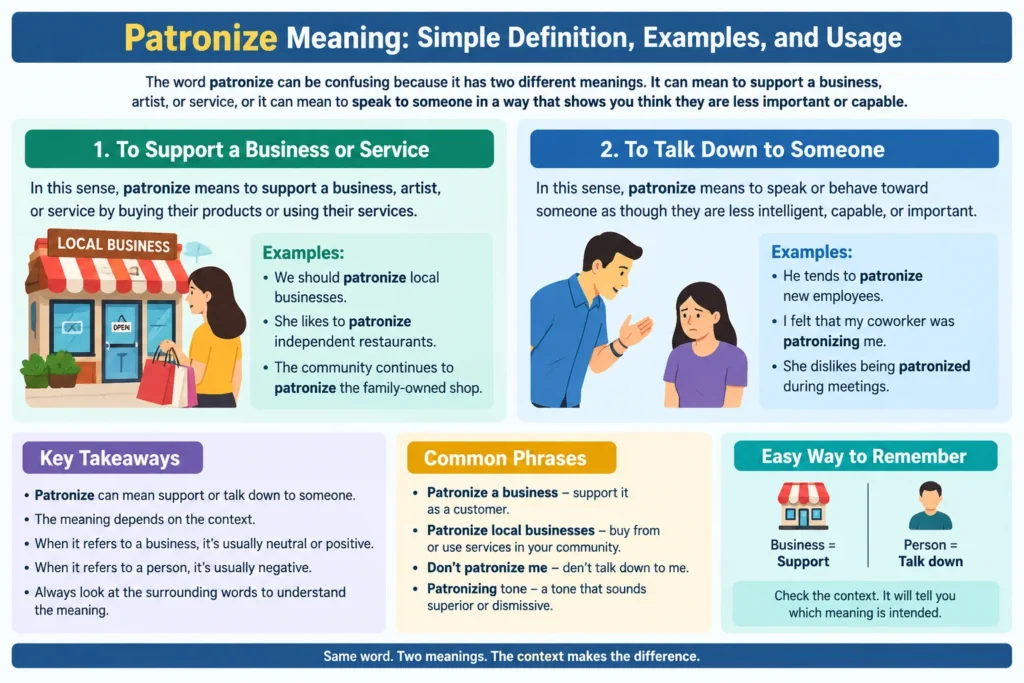

The word patronize can be confusing because it has two very different meanings. In one context, it can mean to support a business, artist, or service by spending money or using their services. In another context, it can mean to speak to someone as though they are less intelligent, capable, or important than you are.
For example, when someone says, “We patronize local businesses,” they mean that they support those businesses. However, when someone says, “Please don’t patronize me,” they are usually asking another person to stop speaking to them in a superior or condescending way.
Understanding the surrounding words and the situation makes the meaning much easier to identify. This guide explains both uses of patronize, along with examples, related words, common phrases, and simple tips for using the word correctly.
Patronize Meaning in Simple English
In everyday English, patronize can mean either to support or to treat someone as though they are inferior.
The meaning depends on the context.
- Patronize a business: support it by buying products or using its services.
- Patronize a person: speak or behave toward them in a way that suggests you think you are superior.
A simple way to remember the difference is:
Business → support
Person → talk down to them
Always look at the complete sentence before deciding which meaning is intended.
What Does Patronize Mean When It Refers to a Business?
When you patronize a business, you regularly support it as a customer. This can involve buying products, visiting a store, eating at a restaurant, or using a company’s services.
For example:
- “We regularly patronize the small bookstore downtown.”
- “She likes to patronize independent restaurants.”
- “The community continues to patronize the family-owned shop.”
In these examples, patronize has a positive or neutral meaning. It does not suggest rude behavior. Instead, it describes customer support.
The word can also be used when discussing local stores, restaurants, theaters, artists, and other service providers.
What Does Patronize Mean When Referring to a Person?
When patronize describes someone’s treatment of another person, it normally has a negative meaning.
It means behaving as though another person is less intelligent, experienced, capable, or important than you are. This attitude may appear through someone’s words, facial expressions, tone, or general behavior.
For example:
- “He tends to patronize new employees.”
- “I felt that my coworker was patronizing me.”
- “She dislikes being patronized during meetings.”
The speaker may not use an obvious insult. Instead, the person’s tone or attitude can make the other person feel underestimated.
What Does “Don’t Patronize Me” Mean?
The expression “Don’t patronize me” usually means “Don’t talk down to me” or “Don’t treat me as if I cannot understand this.”
For example:
“I understand what happened, so don’t patronize me.”
Here, the speaker is not asking for financial support or assistance. They are objecting to the way someone is speaking to them.
The phrase can sound firm or confrontational, particularly when used during an argument or disagreement.
What Does a Patronizing Person Sound Like?
A patronizing person often communicates in a way that makes another person feel inferior.
The issue is not always the vocabulary being used. Sometimes, the tone or attitude creates the problem.
For example:
“Oh, you finally figured it out!”
Depending on the speaker’s tone, this could sound dismissive or patronizing.
Another example is:
“Let me explain this very simple concept to you.”
If the speaker assumes that the listener cannot understand something basic, the statement may come across as patronizing.
Common signs of a patronizing attitude include:
- Speaking to adults as if they were children
- Giving unnecessary explanations
- Acting as though you know more than everyone else
- Using exaggerated or insincere praise
- Making another person feel inexperienced or incapable
Therefore, patronizing behavior is often about attitude and delivery rather than the words alone.
Patronize vs. Patronizing
Patronize and patronizing come from the same word, but they have different grammatical roles.
Patronize is a verb:
“Please don’t patronize me.”
Here, the word describes the action of treating someone in a superior manner.
Patronizing is commonly used as an adjective to describe a person’s tone, attitude, or behavior:
“His response sounded patronizing.”
This means his response gave the impression that he considered himself superior.
You can also say:
“Her patronizing attitude made the discussion uncomfortable.”
Both forms can relate to the negative sense of the word.
Is Patronize Positive or Negative?
Patronize can be either positive, neutral, or negative depending on how it is used.
When it refers to supporting a business, it is generally neutral or positive:
“We should patronize local businesses.”
When it describes someone’s attitude toward another person, it is generally negative:
“He patronized me during the conversation.”
This is why the context is important. The word itself does not always tell you which meaning is intended.
Ask yourself:
Is the sentence describing customer support, or is it describing someone’s attitude toward another person?
That question can quickly clarify the meaning.
Patronize vs. Support
Patronize and support can overlap when discussing businesses, but they are not always interchangeable.
For example:
“We support local businesses.”
This is a very common expression.
You can also say:
“We patronize local businesses.”
Both sentences communicate the idea of helping local businesses through customer activity. However, patronize can sound somewhat more formal.
The main difference is that support has a much wider meaning. You can support a person, idea, organization, cause, or business.
Patronize, in its positive sense, often specifically refers to supporting a business, service, artist, or establishment through your custom.
Patronize vs. Condescend
Patronize and condescend can be similar when they describe a person’s superior attitude.
For example:
“He was patronizing toward his assistant.”
You could also say:
“He was condescending toward his assistant.”
Both sentences suggest that he behaved as though he were above the other person.
However, patronize has an additional meaning that condescend does not have. Patronize can also mean supporting a business or service as a customer.
For example:
“We patronize the local theater.”
This meaning does not apply to condescend.
Examples of Patronize in Everyday English
The following examples show how context changes the meaning.
Supporting a Business
“Our family patronizes the restaurant every weekend.”
This means the family regularly eats there and supports the business.
Supporting Local Stores
“Many residents choose to patronize local shops.”
This means they spend money at businesses in their local community.
Talking Down to Someone
“Please don’t patronize your coworkers.”
This means not treating coworkers as though they are less capable or intelligent.
Feeling Belittled
“She felt that her supervisor was patronizing her.”
This means she felt that her supervisor was treating her in a superior or dismissive way.
Describing a Tone
“His patronizing tone made the discussion uncomfortable.”
Here, patronizing describes a manner of speaking that suggests superiority.
Common Phrases With Patronize
Learning common expressions can make the two meanings easier to recognize.
Patronize a Business
This means to support a business by becoming a customer.
“People continue to patronize the neighborhood café.”
Patronize Local Businesses
This means buying from or using services provided by businesses in your local community.
“We encourage residents to patronize local businesses.”
Don’t Patronize Me
This means don’t talk down to me.
“I know what I’m doing, so don’t patronize me.”
Patronizing Tone
This describes speech that sounds superior, dismissive, or condescending.
“Her patronizing tone upset the other employees.”
Why Can Someone Sound Patronizing Without Being Obviously Rude?
A person does not have to use an offensive word to sound patronizing.
Sometimes the problem comes from the way something is said. A person might explain information that the listener already understands, use an exaggeratedly slow tone, or act surprised when the other person knows the answer.
For example:
“Don’t worry, I’ll explain everything to you.”
This sentence can sound helpful in one situation. In another situation, it may sound patronizing if the speaker assumes the listener is unable to understand the subject.
This is why tone, context, and attitude are important when interpreting the word.
Common Mistakes With Patronize
One frequent mistake is assuming that patronize always means to insult someone.
That is incorrect.
“We patronize independent stores.”
Here, it means support as customers.
Another mistake is assuming that patronize always means support.
That is also incorrect.
“Don’t patronize me.”
Here, it means don’t talk down to me.
The words around patronize can provide useful clues. If the sentence discusses a shop, restaurant, theater, or business, the word may refer to customer support. If it describes how one person treats another, it often has the negative meaning.
What Is the Noun Form Related to Patronize?
The noun patron is closely connected to the supportive meaning of patronize.
A patron is someone who regularly supports a business, artist, organization, or establishment.
For example:
“She is a regular patron of the local café.”
This means she frequently visits the café or purchases its products or services.
The word patron can have other meanings in different contexts, but the central idea is often one of support or sponsorship.
Is Patronize the Same as Insult?
No. Patronize and insult are related but do not mean exactly the same thing.
An insult is something said or done to offend, disrespect, or hurt another person.
To patronize someone means to behave as though you are superior to them or as though they are less capable.
A patronizing comment can certainly be insulting, but the focus is usually on the speaker’s attitude of superiority.
For example:
“You’re not smart enough to understand this.”
This is a direct insult.
By contrast:
“Don’t worry. This might be a little too complicated for you.”
This can sound patronizing because the speaker assumes the other person cannot understand the subject.
How to Remember the Meaning of Patronize
A simple memory trick can help:
Business = support
Person = talk down
For example:
“They patronize the local theater.”
Think support.
But:
“He patronizes his coworkers.”
Think treats them as though they are inferior.
This shortcut works for many everyday sentences, although the complete context should always be considered.
Final Takeaway
The word patronize has two distinct meanings, which is why it can sometimes be confusing.
It can mean to support a business, artist, service, or establishment by becoming a customer. It can also mean to speak or behave toward someone as though they are less intelligent, capable, or important.
The easiest way to remember the difference is:
Patronize a business = support it.
Patronize a person = talk down to them.
When someone says “Don’t patronize me,” they usually mean “Don’t talk to me as though I am less capable than you.”
Once you pay attention to the context, the two meanings become much easier to understand.
FAQs About Patronize Meaning
What does patronize mean in simple words?
Patronize can mean supporting a business by buying its products or using its services. It can also mean treating someone as though they are less intelligent or capable.
What does “Don’t patronize me” mean?
It usually means “Don’t talk down to me.” The speaker feels that someone is treating them as though they are inferior or unable to understand.
Is patronize a negative word?
Not always. When it means supporting a business, it is generally neutral or positive. When it describes treating someone with a superior attitude, it is usually negative.
What does patronizing mean?
Patronizing describes speech or behavior that makes someone appear superior to another person.
What is the difference between patronize and condescend?
Both words can describe superior behavior toward another person. However, patronize can also mean supporting a business or service, while condescend does not have that meaning.
What is another word for patronize?
For the supportive meaning, alternatives include support, sponsor, visit, and buy from. For the negative meaning, alternatives include condescend, belittle, and talk down to.
Conclusion
Understanding patronize meaning becomes easier once you recognize its two main uses. The word can describe supporting a business, artist, or service, or it can describe treating another person as though you are superior to them.
The surrounding context usually tells you which meaning is intended. If the subject is a business, patronize often means to support it as a customer. If the subject is a person, it commonly refers to speaking or behaving toward them in a condescending way.
Remember the simple distinction: business means support, while person can mean talk down. This will help you understand phrases such as “patronize local businesses” and “don’t patronize me” correctly.